Minor Arcana, the Swords
Ten of Swords
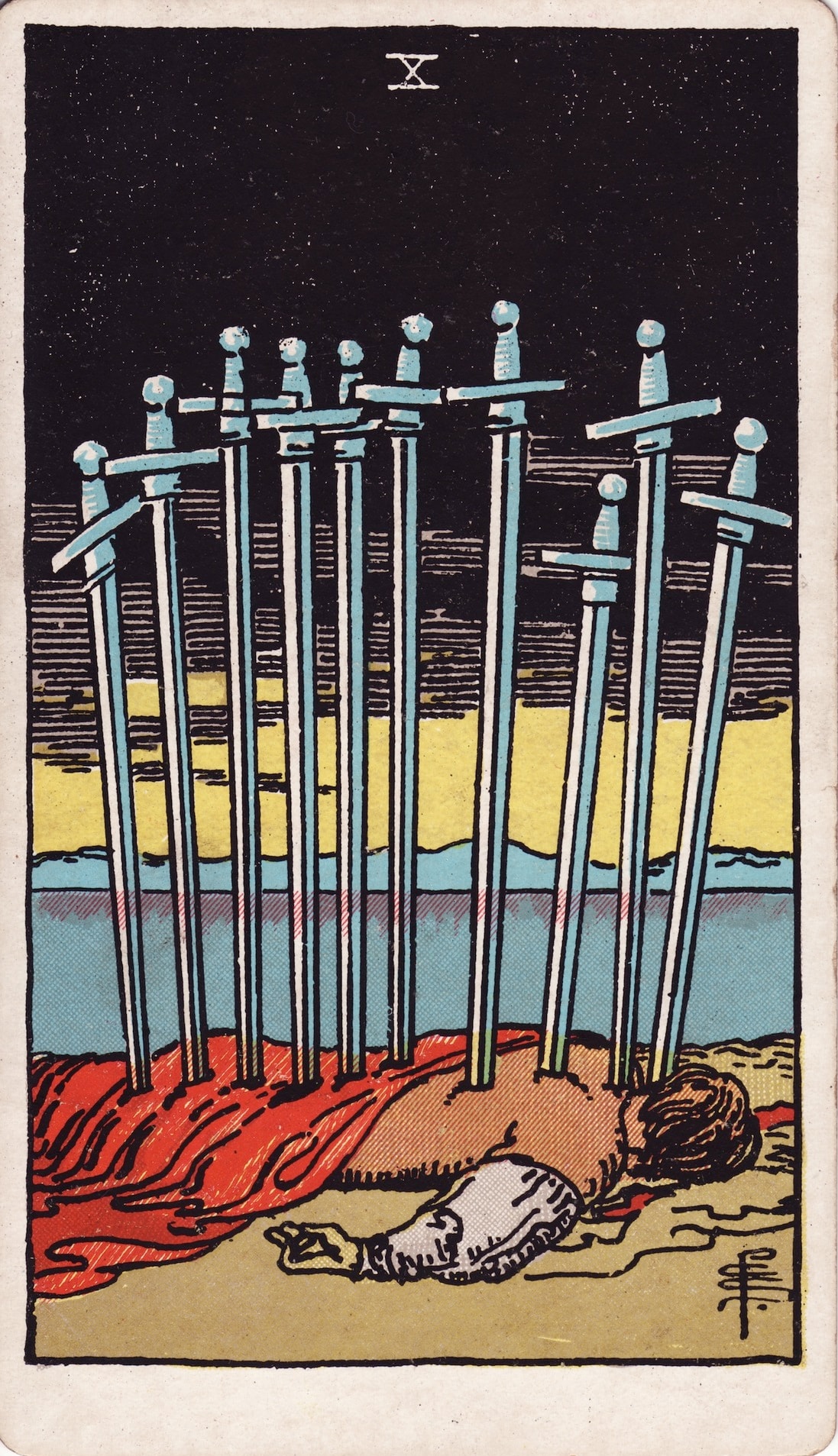
The Ten of Swords closes the numbered cards of the suit of swords in the deck Pamela Colman Smith drew in 1909 for Arthur Edward Waite. A man lies face down on the shore by still water, a red cloth over him and ten swords standing in his back, while a black sky breaks into a band of yellow light over far hills.
What Waite wrote it means (1910)
- Divinatory meanings
Whatsoever is intimated by the design; also pain, affliction, tears, sadness, desolation. It is not especially a card of violent death.
- Reversed
Advantage, profit, success, favour, but none of these are permanent; also power and authority.
Arthur Edward Waite, The Pictorial Key to the Tarot (London, 1911), p. 234. Read it in the chapter
A prostrate figure, pierced by all the swords belonging to the card.
What's in the picture
- The ten swords. Ten swords stand in a row along his back, from his legs up to his neck. They lean a little this way and that, the hilts at different heights, and all are driven in deep.
- The head. His head lies at the right, turned away and face down on the ground, so we see only dark hair. There is a little red on the ground near his face.
- The red cloth. A red cloth lies over the lower half of his body and spreads out on the ground on the left, in long folds.
- The sleeve and hand. A pale sleeve shows below his body, and at its end his hand lies on the ground, fingers bent. It is hard to tell how they are held.
- The black sky. The top half of the sky is black, flecked with small white specks.
- The band of light. Lower down, the dark breaks up into streaks, and a band of yellow light lies along the horizon, like the first light before sunrise or the last after sunset.
- The far hills. Under the yellow light runs a low, dark line of hills.
- The still water. Between the hills and the shore is a band of calm blue water, with no waves and no boats.
- The shore. He lies on flat, sandy ground at the very bottom of the card. Waite calls him “a prostrate figure, pierced by all the swords belonging to the card”.
The card in brief
- In the deck
- Card 60 of 78
- Arcana
- Minor Arcana, Swords
- Number
- Ten
- Element (Golden Dawn)
- Air
- Astrology (Golden Dawn)
- Sun in Gemini
- Title in Book T
- Lord of Ruin
- Drawn by
- Pamela Colman Smith
- Planned by
- Arthur Edward Waite
- Published
- London, William Rider & Son, 1909
- Scan
- Pam-A printing, c. 1910, Wikimedia Commons
In the old books
Book T (1912)
Four Hands holding eight swords, as in the preceding symbol; the points falling away from each other. Two hands hold two swords crossed in the centre, as though their junction had disunited the others. No rose, flower or bud, is shewn. Above and below are ☉ and ♊︎, representing the Decan.
Almost a worse symbol than the Nine of Swords. Undisciplined, warring force, complete disruption and failure. Ruin of all plans and projects. Disdain, insolence and impertinence, yet mirth and jollity therewith. A marplot, loving to overthrow the happiness of others; a repeater of things; given to much unprofitable speech, and of many words. Yet clever, eloquent, etc., according to dignity.
Book T, “A Description of the Cards of the Tarot”, The Equinox I.8 (London, 1912), p. 200. See the source Papus (1892)
Uncertainty in the enmity.
Papus, The Tarot of the Bohemians, tr. A. P. Morton (London, 1892), p. 314. See the source
Before 1909
The older cards and pictures behind this one will be shown here once their licences are checked.
The film
No film for this card yet.
Sources
- Waite: a prostrate figure, pierced by all the swords belonging to the card.Arthur Edward Waite, The Pictorial Key to the Tarot (1910), Part III, Ten of Swords
Around this card
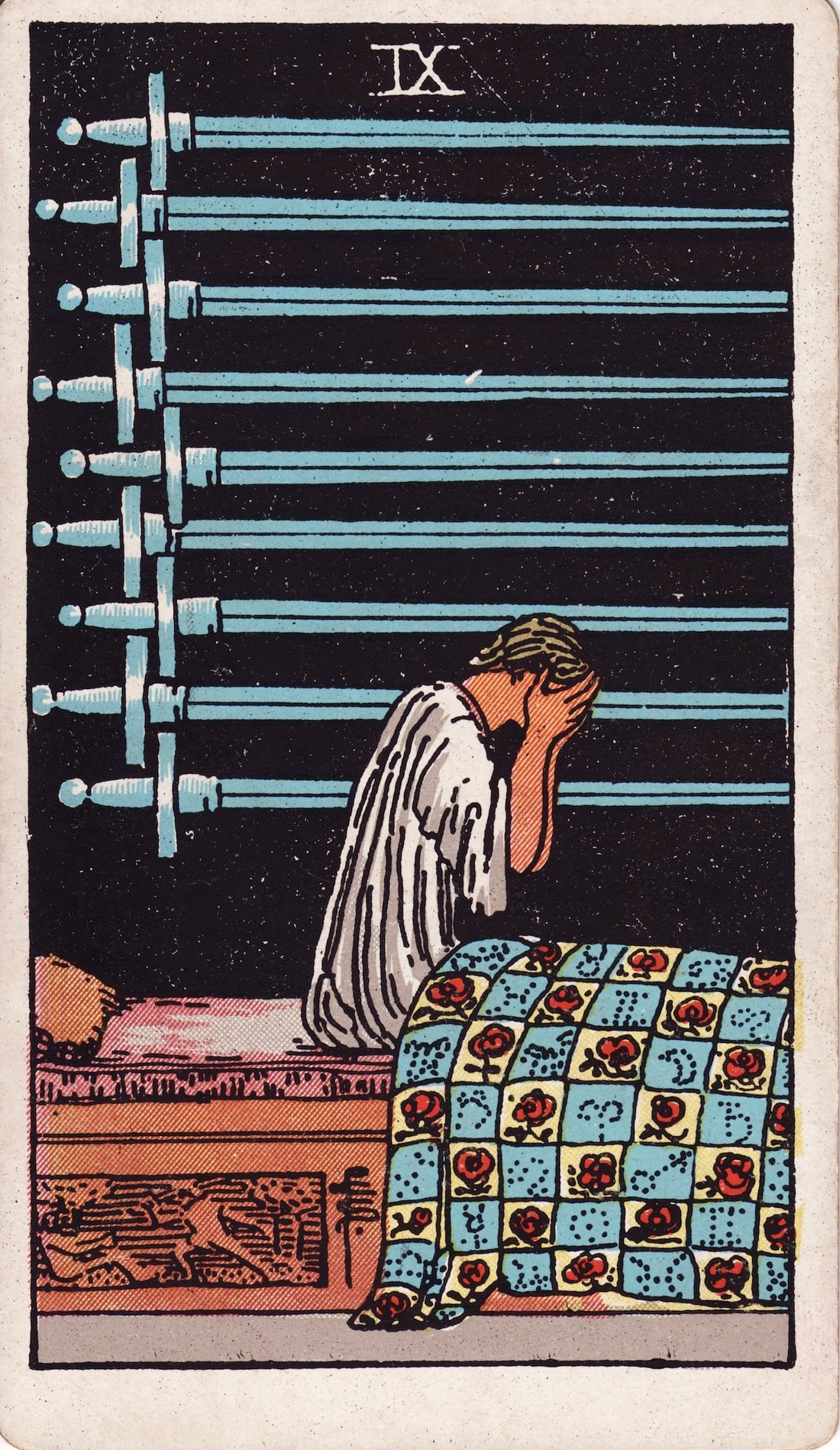
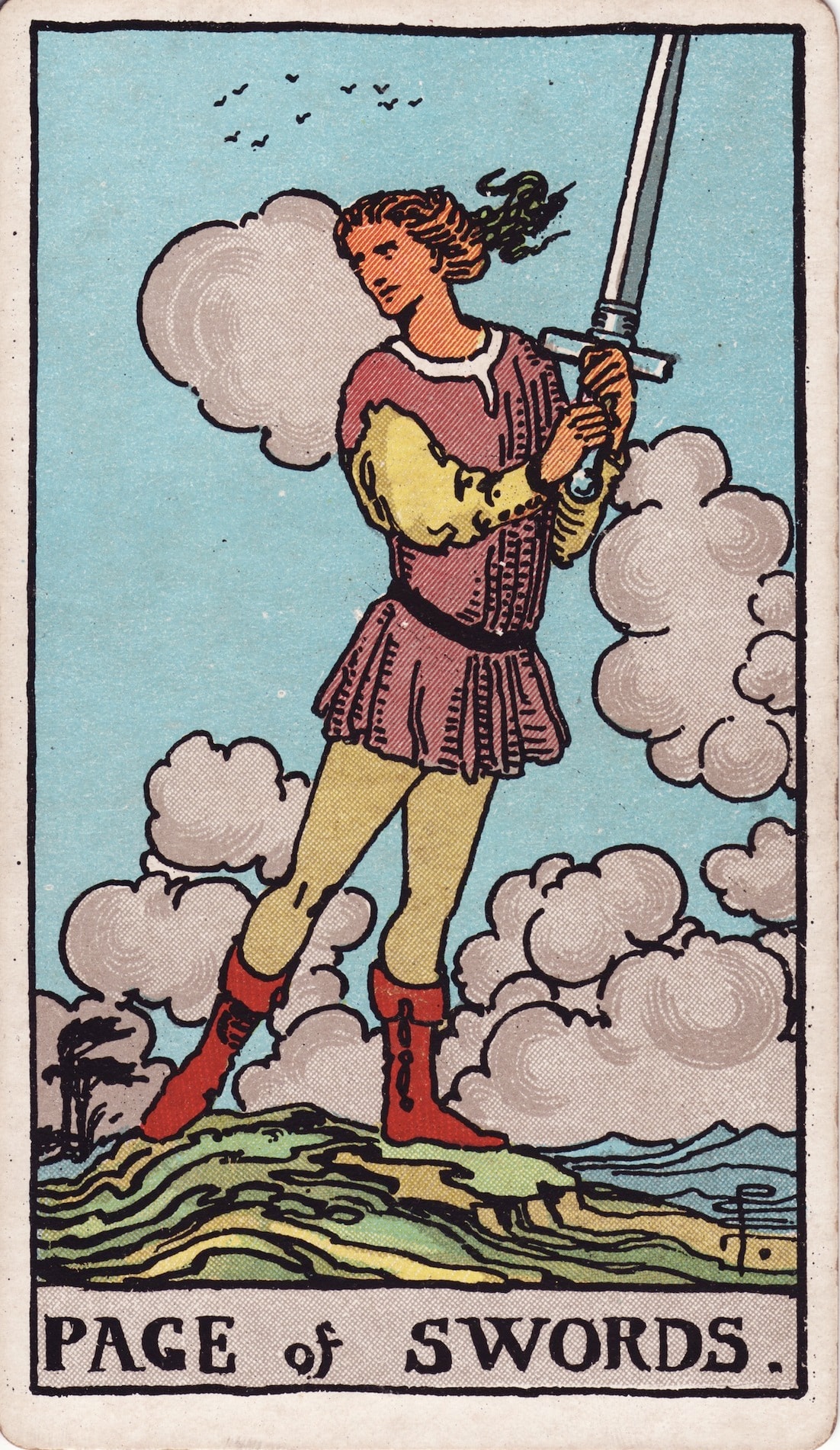
Before and after it in the deck
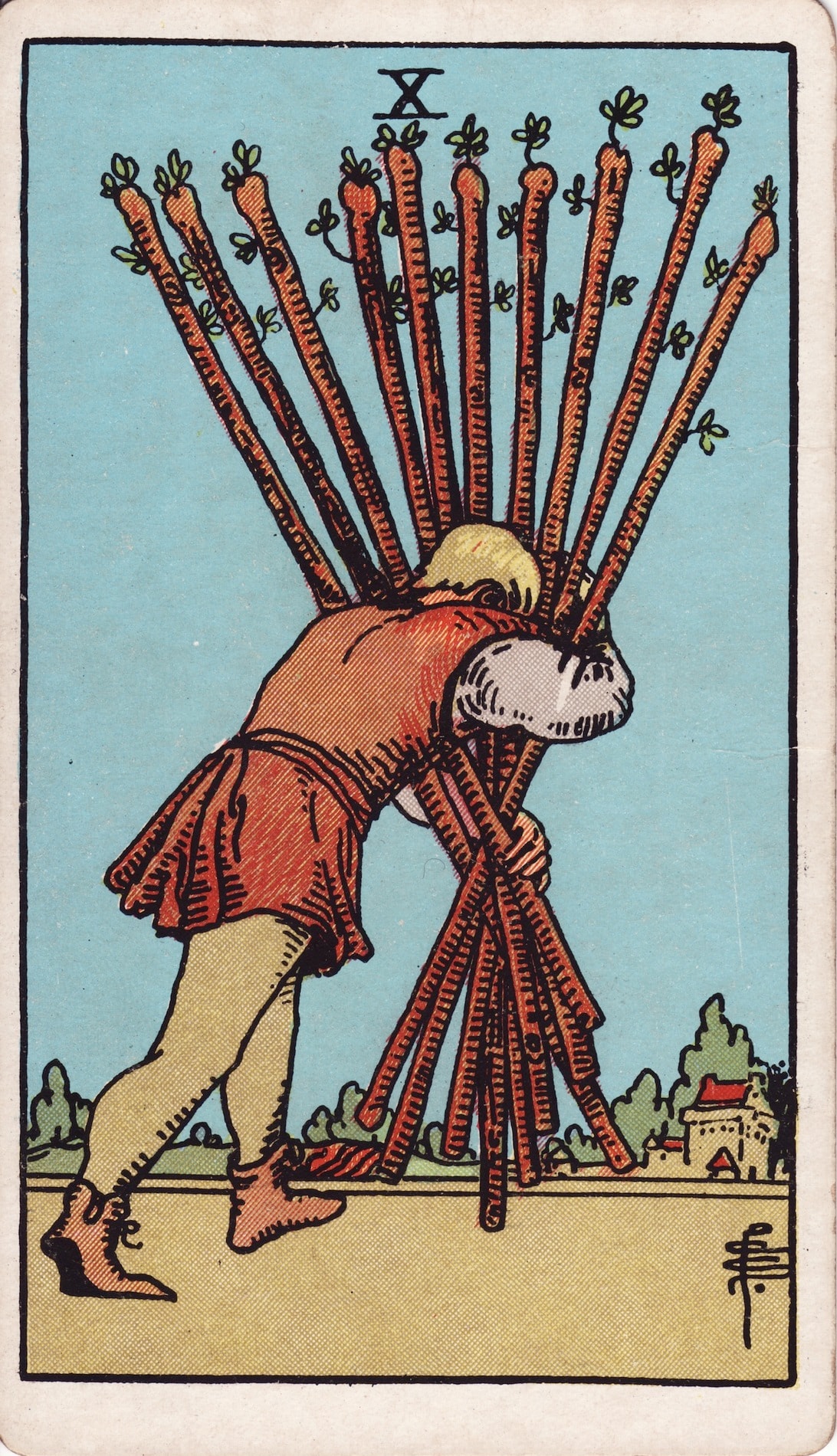
The same number in the other suits

All the cards of the Swords, or the whole deck.