Who drew the Rider-Waite tarot?
Pamela Colman Smith drew all 78 cards in 1909, to a plan by the writer Arthur Edward Waite. William Rider & Son published the deck in London that December. A year later Waite’s Pictorial Key to the Tarot printed her designs as plates, and its title page says so: “from designs by Pamela Colman Smith”. Inside, Waite wrote that the cards “have been drawn and coloured by Miss Pamela Colman Smith”. In his preface he praised “a lady who has high claims as an artist” and left her name out.
The deck took its common name, the Rider-Waite, from its publisher and its planner. Many people now say Rider-Waite-Smith, to put her back in. You can see all 78 of her cards on this site, each with a scan of an early printing.
What Waite asked for, and what she made
Waite wanted to “rectify the symbolism” of the old cards, as he put it in 1909. He wrote that the designs were made “under my supervision—in respect of the attributions and meanings”. Of the changes to the old symbols, he said: “I alone am responsible.” Years later he admitted that she “had to be spoon-fed carefully” over three trumps: the High Priestess, the Fool and the Hanged Man.
The other cards seem to have been more her own. In most older decks the numbered cards showed only rows of cups, swords, wands or coins. In this one, Waite wrote, every numbered card, “the Aces only excepted”, has “figures or pictures”, most of them scenes with people. K. Frank Jensen and Robert Place, who have both studied the early deck, think Waite gave her a fairly free hand with these. Look at the black cat at the feet of the Queen of Wands: neither Waite’s book nor the Golden Dawn’s notes on the cards mention it.
Some of her pictures have older models. Her Three of Swords, a heart pierced by three swords, is close to the same card in the Sola Busca, an Italian tarot engraved in the late 1400s. Photographs of the Sola Busca reached the British Museum in London around 1907, and the tarot historian Stuart Kaplan suggested that she saw them there. No letter or note of hers says so. The case rests on how alike the cards are, and on the timing.
“A big job for very little cash”
On 19 November 1909 Smith wrote to Alfred Stieglitz, the New York photographer who had shown her pictures: “I’ve just finished a big job for very little cash! A set of designs for a pack of tarot cards - 80 designs.”
Her monogram on the cards
Smith signed the cards with a small monogram: a P crossed with a looping C and S. It sits in a corner of nearly every card. The collector K. Frank Jensen thinks the Fool may be the only card without it. Try finding it in the lower right of the King of Wands.
Her life before the tarot
Smith was born in London in 1878 to American parents. She grew up between Manchester, Kingston in Jamaica and New York, and studied art at the Pratt Institute in Brooklyn. In 1899 she published Annancy Stories, Jamaican tales of Anansi the spider, told and drawn by her. That December her father died, and she went back to England.
There she worked with the Lyceum Theatre company of Henry Irving and Ellen Terry, and designed sets. Terry is said to have named her Pixie. In 1901 she joined the Golden Dawn, the magical order Waite also belonged to. From 1903 she ran her own small magazine, The Green Sheaf. In 1907 Stieglitz gave her a show at his gallery in New York, the first there that was not of photographs.
Her other work
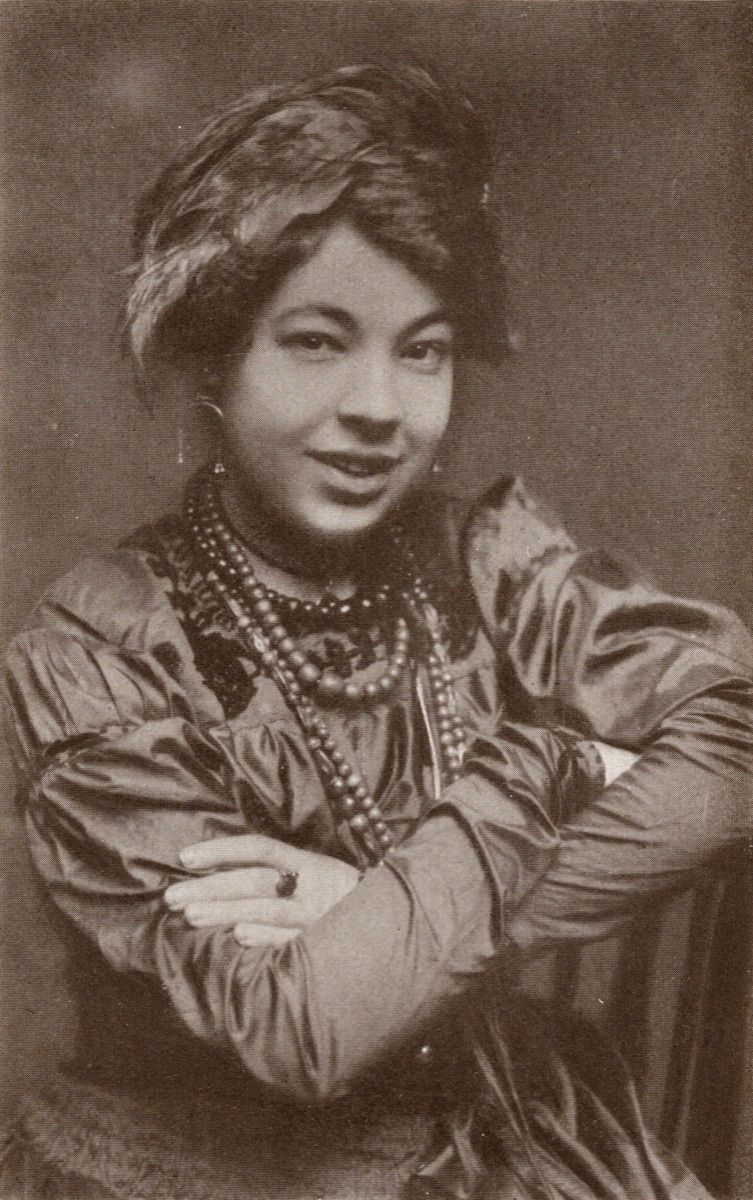
Before the tarot, Smith was known as an illustrator. Her books include Annancy Stories (1899), The Golden Vanity and the Green Bed (1899), Widdicombe Fair (1899) and Chim-Chim: Folk Stories from Jamaica (1905). She edited The Green Sheaf (1903–1904), and in 1908 wrote an essay for The Craftsman, “Should the Art Student Think?”. In 1912 the same magazine wrote about her “pictured music” and printed the photograph above. Each of these is in the timeline below, with a link to a scan or a record.
Was Pamela Colman Smith Black?
People often ask, and no one has shown that she was. Her parents, Charles Edward Smith and Corinne Colman, were in her biographer’s words “wealthy white American expatriate parents”. That biographer, Elizabeth Foley O’Connor, points to Smith’s “well-documented dark skin” and thinks it “highly likely” that she was biracial, but writes that she has “found no direct evidence” for it. The tarot historian Mary K. Greer thinks “the facts of her life make it near impossible”, and the scholar Thea Wirsching has argued against the idea at length. She did live in Jamaica as a girl, and she retold its stories in two books.
Her last years and her grave
In 1911 Smith became a Catholic. After the First World War an inheritance let her move to the Lizard, in Cornwall, and in the early 1940s she moved to Bude, on the north coast. When she died, in her flat in Bude on 18 September 1951, aged 73, she was in debt and few people knew her work. Her estate came to nothing once the debts were paid.
She was buried on 25 September 1951 in the churchyard of St Michael and All Angels in Bude. Her grave was never marked, or its marker has been lost, and the burial records of the time were destroyed in a fire.
Smith in 2026
From June to October 2026 the Morgan Library & Museum in New York showed her deck in its exhibition Tarot! Renaissance Symbols, Modern Visions. In March 2026 Jill Dawson published Pixie, a novel about her life.
Timeline
- 16 February 1878
- Born Corinne Pamela Colman Smith in London, to the American parents Charles Edward Smith and Corinne Colman. (Boston College, Burns Library)
- 1889
- Her father's work takes the family to Kingston, Jamaica. She grows up between Manchester, Kingston and New York. (Dennis Denisoff, Yellow Nineties 2.0)
- 1893–1897
- Studies art at the Pratt Institute in Brooklyn, under Arthur Wesley Dow, and leaves without a degree. (Hyperallergic, 2019)
- 1899
- Publishes Annancy Stories in New York, Jamaican tales of Anansi the spider, told and drawn by her. (Scan of the 1899 book, Internet Archive)
- December 1899
- Her father dies, and she goes back to England. (Hannah Staunton, Études irlandaises, 2025, after Elizabeth Foley O’Connor)
- About 1900
- Travels with the Lyceum Theatre company of Henry Irving and Ellen Terry and designs sets for it. Terry is said to have given her the name Pixie. (Pamela Colman Smith collection, Bryn Mawr College; Denisoff)
- 1901
- Joins the Hermetic Order of the Golden Dawn, introduced by W. B. Yeats, and stays about four years. (Denisoff)
- 1903–1904
- Edits and publishes her own magazine, The Green Sheaf: 13 monthly issues from January 1903. (Denisoff)
- January 1907
- Shows her pictures at Alfred Stieglitz's Little Galleries of the Photo-Secession in New York, the first work there that was not photography. Shows follow in 1908 and 1909. (Bryn Mawr College; Wikipedia, 291 (art gallery))
- July 1908
- Writes "Should the Art Student Think?" for The Craftsman. (Scan of The Craftsman, vol. XIV no. 4, Internet Archive)
- 1909
- Draws the 78 cards for Arthur Edward Waite, between spring and autumn by Robert Place’s reckoning. (Robert M. Place, 2015)
- 19 November 1909
- Writes to Stieglitz that she has "just finished a big job for very little cash". (Place; Mary K. Greer, 2015)
- December 1909
- William Rider & Son publishes the deck in London, with Waite’s small guide, The Key to the Tarot. (The Occult Review, December 1909; The World of Playing Cards)
- End of 1910
- Waite’s Pictorial Key to the Tarot comes out, dated 1911, with her 78 designs as plates. (Title page of the 1911 printing)
- 1911
- Is received into the Catholic Church. (Dawn G. Robinson, Art Cornwall, 2022)
- October 1912
- The Craftsman prints a long article on her work, "The Fairy Faith and Pictured Music of Pamela Colman Smith", with the photograph on this page. (Scan of The Craftsman, October 1912, Internet Archive)
- First World War
- Works as an illustrator for the war effort. (Denisoff)
- 1918 to early 1920s
- Moves to the Lizard, in Cornwall, on an inheritance. Sources give different years. (Robinson (1918); Denisoff (early 1920s))
- Early 1940s
- Moves to Bude, on the north coast of Cornwall. (Cherry’s Cache, 2021)
- 18 September 1951
- Dies in her flat at Bencoolen House, Bude, aged 73. Some records give 16 September. (The Post, 26 September 2018, reporting Pamela Colman Smith: The Untold Story)
- 25 September 1951
- Buried in the churchyard of St Michael and All Angels, Bude, by a Catholic priest. The grave was never marked, or its marker is lost. (Marcus Katz, Tarot Association)
Her work on this site
- All 78 cards, each with a scan of an early printing
- The Major Arcana, the 22 trumps in order
- The Pictorial Key to the Tarot, Waite's book with her 78 plates
- Is the deck in the public domain?
- The glossary, for the Golden Dawn, Book T and other words used here
Sources
- The title page credits the plates "from designs by Pamela Colman Smith".Waite, The Pictorial Key to the Tarot (London, 1911), title page
- Waite: the cards "have been drawn and coloured by Miss Pamela Colman Smith"; "For the variations in the symbolism by which the designs have been affected, I alone am responsible."Waite, The Pictorial Key to the Tarot (1911), Part II § 1
- The preface calls her "a lady who has high claims as an artist" and says the designs were "prepared under my supervision—in respect of the attributions and meanings".Waite, The Pictorial Key to the Tarot (1911), Preface, pp. viii–ix
- Waite, December 1909: "a very skilful and original artist" with "some knowledge of Tarot values" (printed "Coleman"), who "lent a sympathetic ear to my proposal to rectify the symbolism".A. E. Waite, "The Tarot: A Wheel of Fortune", The Occult Review vol. X no. 6 (December 1909), p. 309
- The deck is commonly called the Rider-Waite, after its publisher and Waite; many now call it the Rider-Waite-Smith.Wikipedia, "Rider–Waite Tarot"; Hyperallergic, 26 October 2016
- Waite was a member of the Golden Dawn from 1891.Wikipedia, "A. E. Waite"
- Waite later wrote that she "had to be spoon-fed carefully over the Priestess card, over that which is called the Fool and over the Hanged Man".Waite, Shadows of Life and Thought (1938), as quoted by Robert M. Place
- Waite seems to have left the design of the minor cards largely to her.K. Frank Jensen, "The Early Waite-Smith Tarot Editions", The Playing-Card (2005); Place
- All numbered cards, "the Aces only excepted", are "furnished with figures or pictures".Waite, The Pictorial Key to the Tarot (1911), Part III § 1
- Her Three of Swords is nearly identical to the Sola Busca card; the case for her having seen the Sola Busca photographs at the British Museum goes back to Stuart Kaplan, and rests on likeness and timing.Place; Giordano Berti, Sola-Busca & Waite-Smith Tarot (with the card pairs)
- The Sola Busca is an Italian tarot engraved in the late fifteenth century.Wikipedia, "Sola Busca tarot"
- The letter: "I’ve just finished a big job for very little cash! A set of designs for a pack of tarot cards - 80 designs."The Battersea Society, "Pamela Colman Smith and the Rider Waite Tarot", transcribed from the letter as shown at the Warburg Institute
- Her monogram is "a ‘P’ crossed with a looping ‘C’ and ‘S’"; the deck "should rightfully be called the Rider-Waite-Smith deck".Allison Meier, "The Unsung Woman Artist Behind Your Tarot Cards", Hyperallergic, 26 October 2016
- She signed nearly every card, except perhaps the Fool.Jensen (2005)
- The black cat on the Queen of Wands is in neither Waite nor Book T.Waite, The Pictorial Key to the Tarot, Part III § 2, the Queen of Wands; Book T, the Queen of Wands
- Born to "wealthy white American expatriate parents"; "it seems highly likely that Colman Smith was biracial, but I have found no direct evidence to support this through my archival research."Elizabeth Foley O’Connor, Pamela Colman Smith: Artist, Feminist, and Mystic (Liverpool University Press, 2021), Introduction, abstract
- Mary K. Greer: "the facts of her life make it near impossible."Mary K. Greer, "PCS and the American Renaissance Tarot Deck", 12 April 2019
- An essay arguing against the claim that she was Black.Thea Wirsching, "The Myth of Pamela Colman Smith’s Blackness", in Essays on Women in Western Esotericism (Palgrave Macmillan, 2021), pp. 45–71
- The Golden Vanity and the Green Bed (1899), her book of songs with pictures.HathiTrust, full view of the 1899 book
- Widdicombe Fair (1899) and Chim-Chim: Folk Stories from Jamaica (1905).Pamela Colman Smith collection, Bryn Mawr College
- The Green Sheaf ran for 13 issues; her estate "amounted to nothing after debts were addressed".Dennis Denisoff, "Pamela Colman Smith (1878–1951)", Y90s Biographies, Yellow Nineties 2.0 (2019)
- Ellen Terry gave her the name Pixie.Lorraine Janzen Kooistra, general introduction to The Green Sheaf, Yellow Nineties 2.0, after O’Connor
- The burial records of the time were destroyed in a fire, so the grave cannot be placed for certain.The Post, 26 September 2018
- The Morgan Library & Museum showed the deck, in a copy of about 1921–31, in Tarot! Renaissance Symbols, Modern Visions, 26 June to 4 October 2026.Sonja Anderson, Smithsonian Magazine, 11 June 2026
- Jill Dawson’s novel Pixie (Bloomsbury, March 2026) is about Smith.Goodreads; Jill Dawson’s site
- The photograph appeared with the caption "Miss Pamela Colman Smith, from a recent photograph" in M. Irwin MacDonald, "The Fairy Faith and Pictured Music of Pamela Colman Smith".The Craftsman, October 1912, Internet Archive scan; Wikimedia Commons file