Minor Arcana, the Wands
Three of Wands
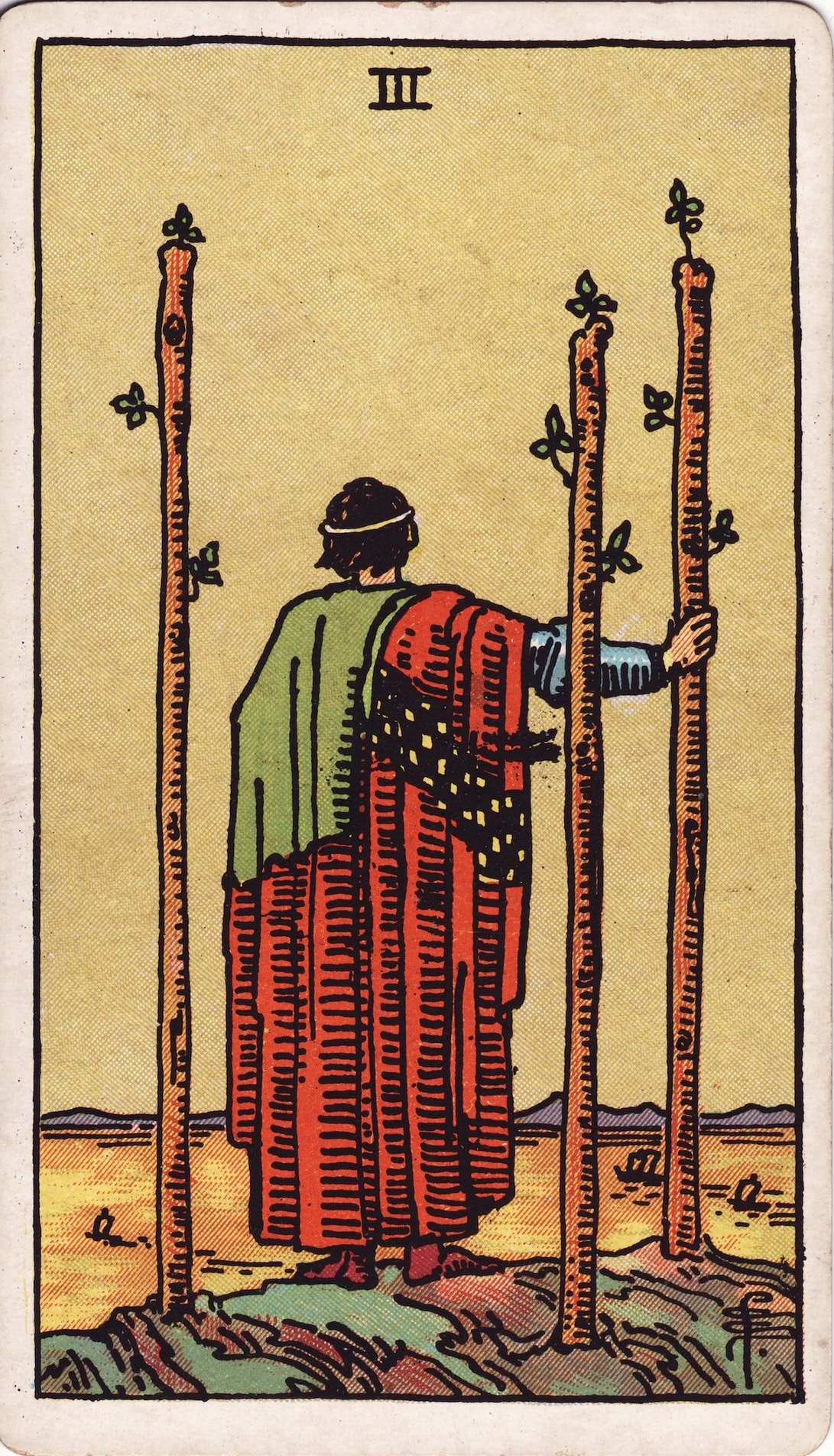
The Three of Wands, drawn by Pamela Colman Smith in 1909, shows a man from behind as he stands on a high, rough ridge between three tall wooden staffs planted in the ground. He looks out over a yellow sea where three small ships are sailing, toward a low line of purple hills on the far shore.
What Waite wrote it means (1910)
- Divinatory meanings
He symbolizes established strength, enterprise, effort, trade, commerce, discovery; those are his ships, bearing his merchandise, which are sailing over the sea. The card also signifies able co-operation in business, as if the successful merchant prince were looking from his side towards yours with a view to help you.
- Reversed
The end of troubles, suspension or cessation of adversity, toil and disappointment.
Arthur Edward Waite, The Pictorial Key to the Tarot (London, 1911), p. 192. Read it in the chapter
A calm, stately personage, with his back turned, looking from a cliff's edge at ships passing over the sea. Three staves are planted in the ground, and he leans slightly on one of them.
What's in the picture
- The turned back. We never see his face. He stands with his back to us, dark hair held by a thin white band, looking out the same way we do.
- The robe and cloak. A long red robe hangs from his shoulders to his feet, and a green cloak lies over his left shoulder. Down the red runs a dark strip patterned with small yellow squares.
- The hand on the staff. His right arm, in a blue sleeve, reaches out to hold the staff at the far right. Waite wrote that he leans on it slightly.
- The three staffs. They stand in the ground in a loose row, one on the left of him and two on the right. All three are taller than he is, and each one has a few small leaves sprouting along it.
- The ships. Far out on the water are three small ships, drawn as tiny dark shapes with sails: one on the left, two on the right. Waite saw them "passing over the sea".
- The yellow sea. The water is yellow and orange, and the sky above it is a paler yellow. A thin band of purple hills marks where the two meet, far off.
- The red shoes. His feet stand close together in dark red shoes, just under the hem of the robe.
- The ridge. He stands at the edge of rough green and brown ground. All three staffs are set near the drop, with only the sea beyond.
The card in brief
- In the deck
- Card 25 of 78
- Arcana
- Minor Arcana, Wands
- Number
- Three
- Element (Golden Dawn)
- Fire
- Astrology (Golden Dawn)
- Sun in Aries
- Title in Book T
- Lord of Established Strength
- Drawn by
- Pamela Colman Smith
- Planned by
- Arthur Edward Waite
- Published
- London, William Rider & Son, 1909
- Scan
- Pam-A printing, c. 1910, Wikimedia Commons
In the old books
Book T (1912)
A White Radiating Angelic Hand, as before, issuing from clouds and grasping three wands in the centre (two crossed, the third upright). Flames issue from the point of junction. Above and below are the symbols ☉ and ♈︎.
Established force, strength, realization of hope. Completion of labour. Success after struggle. Pride, nobility, wealth, power, conceit. Rude self-assumption and insolence. Generosity, obstinacy, etc.
Book T, “A Description of the Cards of the Tarot”, The Equinox I.8 (London, 1912), p. 195. See the source Papus (1892)
Realization of the commencement of the Enterprise.
The basis of the work is now definitely established, and the undertaking can be fearlessly continued.
Papus, The Tarot of the Bohemians, tr. A. P. Morton (London, 1892), p. 311. See the source
Before 1909
The older cards and pictures behind this one will be shown here once their licences are checked.
The film
No film for this card yet.
Around this card
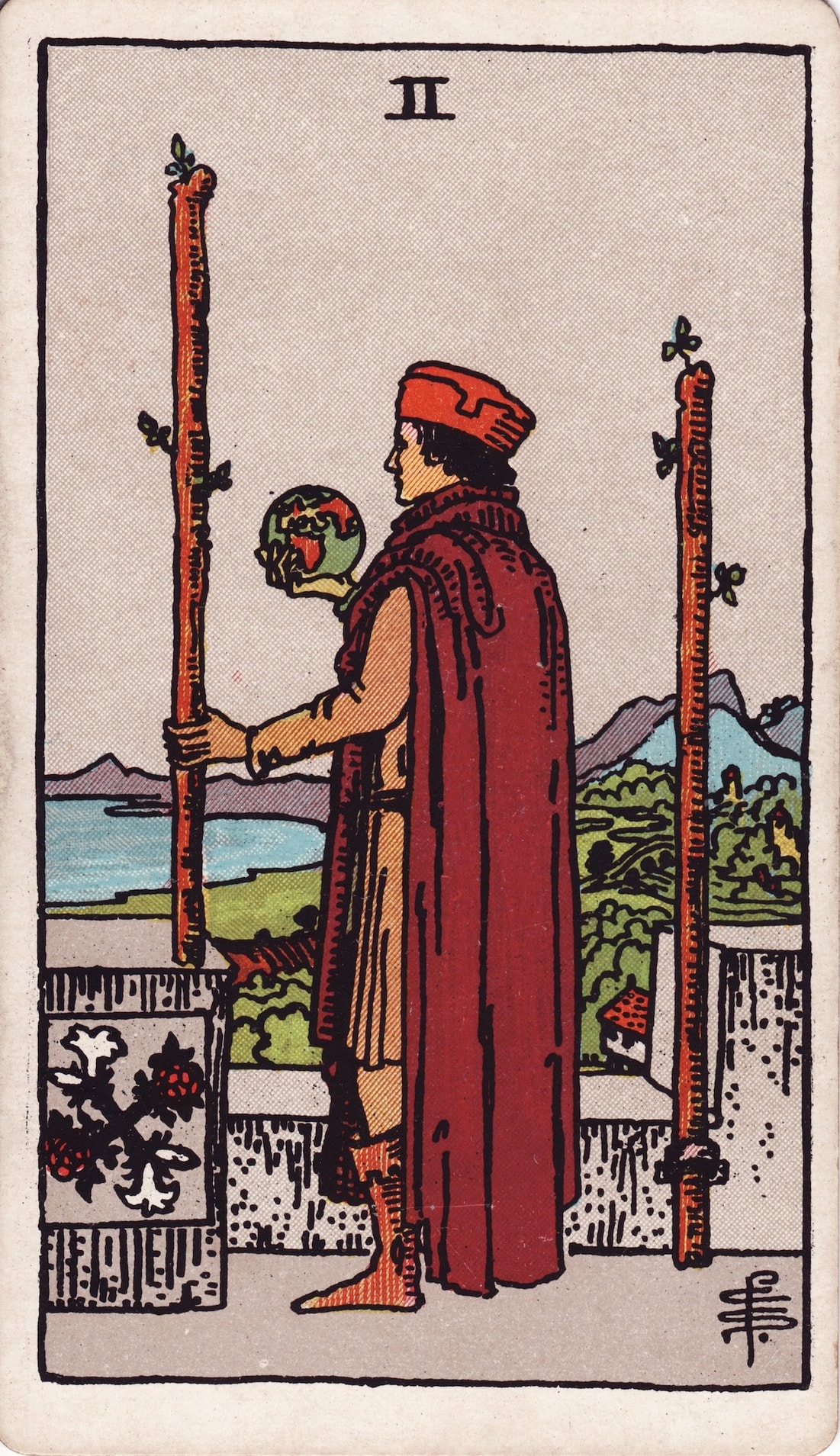
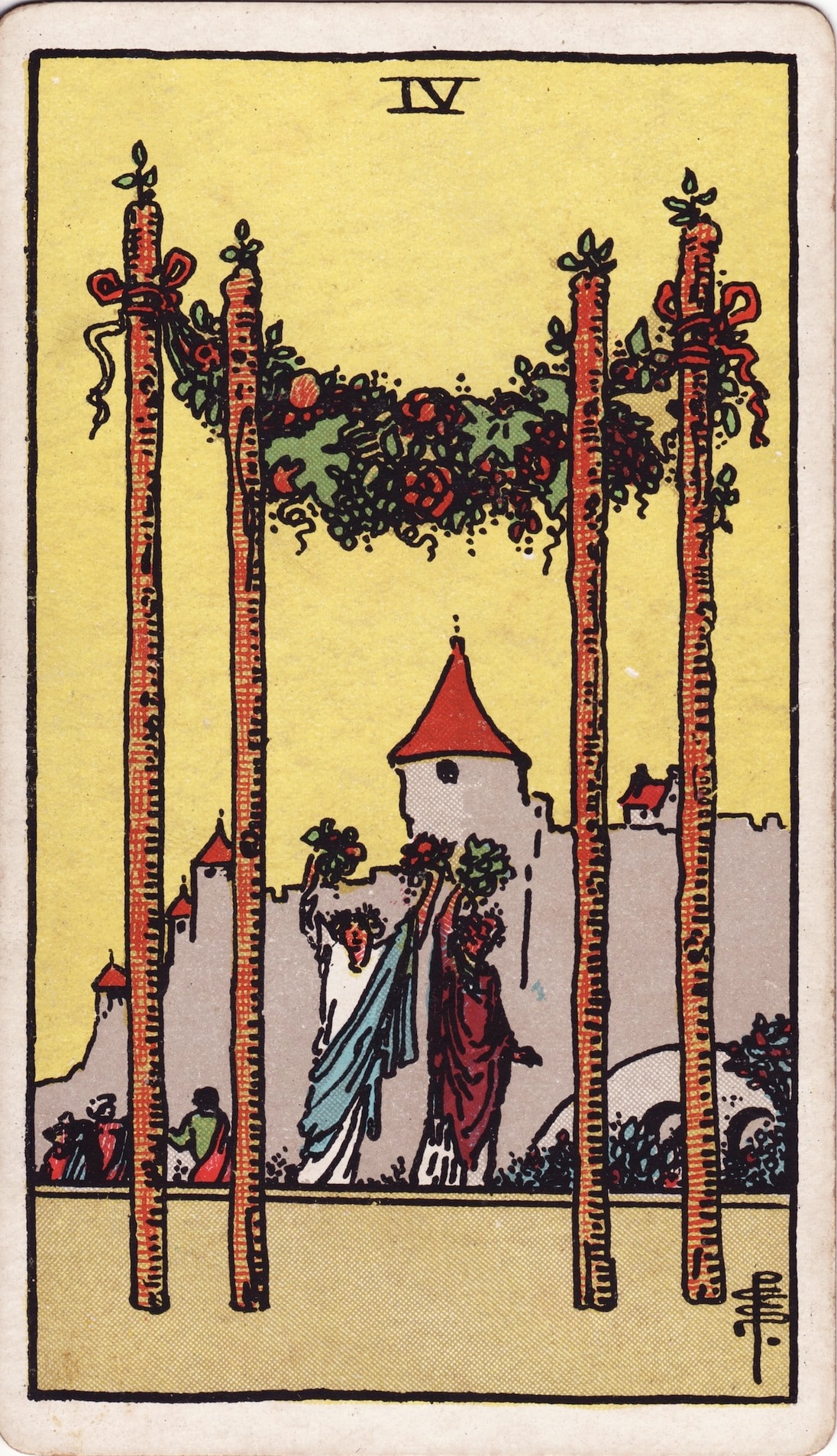
Before and after it in the deck
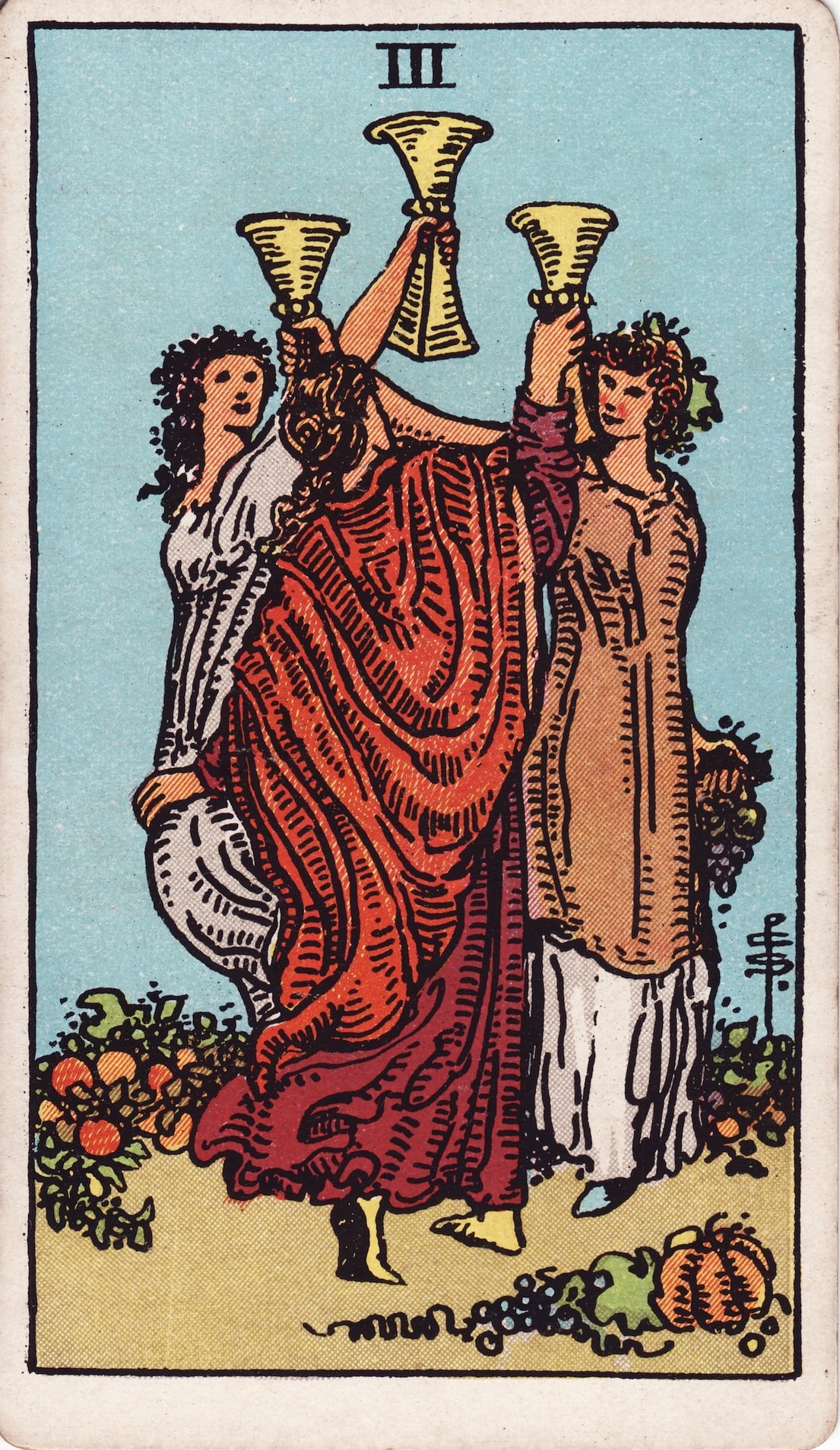
The same number in the other suits

All the cards of the Wands, or the whole deck.