Minor Arcana, the Wands
Eight of Wands
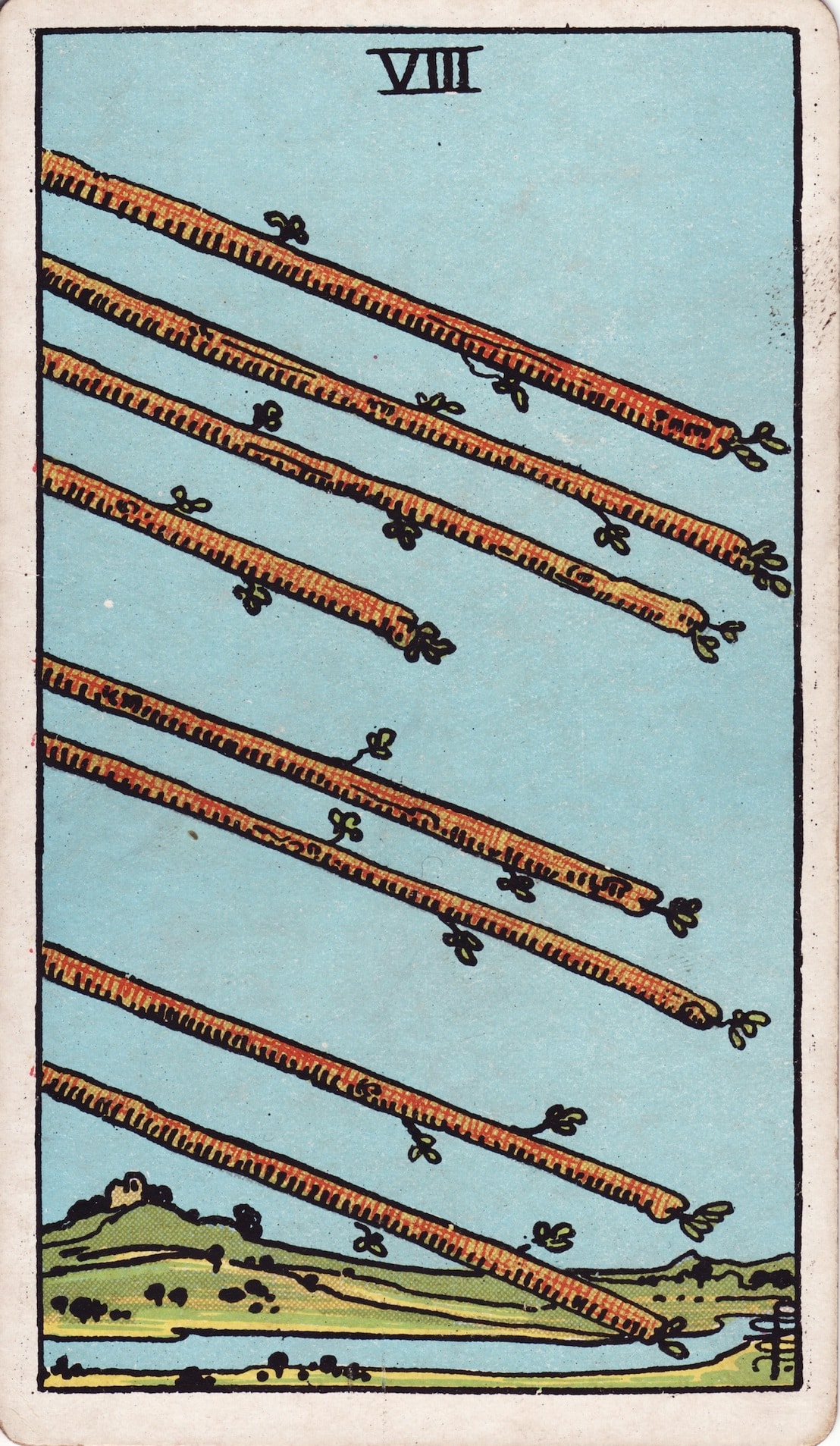
There are no people in Pamela Colman Smith's Eight of Wands (1909), only eight wooden staffs flying in a slanting row across a clear blue sky. Below them lie a river, green fields and a small building on a hill at the left, and the lowest staff has almost come down to the ground by the river.
What Waite wrote it means (1910)
- Divinatory meanings
Activity in undertakings, the path of such activity, swiftness, as that of an express messenger; great haste, great hope, speed towards an end which promises assured felicity; generally, that which is on the move; also the arrows of love.
- Reversed
Arrows of jealousy, internal dispute, stingings of conscience, quarrels; and domestic disputes for persons who are married.
Arthur Edward Waite, The Pictorial Key to the Tarot (London, 1911), p. 182. Read it in the chapter
The card represents motion through the immovable—a flight of wands through an open country; but they draw to the term of their course. That which they signify is at hand; it may be even on the threshold.
What's in the picture
- The flight. All eight staffs are parallel, slanting down from the upper left to the lower right at the same angle. Their back ends are cut off by the left edge of the card, so we only ever see them arriving.
- Four and four. The upper four staffs fly close together. The lower four are spread out more, in two pairs, with bands of empty sky between them.
- The leading tips. The front end of each staff is rounded off and tipped with a little sprig of leaves, like a bud about to open. A few more sprigs grow along the shafts.
- The lowest staff. The bottom staff has nearly touched down, at the edge of the river. Waite wrote that the wands "draw to the term of their course".
- The sky. Behind the staffs the sky is one clean, even blue, without a single cloud. The card does not show who threw them or where they are coming from.
- The building on the hill. On a green hill at the far left, a small pale shape sits among dark bushes, perhaps a house or a ruin, with nobody near it.
- The river. A blue river runs along the bottom of the card, between flat green and yellow banks, and off both edges. On the far side, to the right, low hills rise against the sky.
- The bushes. Round dark bushes dot the fields on both banks, drawn as simple black blobs of ink.
The card in brief
- In the deck
- Card 30 of 78
- Arcana
- Minor Arcana, Wands
- Number
- Eight
- Element (Golden Dawn)
- Fire
- Astrology (Golden Dawn)
- Mercury in Sagittarius
- Title in Book T
- Lord of Swiftness
- Drawn by
- Pamela Colman Smith
- Planned by
- Arthur Edward Waite
- Published
- London, William Rider & Son, 1909
- Scan
- Pam-A printing, c. 1910, Wikimedia Commons
In the old books
Book T (1912)
Four White Radiating Angelic Hands (two proceeding from each side) issuant from clouds; clasped in two pairs in the centre with the grip of the First Order. They hold eight wands, crossed four with four. Flames issue from the point of junction. Surmounting the small wands with flames issuing down them, and placed in the centre at the top and bottom of the card respectively, are the symbols of ☿ and ♐︎ for the Decan.
Too much force applied too suddenly. Very rapid rush, but quickly passed and expended. Violent, but not lasting. Swiftness, rapidity, courage, boldness, confidence, freedom, warfare, violence; love of open air, field-sports, gardens and meadows. Generous, subtle, eloquent, yet somewhat untrustworthy; rapacious, insolent, oppressive. Theft and robbery. According to dignity.
Book T, “A Description of the Cards of the Tarot”, The Equinox I.8 (London, 1912), p. 186. See the source Papus (1892)
Opposition to its success. The Enterprise will only partially succeed.
Papus, The Tarot of the Bohemians, tr. A. P. Morton (London, 1892), p. 312. See the source
Before 1909
The older cards and pictures behind this one will be shown here once their licences are checked.
The film
No film for this card yet.
Around this card
Before and after it in the deck
The same number in the other suits

All the cards of the Wands, or the whole deck.