Minor Arcana, the Wands
Seven of Wands
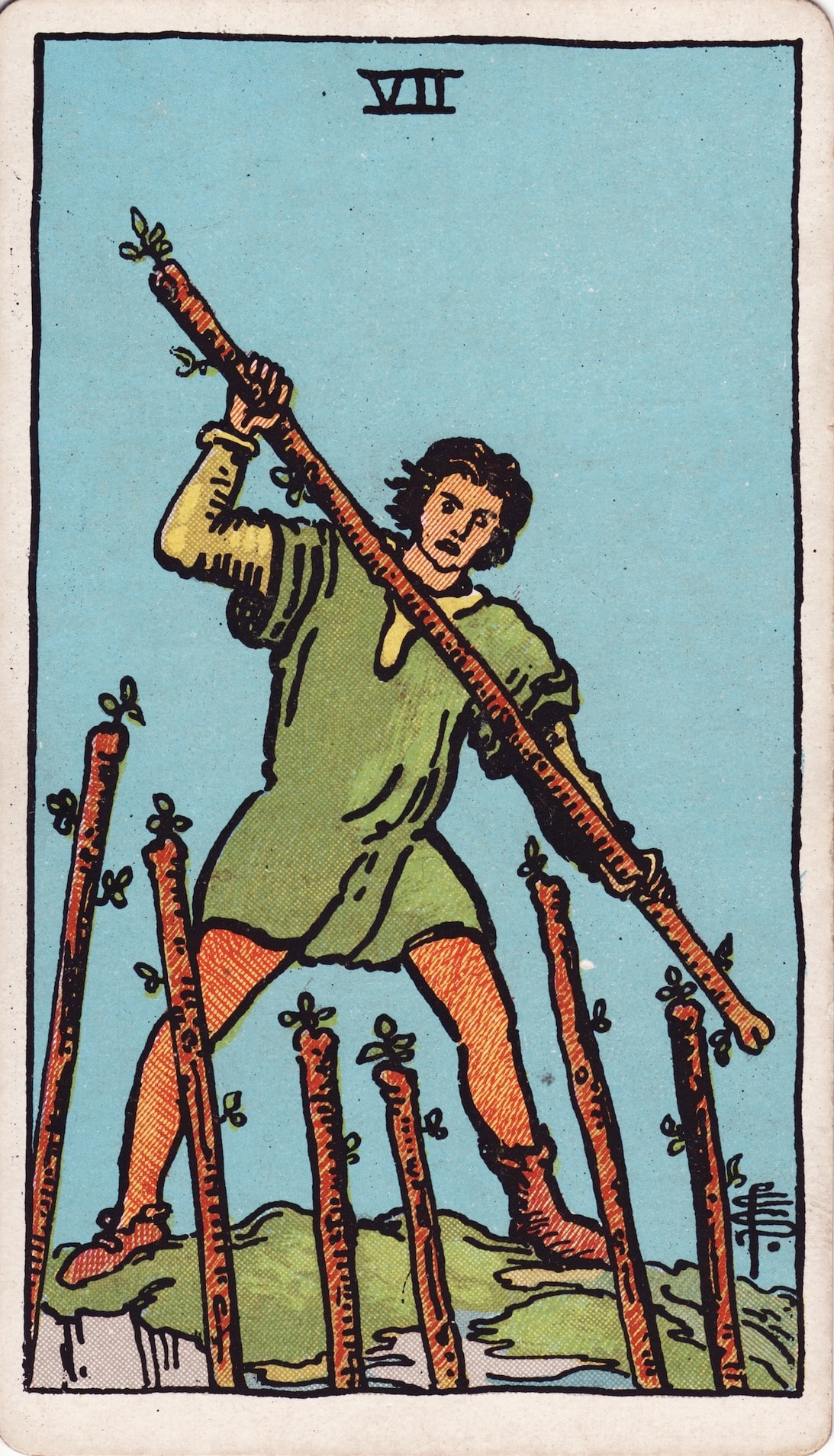
The Seven of Wands, drawn by Pamela Colman Smith in 1909, puts a young man in a green tunic on top of a grassy rise, swinging a staff at six others that come up at him from below. He holds his ground with his feet set wide apart, and each foot wears a different kind of shoe.
What Waite wrote it means (1910)
- Divinatory meanings
It is a card of valour, for, on the surface, six are attacking one, who has, however, the vantage position. On the intellectual plane, it signifies discussion, wordy strife; in business—negotiations, war of trade, barter, competition. It is further a card of success, for the combatant is on the top and his enemies may be unable to reach him.
- Reversed
Perplexity, embarrassments, anxiety. It is also a caution against indecision.
Arthur Edward Waite, The Pictorial Key to the Tarot (London, 1911), p. 184. Read it in the chapter
A young man on a craggy eminence brandishing a staff; six other staves are raised towards him from below.
What's in the picture
- The swung staff. He holds his staff across his body with both hands, one raised above his head and one down by his side, as if to block a blow.
- The six staffs. Six staffs rise from below the edge of the hill, spread across the bottom of the card, two of them between his legs. Whoever holds them stays out of sight; the card shows only their tops.
- His face. His dark hair is ruffled and his mouth is open. His brows are drawn together, and he looks straight out of the card at us.
- The green tunic. He wears a loose green tunic with a yellow collar, cut short above orange hose. Its sleeves are pushed up and creased by the swing of his arms, and a yellow under-sleeve shows on the raised arm.
- The shoe. On the foot at the left of the card is a low shoe, flat and open at the ankle, like a slipper.
- The boot. On the other foot is an ankle boot with a turned-down top. The picture gives no reason for the odd pair, and it is easy to miss.
- The leaves. Like his own staff, each of the six below has small sprigs of leaves sprouting from it.
- The hilltop. He stands on a green mound, the only ground in the picture, with a patch of grey-white below it at the left. Behind him the sky is a clear, plain blue from edge to edge.
The card in brief
- In the deck
- Card 29 of 78
- Arcana
- Minor Arcana, Wands
- Number
- Seven
- Element (Golden Dawn)
- Fire
- Astrology (Golden Dawn)
- Mars in Leo
- Title in Book T
- Lord of Valour
- Drawn by
- Pamela Colman Smith
- Planned by
- Arthur Edward Waite
- Published
- London, William Rider & Son, 1909
- Scan
- Pam-A printing, c. 1910, Wikimedia Commons
In the old books
Book T (1912)
Two hands holding by grip six wands, three crossed. A third hand issuing from a cloud at the lower part of the card, holding an upright wand which passes between the others. Flames leap from the point of junction. Above and below the central wand are the symbols of Mars and Leo, representing the Decan.
Possible victory, depending on the energy and courage exercised; valour; opposition, obstacles and difficulties, yet courage to meet them; quarrelling, ignorance, pretence, and wrangling, and threatening; also victory in small and unimportant things: and influence upon subordinates.
Book T, “A Description of the Cards of the Tarot”, The Equinox I.8 (London, 1912), p. 179. See the source Papus (1892)
Certain success to the Enterprise.
Papus, The Tarot of the Bohemians, tr. A. P. Morton (London, 1892), p. 312. See the source
Before 1909
The older cards and pictures behind this one will be shown here once their licences are checked.
The film
No film for this card yet.
Around this card
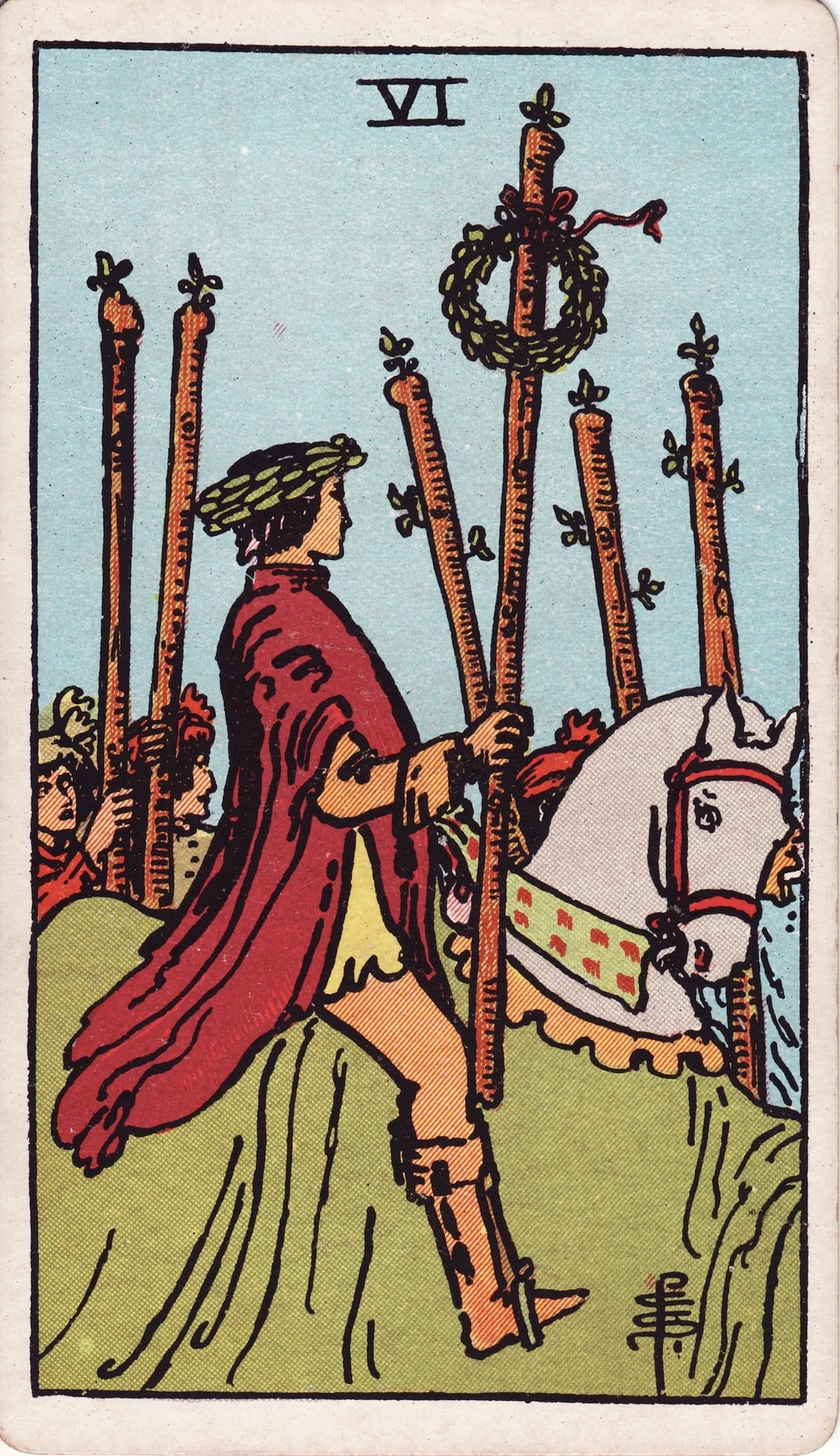
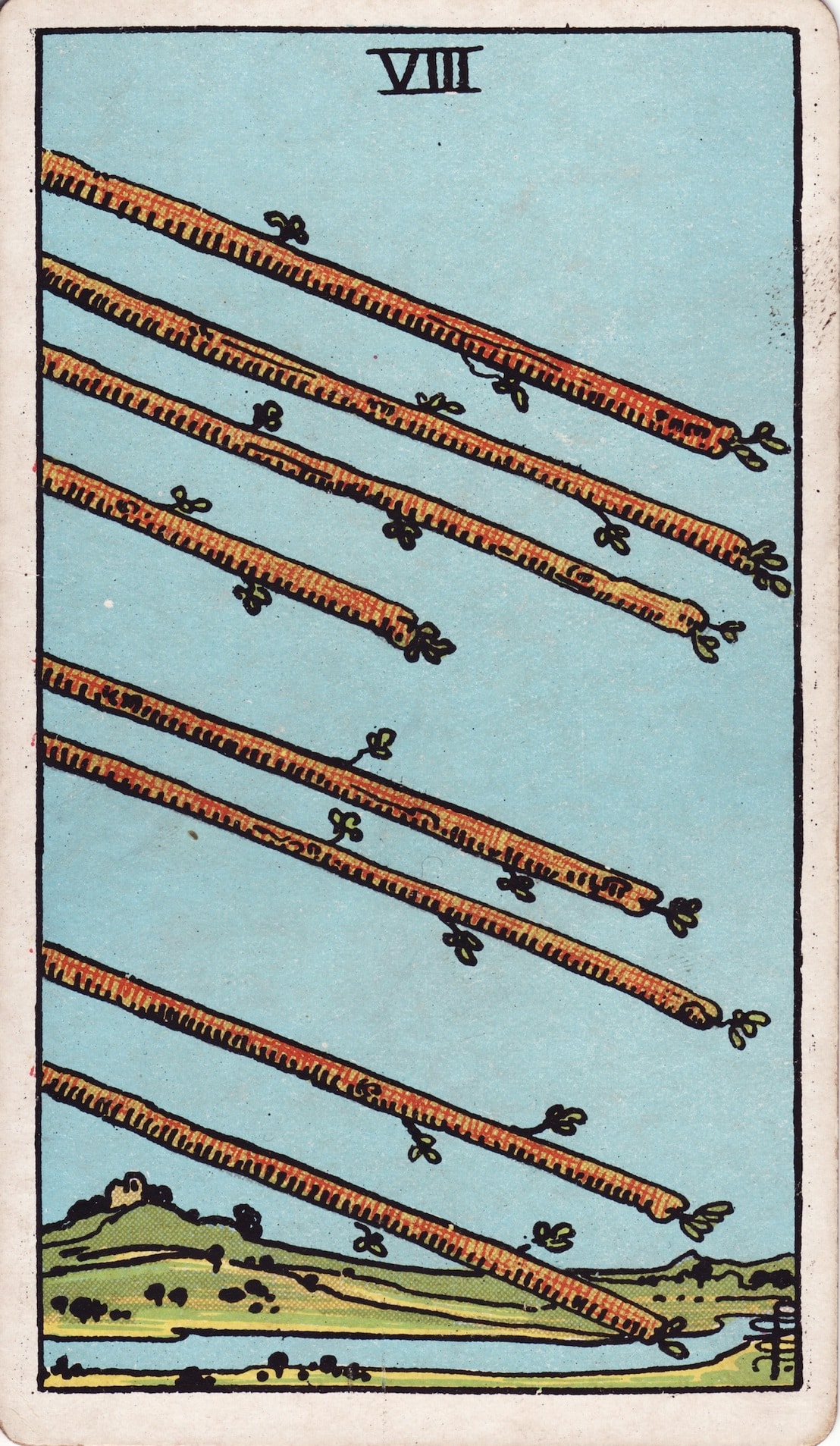
Before and after it in the deck
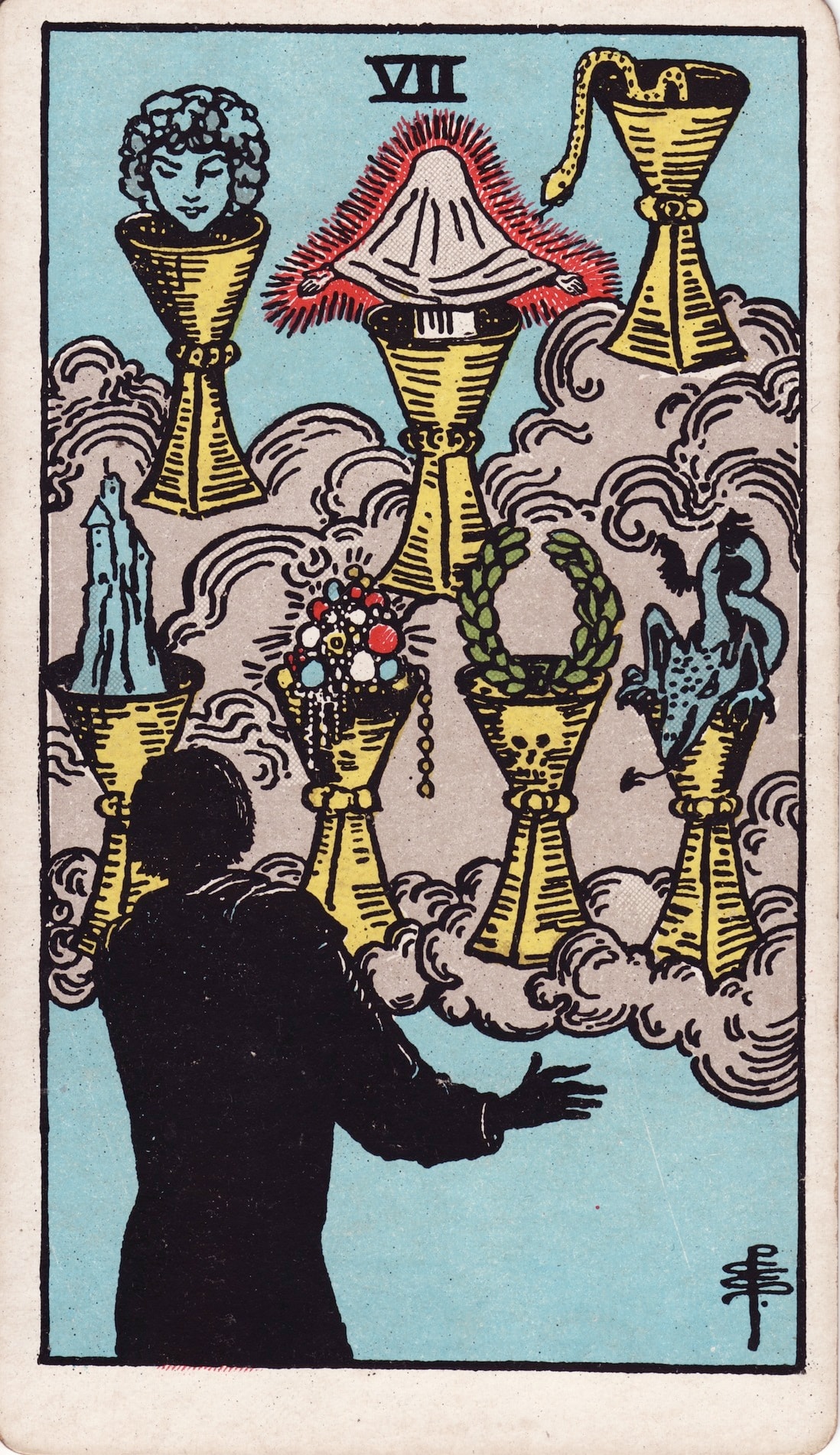
The same number in the other suits

All the cards of the Wands, or the whole deck.