Minor Arcana, the Cups
Four of Cups
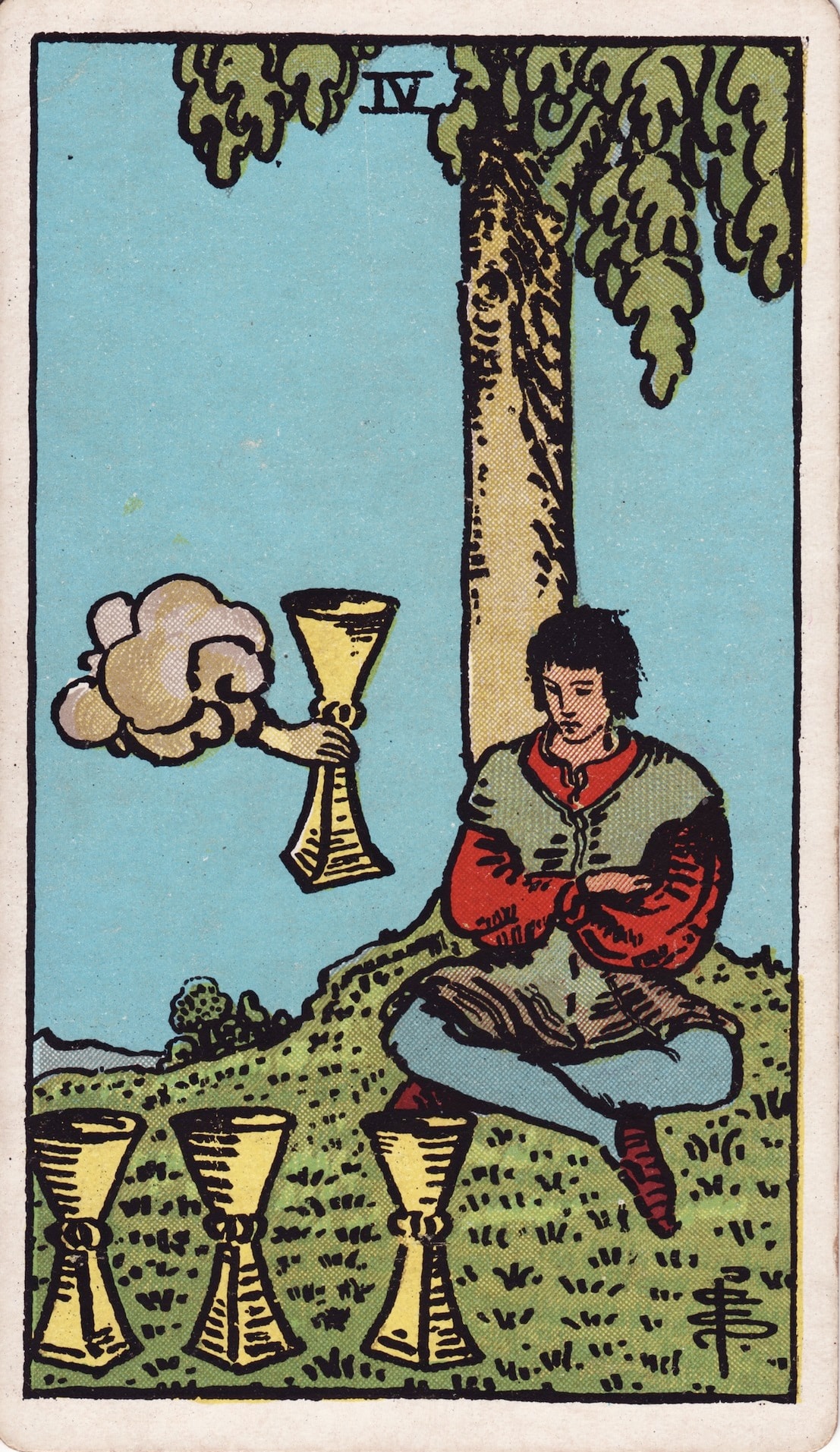
A young man sits cross-legged on the grass under a tree in Pamela Colman Smith's Four of Cups (1909), his arms folded and his head bowed. Three cups stand on the grass in front of him, and from a small cloud on the left a hand holds out a fourth cup, which he does not seem to notice at all.
What Waite wrote it means (1910)
- Divinatory meanings
Weariness, disgust, aversion, imaginary vexations, as if the wine of this world had caused satiety only; another wine, as if a fairy gift, is now offered the wastrel, but he sees no consolation therein. This is also a card of blended pleasure.
- Reversed
Novelty, presage, new instruction, new relations.
Arthur Edward Waite, The Pictorial Key to the Tarot (London, 1911), p. 218. Read it in the chapter
A young man is seated under a tree and contemplates three cups set on the grass before him; an arm issuing from a cloud offers him another cup. His expression notwithstanding is one of discontent with his environment.
What's in the picture
- The offered cup. A hand reaches out of a little grey-pink cloud and holds up a gold cup by its stem, at the height of his head. It is the only cup above the ground.
- The cloud. The cloud floats in the open sky at the left, round and soft, with nothing holding it up.
- The folded arms. His arms are crossed over his chest, the hands tucked against the red sleeves, holding nothing.
- The lowered eyes. His head tilts down and his eyes are half closed, aimed at the grass or the cups in front of him. Waite saw "discontent with his environment" in his face.
- The three cups. Three gold cups stand in a row along the bottom of the card, all upright and all the same. The cup nearest him is set a little apart from the other two.
- His clothes. He wears a grey-green tunic over a red shirt with full sleeves, blue leggings and red shoes. One foot pokes out from under his crossed legs.
- The tree. A thick tree trunk rises behind his back, and its leaves hang in green clumps across the top of the card. He sits on a low mound of grass at its foot, his back against the trunk.
- The far land. Off to the left the ground drops away to a few small bushes and a grey-blue strip of distant land, far below the mound. The sky is clear and blue.
The card in brief
- In the deck
- Card 40 of 78
- Arcana
- Minor Arcana, Cups
- Number
- Four
- Element (Golden Dawn)
- Water
- Astrology (Golden Dawn)
- Moon in Cancer
- Title in Book T
- Lord of Blended Pleasure
- Drawn by
- Pamela Colman Smith
- Planned by
- Arthur Edward Waite
- Published
- London, William Rider & Son, 1909
- Scan
- Pam-A printing, c. 1910, Wikimedia Commons
In the old books
Book T (1912)
Four cups: the two upper overflowing into the two lower, which do not overflow. An Angelic Hand grasps a branch of lotus, from which ascends a stem bearing one flower at the top of the card, from which the white water flows into the two upper cups. From the centre two leaves pass right and left, making, as it were, a cross between the four cups. Above and below are the symbols ☽ and ♋︎ for the Decan.
Success or pleasure approaching their end. A stationary period in happiness, which may, or may not, continue. It does not mean love and marriage so much as the previous symbol. It is too passive a symbol to represent perfectly complete happiness. Swiftness, hunting and pursuing. Acquisition by contention: injustice sometimes; some drawbacks to pleasure implied.
Book T, “A Description of the Cards of the Tarot”, The Equinox I.8 (London, 1912), p. 202. See the source Papus (1892)
Serious obstacles to the love. They arise from other persons, not from the lovers.
Papus, The Tarot of the Bohemians, tr. A. P. Morton (London, 1892), p. 312. See the source
Before 1909
The older cards and pictures behind this one will be shown here once their licences are checked.
The film
No film for this card yet.
Around this card
Before and after it in the deck
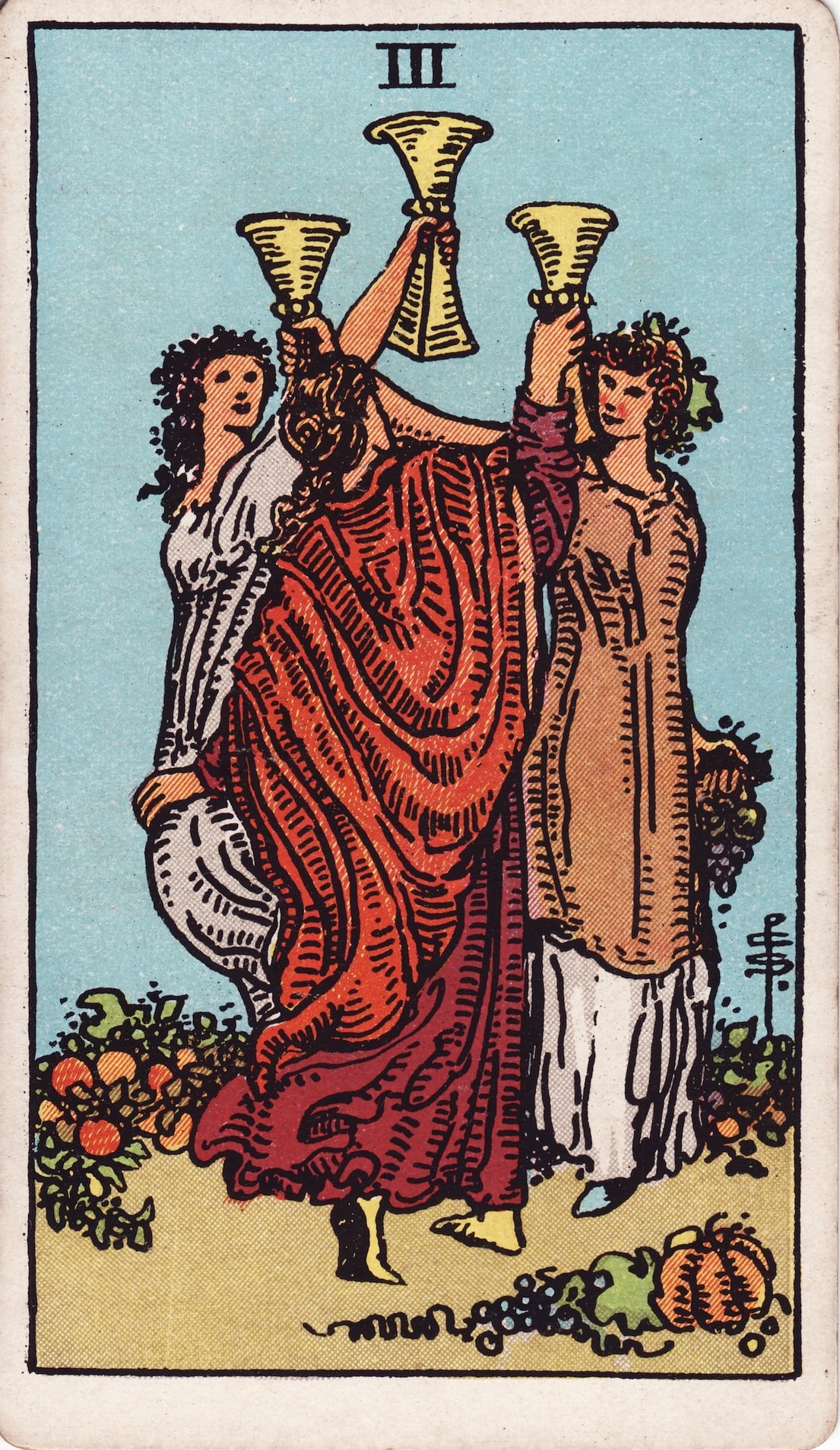
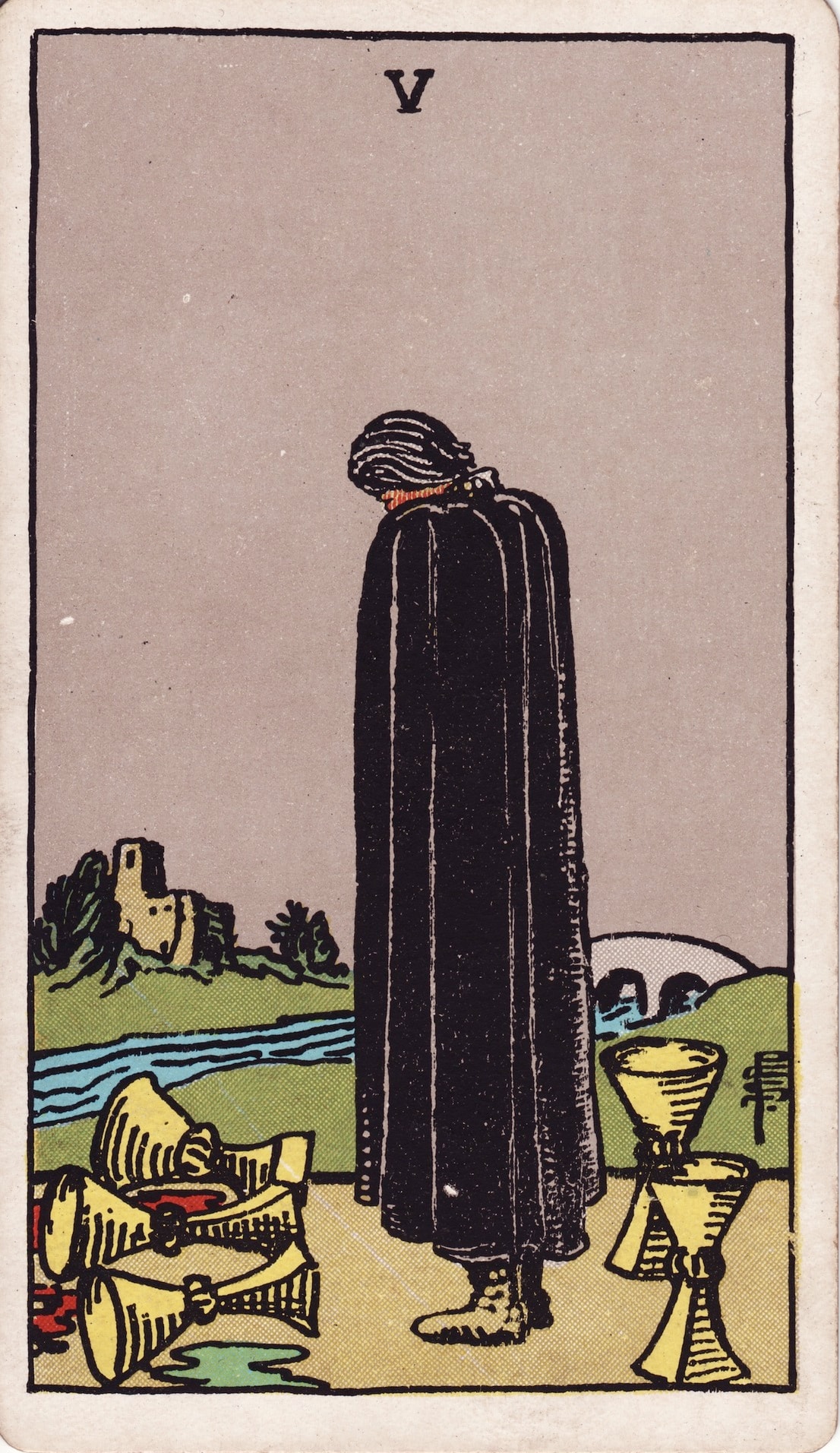
The same number in the other suits
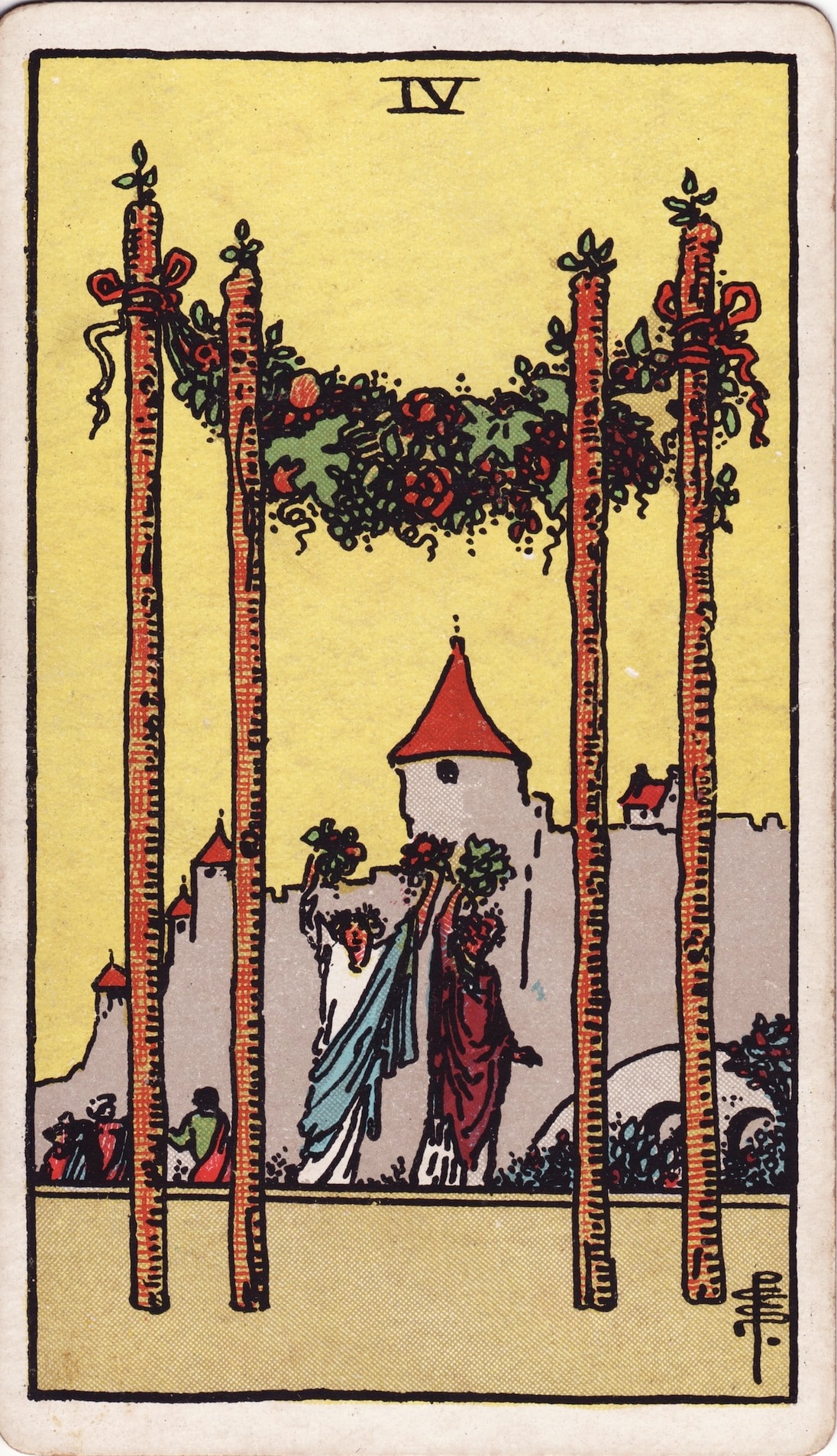

All the cards of the Cups, or the whole deck.