Minor Arcana, the Swords
Four of Swords
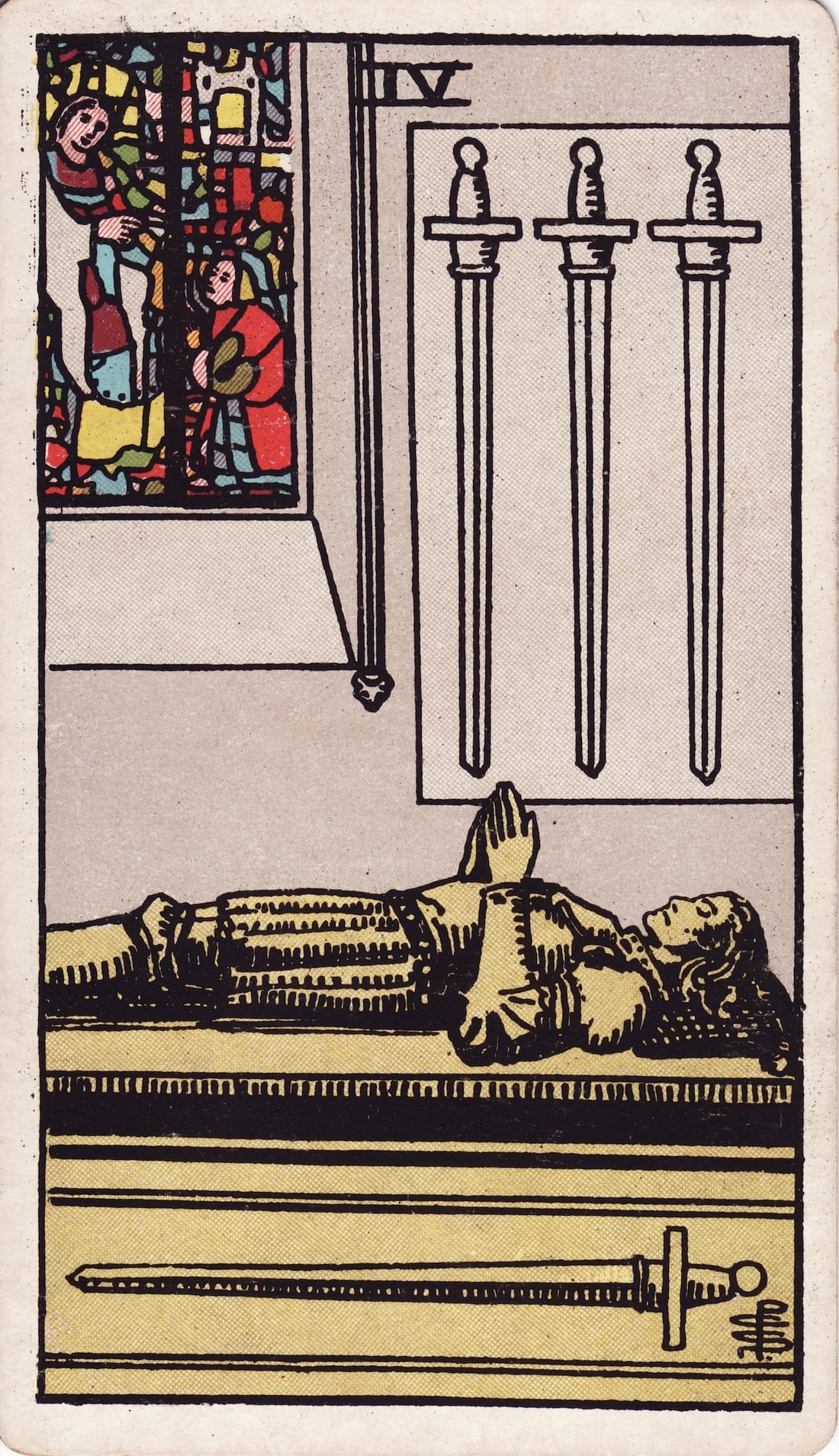
Pamela Colman Smith's Four of Swords, drawn in 1909 for A. E. Waite's deck, is the fourth card of the suit of swords. A knight's figure lies on a tomb with his hands joined in prayer, three swords hang on the wall above him, a fourth lies along the side of the tomb, and a window of coloured glass fills the top left corner.
What Waite wrote it means (1910)
- Divinatory meanings
Vigilance, retreat, solitude, hermit's repose, exile, tomb and coffin. It is these last that have suggested the design.
- Reversed
Wise administration, circumspection, economy, avarice, precaution, testament.
Arthur Edward Waite, The Pictorial Key to the Tarot (London, 1911), p. 246. Read it in the chapter
The effigy of a knight in the attitude of prayer, at full length upon his tomb.
What's in the picture
- The knight on the tomb. A knight in armour lies on his back at full length on top of the tomb. He is the same pale yellow as the stone, so he seems carved from it. Waite calls him “the effigy of a knight”.
- The joined hands. His hands are pressed together over his chest, palms flat, fingers pointing up.
- His face. His head lies on the right, his face turned up and his eyes closed.
- Three swords on the wall. Three swords hang side by side on a pale panel above him, points down. The left one points straight at his joined hands.
- The fourth sword. A fourth sword lies flat along the side of the tomb, hilt to the right, as if carved into it.
- The tomb. The side of the tomb is banded with lines of carved moulding, and it runs right across the card from edge to edge.
- The window. In the top left corner is a window of coloured glass, made of many small pieces in red, yellow, blue and green.
- Two figures in the glass. Two figures are pieced into the window. The one on the left reaches a hand toward the second, a figure in red lower down, who looks up.
- The quiet room. Below the window and around the swords the wall is plain grey. Apart from the stone knight the room is empty, and the strong colours are all in the glass.
The card in brief
- In the deck
- Card 54 of 78
- Arcana
- Minor Arcana, Swords
- Number
- Four
- Element (Golden Dawn)
- Air
- Astrology (Golden Dawn)
- Jupiter in Libra
- Title in Book T
- Lord of Rest from Strife
- Drawn by
- Pamela Colman Smith
- Planned by
- Arthur Edward Waite
- Published
- London, William Rider & Son, 1909
- Scan
- Pam-A printing, c. 1910, Wikimedia Commons
In the old books
Book T (1912)
Two White Radiating Angelic Hands, each holding two swords; which four cross in the centre. The rose of five petals with white radiations is reinstated on the point of their intersection. Above and below, on the points of two small daggers, are ⟨♃⟩ and ♎︎, representing the Decanate.
Rest from sorrow; yet after and through it. Peace from and after war. Relaxation of anxiety. Quietness, rest, ease and plenty, yet after struggle. Goods of this life; abundance; modified by dignity as is usual.
Book T, “A Description of the Cards of the Tarot”, The Equinox I.8 (London, 1912), p. 183. See the source Papus (1892)
Opposition to the hatred. Success against the enemy.
Papus, The Tarot of the Bohemians, tr. A. P. Morton (London, 1892), p. 313. See the source
Before 1909
The older cards and pictures behind this one will be shown here once their licences are checked.
The film
No film for this card yet.
Sources
- Waite: the effigy of a knight in the attitude of prayer, at full length upon his tomb.Arthur Edward Waite, The Pictorial Key to the Tarot (1910), Part III, Four of Swords
Around this card
Before and after it in the deck
The same number in the other suits

All the cards of the Swords, or the whole deck.