Minor Arcana, the Swords
Knight of Swords
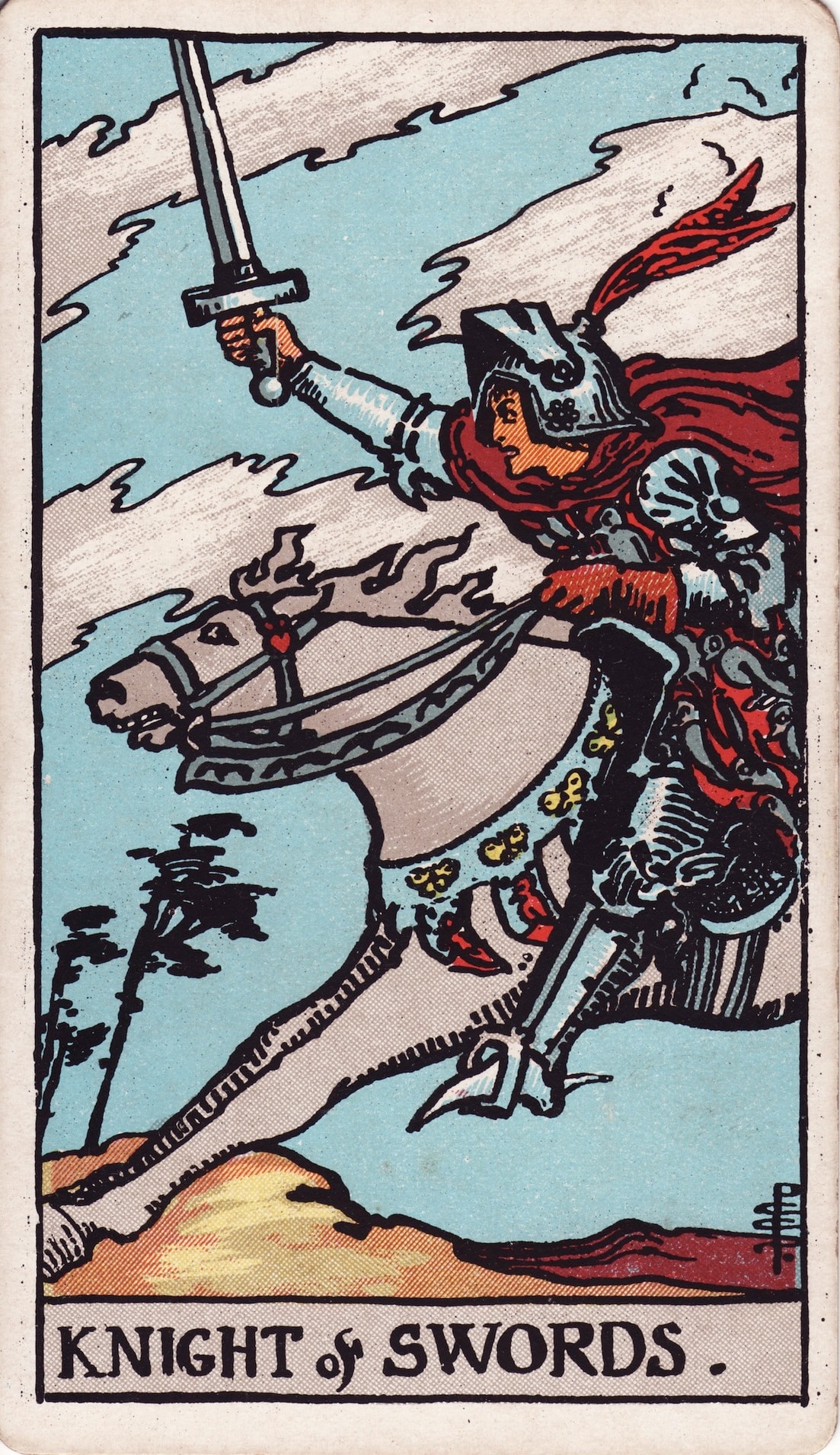
The Knight of Swords was drawn by Pamela Colman Smith in 1909 as the knight of the suit of swords in A. E. Waite's deck. A knight in armour charges to the left on a galloping white horse with his sword raised high, his red plume and cloak streaming behind him, while the wind tears at the clouds and bends the trees.
What Waite wrote it means (1910)
- Divinatory meanings
Skill, bravery, capacity, defence, address, enmity, wrath, war, destruction, opposition, resistance, ruin. There is therefore a sense in which the card signifies death, but it carries this meaning only in its proximity to other cards of fatality.
- Reversed
Imprudence, incapacity, extravagance.
Arthur Edward Waite, The Pictorial Key to the Tarot (London, 1911), p. 230. Read it in the chapter
He is riding in full course, as if scattering his enemies. In the design he is really a prototypical hero of romantic chivalry. He might almost be Galahad, whose sword is swift and sure because he is clean of heart.
What's in the picture
- The raised sword. He holds the sword high in his right hand, the blade pointing up and forward, ahead of his body, his arm straight.
- The red plume. Long red feathers fly back from the top of his helmet, pulled straight out by the speed.
- His face. The visor is up, and his face looks straight ahead in the direction of the charge. His helmet is steel, with a round boss on the side.
- The red cloak. A red cloak streams behind him over the armour and the horse's back, with a large round plate of armour at his shoulder.
- The white horse. The horse gallops to the left with its front legs stretched out, mouth open and eyes wide. Its mane flies up like flames.
- The harness. The horse's breast strap is decorated with small yellow shapes like butterflies and red ones like birds, and a red heart hangs from the bridle.
- The torn clouds. Clouds stream across the sky in long ragged strips, all slanting the same way, behind the knight and above him. Small dark birds fly in the gap at the top right.
- The bent trees. On the left, thin dark trees lean hard in the wind, their tops pushed to one side.
- The ground. The horse's hooves barely touch a low mound of orange and yellow earth, and a strip of red ground runs off to the right. Waite: “He is riding in full course, as if scattering his enemies.”
The card in brief
- In the deck
- Card 62 of 78
- Arcana
- Minor Arcana, Swords
- Number
- Knight
- Element (Golden Dawn)
- Air
- Title in Book T
- The Lord of the Wind and the Breezes: the King of the Spirits of Air
- Drawn by
- Pamela Colman Smith
- Planned by
- Arthur Edward Waite
- Published
- London, William Rider & Son, 1909
- Scan
- Pam-A printing, c. 1910, Wikimedia Commons
In the old books
Book T (1912)
A Winged Warrior with crowned Winged Helmet, mounted upon a brown steed. His general equipment is as that of the Knight of Wands, but he wears as a crest a winged six-pointed star, similar to those represented on the heads of Castor and Pollux the Dioscuri, the twins Gemini (a part of which constellation is included in his rule). He holds a drawn sword with the sigil of his scale upon its pommel. Beneath his horse's feet are dark-driving stratus clouds.
He is active, clever, subtle, fierce, delicate, courageous, skilful, but inclined to domineer. Also to overvalue small things, unless well dignified.
If ill dignified, deceitful, tyrannical and crafty.
Book T, “A Description of the Cards of the Tarot”, The Equinox I.8 (London, 1912), pp. 165–166. See the source Papus (1892)
A young, dark man, an enemy. He is also a spy.
Papus, The Tarot of the Bohemians, tr. A. P. Morton (London, 1892), p. 313. See the source
Before 1909
The older cards and pictures behind this one will be shown here once their licences are checked.
The film
No film for this card yet.
Sources
- Waite: he is riding in full course, as if scattering his enemies.Arthur Edward Waite, The Pictorial Key to the Tarot (1910), Part III, Knight of Swords
Around this card
Before and after it in the deck
The same number in the other suits

All the cards of the Swords, or the whole deck.