Minor Arcana, the Wands
Knight of Wands
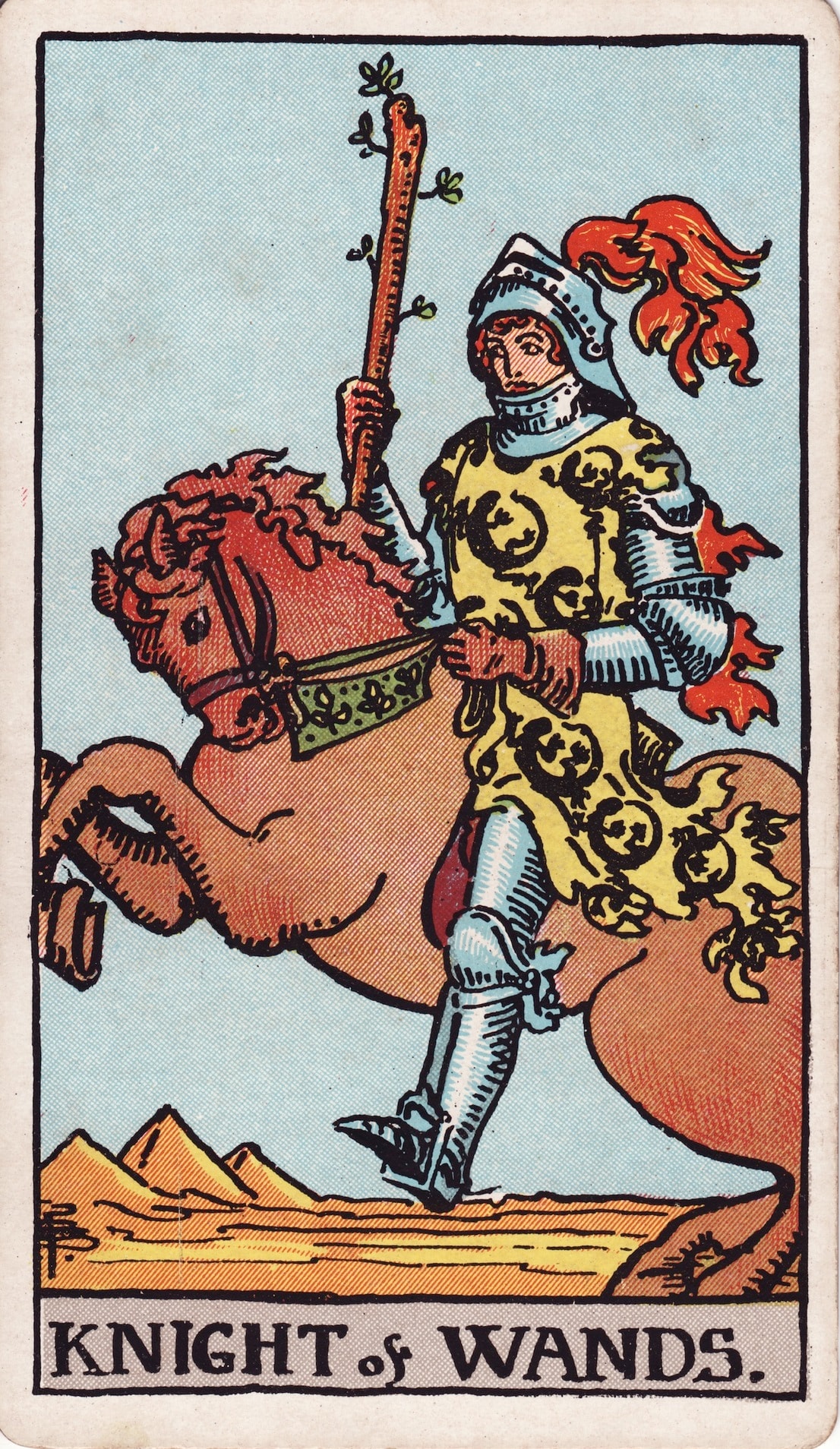
Pamela Colman Smith drew the Knight of Wands in 1909 as a young knight in armour and a yellow tunic, riding a chestnut horse that rears with its front legs in the air. He holds a short, leafy staff up high in one hand, and three pyramids rise from the orange desert behind him, at the lower left.
What Waite wrote it means (1910)
- Divinatory meanings
Departure, absence, flight, emigration. A dark young man, friendly. Change of residence.
- Reversed
Rupture, division, interruption, discord.
Arthur Edward Waite, The Pictorial Key to the Tarot (London, 1911), p. 174. Read it in the chapter
He is shewn as if upon a journey, armed with a short wand, and although mailed is not on a warlike errand. He is passing mounds or pyramids. The motion of the horse is a key to the character of its rider, and suggests the precipitate mood, or things connected therewith.
What's in the picture
- The plume. A big red-orange plume streams back from the top of his helmet like a flame. Smaller red tufts fly out from his shoulder and his elbow in the same way.
- The short staff. He raises a short staff in his gloved hand, gripping it near the bottom. It reaches higher than his helmet. Small leaves sprout from its sides, and its top is broken off rough.
- His face. Inside the open helmet his face is young and calm, eyes turned to the left of the card, the way the horse is going. A metal collar guards his throat.
- The salamander tunic. Over his armour he wears a yellow tunic patterned with black salamanders curled into rings. Its lower edge is cut into ragged points that flicker like fire.
- The rearing horse. The chestnut horse lifts its forelegs high, and its mane is a mass of red-orange curls, like its rider's plume. In Waite's words, the horse's motion "is a key to the character of its rider".
- The breastband. A green band patterned with small pale flowers crosses the horse's neck, under a red bridle. The horse's eye is wide and dark.
- The pyramids. Three pyramids stand on the orange desert at the lower left. Waite called them "mounds or pyramids". Smith's monogram sits just below them, in the corner.
- The armoured leg. His leg is cased in grey-blue plate armour down to a long, pointed steel shoe that hangs below the horse's belly.
The card in brief
- In the deck
- Card 34 of 78
- Arcana
- Minor Arcana, Wands
- Number
- Knight
- Element (Golden Dawn)
- Fire
- Title in Book T
- The Lord of the Flame and Lightning: the King of the Spirits of Fire
- Drawn by
- Pamela Colman Smith
- Planned by
- Arthur Edward Waite
- Published
- London, William Rider & Son, 1909
- Scan
- Pam-A printing, c. 1910, Wikimedia Commons
In the old books
Book T (1912)
A Winged Warrior riding upon a black horse with flaming mane and tail: the horse itself is not winged. The rider wears a winged helmet (like the old Scandinavian and Gaulish helmet) with a Rayed Crown, a corslet of scale-mail and buskins of the same, and a flowing scarlet mantle. Above his helmet, upon his cuirass, and on the shoulder-pieces and buskins, he wears as a crest a winged black horse's head. He grasps a club with flaming ends, somewhat similar to that in the symbol of the Ace of Wands, but not so heavy, and also the sigil of his scale is shown; beneath the rushing feet of his steed are waving flames and fire. He is active—generous—fierce—sudden—impetuous.
If ill dignified, he is evil-minded—cruel—bigoted—brutal.
Book T, “A Description of the Cards of the Tarot”, The Equinox I.8 (London, 1912), p. 159. See the source Papus (1892)
A dark young mau, a friend.
Papus, The Tarot of the Bohemians, tr. A. P. Morton (London, 1892), p. 311. See the source
Before 1909
The older cards and pictures behind this one will be shown here once their licences are checked.
The film
No film for this card yet.
Around this card
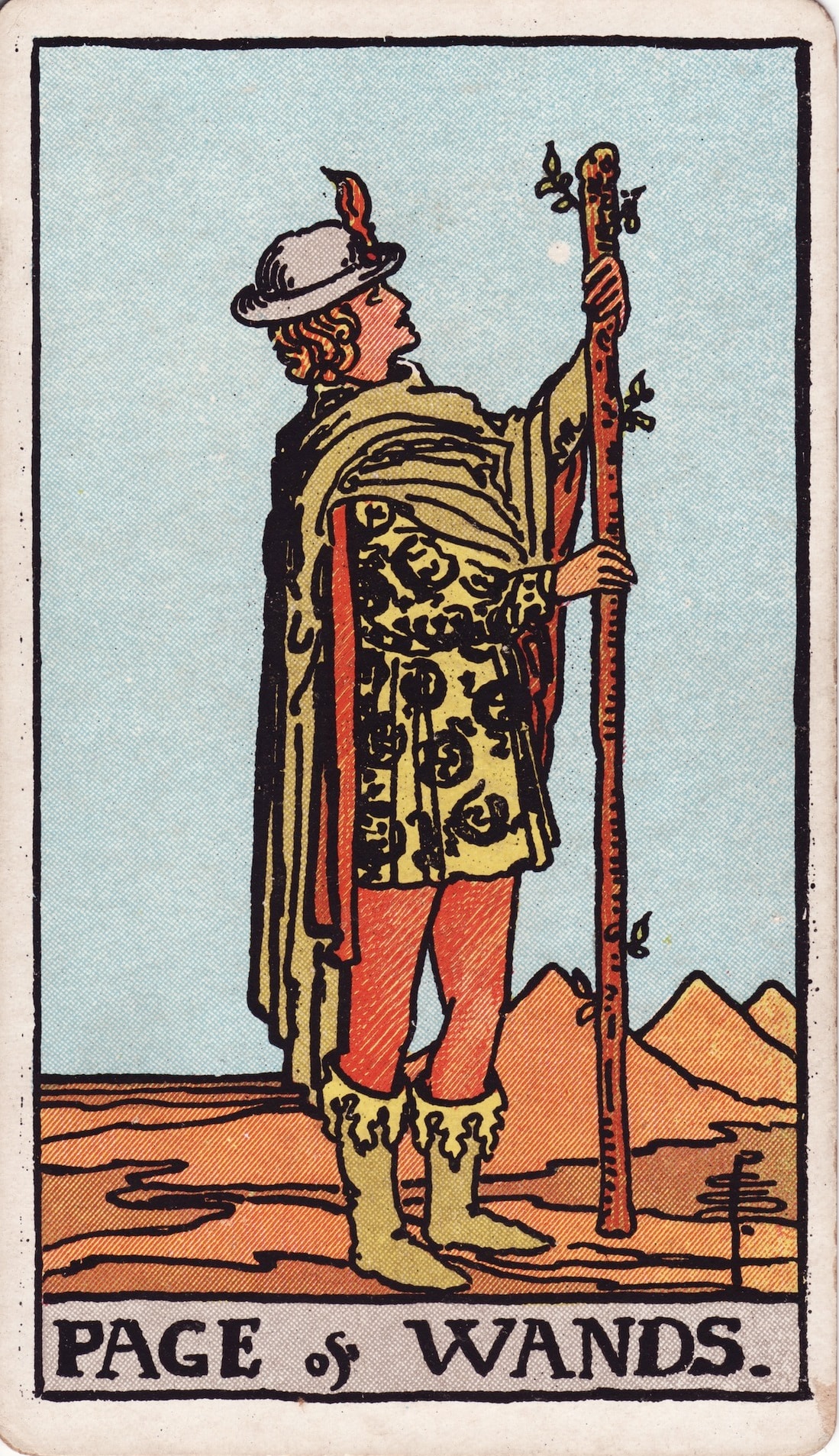
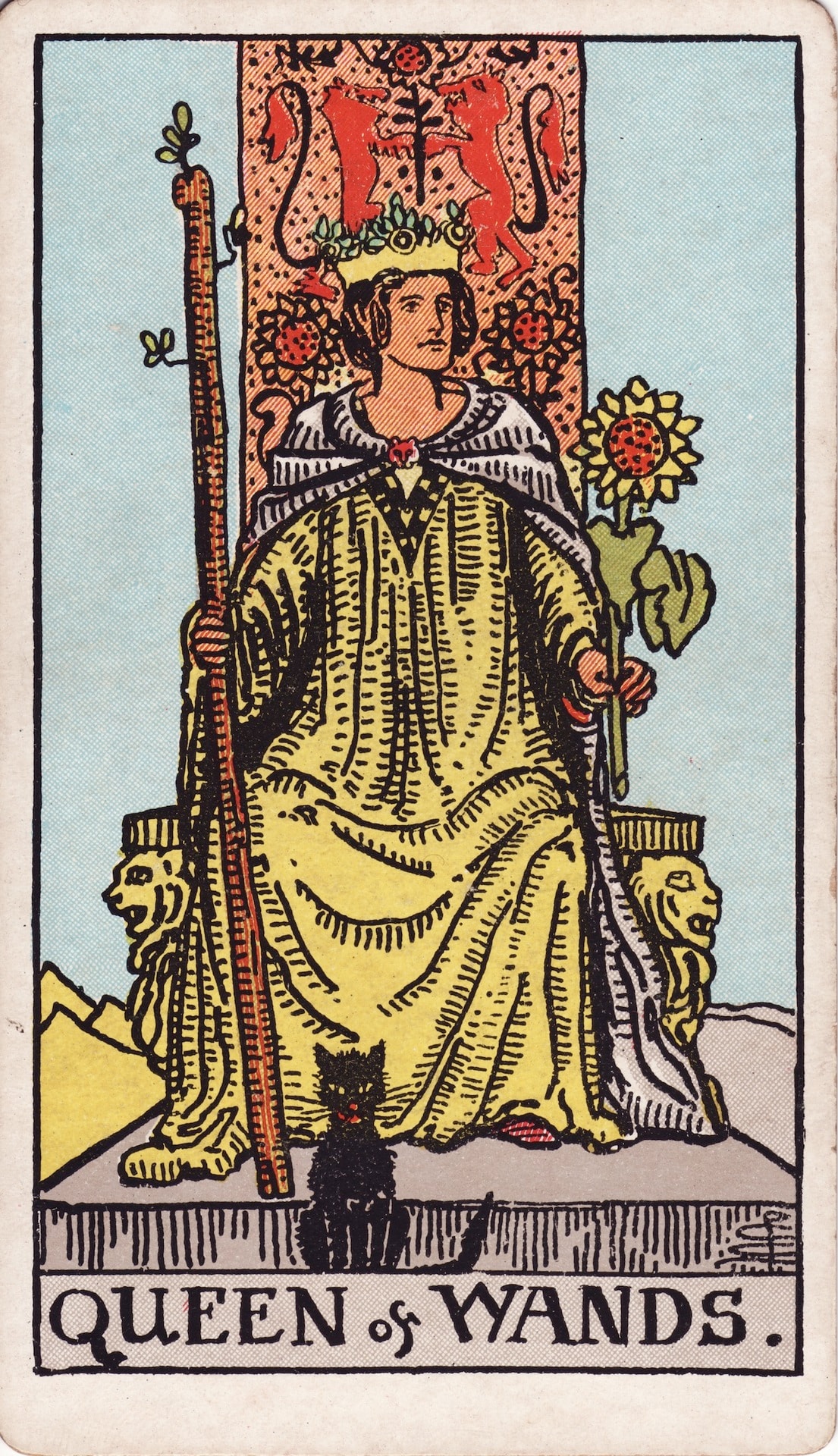
Before and after it in the deck
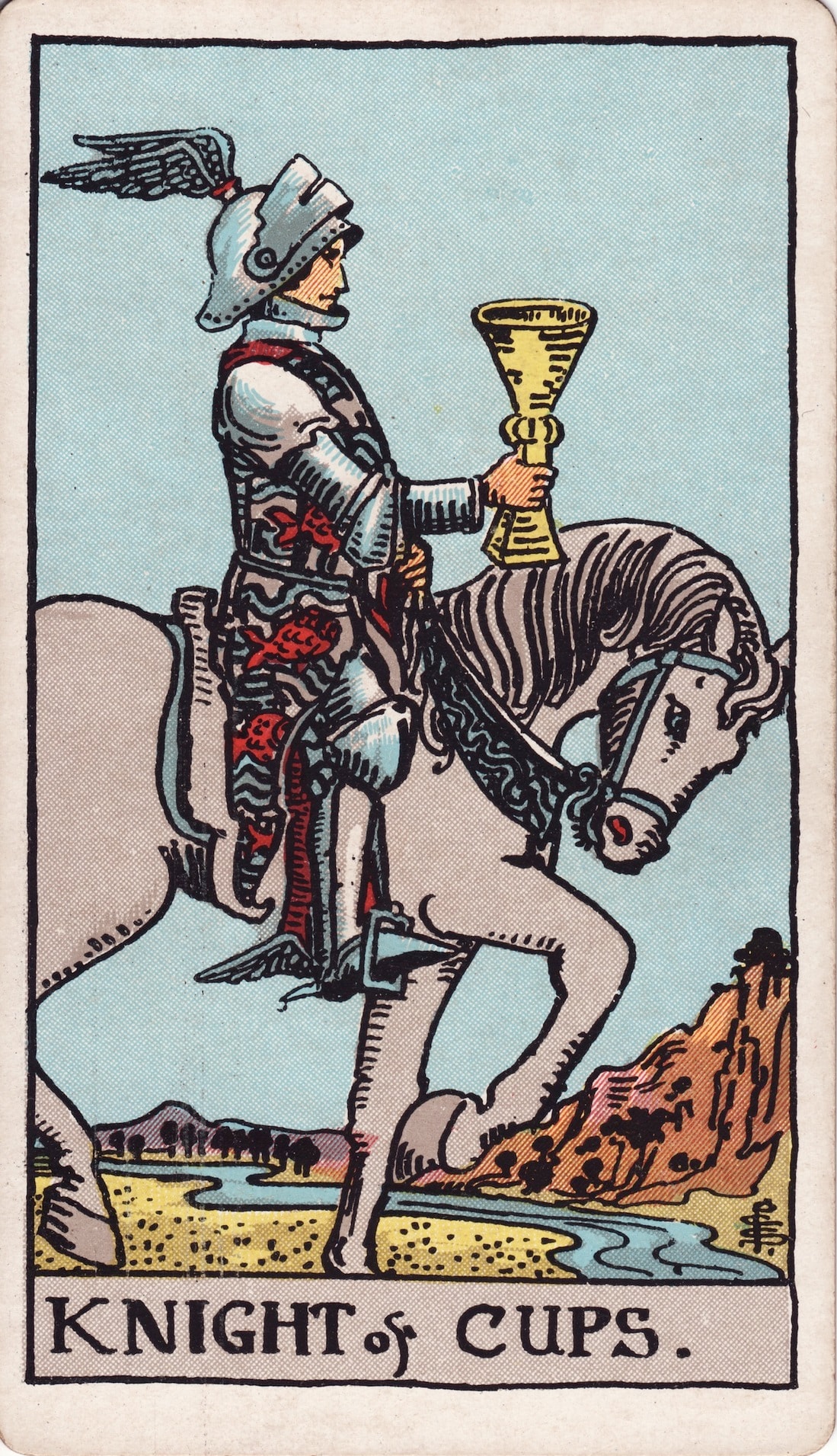
The same number in the other suits

All the cards of the Wands, or the whole deck.