Minor Arcana, the Cups
Six of Cups
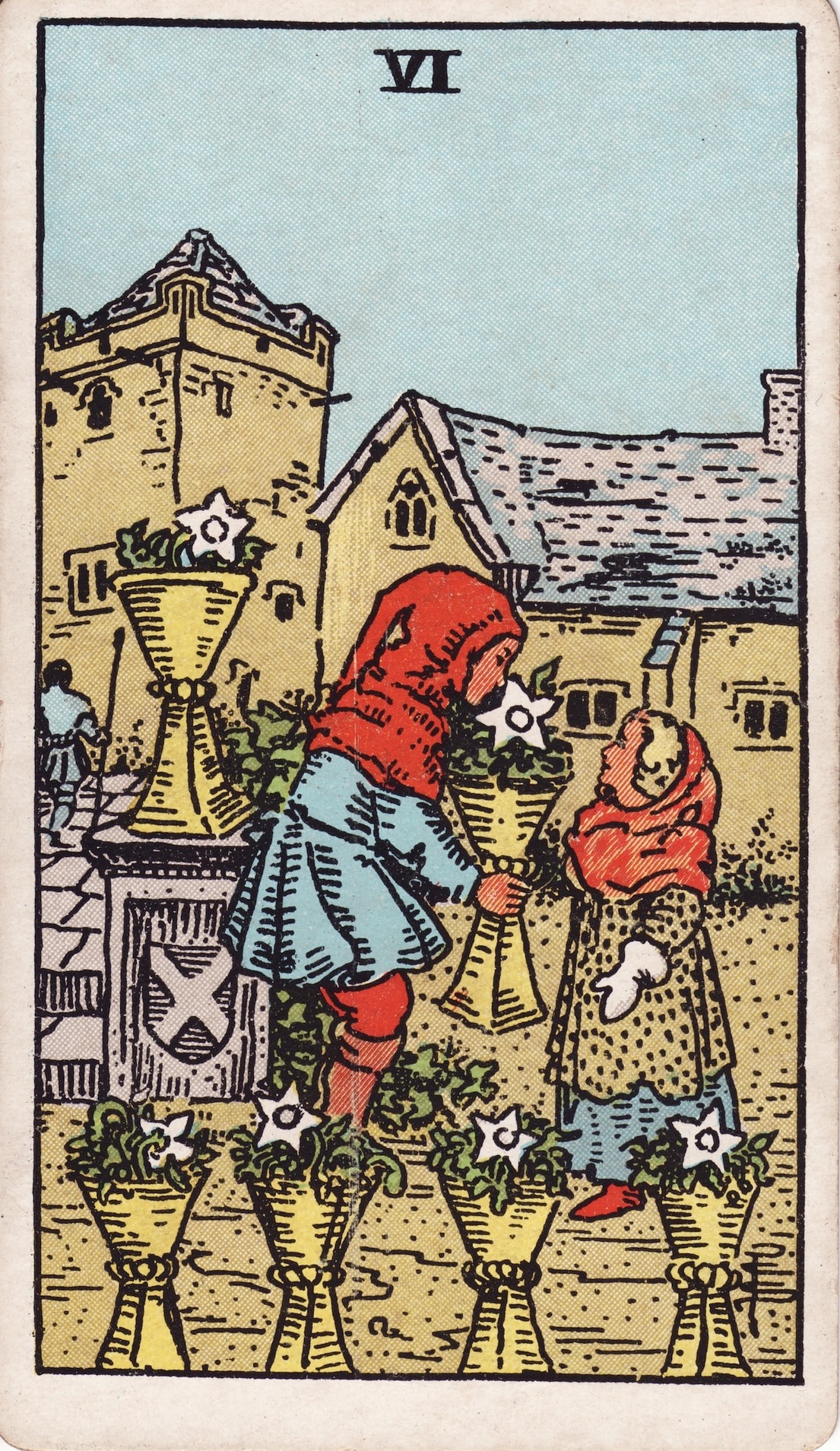
Pamela Colman Smith set her Six of Cups (1909) in the courtyard of an old house, where a boy in a red hood bends down to give a smaller girl a gold cup filled with white flowers. Five more cups stand around them, each one full of the same white, star-shaped flowers and green leaves.
What Waite wrote it means (1910)
- Divinatory meanings
A card of the past and of memories, looking back, as—for example—on childhood; happiness, enjoyment, but coming rather from the past; things that have vanished. Another reading reverses this, giving new relations, new knowledge, new environment, and then the children are disporting in an unfamiliar precinct.
- Reversed
The future, renewal, that which will come to pass presently.
Arthur Edward Waite, The Pictorial Key to the Tarot (London, 1911), p. 214. Read it in the chapter
Children in an old garden, their cups filled with flowers.
What's in the picture
- The boy. A red hood covers his head, and he wears a loose blue tunic and red hose. He leans down toward the girl, his face close to the flower in the cup, as if he were smelling it.
- The offered cup. He holds the cup low with both hands, by its stem, so it sits between them at her height.
- The girl. She is smaller, in a red headscarf and a long yellow dress dotted with black over a blue skirt, with red shoes. She looks up at the boy's face.
- The white glove. Her hand, in a big white glove or mitten, is raised in front of her, half open toward the cup.
- The flowers. Every cup holds a white flower with five points and a dark ring in the middle, tucked into green leaves. They look more like stars than like real blooms.
- The cup on the pillar. At the left, one cup stands on top of a stone pillar. Its front is carved with a shield, and on the shield is a white X-shaped cross.
- The guard. Behind the pillar, at the very edge of the card, a small man in blue walks away from us carrying a long staff or spear. He is the only grown-up in sight.
- The old buildings. A square tower stands at the left and a house with a pointed gable and a long slate roof fills the back. The ground of the courtyard is yellow, under a pale blue sky.
The card in brief
- In the deck
- Card 42 of 78
- Arcana
- Minor Arcana, Cups
- Number
- Six
- Element (Golden Dawn)
- Water
- Astrology (Golden Dawn)
- Sun in Scorpio
- Title in Book T
- Lord of Pleasure
- Drawn by
- Pamela Colman Smith
- Planned by
- Arthur Edward Waite
- Published
- London, William Rider & Son, 1909
- Scan
- Pam-A printing, c. 1910, Wikimedia Commons
In the old books
Book T (1912)
An Angelic Hand, as before, holds a group of stems of water-lilies or lotuses, from which six flowers bend, one over each cup. From these flowers a white glistening water flows into the cups as from a fountain, but they are not yet full. Above and below are ☉ and ♏︎, referring to the Decan.
Commencement of steady increase, gain and pleasure; but commencement only. Also affront, detection, knowledge, and in some instances contention and strife arising from unwarranted self-assertion and vanity. Sometimes thankless and presumptuous; sometimes amiable and patient. According to dignity as usual.
Book T, “A Description of the Cards of the Tarot”, The Equinox I.8 (London, 1912), pp. 184–185. See the source Papus (1892)
The obstacles triumph. Love destroyed in the midst of happiness. Widowhood.
Papus, The Tarot of the Bohemians, tr. A. P. Morton (London, 1892), p. 313. See the source
Before 1909
The older cards and pictures behind this one will be shown here once their licences are checked.
The film
No film for this card yet.
Around this card
Before and after it in the deck
The same number in the other suits

All the cards of the Cups, or the whole deck.