Minor Arcana, the Wands
Six of Wands
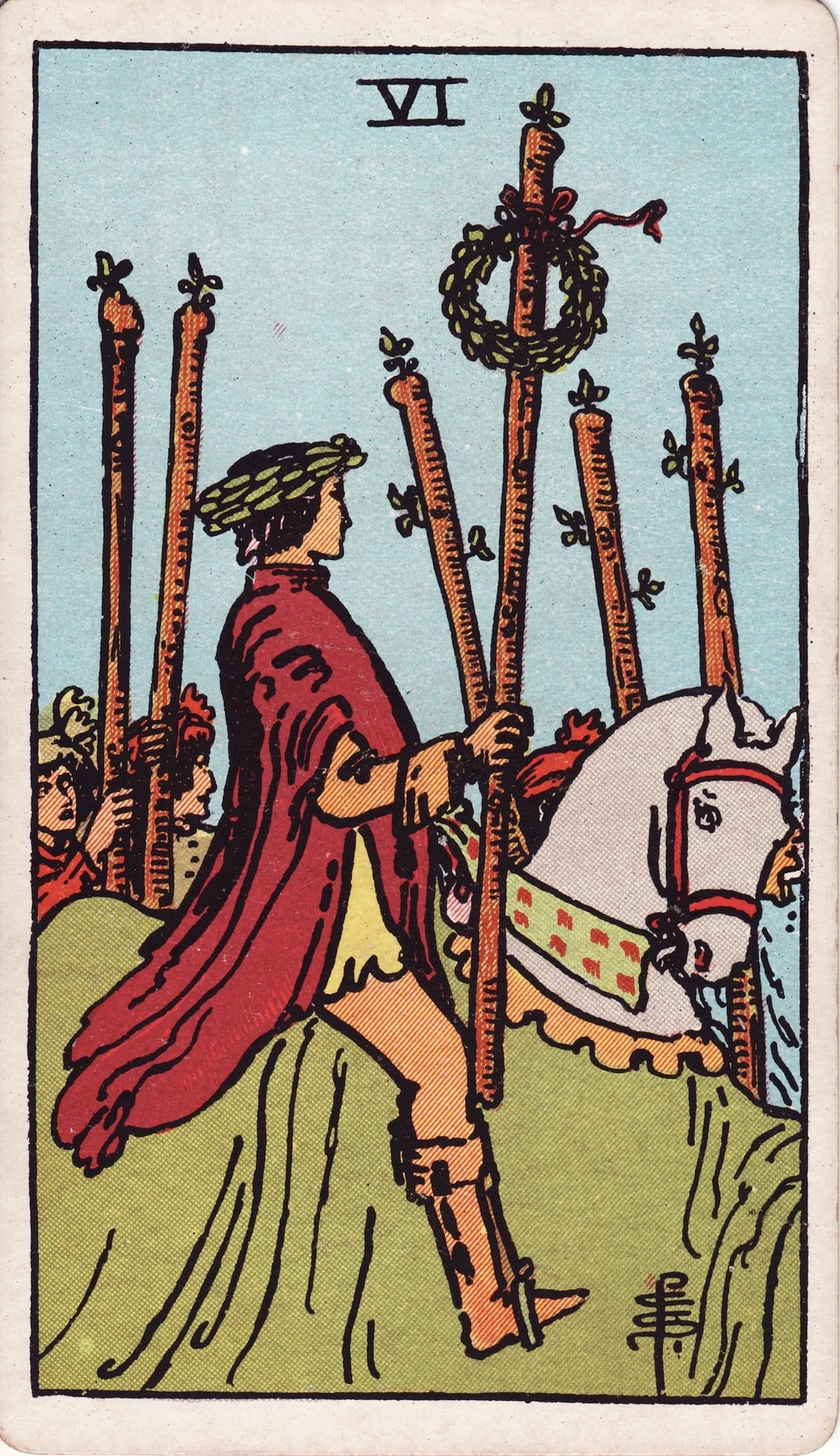
A rider crowned with laurel comes through a crowd on a white horse in the Six of Wands, as Pamela Colman Smith drew it in 1909. He holds up a tall staff with a laurel wreath tied near its top, while men on foot walk alongside him with the other five staffs held upright.
What Waite wrote it means (1910)
- Divinatory meanings
The card has been so designed that it can cover several significations; on the surface, it is a victor triumphing, but it is also great news, such as might be carried in state by the King's courier; it is expectation crowned with its own desire, the crown of hope, and so forth.
- Reversed
Apprehension, fear, as of a victorious enemy at the gate; treachery, disloyalty, as of gates being opened to the enemy; also indefinite delay.
Arthur Edward Waite, The Pictorial Key to the Tarot (London, 1911), p. 186. Read it in the chapter
A laurelled horseman bears one staff adorned with a laurel crown; footmen with staves are at his side.
What's in the picture
- The wreath on the staff. A round laurel wreath hangs near the top of his staff, tied on with a red ribbon whose ends flutter out to the right.
- The wreath on his head. He wears a second laurel wreath on his dark hair. His face is in profile, turned the same way as the horse, and his mouth is closed.
- The red cloak. A long red cloak falls from his shoulders and spills down over the horse's back, almost to the bottom of the card.
- The horse's head. Only the horse's white head and neck show clearly, with a red bridle round its nose and brow. It lowers its head as it walks.
- The trappings. The rest of the horse is hidden under a long green cloth. Across its front runs a pale band printed with small red shapes, with a scalloped orange fringe below.
- The men on foot. At the left edge, men on foot crowd in close behind the rider, their faces turned his way. They hold their staffs straight up beside them.
- Beyond the horse. Three more staffs rise on the far side of the horse. The men holding them are hidden behind it; only a shock of red hair and part of a face show at its edges.
- The boot. His leg hangs down over the green cloth in a tall orange boot with a strap, the toe pointing forward through a stirrup. Smith's monogram stands in the grass just to the right.
The card in brief
- In the deck
- Card 28 of 78
- Arcana
- Minor Arcana, Wands
- Number
- Six
- Element (Golden Dawn)
- Fire
- Astrology (Golden Dawn)
- Jupiter in Leo
- Title in Book T
- Lord of Victory
- Drawn by
- Pamela Colman Smith
- Planned by
- Arthur Edward Waite
- Published
- London, William Rider & Son, 1909
- Scan
- Pam-A printing, c. 1910, Wikimedia Commons
In the old books
Book T (1912)
Two hands in grip as the last, holding six wands crossed three and three. Flames issue from the point of junction. Above and below are short wands with flames issuing, surmounted respectively by the symbols of ♃ and ♌︎, representing the Decan.
Victory after strife: Love: pleasure gained by labour: carefulness, sociability and avoiding of strife, yet victory therein: also insolence, and pride of riches and success, etc. The whole dependent on the dignity.
Book T, “A Description of the Cards of the Tarot”, The Equinox I.8 (London, 1912), p. 178. See the source Papus (1892)
Realization of the opposition.
At last the obstacles succeed. Failure of the Enterprise in the midst of its execution.
Papus, The Tarot of the Bohemians, tr. A. P. Morton (London, 1892), p. 312. See the source
Before 1909
The older cards and pictures behind this one will be shown here once their licences are checked.
The film
No film for this card yet.
Around this card
Before and after it in the deck
The same number in the other suits

All the cards of the Wands, or the whole deck.