Minor Arcana, the Pentacles
Two of Pentacles
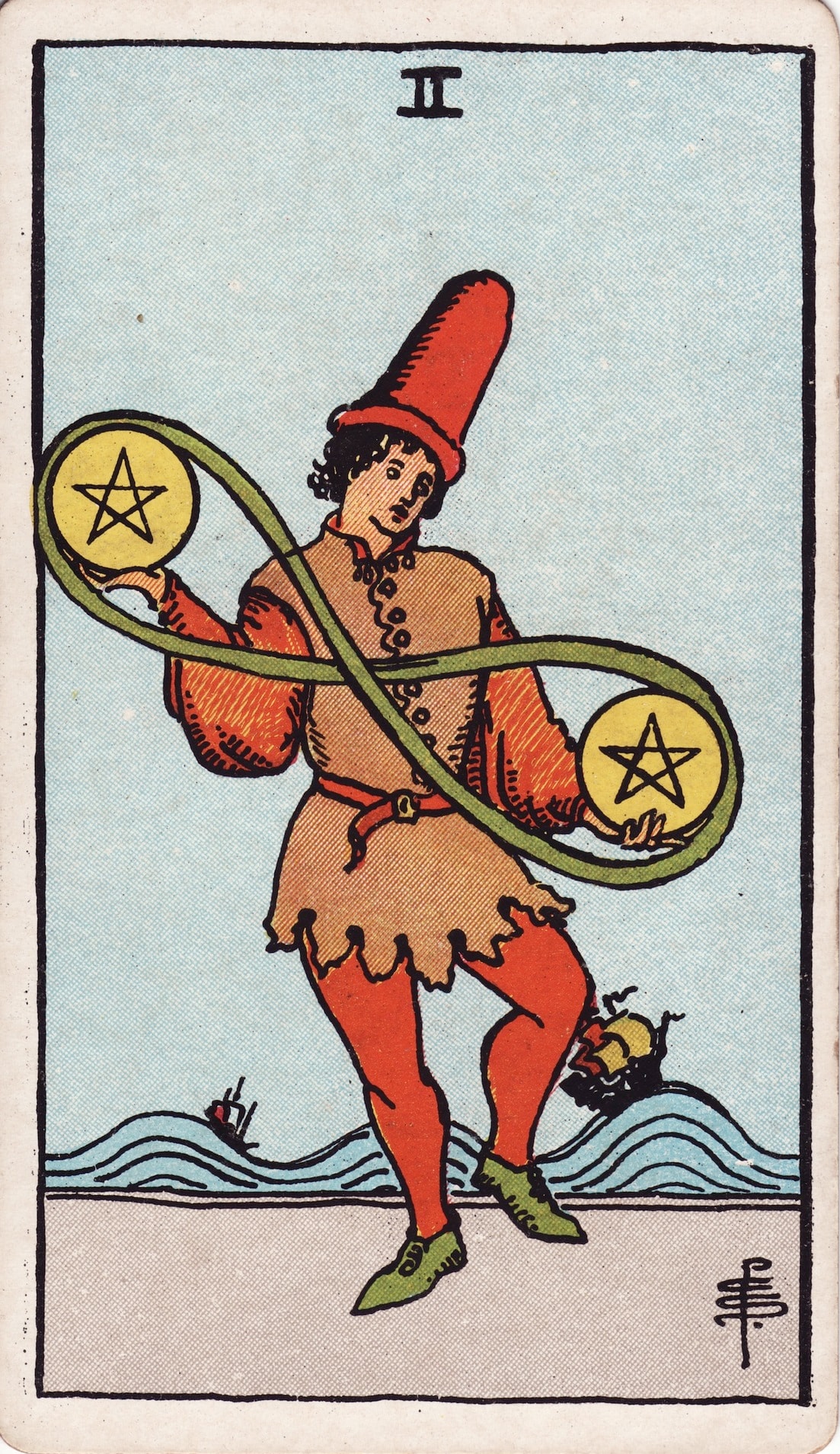
Pamela Colman Smith drew the Two of Pentacles in 1909 for A. E. Waite's deck, as the second card of the suit of pentacles. A young man in a tall red hat dances on one foot by the sea with a coin in each hand, a green band looping around both coins in a figure eight, while two ships ride high waves behind him.
What Waite wrote it means (1910)
- Divinatory meanings
On the one hand it is represented as a card of gaiety, recreation and its connexions, which is the subject of the design; but it is read also as news and messages in writing, as obstacles, agitation, trouble, embroilment.
- Reversed
Enforced gaiety, simulated enjoyment, literal sense, handwriting, composition, letters of exchange.
Arthur Edward Waite, The Pictorial Key to the Tarot (London, 1911), p. 278. Read it in the chapter
A young man, in the act of dancing, has a pentacle in either hand, and they are joined by that endless cord which is like the number 8 reversed.
What's in the picture
- The tall hat. His red hat is soft and very tall, taller than his head, and it leans a little to one side. Dark curls show under its brim.
- The raised coin. In his right hand he lifts one coin up beside his head, holding it from below on his fingertips.
- The low coin. His left hand holds the other coin down at hip height, on the far side of his body.
- The green band. A green band runs around both coins and crosses itself in front of him, making a sideways eight. Waite called it an “endless cord”, “like the number 8 reversed”.
- The tunic. His short tunic has a row of buttons down the front, a red belt with a buckle, and a ragged hem cut into points. His sleeves are red and puffed.
- The dancing step. He stands on his right foot. The left knee is bent and that foot lifts behind him, so he seems caught in the middle of a step. Both shoes are green and pointed.
- The big ship. Behind him the sea swells in high waves. On the right a ship with a round yellow sail heels over on the crest of one.
- The small ship. Further off on the left, a smaller ship with bare masts rides a lower wave. The sea sits behind his knees, so he dances on a strip of bare grey shore in front of it.
The card in brief
- In the deck
- Card 66 of 78
- Arcana
- Minor Arcana, Pentacles
- Number
- Two
- Element (Golden Dawn)
- Earth
- Astrology (Golden Dawn)
- Jupiter in Capricorn
- Title in Book T
- Lord of Harmonious Change
- Drawn by
- Pamela Colman Smith
- Planned by
- Arthur Edward Waite
- Published
- London, William Rider & Son, 1909
- Scan
- Pam-A printing, c. 1910, Wikimedia Commons
In the old books
Book T (1912)
Two wheels, disks or pentacles, similar to that of the Ace. They are united by a green-and-gold serpent, bound about them like a figure of 8. It holds its tail in its mouth. A White Radiant Angelic Hand holds the centre of the whole. No roses enter into this card. Above and below are the symbols of ♃ and ♑︎. It is a revolving symbol.
The harmony of change, alternation of gain and loss; weakness and strength; everchanging occupation; wandering, discontented with any fixed condition of things; now elated, then melancholy; industrious, yet unreliable; fortunate through prudence of management, yet sometimes unaccountably foolish; alternately talkative and suspicious. Kind, yet wavering and inconsistent. Fortunate in journeying. Argumentative.
Book T, “A Description of the Cards of the Tarot”, The Equinox I.8 (London, 1912), p. 188. See the source Papus (1892)
Opposition to this commencement. Difficulty in well establishing the first landmarks of good fortune.
Papus, The Tarot of the Bohemians, tr. A. P. Morton (London, 1892), p. 314. See the source
Before 1909
The older cards and pictures behind this one will be shown here once their licences are checked.
The film
No film for this card yet.
Sources
- Waite: the two pentacles are joined by an endless cord like the number 8 reversed.Arthur Edward Waite, The Pictorial Key to the Tarot (1910), Part III, Two of Pentacles
Around this card
Before and after it in the deck
The same number in the other suits

All the cards of the Pentacles, or the whole deck.