Minor Arcana, the Swords
Two of Swords
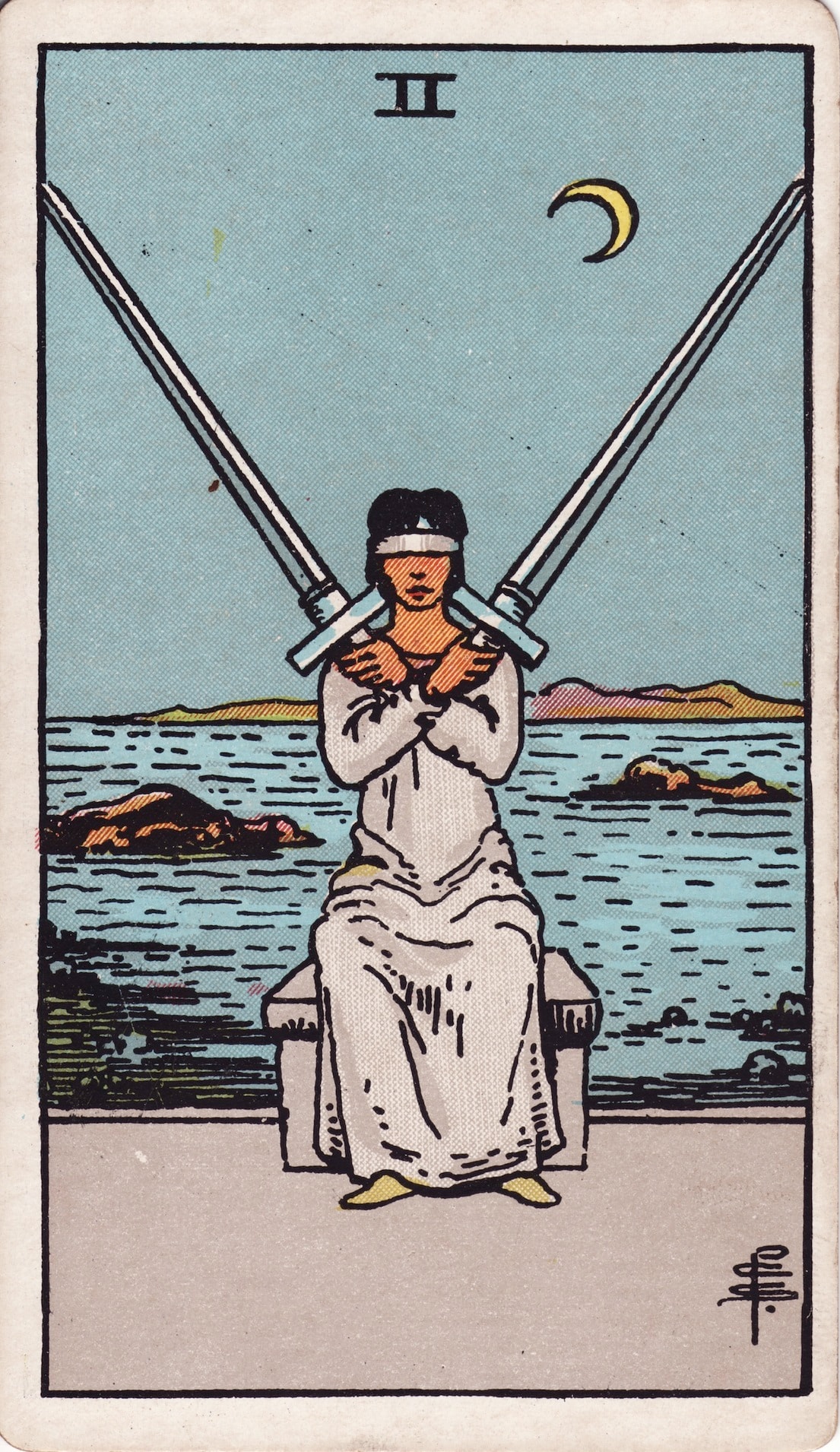
Second in the suit of swords, the Two of Swords was drawn by Pamela Colman Smith in 1909 for the deck Arthur Edward Waite devised. A blindfolded woman in white sits on a stone bench with her back to the sea, arms crossed over her chest, holding two long swords that rise in a V past her shoulders under a crescent moon.
What Waite wrote it means (1910)
- Divinatory meanings
Conformity and the equipoise which it suggests, courage, friendship, concord in a state of arms; another reading gives tenderness, affection, intimacy. The suggestion of harmony and other favourable readings must be considered in a qualified manner, as Swords generally are not symbolical of beneficent forces in human affairs.
- Reversed
Imposture, falsehood, duplicity, disloyalty.
Arthur Edward Waite, The Pictorial Key to the Tarot (London, 1911), p. 250. Read it in the chapter
A hoodwinked female figure balances two swords upon her shoulders.
What's in the picture
- The blindfold. A white band is tied over her eyes. Below it her mouth is closed and her face is still, framed by short dark hair.
- The crossed arms. Her arms cross over her chest, so each hand holds a sword at the opposite shoulder. The arms make an X, and the swords make a V.
- The long blades. The two swords are long and rise in a V. Their blades run up past her head almost to the edges of the card, and their points touch the frame.
- The hilts. The crossguards rest against her shoulders, held tight. Waite wrote that she “balances two swords upon her shoulders”.
- The crescent moon. A yellow crescent moon hangs in the sky at the upper right, its open side turned down and to the left.
- The bench. She sits on a low stone bench, plain and grey, set on a pale stone floor that runs along the front of the card.
- The sea. Behind her lies the sea, drawn in short dashes like ripples. She has her back to it, so whatever moves out there, she can't see it.
- Rocks and far shore. Dark rocks break the water on both sides of her, and a far shore of low hills lies along the horizon, touched with yellow and pink, under a clear sky.
- The white robe. Her long white robe falls in folds to her feet, which show in yellow shoes. She sits very straight and still, facing us.
The card in brief
- In the deck
- Card 52 of 78
- Arcana
- Minor Arcana, Swords
- Number
- Two
- Element (Golden Dawn)
- Air
- Astrology (Golden Dawn)
- Moon in Libra
- Title in Book T
- Lord of Peace Restored
- Drawn by
- Pamela Colman Smith
- Planned by
- Arthur Edward Waite
- Published
- London, William Rider & Son, 1909
- Scan
- Pam-A printing, c. 1910, Wikimedia Commons
In the old books
Book T (1912)
Two crossed swords, like the air dagger of a Z.A.M, each held by a White Radiant Angelic Hand. Upon the point where the two cross is a rose of five petals, emitting white rays. At the top and bottom of the card are two small daggers, supporting respectively the symbol ☽ thus, and ♎︎ representing the Decanate.
Contradictory characters in the same nature, strength through suffering; pleasure after pain. Sacrifice and trouble, yet strength arising therefrom, symbolized by the position of the rose, as though the pain itself had brought forth beauty. Arrangement, peace restored; truce; truth and untruth; sorrow and sympathy. Aid to the weak; arrangement; justice, unselfishness; also a tendency to repetition of affronts on being pardoned; injury when meaning well; given to petitions; also a want of tact, and asking questions of little moment; talkative.
Book T, “A Description of the Cards of the Tarot”, The Equinox I.8 (London, 1912), pp. 181–182. See the source Papus (1892)
Opposition to this commencement. The enmity does not last.
Papus, The Tarot of the Bohemians, tr. A. P. Morton (London, 1892), p. 313. See the source
Before 1909
The older cards and pictures behind this one will be shown here once their licences are checked.
The film
No film for this card yet.
Sources
- Waite: a hoodwinked female figure balances two swords upon her shoulders.Arthur Edward Waite, The Pictorial Key to the Tarot (1910), Part III, Two of Swords
Around this card
Before and after it in the deck
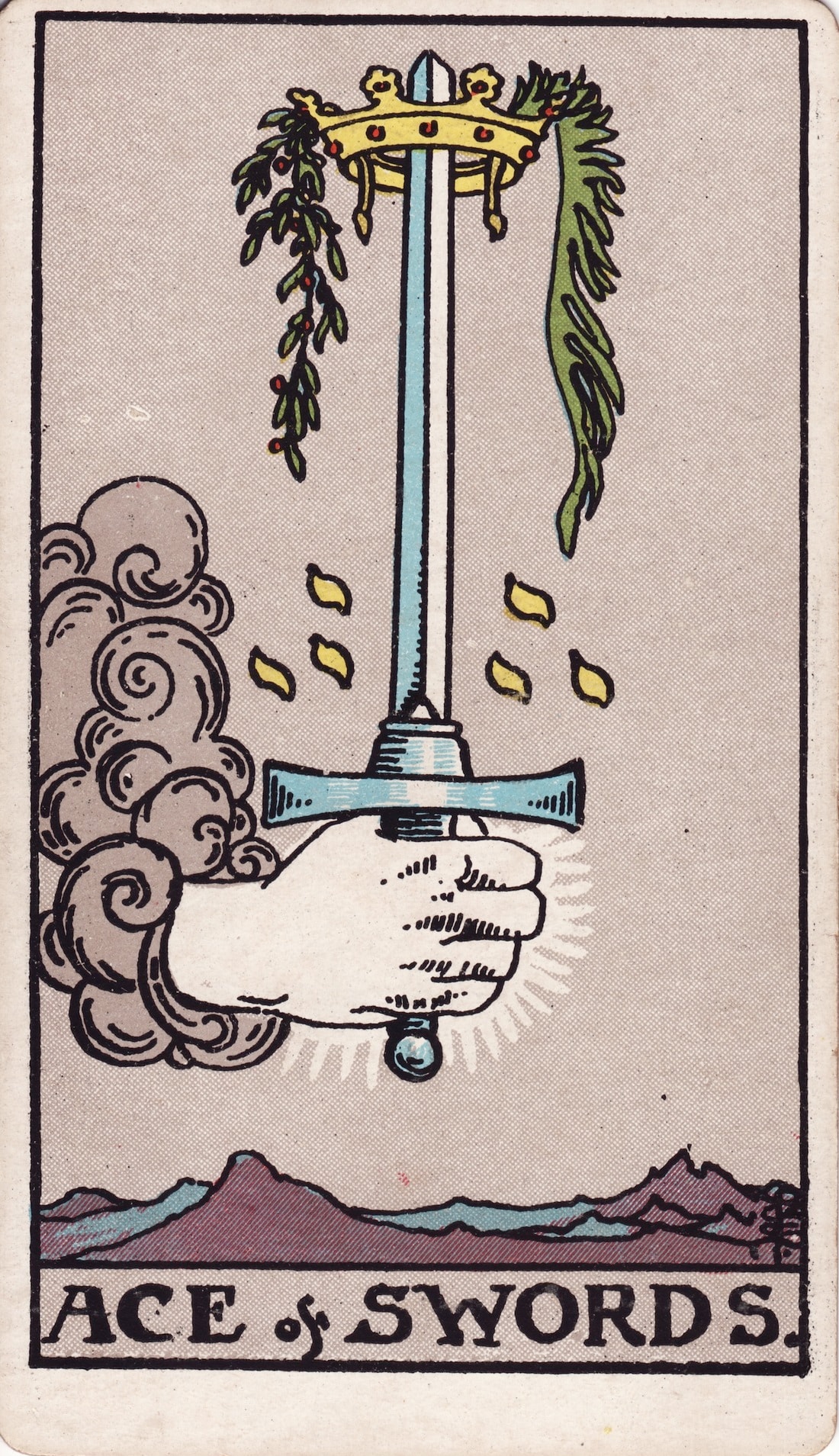
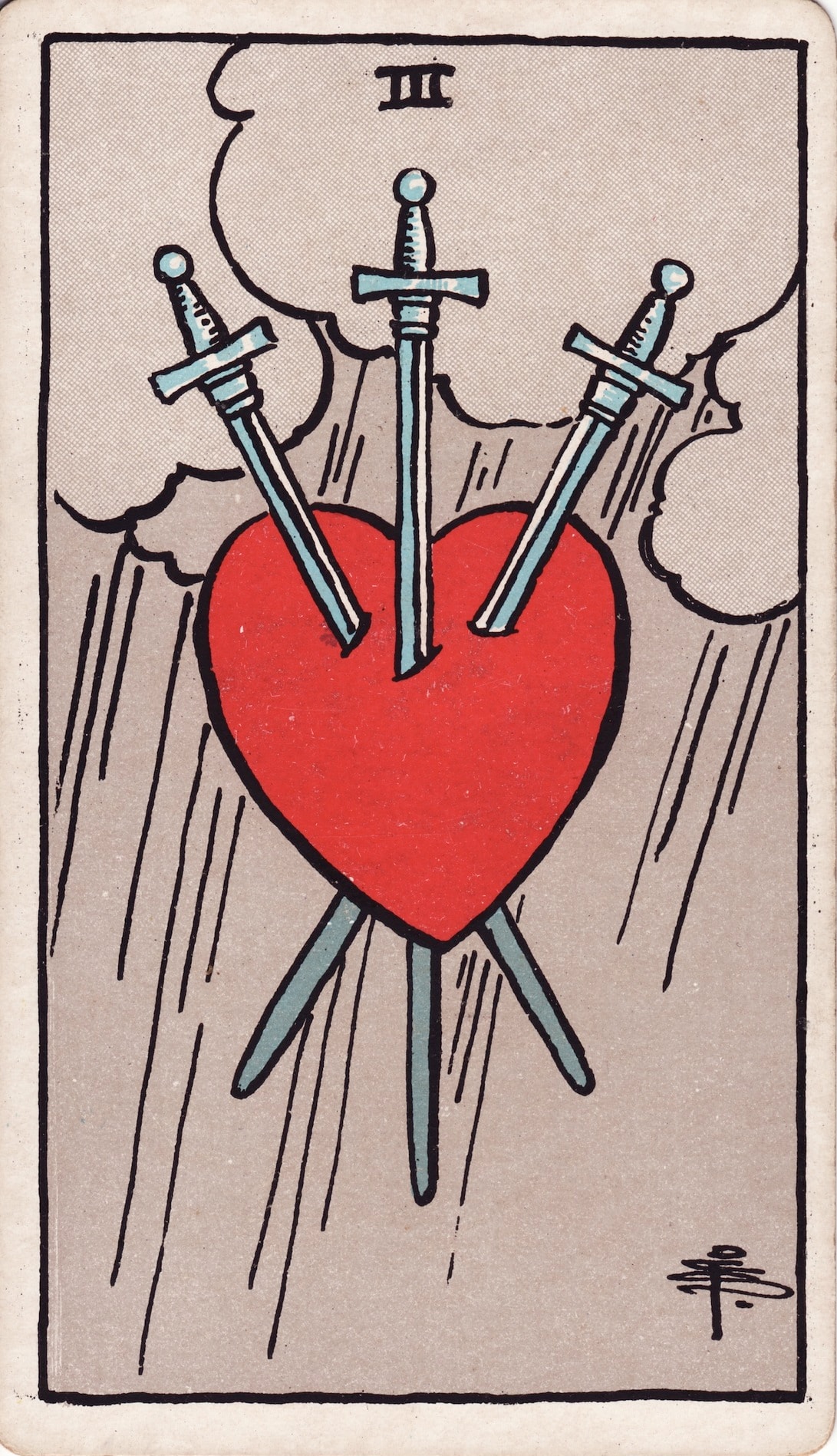
The same number in the other suits
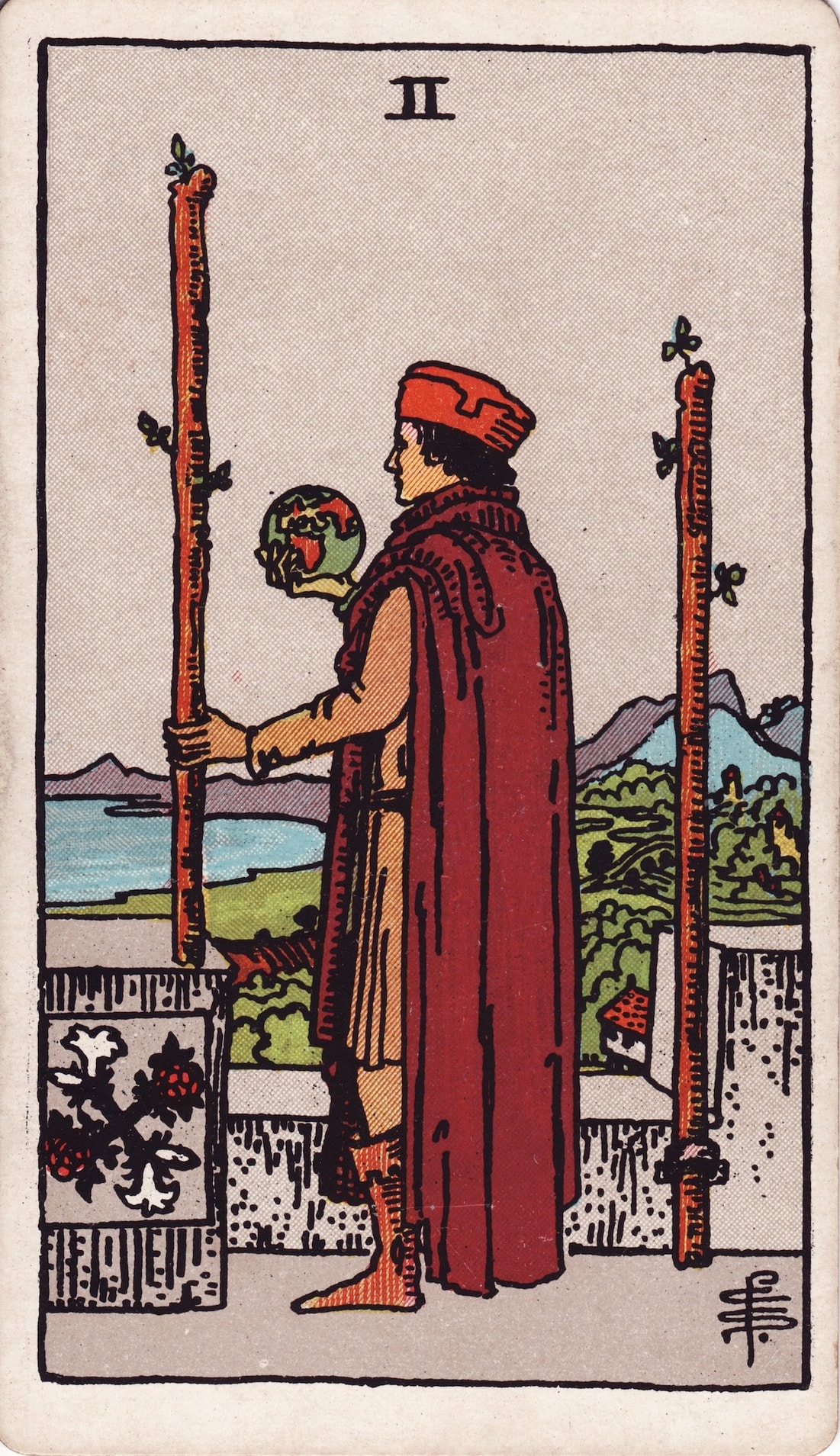

All the cards of the Swords, or the whole deck.