Minor Arcana, the Cups
King of Cups
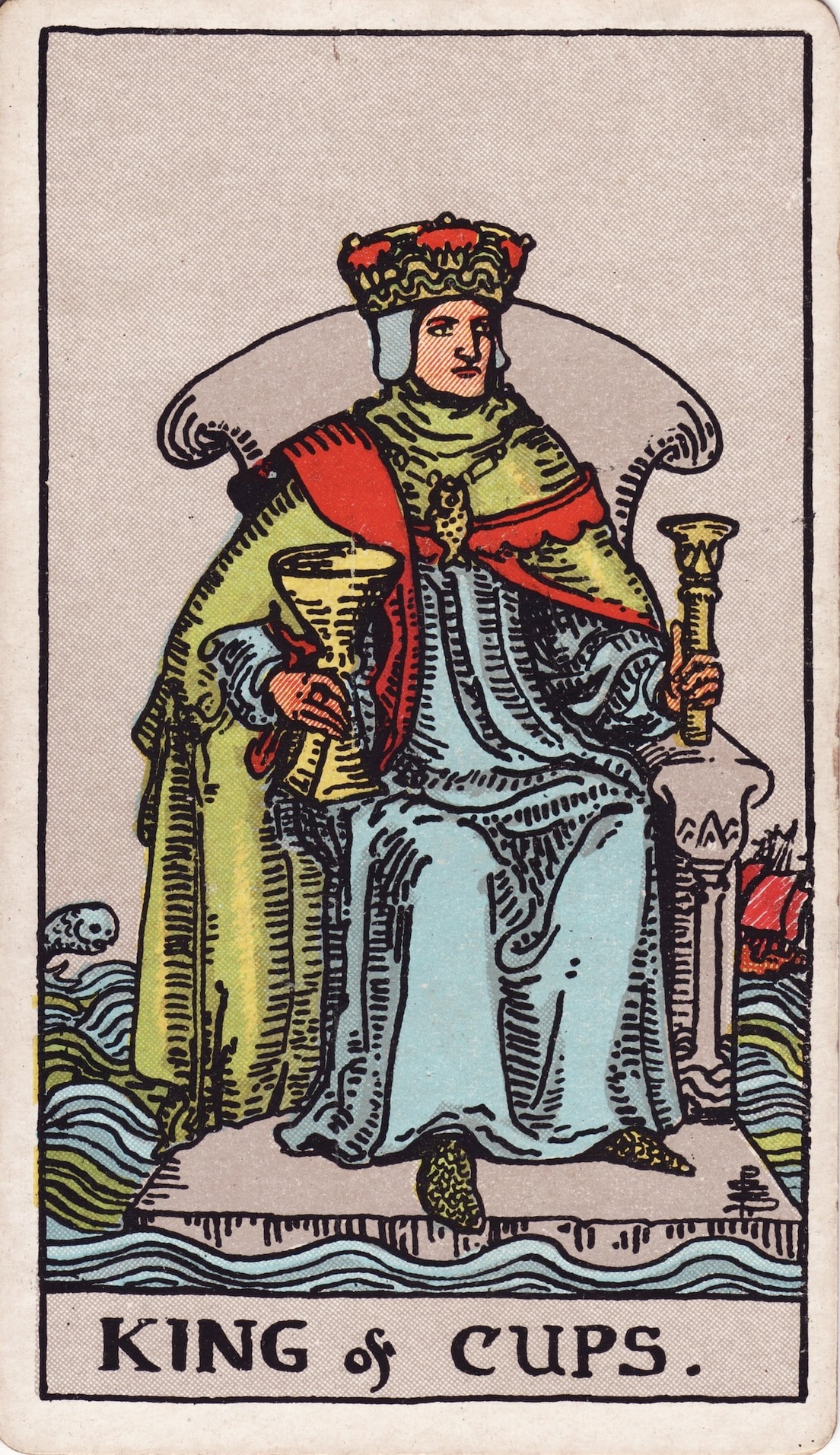
Pamela Colman Smith's King of Cups (1909) sits on a square stone throne that floats alone on the open sea, holding a large gold cup in one hand and a short sceptre in the other. A grey sea creature leaps from the waves at the left of the card, and a ship with a red sail rides the rough water at the right.
What Waite wrote it means (1910)
- Divinatory meanings
Fair man, man of business, law, or divinity; responsible, disposed to oblige the Querent; also equity, art and science, including those who profess science, law and art; creative intelligence.
- Reversed
Dishonest, double-dealing man; roguery, exaction, injustice, vice, scandal, pillage, considerable loss.
Arthur Edward Waite, The Pictorial Key to the Tarot (London, 1911), p. 198. Read it in the chapter
He holds a short sceptre in his left hand and a great cup in his right; his throne is set upon the sea; on one side a ship is riding and on the other a dolphin is leaping. The implicit is that the Sign of the Cup naturally refers to water, which appears in all the court cards.
What's in the picture
- The cup. He holds a large gold cup upright by its stem, at the height of his waist. Waite calls it "a great cup".
- The sceptre. In his other hand is a short gold sceptre, shaped almost like a narrow cup on a handle, held upright beside the arm of the throne.
- The fish pendant. A small gold fish hangs on a chain at his chest, head up, just below the red collar.
- The crown and cap. His crown is red and gold. Under it a white cap covers his ears, the "cap of maintenance" that Waite, writing of the King of Wands, gives to all four kings.
- The leaping creature. On the left, a grey sea creature arches out of the waves with its head up. Waite calls it a dolphin; it looks more like a big fish.
- The ship. On the right, a ship with a red sail rides the waves just beside the throne, half hidden behind its arm.
- The floating throne. The throne is a block of grey stone with no land anywhere. Waves in blue, green and yellow break all around its base.
- The robes. Over a long blue robe he wears a yellow-green cloak with a red collar. A pointed shoe with a scale pattern pokes out at the hem.
- The scrolled back. The back of the throne ends in two large curling scrolls, one at each side of his shoulders, grey like the stone.
The card in brief
- In the deck
- Card 50 of 78
- Arcana
- Minor Arcana, Cups
- Number
- King
- Element (Golden Dawn)
- Water
- Title in Book T
- The Prince of the Chariot of the Waters
- Drawn by
- Pamela Colman Smith
- Planned by
- Arthur Edward Waite
- Published
- London, William Rider & Son, 1909
- Scan
- Pam-A printing, c. 1910, Wikimedia Commons
In the old books
Book T (1912)
A Winged Kingly Figure with winged crown seated in a chariot drawn by an eagle. On the wheel is the symbol of a scorpion. The eagle is borne as a crest on his crown, cuirass and buskins. General attire like King of Wands. Beneath his chariot is the calm and stagnant water of a lake. His armour resembles feathers more than scales. He holds in one hand a lotus, and in the other a cup, charged with the sigil of his scale. A serpent issues from the cup, and has its head tending down to the waters of the lake. He is subtle, violent, crafty and artistic; a fierce nature with calm exterior. Powerful for good or evil, but more attracted by the evil if allied with apparent Power or Wisdom.
If ill dignified, he is intensely evil and merciless.
Book T, “A Description of the Cards of the Tarot”, The Equinox I.8 (London, 1912), p. 164. See the source Papus (1892)
A fair man, a friend. This card also represents a barrister, judge, or ecclesiastic. It symbolizes a Bachelor.
Papus, The Tarot of the Bohemians, tr. A. P. Morton (London, 1892), p. 312. See the source
Before 1909
The older cards and pictures behind this one will be shown here once their licences are checked.
The film
No film for this card yet.
Around this card
Before and after it in the deck
The same number in the other suits

All the cards of the Cups, or the whole deck.