Minor Arcana, the Pentacles
King of Pentacles
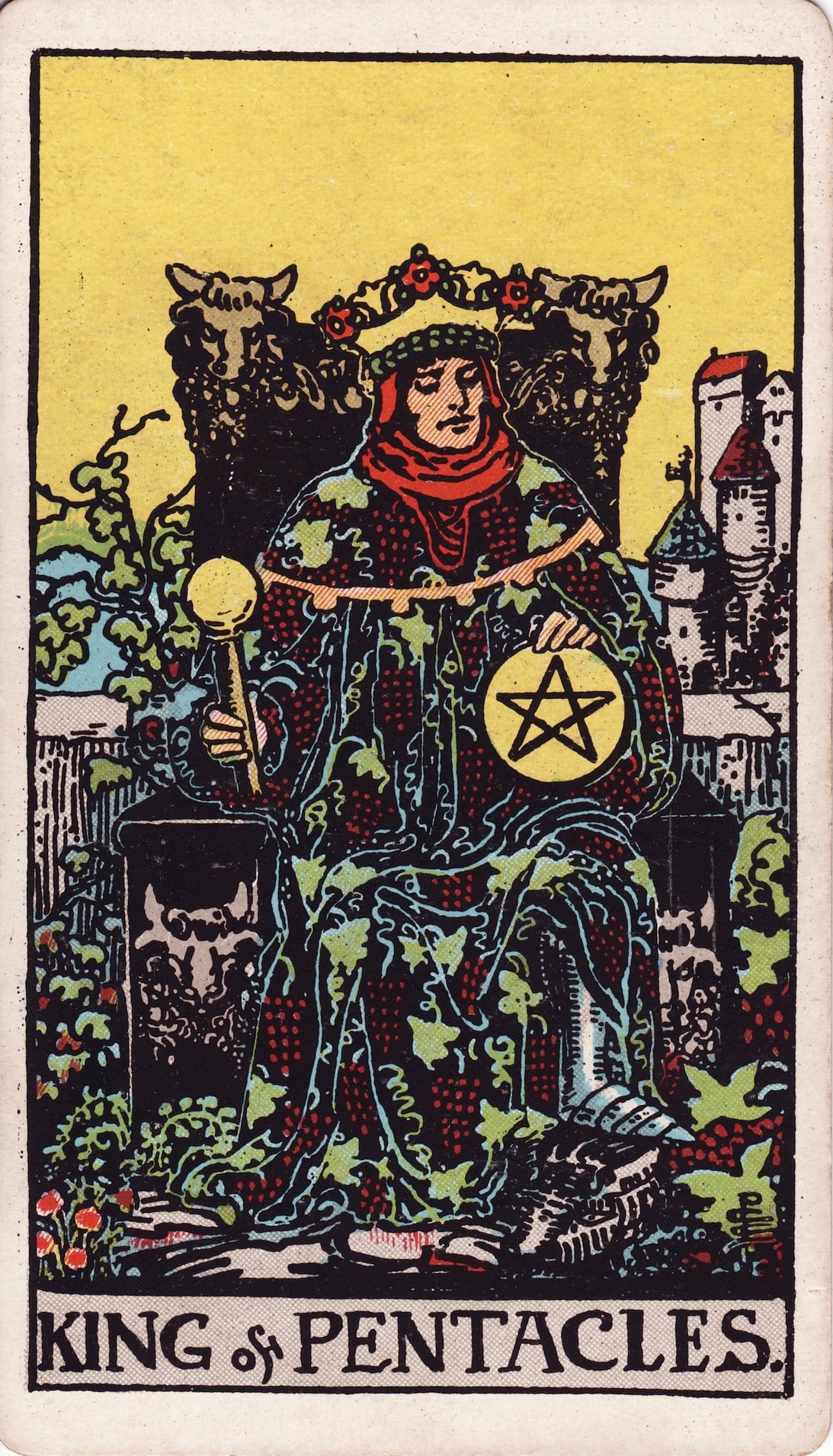
The King of Pentacles is the king of the suit of pentacles, drawn by Pamela Colman Smith in 1909 for A. E. Waite's deck. He sits on a dark throne carved with bulls' heads, in a robe covered with grapes and vine leaves, a sceptre in one hand and a gold coin under the other, with a castle behind the wall.
What Waite wrote it means (1910)
- Divinatory meanings
Valour, realizing intelligence, business and normal intellectual aptitude, sometimes mathematical gifts and attainments of this kind; success in these paths.
- Reversed
Vice, weakness, ugliness, perversity, corruption, peril.
Arthur Edward Waite, The Pictorial Key to the Tarot (London, 1911), p. 254. Read it in the chapter
The figure calls for no special description; the face is rather dark, suggesting also courage, but somewhat lethargic in tendency. The bull's head should be noted as a recurrent symbol on the throne. The sign of this suit is represented throughout as engraved or blazoned with the pentagram, typifying the correspondence of the four elements in human nature and that by which they may be governed. In many old Tarot packs this suit stood for current coin, money, deniers. I have not invented the substitution of pentacles and I have no special cause to sustain in respect of the alternative. But the consensus of divinatory meanings is on the side of some change, because the cards do not happen to deal especially with questions of money.
What's in the picture
- The bulls' heads. Two bulls' heads with short, curved horns crown the back of the throne, one at each corner. Waite asked readers to note “the bull's head” as “a recurrent symbol on the throne”.
- More bulls. More bulls' heads are carved low on the sides of the throne, beside his knees, so the bull appears at least four times.
- The crown and flowers. On his head is a green crown or wreath, and above it an arch of red flowers and leaves runs across the throne.
- His face. His eyes are lowered, nearly closed, and his face is calm inside a red hood that covers his neck.
- The sceptre. In his right hand he holds a gold sceptre topped with a ball, upright beside his shoulder.
- The coin. His left hand rests on a large gold coin that stands upright on his knee, its star drawn in thin black lines.
- The robe of vines. His robe is dark and covered all over with vine leaves and bunches of grapes, so that he almost merges with the garden around him.
- The armoured foot. Under the hem of the robe, one foot shows steel plates, as if he wore armour underneath.
- Wall and castle. Behind the throne a grey wall runs across the card. On the right a castle rises with towers and red roofs, and the sky above is plain yellow. Red flowers grow in the lower left corner.
The card in brief
- In the deck
- Card 78 of 78
- Arcana
- Minor Arcana, Pentacles
- Number
- King
- Element (Golden Dawn)
- Earth
- Title in Book T
- The Prince of the Chariot of Earth
- Drawn by
- Pamela Colman Smith
- Planned by
- Arthur Edward Waite
- Published
- London, William Rider & Son, 1909
- Scan
- Pam-A printing, c. 1910, Wikimedia Commons
In the old books
Book T (1912)
A Winged Kingly Figure seated in a chariot drawn by a bull. He bears as a crest the symbol of the head of the winged bull. Beneath the chariot is land, with many flowers. In one hand he bears an orb of gold held downwards, and in the other a sceptre surmounted by an orb and cross.
Increase of matter. Increases good or evil, solidifies; practically applies things. Steady; reliable.
If ill dignified he is selfish, animal and material: stupid. In either case slow to anger, but furious if roused.
Book T, “A Description of the Cards of the Tarot”, The Equinox I.8 (London, 1912), p. 170. See the source Papus (1892)
A fair man, inimical or indifferent.
Papus, The Tarot of the Bohemians, tr. A. P. Morton (London, 1892), p. 314. See the source
Before 1909
The older cards and pictures behind this one will be shown here once their licences are checked.
The film
No film for this card yet.
Sources
- Waite: the bull's head should be noted as a recurrent symbol on the throne.Arthur Edward Waite, The Pictorial Key to the Tarot (1910), Part III, King of Pentacles
Around this card
Before and after it in the deck
The same number in the other suits

All the cards of the Pentacles, or the whole deck.