Minor Arcana, the Wands
Queen of Wands
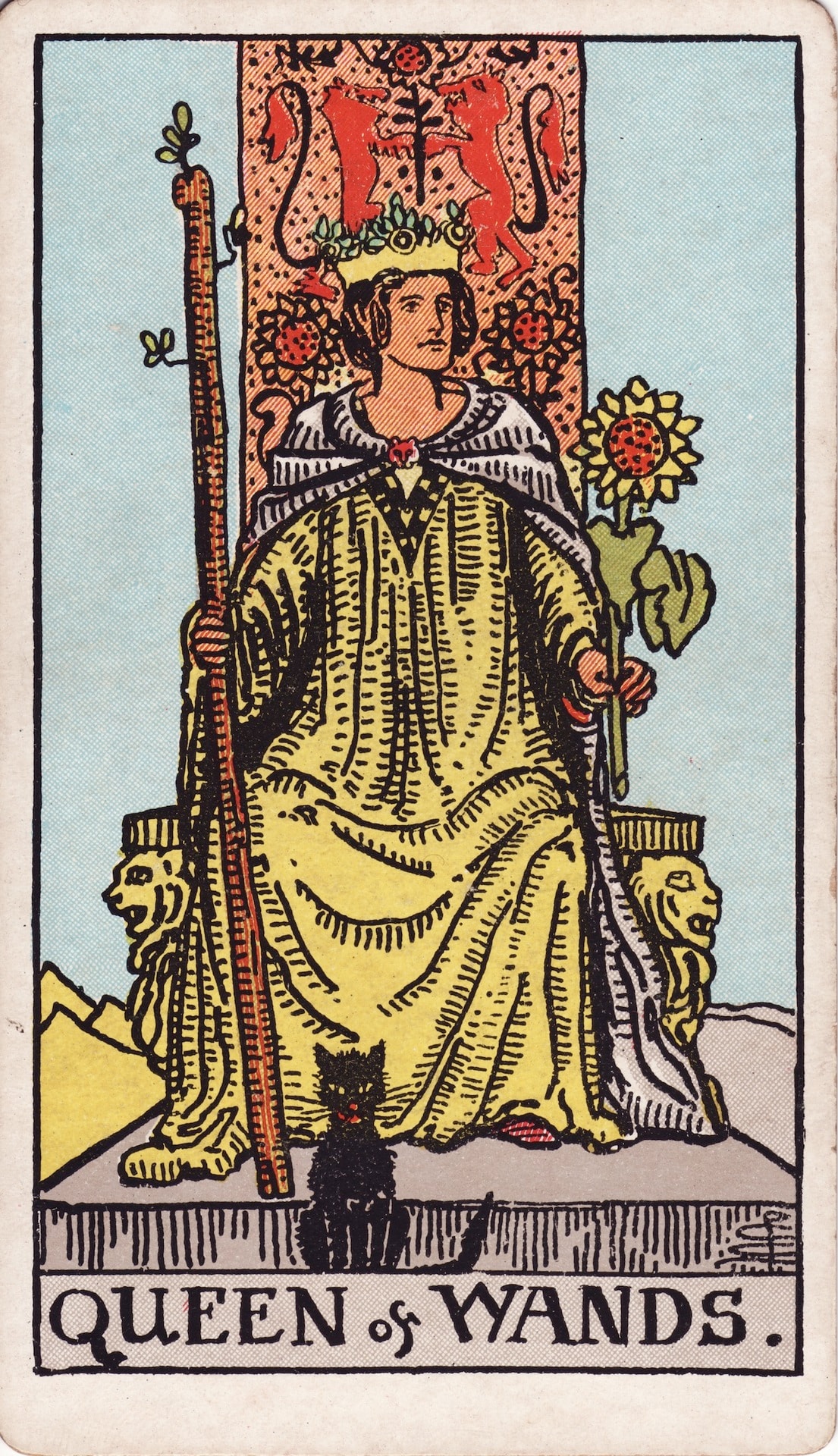
The Queen of Wands sits on a throne carved with lions, a leafing wand in one hand and a sunflower in the other. Pamela Colman Smith, who drew the deck in 1909, put a small black cat at her feet that neither Waite's text nor the Golden Dawn's mentions.
What Waite wrote it means (1910)
- Divinatory meanings
A dark woman, countrywoman, friendly, chaste, loving, honourable. If the card beside her signifies a man, she is well disposed towards him; if a woman, she is interested in the Querent. Also, love of money, or a certain success in business.
- Reversed
Good, economical, obliging, serviceable. Signifies also—but in certain positions and in the neighbourhood of other cards tending in such directions—opposition, jealousy, even deceit and infidelity.
Arthur Edward Waite, The Pictorial Key to the Tarot (London, 1911), p. 172. Read it in the chapter
The Wands throughout this suit are always in leaf, as it is a suit of life and animation. Emotionally and otherwise, the Queen's personality corresponds to that of the King, but is more magnetic.
What's in the picture
- The wand. A tall wooden wand stands on the ground at her right side, taller than she is. Small sprigs of green leaves grow from it, and she grips it near the middle.
- The sunflower. In her other hand she holds a sunflower on a long, leafy stem. Its face is turned out toward you.
- The crown. Her gold crown is topped with green leaves and small round flowers, as if it were growing too.
- The red lions. At the top of the throne's tall back, two red lions stand on their hind legs and face each other.
- The flowers behind her head. Two more sunflowers, with red centres, bloom on the throne back, one on each side of her head.
- The lion heads. Each arm of the throne ends in a lion's head, seen from the side, its mouth open.
- The robe and cloak. She sits facing you in a long yellow robe. A pale cloak hangs from her shoulders, held at the neck by a red clasp.
- The pyramids. Behind the throne on the left rise yellow peaks shaped like pyramids. Pale hills show on the right.
- The black cat. A small black cat with yellow eyes and a red mouth sits at her feet, at the front of the stone step, facing straight out. Its tail curls along the step.
- Smith's monogram. Her small knot-like mark is drawn on the front of the step, in the lower right corner.
The card in brief
- In the deck
- Card 35 of 78
- Arcana
- Minor Arcana, Wands
- Number
- Queen
- Element (Golden Dawn)
- Fire
- Title in Book T
- The Queen of the Thrones of Flame
- Drawn by
- Pamela Colman Smith
- Planned by
- Arthur Edward Waite
- Published
- London, William Rider & Son, 1909
- Scan
- Pam-A printing, c. 1910, Wikimedia Commons
In the old books
Book T (1912)
A Crowned Queen with long red-golden hair, seated upon a Throne, with steady flames beneath. She wears a corslet and buskins of scale-mail, which latter her robe discloses. Her arms are almost bare. On cuirass and buskins are leopard's heads winged, and the same symbol surmounteth her crown. At her side is a couchant leopard on which her hands rest. She bears a long wand with a very heavy conical head. The face is beautiful and resolute.
Adaptability, steady force applied to an object, steady rule, great attractive power, power of command, yet liked notwithstanding. Kind and generous when not opposed.
If ill dignified, obstinate, revengeful, domineering, tyrannical, and apt to turn against another without a cause.
Book T, “A Description of the Cards of the Tarot”, The Equinox I.8 (London, 1912), p. 160. See the source Papus (1892)
A dark woman, a friend. Represents a serious woman, a very good counsellor, often the mother of a family.
Papus, The Tarot of the Bohemians, tr. A. P. Morton (London, 1892), p. 311. See the source
Before 1909
The older cards and pictures behind this one will be shown here once their licences are checked.
The queen and her black cat
Start with her hands. In one, she holds a wand with leaves on it. In the other, she holds a sunflower. Now let your eyes move around the card. Lion heads end the arms of her throne. Two red lions stand on its tall back, and more sunflowers bloom behind her head. Almost everything around her points to fire and the sun.
Then look down. A small black cat sits at her feet, looking at you. Waite never mentions the cat in his guide to the deck. The Golden Dawn gave this queen a leopard. The cat comes from the artist, Pamela Colman Smith. You could try giving the cat as much attention as the queen.
The image
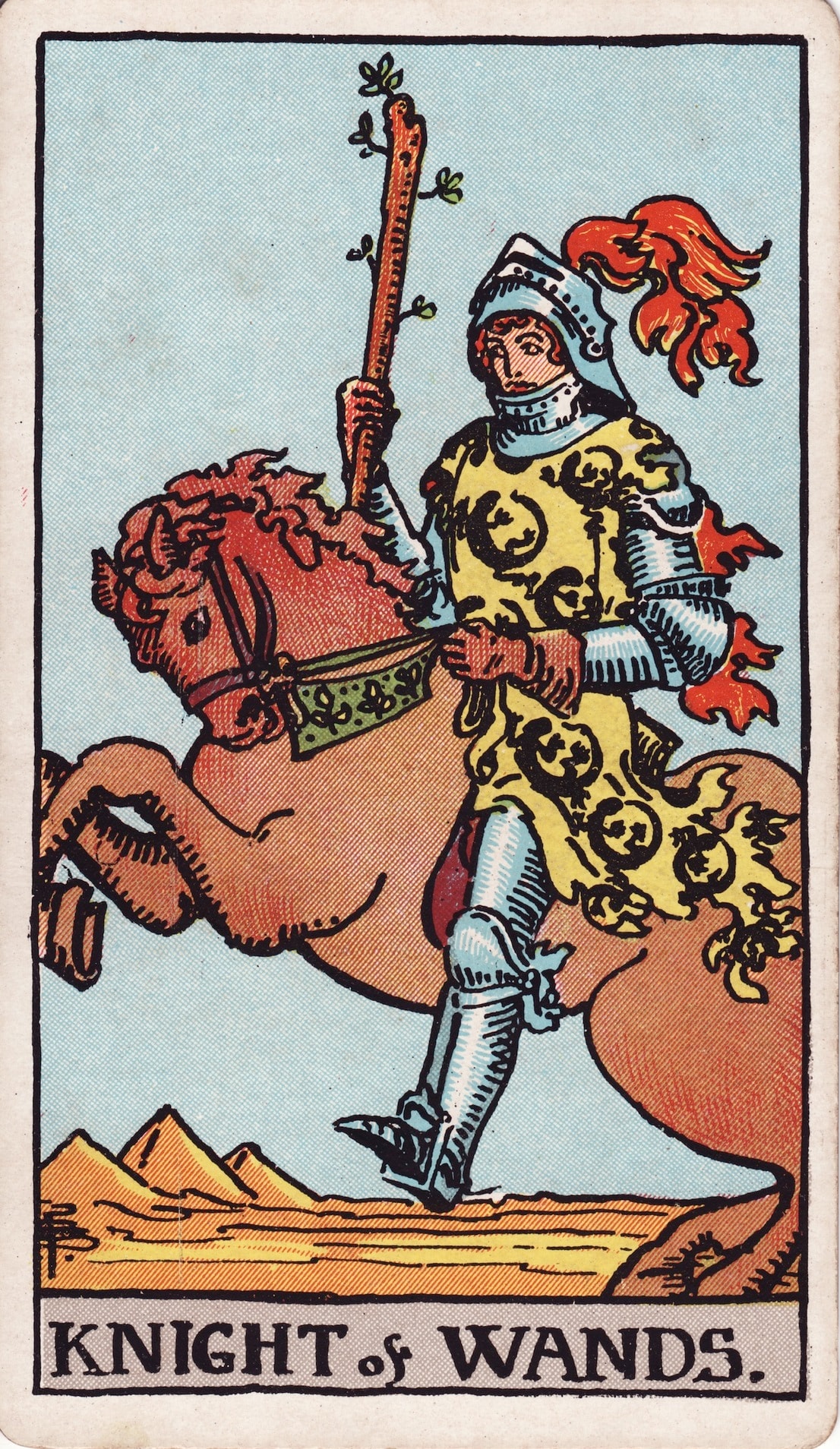
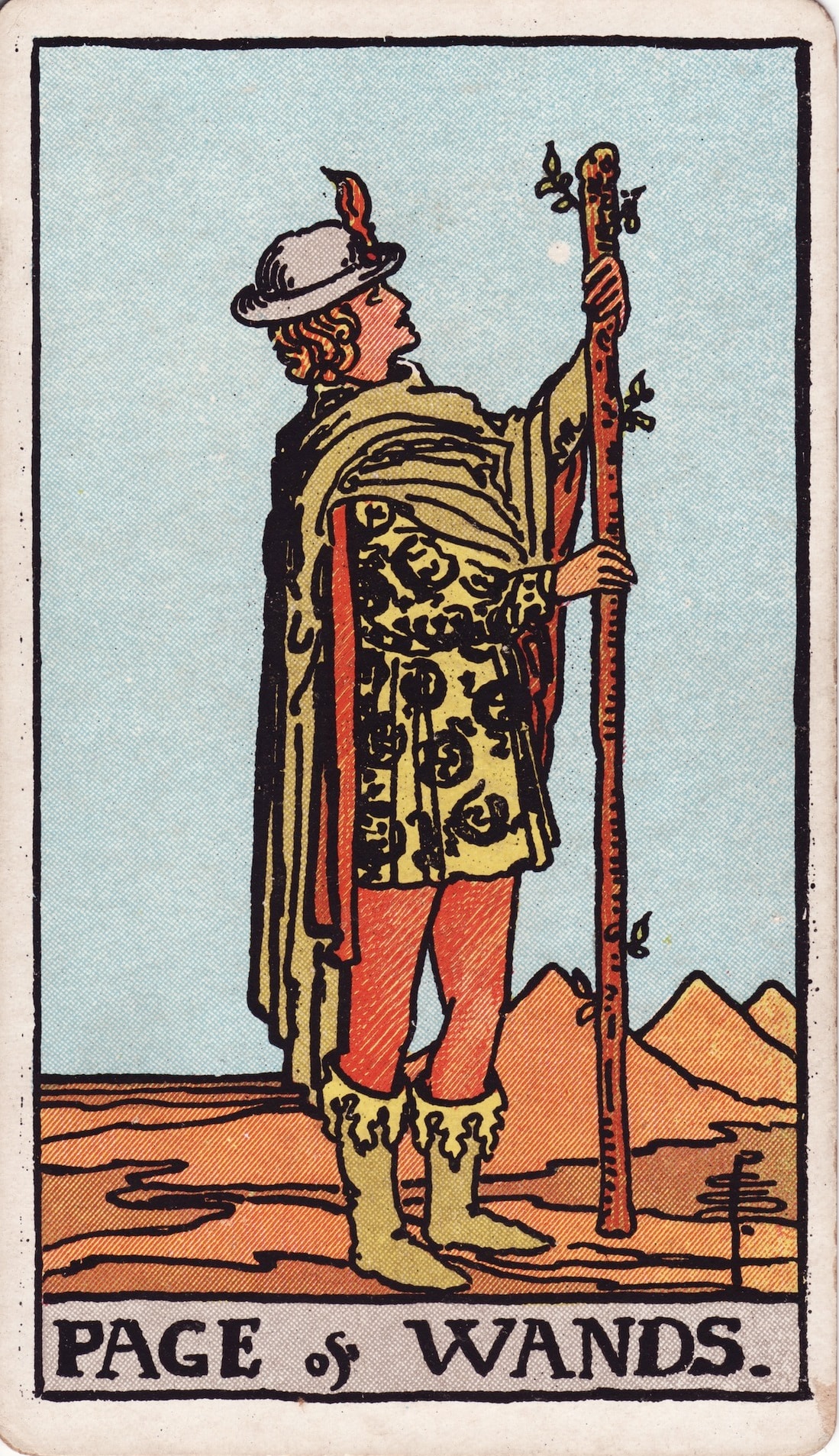
She sits facing you, in a yellow robe and a pale cloak. Her crown has green leaves in it, like the wand. The wand stands on the ground beside her. It is taller than she is, and small sprigs grow along it. The sunflower stands up by her shoulder, its face turned out toward you. Behind the throne the sky is pale blue. On the left, yellow peaks rise like pyramids. Waite's Knight of Wands is "passing mounds or pyramids", and the Page stands among the same shapes on his own card.
The sunflower has an old story behind it. The Roman poet Ovid tells of Clytie, a young woman who loved the Sun god. He left her. For nine days she sat on the bare ground, turning her face to follow him across the sky. In the end she took root and became a flower that still turns toward the sun. Ovid's flower was small, "very like a violet". Later tellers made it a sunflower, and painters followed. Even Henry Riley, who translated Ovid in 1851, did both. In a footnote he said the flower could not be the sunflower. In his notes on the story, he called it a sunflower anyway.
In 1688 the painter Charles de La Fosse showed her weeping on a rock, in Clytie Changed into a Sunflower, which still hangs at the Grand Trianon in Versailles. The Sun drives his chariot away across the sky, and sunflowers already grow beside her.
So the queen may be holding Clytie's flower, the one that keeps its face on the sun. You could look at where the sunflower faces, and then at where the queen is looking.
You could also set her beside the King of Wands. He sits in profile, looking away. On the floor at his feet is a tiny black lizard, the salamander of his suit. She faces forward, and at her feet is the cat. So each of them has a small dark animal down by the step.
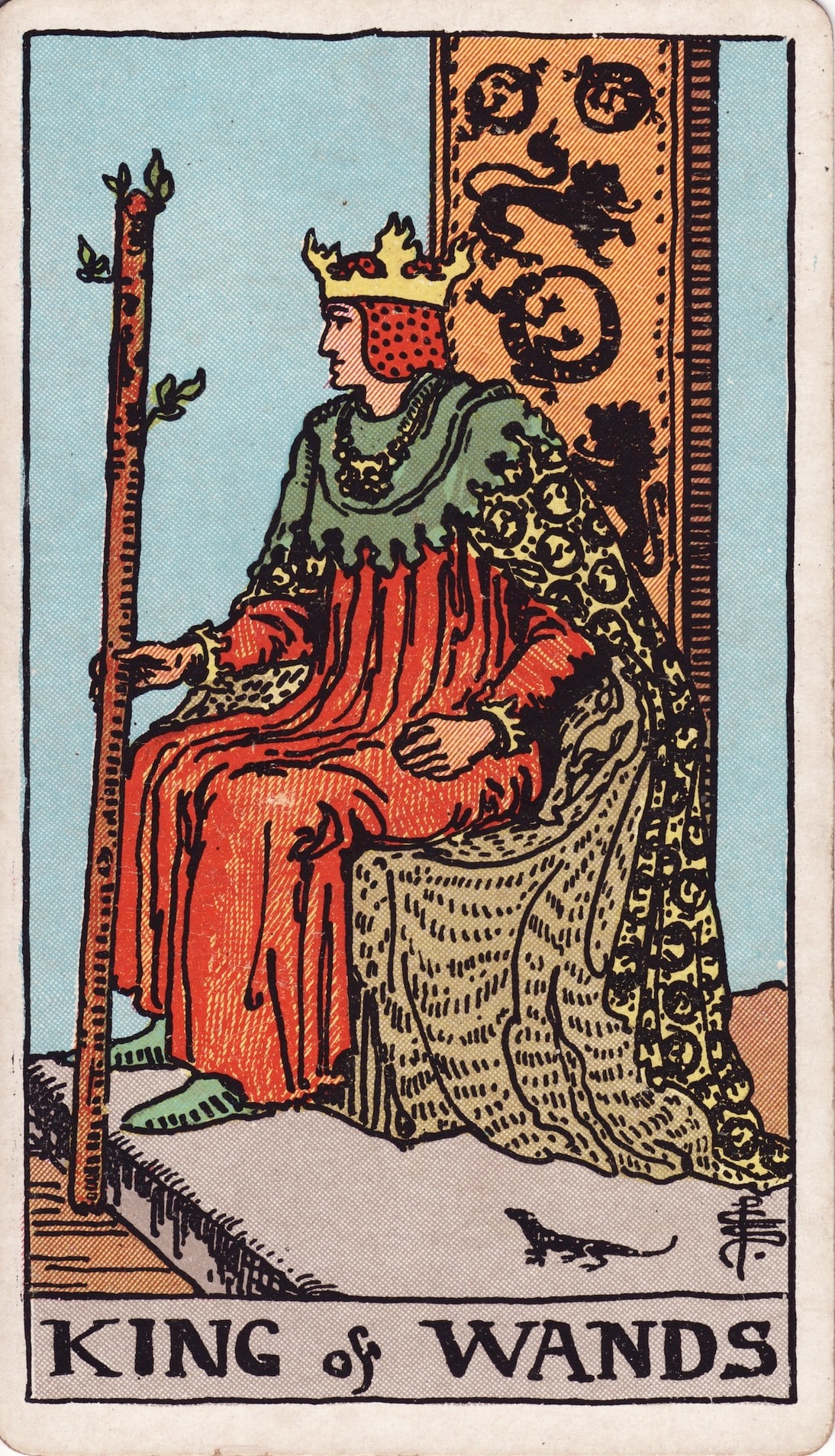
The King, the Knight and the Page wear clothes covered in salamanders. Her robe is plain. She has the lions and the sunflowers instead.
Waite wrote very little about her. He said the wands are always in leaf. He also said her character is like the King's, "but is more magnetic".
Across traditions
In Book T the Golden Dawn describes a very different Queen of Wands. She has red-gold hair and sits above steady flames. Winged leopard heads decorate her armour and her crown. Her hands rest on a leopard lying at her side. Smith kept the cat family but changed almost everything else. The animal shrinks and turns black. It leaves her hands and sits on its own, in front of her. You could read that as a wild animal brought indoors, like fire tamed for the home. You could also read it the other way round. A house cat never quite belongs to anyone, and this one looks at you as if it has its own opinion.
Book T marks her with two alchemical signs, water of fire. In the Golden Dawn's system, each suit has an element, and each queen is the watery side of her suit. Water takes things in and holds them. So she is fire that has been taken in and held. Book T gives her "steady force applied to an object" and "great attractive power". It says all four queens have a force that is "steady and unshaken".
The Golden Dawn also gave each court card a stretch of the zodiac. Hers runs from the last decan of Pisces, a water sign, to the twentieth degree of Aries, a fire sign. In dates, that is roughly 10 March to 10 April. It crosses the March equinox, where the zodiac starts again at Aries. So she sits right where water turns into fire. Late in his life Carl Jung wrote a whole book about the old alchemists and their dream of joining opposites like these.
Now the lions. In Book T, the three fire signs all belong to the Wands. Leo, the lion, is one of them. The Golden Dawn also linked Leo to the card Strength, which shows a woman with a lion. Waite moved Strength to number VIII in his deck, "for reasons which satisfy myself". You could lay Strength beside this queen.
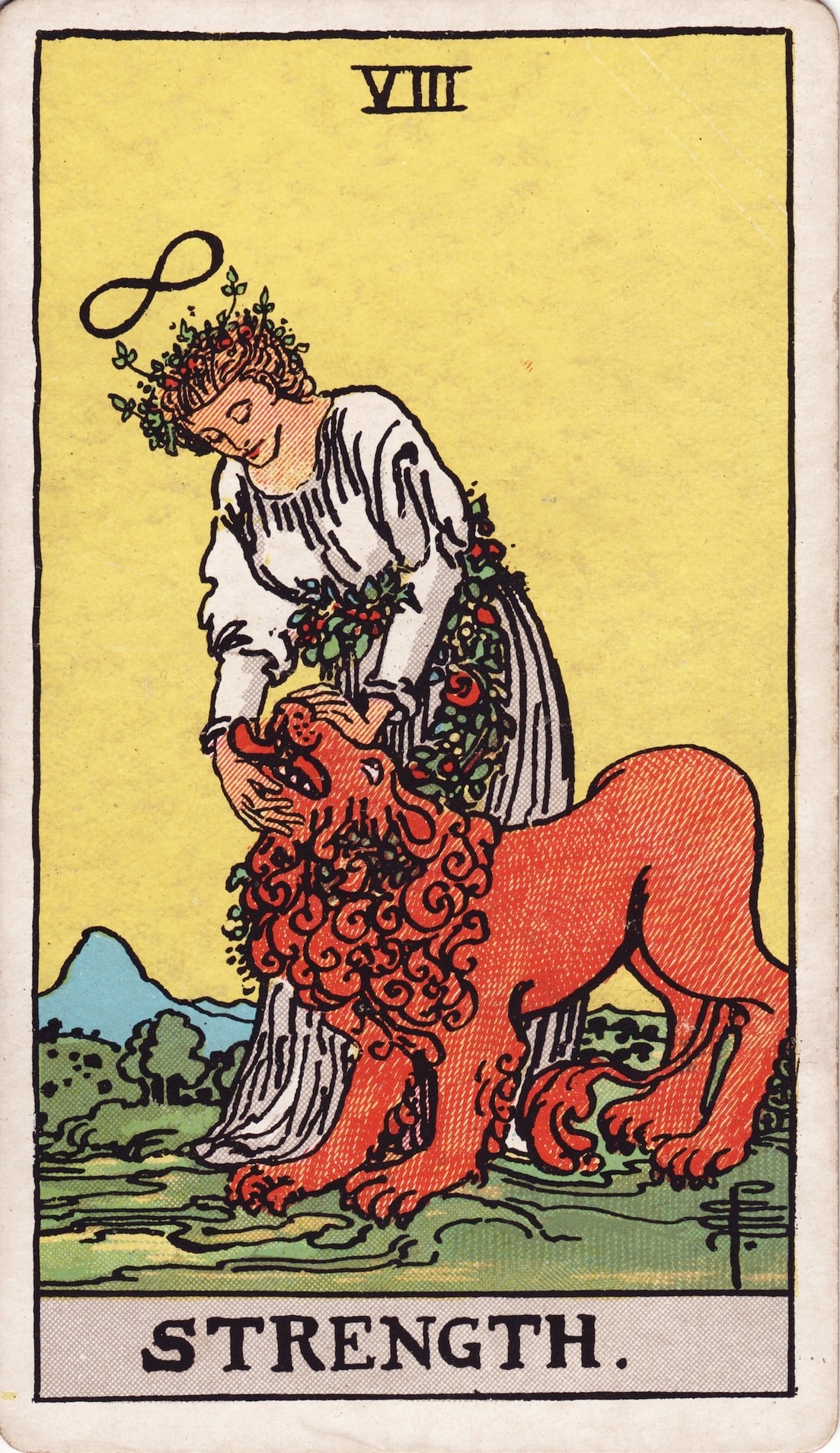
On one card, a woman closes a lion's jaws with her bare hands. On the other, the lions have become part of the chair she sits on. What might have happened in between?
Meeting her
Here is an experiment you could play with. Imagine the queen as a person with a mind of her own, sitting somewhere in your day. She has a cat, some lions and a stick that keeps sprouting. What does she make of you? What might she say about how you used your energy this week? If that doesn't lead anywhere, let it go and try something else.
You could try the same with the cat. It is small and black against all that yellow. It sits lower than anyone else on the card, so it sees the room from the floor. It looks straight out of the picture, at whoever is looking in. What does it see?
Try this
Sit like her for one minute. Put both feet on the floor. Hold something that grows in one hand, and something that turns toward light in the other. A pen and a cup are enough. Notice what your body does when it takes up that much space and holds still. Then look at the card again from the cat's height, from below the step. See what changes.
Questions to sit with
- What is the cat watching? What is the queen watching?
- Is she about to stand up, or has she only just sat down?
- Where in your life has something wild come indoors? Does it still belong to you?
- What in you turns toward the sun without being told to?
- If her fire is steady, what keeps it burning?
The film
No film for this card yet.
Sources
- Waite planned the deck; Smith drew and coloured the cards.Arthur Edward Waite, The Pictorial Key to the Tarot (London, 1911), Part II, The Tarot and Secret Tradition, p. 67
- Waite on the Queen: the wands always in leaf, her personality like the King's but more magnetic; no cat and no sunflower.Arthur Edward Waite, The Pictorial Key to the Tarot (London, 1911), Part III, The Suit of Wands, Queen, p. 172
- The Knight of Wands passing mounds or pyramids.Arthur Edward Waite, The Pictorial Key to the Tarot (London, 1911), Part III, The Suit of Wands, Knight, p. 174
- Waite moved Strength to VIII "for reasons which satisfy myself"; on his card a woman closes the jaws of a lion.Arthur Edward Waite, The Pictorial Key to the Tarot (London, 1911), Part II, Strength, or Fortitude, p. 100
- Book T's Queen of Wands: red-golden hair, steady flames, winged leopards' heads, a leopard under her hands; Water of Fire; steady force and great attractive power; the four queens steady and unshaken; her span from the last decan of Pisces to 20° Aries; the fire signs given to the Wands; Leo given to Fortitude.Book T, The Equinox I.8 (1912), the Queen of the Thrones of Flame, the four Queens, the table of the decans and the table of the Keys
- The sun enters Aries at the March equinox.Webster's Revised Unabridged Dictionary (1913), Aries
- Clytie watches the Sun for nine days, takes root and becomes a flower very like a violet that turns toward the Sun; Riley's footnote and his explanation of the fable.Ovid, Metamorphoses IV.256–270, translated by Henry T. Riley (London, 1851), with his footnote 42 and explanation of the fables of Book IV
- La Fosse's Clytie weeping on a rock, the Sun's chariot driving away, sunflowers beside her.Charles de La Fosse, Clytie Changed into a Sunflower (1688), Grand Trianon, Château de Versailles, MV 7256; Wikimedia Commons
- Jung's late book on the alchemists and the joining of opposites.C. G. Jung, Mysterium Coniunctionis (1955–1956), Collected Works 14
Around this card
Before and after it in the deck
The same number in the other suits
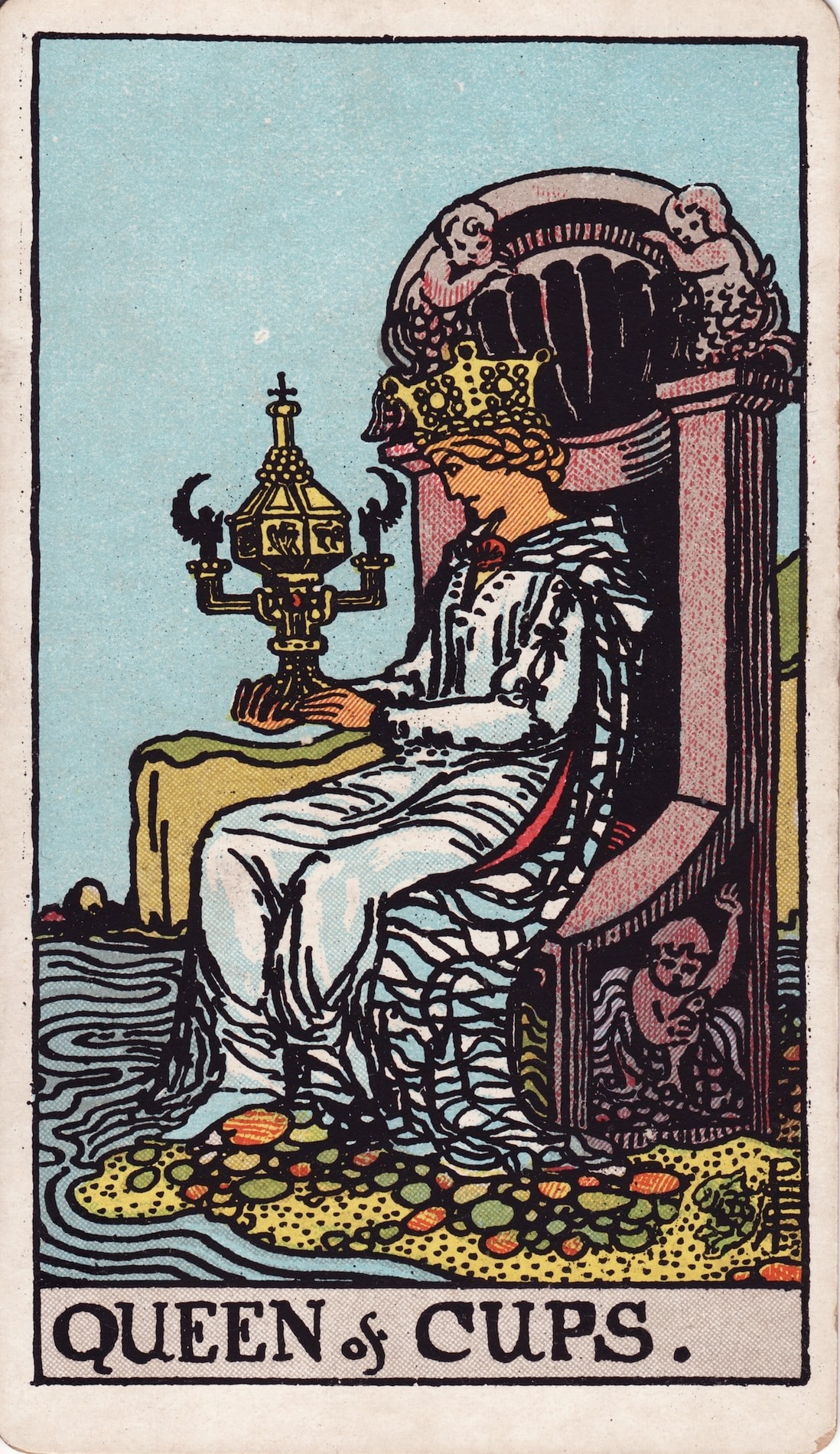
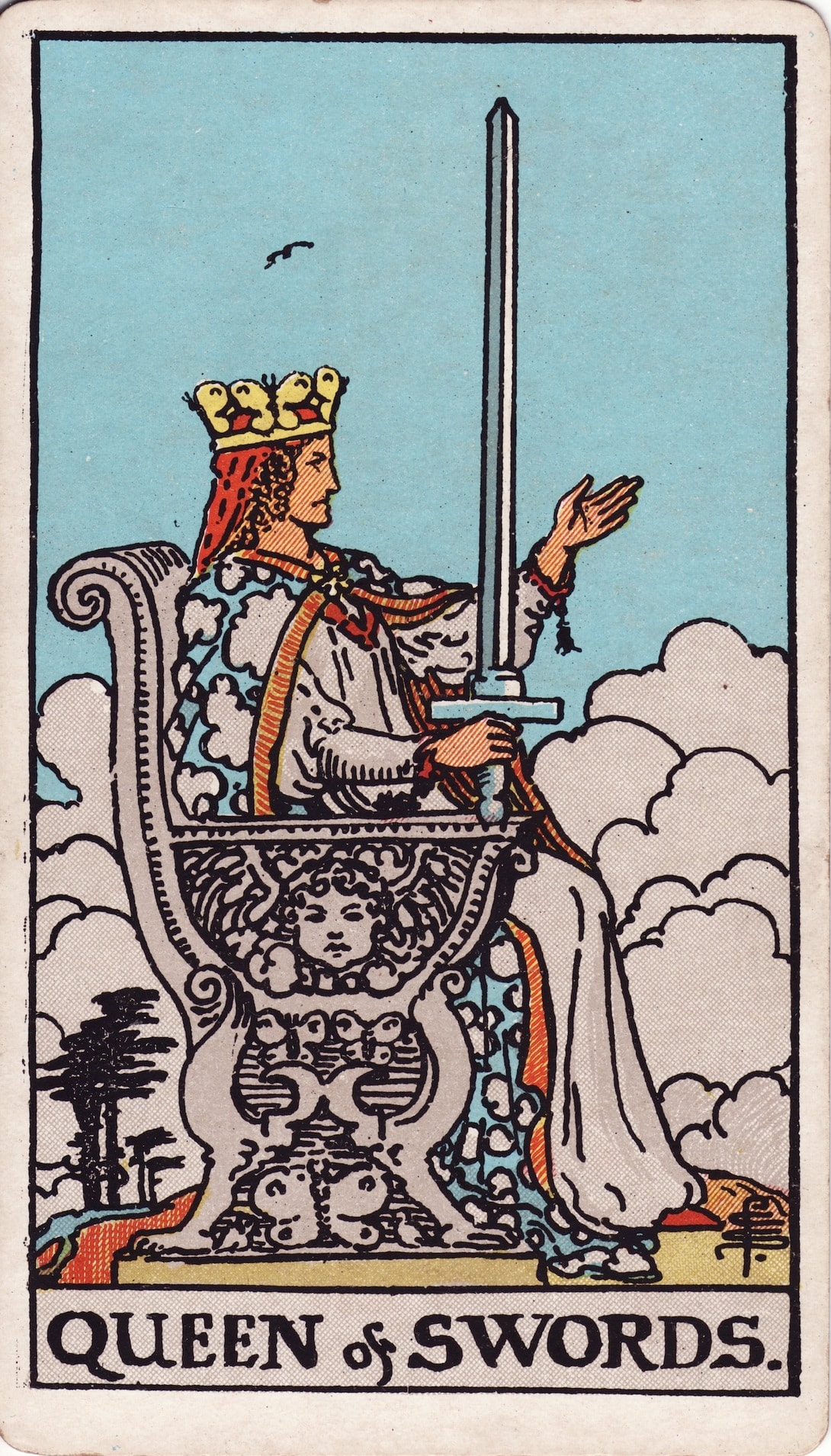
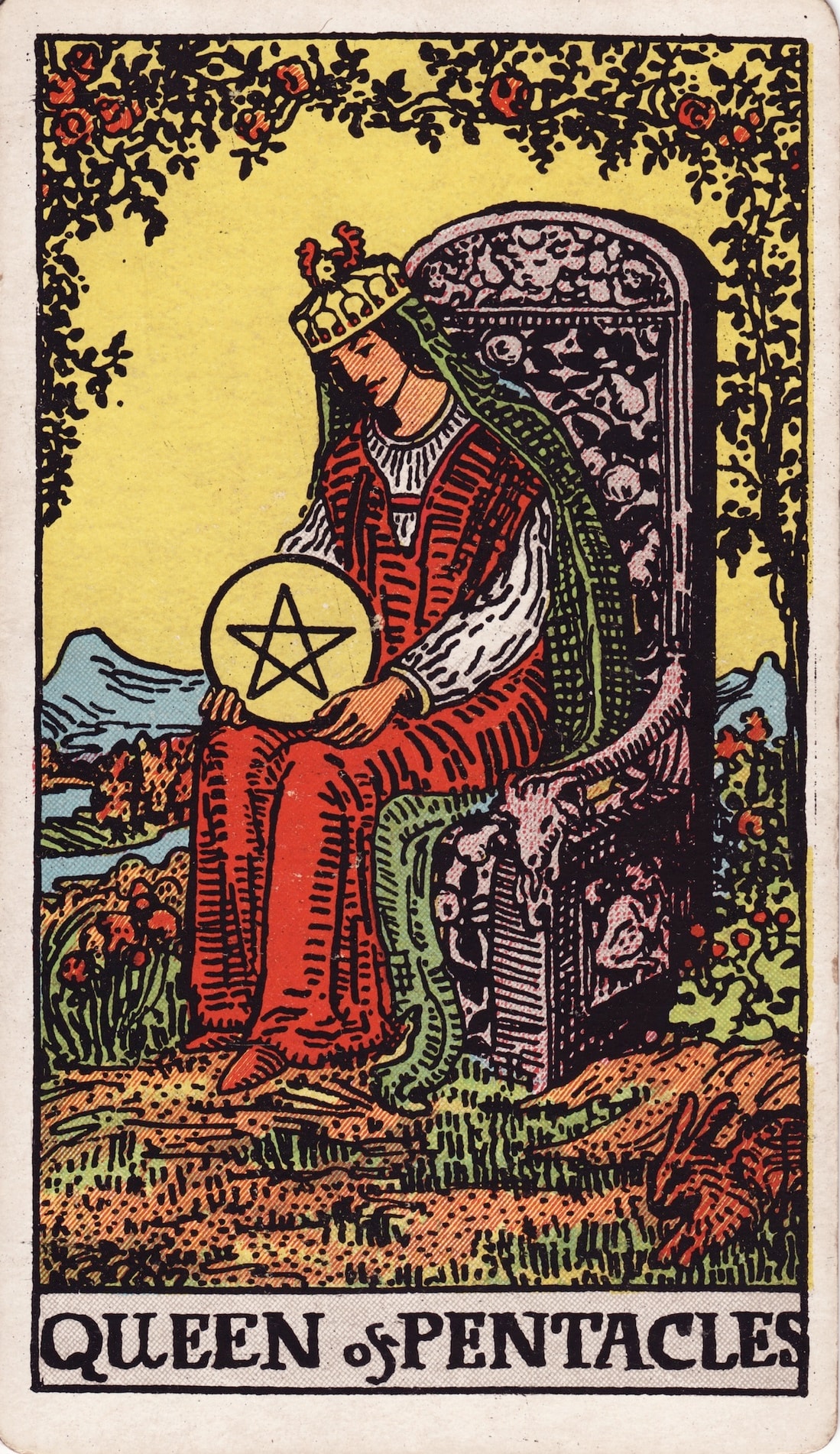


All the cards of the Wands, or the whole deck.