Trump II, Major Arcana
The High Priestess
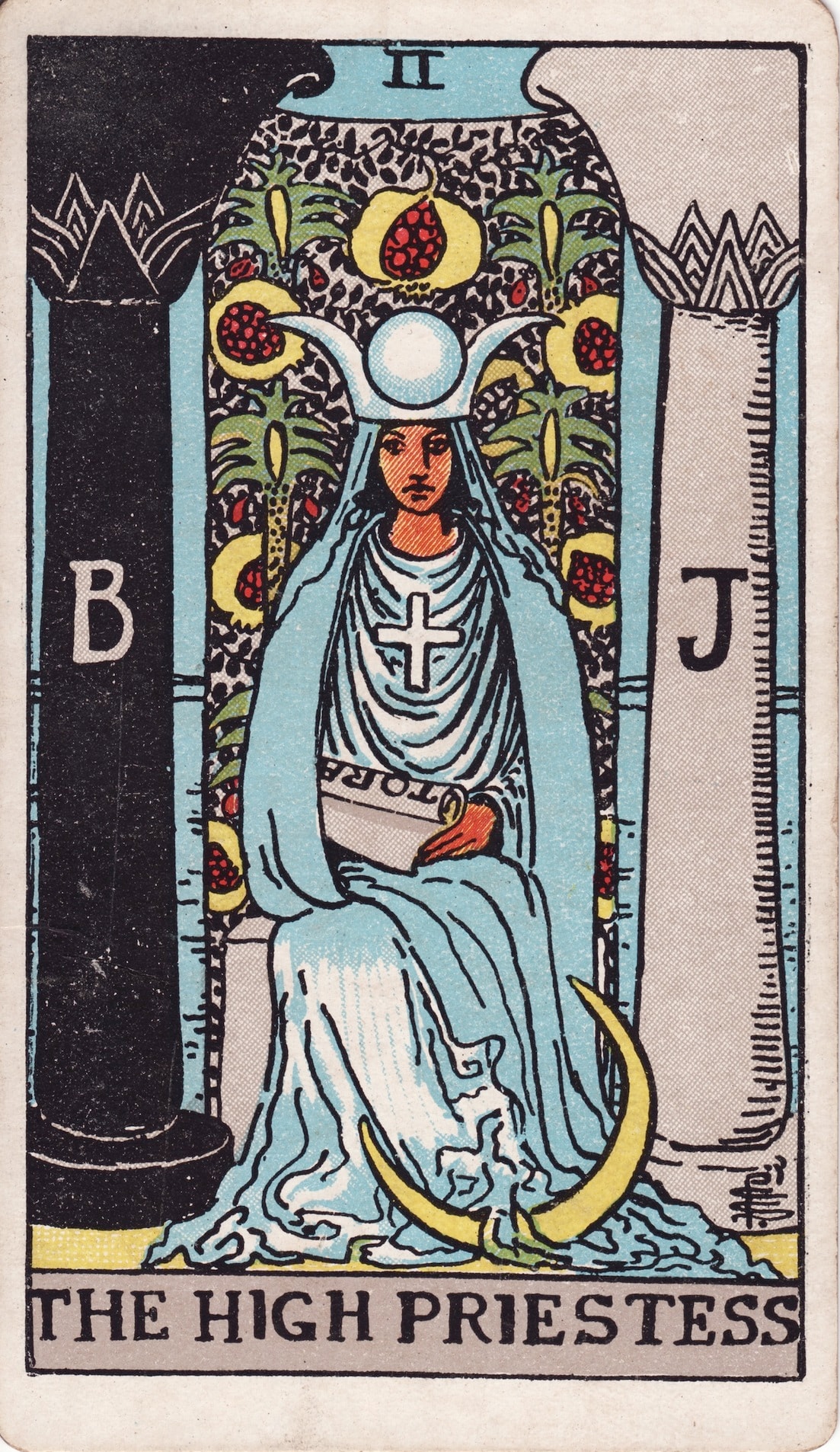
Trump II, the High Priestess, sits between a black pillar marked B and a white pillar marked J. Pamela Colman Smith drew her in 1909 with a horned crown round a white globe, a scroll marked TORA half hidden in her blue cloak and a crescent moon at her feet.
What Waite wrote it means (1910)
- Divinatory meanings
Secrets, mystery, the future as yet unrevealed; the woman who interests the Querent, if male; the Querent herself, if female; silence, tenacity; mystery, wisdom, science.
- Reversed
Passion, moral or physical ardour, conceit, surface knowledge.
Arthur Edward Waite, The Pictorial Key to the Tarot (London, 1911), p. 283. Read it in the chapter
She has the lunar crescent at her feet, a horned diadem on her head, with a globe in the middle place, and a large solar cross on her breast. The scroll in her hands is inscribed with the word Tora, signifying the Greater Law, the Secret Law and the second sense of the Word. It is partly covered by her mantle, to shew that some things are implied and some spoken. She is seated between the white and black pillars—J. and B.—of the mystic Temple, and the veil of the Temple is behind her: it is embroidered with palms and pomegranates. The vestments are flowing and gauzy, and the mantle suggests light—a shimmering radiance. She has been called Occult Science on the threshold of the Sanctuary of Isis, but she is really the Secret Church, the House which is of God and man. She represents also the Second Marriage of the Prince who is no longer of this world; she is the spiritual Bride and Mother, the daughter of the stars and the Higher Garden of Eden. She is, in fine, the Queen of the borrowed light, but this is the light of all. She is the Moon nourished by the milk of the Supernal Mother.
In a manner, she is also the Supernal Mother herself—that is to say, she is the bright reflection. It is in this sense of reflection that her truest and highest name in bolism is Shekinah—the co-habiting glory. According to Kabalism, there is a Shekinah both above and below. In the superior world it is called Binah, the Supernal Understanding which reflects to the emanations that are beneath. In the lower world it is Malkuth—that world being, for this purpose, understood as a blessed Kingdom—that with which it is made blessed being the Indwelling Glory. Mystically speaking, the Shekinah is the Spiritual Bride of the just man, and when he reads the Law she gives the Divine meaning. There are some respects in which this card is the highest and holiest of the Greater Arcana.
What's in the picture
- The black pillar. On the left stands a black pillar with a white B on it. Its top opens out like a lily.
- The white pillar. On the right stands a pale pillar with a black J, shaded with fine lines down one side. Its top opens out in the same way.
- The veil. A curtain hangs behind her throne, patterned with palm leaves and red pomegranates split open to show their seeds. Thin strips of pale blue show at its sides.
- The crown. She wears a crown with two horns curving up from a white globe, like a full moon between two crescents.
- The cross. A plain white cross with arms of equal length sits on her breast, on the folds of her white robe.
- The scroll. She holds a rolled scroll in her lap, and the letters TORA show along its edge. A fold of her cloak hides the rest of it.
- The crescent moon. A yellow crescent moon lies at her feet, its tips pointing up, half caught in the folds of her robe.
- The robe. Her pale blue robe falls from the throne in wavy lines and spills over the floor at the bottom of the card, almost like water.
- Smith's monogram. Low on the right, below the white pillar, is the small knot-like mark Pamela Colman Smith put on many of her cards.
The card in brief
- In the deck
- Card 3 of 78
- Arcana
- Major Arcana
- Number
- Trump II
- Hebrew letter (Golden Dawn)
- Gimel
- Astrology (Golden Dawn)
- The Moon
- Title in Book T
- The Priestess of the Silver Star
- Drawn by
- Pamela Colman Smith
- Planned by
- Arthur Edward Waite
- Published
- London, William Rider & Son, 1909
- Scan
- Pam-A printing, c. 1910, Wikimedia Commons
In the old books
Book T (1912)
Change, alternation, increase and decrease, fluctuation; whether for good or evil depends on the dignity.
Book T, “A Description of the Cards of the Tarot”, The Equinox I.8 (London, 1912), p. 203. See the source Papus (1892)
The woman is adorned with all the attributes of Authority and persuasion, and she is placed under the porch of the temple of Isis, between two columns.
Idea of a sacred dwelling, of a divine recipient.
The two columns, like the arms of the Juggler, express the Positive and the Negative.
Papus, The Tarot of the Bohemians, tr. A. P. Morton (London, 1892), p. 113. See the source
Before 1909
The older cards and pictures behind this one will be shown here once their licences are checked.
The High Priestess and the veil
The High Priestess sits between two pillars, one black and one white. The black pillar carries the letter B, and the white one a J. Behind her hangs a veil, covered with palm leaves and pomegranates. She wears a horned crown with a white globe in it, like a full moon. A crescent moon lies at her feet. On her lap is a scroll with the word TORA, and her cloak hides part of it.
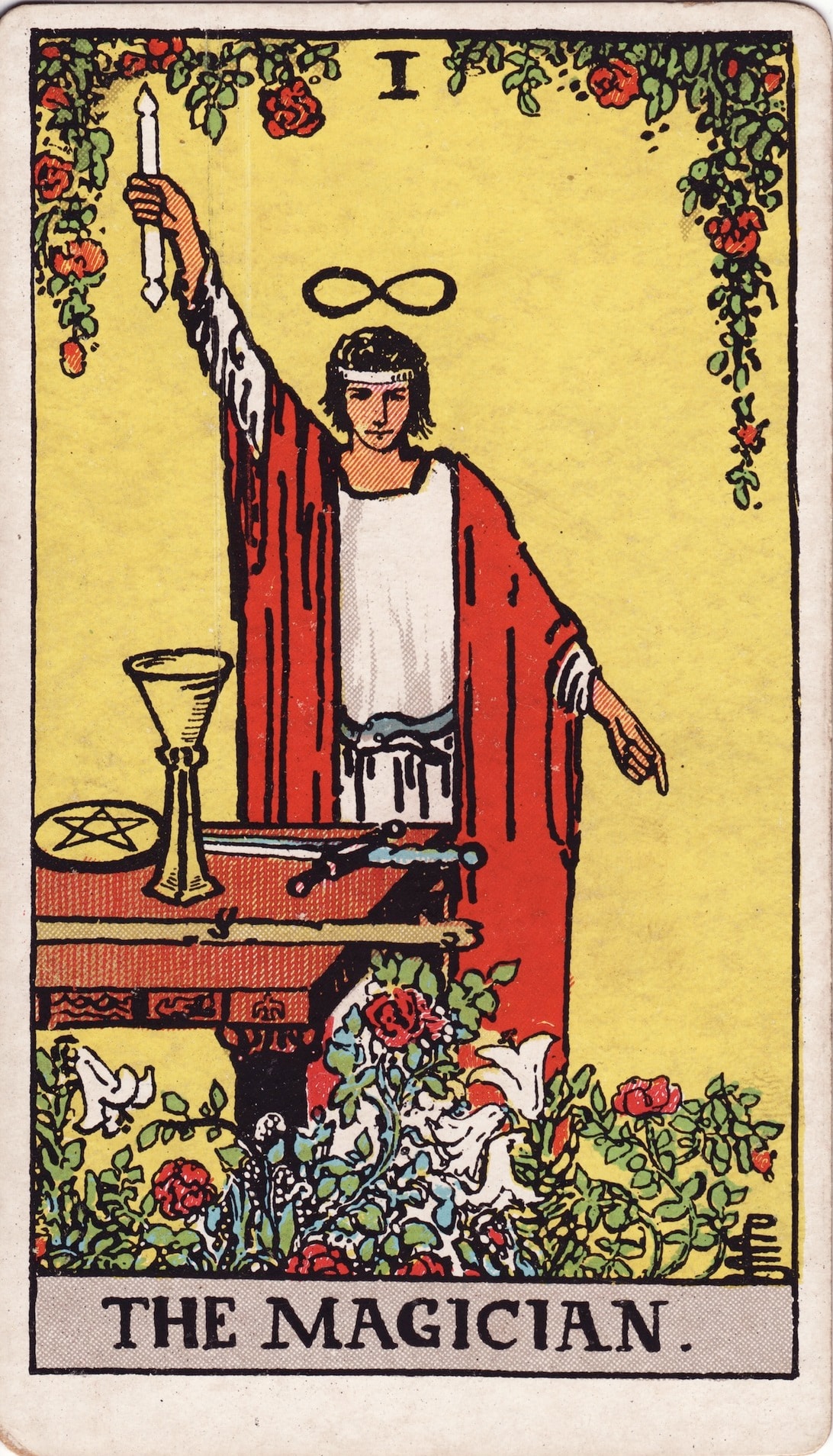
The Magician raised one arm and pointed with the other. She makes no gesture at all. She is trump II, so if you follow the trumps as a journey, she is the second figure the Fool comes to, straight after that busy table. You could try looking at her the way she looks at you: without hurry.
The image
The pillars come from the Bible. The First Book of Kings describes the temple of King Solomon. At its porch stood two bronze pillars. The one on the right was called Jachin, and the one on the left Boaz. Their tops were shaped like lilies, and rows of pomegranates hung around them. Arthur Edward Waite labels them simply "J. and B." On Pamela Colman Smith's card the pomegranates hang on the veil behind her instead.
The veil hides whatever lies behind her. At its edges you can see a strip of pale blue. It could be sky, or water. You can't see past her. Maybe that is why she sits there.
Waite wrote that her scroll is "partly covered by her mantle, to shew that some things are implied and some spoken". He also called her "the Queen of the borrowed light". The Moon has no light of its own. It shines with light borrowed from the Sun. Her whole card is moonlit, in pale blue, white and grey. At the bottom her robe spills off the throne and runs out of the picture like water.
The old name for this card was stranger still. Waite listed it: "the Pope Joan, or Female Pontiff". Pope Joan was a woman in a medieval legend who, the story goes, dressed as a man and rose to be pope. Another old name, "the Mother, or Pope's Wife", Waite rejected. He saw her as "the Secret Tradition".
The inner journey
If the Magician is the "I" waking up, the part of you that knows what it is doing, the High Priestess sits at the edge of what that "I" can know. Carl Jung thought most of the mind is hidden from us, and he called the hidden part the unconscious. One layer is personal, made of what you forgot or pushed away. Below it, he thought, lies a layer everyone shares, the collective unconscious. Its images turn up in dreams, myths and art.
Jung also described an inner figure who can lead a man into that hidden world. He called her the anima, from the Latin word for soul. Many readers see the High Priestess as this guide. She is a woman at a doorway, holding a book she doesn't open for you.
So the Fool, who has just learned to act, meets someone who doesn't act. She waits. What she knows, she knows the way you know a dream before you put it into words.
Along the road she can look like a gate to pass through. You could also try staying at the gate. Carry a question for a day and let it stay a question. Notice what comes to you once you stop pushing for an answer. You could treat her card the same way, and leave part of it unexplained.
Across traditions
In the Golden Dawn's tables the High Priestess gets Gimel, the third of the Hebrew letters, and the Moon. Her secret title in Book T is "The Priestess of the Silver Star".
Waite went further, into the Kabbalah, the Jewish mystical tradition. He wrote that her "truest and highest name" is Shekinah, "the co-habiting glory". In Jewish thought the Shekinah is the presence of God dwelling in the world. Waite also called this card, in some ways, "the highest and holiest of the Greater Arcana".
There is another way into the pomegranates. The Greeks told of Persephone, daughter of the harvest goddess Demeter. Hades, king of the dead, carried her down to the underworld. When the gods made him let her go, he slipped her a pomegranate seed to eat. Because she had eaten there, she had to go back. So she spends a third of every year below, and the rest above.
The Romans called her Proserpine, and in 1874 Dante Gabriel Rossetti painted her under that name. In his picture, now at Tate in London, she holds the pomegranate, bitten open, and looks aside. You could set her beside the High Priestess. Both women sit on the edge of two worlds. Both hold something that ties them to the hidden side.
Try this
Cover half of the card above with your hand or a sheet of paper. Look at the half you can see for a minute. Then guess what lies under your hand before you lift it. Did you guess right? Notice whether the hidden half felt empty or full while you couldn't see it. You could try the same with something you are carrying: leave half of it unsaid for a day.
Questions to sit with
- What is written on the part of the scroll you can't see?
- What might lie behind the veil? Do you want to know?
- Where in your life are you standing between two pillars?
- What do you know that you have never said out loud?
- If she spoke one sentence to the Fool, what would it be?
The film
No film for this card yet.
Sources
- Smith drew and coloured the cards for Waite.Arthur Edward Waite, The Pictorial Key to the Tarot (London, 1911), Part II, The Tarot and Secret Tradition, p. 67
- Waite on the pillars J. and B., the scroll partly covered by her mantle, the Queen of the borrowed light, the Shekinah, and the highest and holiest of the Greater Arcana.Arthur Edward Waite, The Pictorial Key to the Tarot (London, 1911), Part II, The High Priestess, pp. 76–79
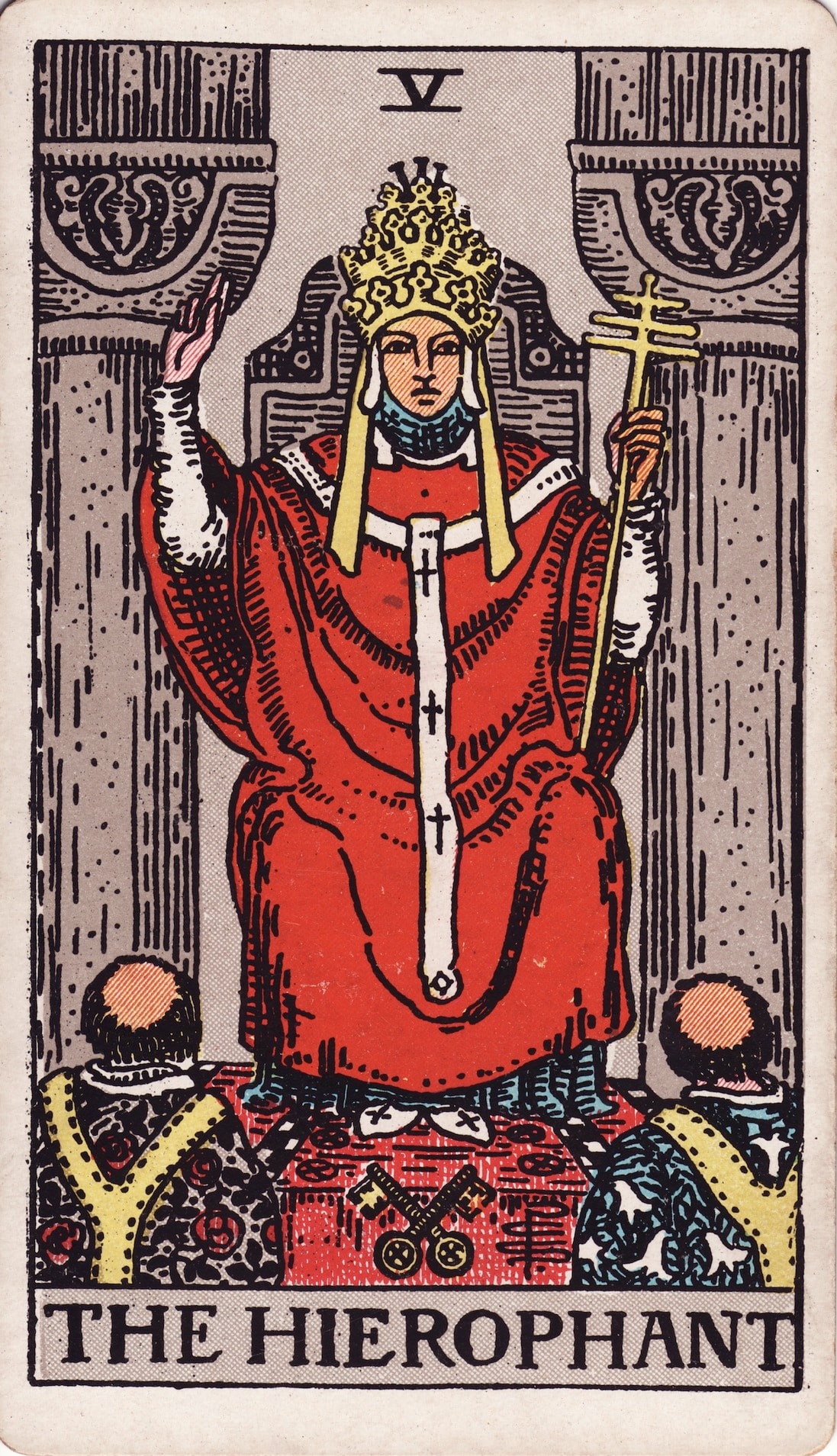
- The High Priestess makes no sign.Arthur Edward Waite, The Pictorial Key to the Tarot (London, 1911), Part II, The Hierophant, p. 88
- The old names: the Pope Joan, or Female Pontiff; the Mother, or Pope's Wife, rejected; the Secret Tradition.Arthur Edward Waite, The Pictorial Key to the Tarot (London, 1911), Part I, Trumps Major, no. 2, p. 13
- Solomon's pillars Jachin and Boaz, with lily work and pomegranates.1 Kings 7:18–22, King James Version
- The legend of Pope Joan.Johann Peter Kirsch, Popess Joan, The Catholic Encyclopedia, vol. 8 (New York, 1913)
- Jung on the personal and the collective unconscious.C. G. Jung, The Concept of the Collective Unconscious (1936), Collected Works 9i
- Jung on the anima and the animus.C. G. Jung, Aion (1951), ch. 3, The Syzygy: Anima and Animus (Collected Works 9ii)
- Many readers see the High Priestess as the anima.A common Jungian reading; for example Sallie Nichols, Jung and Tarot: An Archetypal Journey (1980)
- The Golden Dawn gave her Gimel and the Moon; Book T calls her the Priestess of the Silver Star.Book T, The Equinox I.8 (1912), table of the Keys
- The Shekinah as God's presence dwelling among people.The Jewish Encyclopedia (New York, 1906), Shekinah
- Persephone, the pomegranate seed, and the third of the year below.Homeric Hymn to Demeter, lines 370–374 and 398–403, translated by Hugh G. Evelyn-White (1914)
- Proserpine is Persephone's Roman name.William Smith, Dictionary of Greek and Roman Biography and Mythology (1849), Persephone
- Rossetti's Proserpine holds a bitten pomegranate.Dante Gabriel Rossetti, Proserpine (1874), Tate, London, N05064; Wikimedia Commons
Around this card
Before and after it in the deck
The first row of the Fool's journey


All the cards of the Major Arcana, or the whole deck.