Trump XII, Major Arcana
The Hanged Man
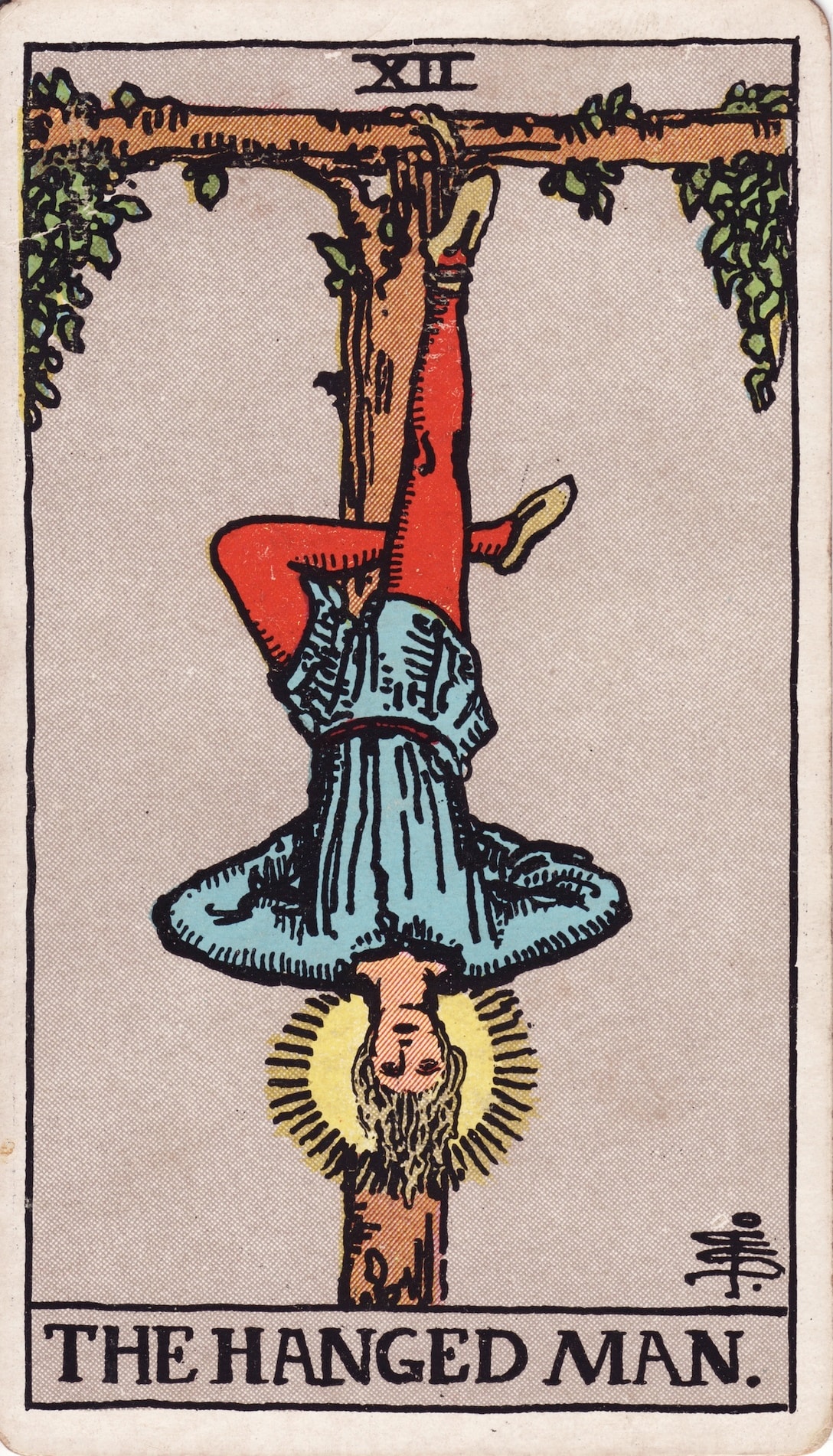
On trump XII, the Hanged Man, a young man hangs head down from a T-shaped wooden beam, tied by one ankle, with his other leg bent behind the knee. His face is calm in Pamela Colman Smith's 1909 drawing, a ring of golden light circles his head, and leaves sprout from the wood.
What Waite wrote it means (1910)
- Divinatory meanings
Wisdom, circumspection, discernment, trials, sacrifice, intuition, divination, prophecy.
- Reversed
Selfishness, the crowd, body politic.
Arthur Edward Waite, The Pictorial Key to the Tarot (London, 1911), p. 285. Read it in the chapter
The gallows from which he is suspended forms a Tau cross, while the figure—from the position of the legs—forms a fylfot cross. There is a nimbus about the head of the seeming martyr. It should be noted (1) that the tree of sacrifice is living wood, with leaves thereon; (2) that the face expresses deep entrancement, not suffering; (3) that the figure, as a whole, suggests life in suspension, but life and not death. It is a card of profound significance, but all the significance is veiled. One of his editors suggests that Éliphas Lévi did not know the meaning, which is unquestionable—nor did the editor himself. It has been called falsely a card of martyrdom, a card of prudence, a card of the Great Work, a card of duty; but we may exhaust all published interpretations and find only vanity. I will say very simply on my own part that it expresses the relation, in one of its aspects, between the Divine and the Universe.
He who can understand that the story of his higher nature is imbedded in this symbolism will receive intimations concerning a great awakening that is possible, and will know that after the sacred Mystery of Death there is a glorious Mystery of Resurrection.
What's in the picture
- The beam. A rough wooden beam, still with knots and stubs on it, runs right across the top of the card.
- The leaves. Clusters of green leaves hang from both ends of the beam, and a few more sprout from the post.
- The post. The beam rests on an upright trunk, and together they make a T. The trunk shows again below his head, at the bottom of the card.
- The rope and the ankle. A pale rope loops over the beam and is wound tight round the ankle of his straight leg, just above a pale yellow shoe.
- The bent leg. His other leg is bent behind the straight one, so the two legs make the shape of a 4. Its yellow shoe sticks out to the side.
- The blue tunic. He wears a blue tunic with a thin red belt, wide at the shoulders, and red tights. His arms do not show; they are behind his back.
- The face. His face is upside down and calm. His eyes seem closed, and nothing in it looks pained.
- The halo. A ring of short black rays on pale yellow surrounds his head like a small sun, low on the card, where the ground would be.
- The hair. His long fair hair falls straight down from his head, toward the bottom edge of the card.
- Smith's monogram. In the lower right corner, on the plain grey ground, is Pamela Colman Smith's small knotted mark.
The card in brief
- In the deck
- Card 13 of 78
- Arcana
- Major Arcana
- Number
- Trump XII
- Hebrew letter (Golden Dawn)
- Mem
- Element (Golden Dawn)
- Water
- Title in Book T
- The Spirit of the Mighty Waters
- Drawn by
- Pamela Colman Smith
- Planned by
- Arthur Edward Waite
- Published
- London, William Rider & Son, 1909
- Scan
- Pam-A printing, c. 1910, Wikimedia Commons
In the old books
Book T (1912)
Enforced sacrifice, punishment, loss, fatal and not voluntary, suffering.
Book T, “A Description of the Cards of the Tarot”, The Equinox I.8 (London, 1912), p. 203. See the source Papus (1892)
A man hanging by one foot to a gibbet, resting upon two trees, each bearing six branches, which have been cut off.
The man's hands are tied behind his back, and the fold of his arms forms the base of a reversed triangle, of which his head forms the point. His eyes are open and his fair hair floats upon the wind. His right leg crosses his left and so forms a cross.
Papus, The Tarot of the Bohemians, tr. A. P. Morton (London, 1892), p. 152. See the source
Before 1909
The older cards and pictures behind this one will be shown here once their licences are checked.
The Hanged Man: upside down
A man hangs upside down from a wooden beam. A rope is tied around one ankle. His other leg bends behind the knee, so his legs make the shape of a 4. His arms are folded behind his back. A ring of golden light shines around his head. Now look at his face. It is calm, almost dreamy. Waite saw it that way too. He wrote that the face shows "deep entrancement, not suffering".
Follow the trumps in order and, right after Justice, the Fool's world turns upside down. The man hanging there seems at peace with it.
The image
The beam and its post make a T. Waite called it "a Tau cross", after tau, the Greek letter T. Look at the wood. Leaves grow at both ends of the beam. Waite pointed this out as well: "the tree of sacrifice is living wood, with leaves thereon". So this is no dead gallows. It is a tree, and it is still growing.
He wears a blue tunic, red tights and pale yellow shoes. His hair falls straight down. The halo glows like a small sun, low on the card, where you would expect the ground.
Waite said the whole figure "suggests life in suspension, but life and not death". He also wrote that "all the significance is veiled". Then he brushed aside the usual explanations. You could read every one of them, he said, "and find only vanity". So even the man who planned the card leaves you free to look for yourself.
The inner journey
On the card before this one, the Fool sat in front of Justice and weighed his life. Now something stranger happens. He is turned upside down. The things he steered by stop working.
Jung borrowed an old Greek word for turns like this. The word is enantiodromia, "running the other way", and it comes from the philosopher Heraclitus. In Jung's view, when a life leans too far to one side, the other side grows strong underneath. One day it rises and takes over. Seen this way, the Hanged Man is where a life that looked outward starts to look inward.
Notice how still he is. His hands are behind him, away from the rope. In this reading, the everyday self stops pushing and lets something else hold it for a while. What looks like being stuck may also be a kind of waiting.
Upside down, the world looks different. The sky is under your feet. You could try this way of seeing on anything: a problem, a person, an old memory. Hang it upside down and look at it again.
This is also a good card to stay with. Nothing here happens fast. You could treat it as a place where time slows down, and hang there for a while.
Old stories
In the Norse poem Hávamál, "the sayings of the High One", the god Odin tells how he once hung on a tree. "I ween that I hung on the windy tree, / Hung there for nights full nine". He calls it an offering, "myself to myself". Then he looked down and took up the runes, the old magic letters. After that, he says, "each word led me on to another word". The tree in the poem is the ash Yggdrasil, the great tree of Norse myth. Like the tree Pamela Colman Smith drew, it is alive.
On older French cards he is Le Pendu, "the hanged one". On the tarot Jean Noblet printed in Paris in the mid-1600s, he hangs between two trunks, and their branches have been cut back to stumps.
Waite knew an even odder version. In some fortune-tellers' decks of the 1700s, the figure stood the right way up, on one foot, loosely tied to a stake.
In the Golden Dawn's Book T, this card belongs to the element of water, and its title is "The Spirit of the Mighty Waters". You could picture him hanging above a deep, still pool, looking down into it.
Try this
Turn the Hanged Man the other way up: tilt your screen, or turn a printed copy round. Look at him for a full minute. What rises? What falls? Does he look more at ease this way round, or less? Then take one worry and turn it over in the same way. What does it look like from underneath? If you like, let your head hang down for a moment too, as far as feels comfortable, and notice how the room changes.
Questions to sit with
- Why does he look so calm?
- What can he see from down there that nobody standing up can see?
- Where in your life are you hanging, waiting, not yet moving?
- If you stopped pushing, what might hold you up?
- What is growing on the tree you hang from?
The film
No film for this card yet.
Sources
- Smith drew and coloured the cards.Arthur Edward Waite, The Pictorial Key to the Tarot (London, 1911), Part II, The Tarot and Secret Tradition, p. 67
- Waite on the Tau cross, the living wood with leaves, the face in deep entrancement, life in suspension, the veiled significance, and the published interpretations that come to vanity.Arthur Edward Waite, The Pictorial Key to the Tarot (London, 1911), Part II, The Hanged Man, p. 116
- Arms bound behind him and one leg crossed over the other; the eighteenth-century fortune-tellers' youth poised on one foot and tied to a stake.Arthur Edward Waite, The Pictorial Key to the Tarot (London, 1911), Part I, Trumps Major, no. 12, p. 23
- Tau is the Greek letter T, and the name of a T-shaped cross.Webster's Revised Unabridged Dictionary (1913), tau
- Enantiodromia, "a running counter to": Heraclitus's word, used by Jung for the rise of the unconscious opposite when one side dominates.C. G. Jung, Psychological Types (1921), translated by H. G. Baynes (London, 1923), ch. XI, Definitions, no. 18, p. 541
- Odin hung nine nights on the windy tree, an offering of himself to himself, took up the runes, and each word led him to another; the tree is the ash Yggdrasil.Hávamál, stanzas 139, 140 and 142, in The Poetic Edda, translated by Henry Adams Bellows (1923), with his note
- Noblet's Le Pendu hangs between two trunks with lopped branches.Jean Noblet, tarot (Paris, mid-1600s), card XII, LE PENDU; Bibliothèque nationale de France, via Wikimedia Commons
- Book T gives the Hanged Man water and calls him the Spirit of the Mighty Waters.Book T, The Equinox I.8 (1912), table of the Keys
Around this card
Before and after it in the deck
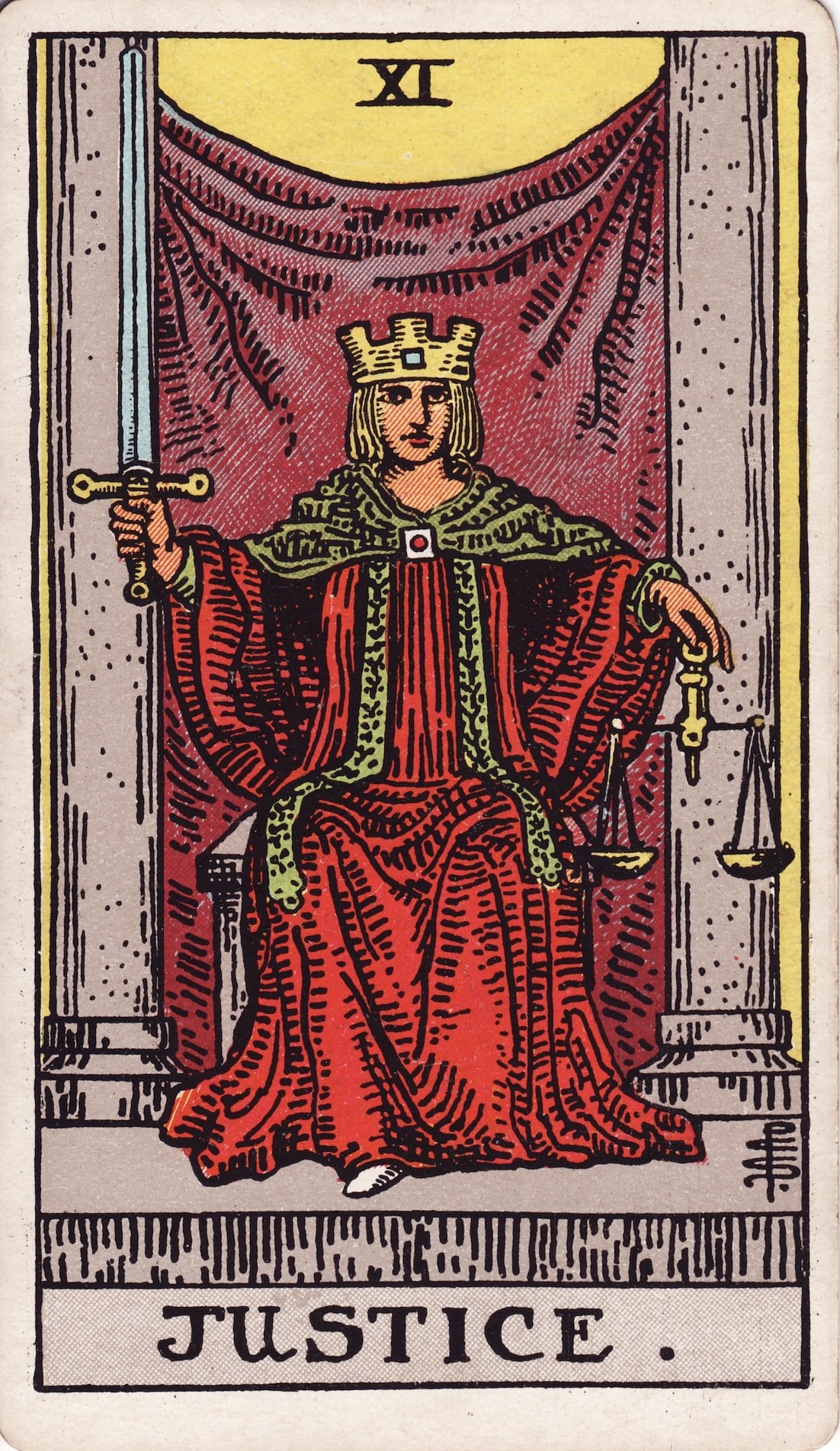
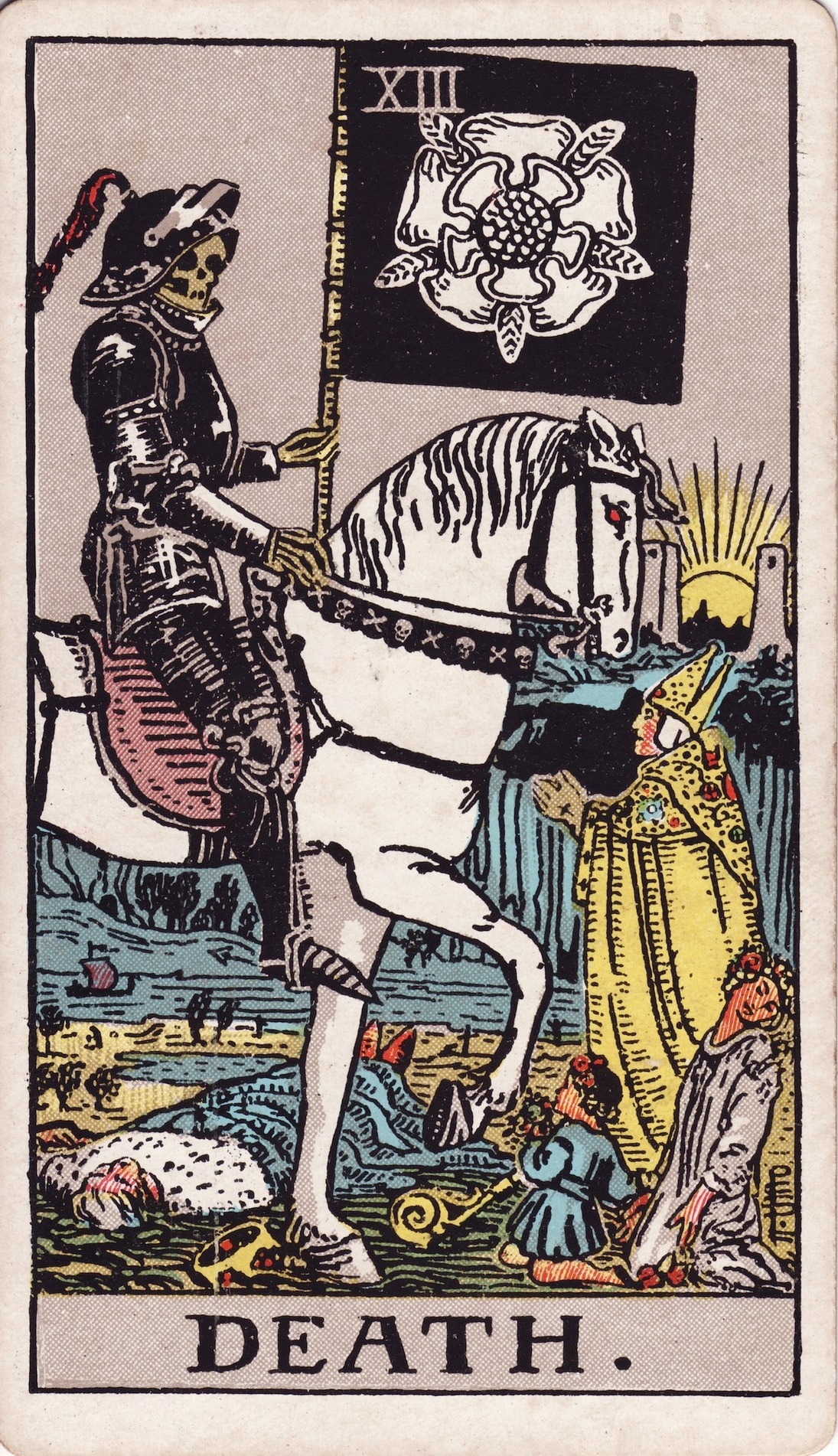
The second row of the Fool's journey
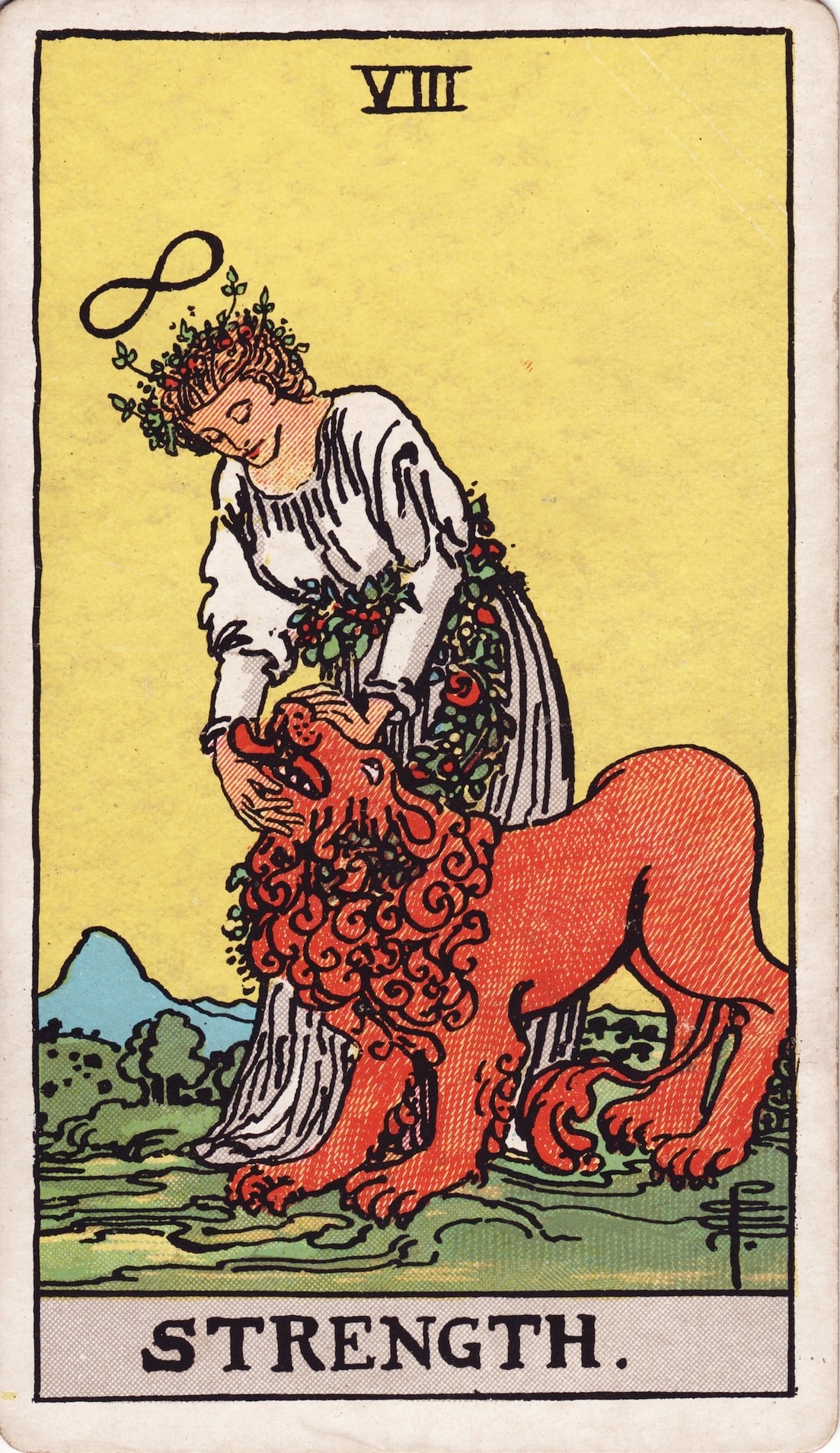


All the cards of the Major Arcana, or the whole deck.