Trump IV, Major Arcana
The Emperor
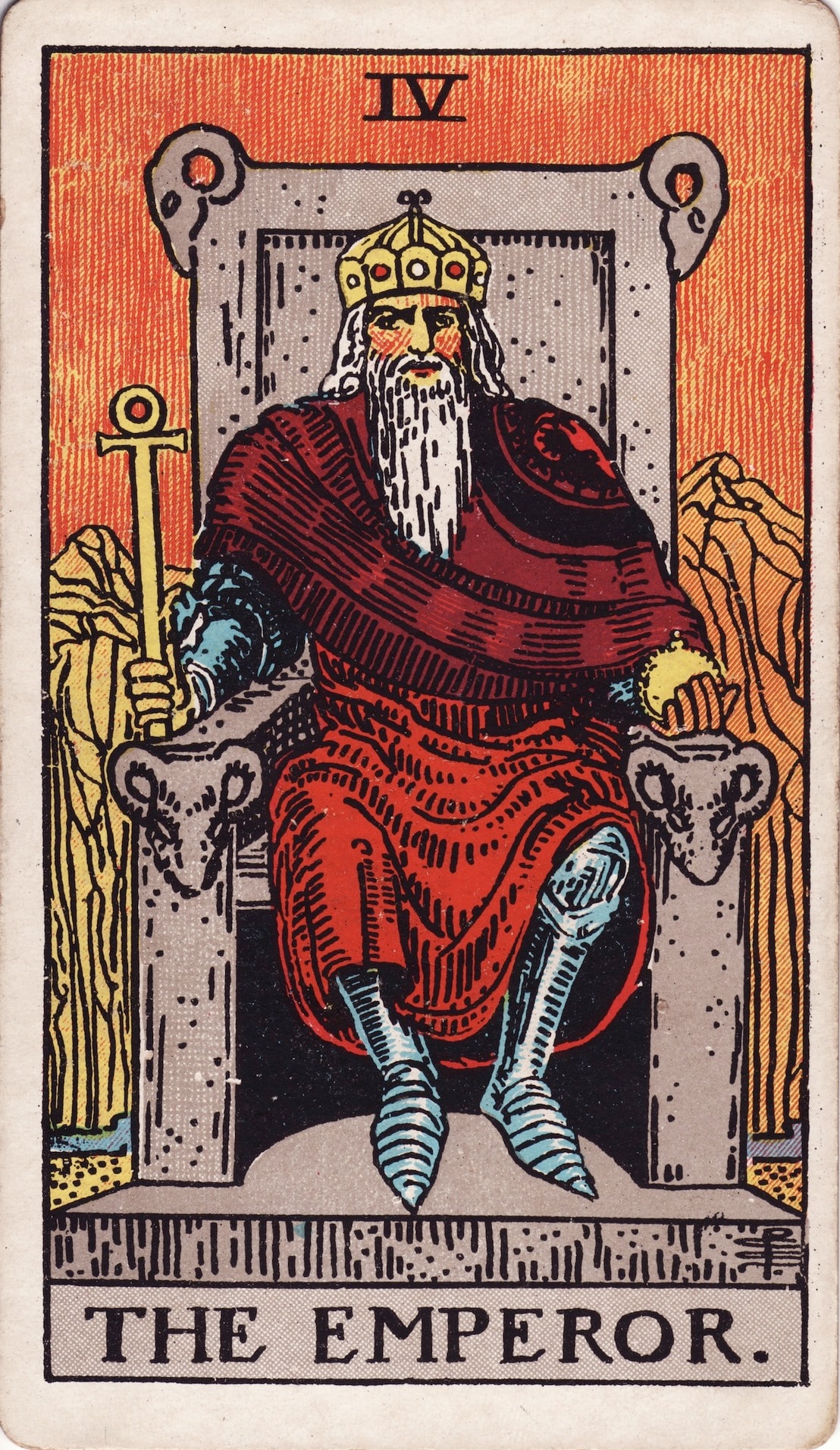
Pamela Colman Smith's Emperor, trump IV of the 1909 deck, is an old king on a stone throne carved with rams' heads. He has a long white beard and a gold crown, holds an ankh-shaped sceptre and a golden globe, and wears armour under his red robe, with bare mountains behind him.
What Waite wrote it means (1910)
- Divinatory meanings
Stability, power, protection, realization; a great person; aid, reason, conviction; also authority and will.
- Reversed
Benevolence, compassion, credit; also confusion to enemies, obstruction, immaturity.
Arthur Edward Waite, The Pictorial Key to the Tarot (London, 1911), p. 283. Read it in the chapter
He has a form of the Crux ansata for his sceptre and a globe in his left hand. He is a crowned monarch—commanding, stately, seated on a throne, the arms of which are fronted by rams' heads. He is executive and realization, the power of this world, here clothed with the highest of its natural attributes. He is occasionally represented as seated on a cubic stone, which, however, confuses some of the issues. He is the virile power, to which the Empress responds, and in this sense is he who seeks to remove the Veil of Isis; yet she remains virgo intacta.
It should be understood that this card and that of the Empress do not precisely represent the condition of married life, though this state is implied. On the surface, as I have indicated, they stand for mundane royalty, uplifted on the seats of the mighty; but above this there is the suggestion of another presence. They signify also—and the male figure especially—the higher kingship, occupying the intellectual throne. Hereof is the lordship of thought rather than of the animal world. Both personalities, after their own manner, are "full of strange experience," but theirs is not consciously the wisdom which draws from a higher world. The Emperor has been described as (a) will in its embodied form, but this is only one of its applications, and (b) as an expression of virtualities contained in the Absolute Being—but this is fantasy.
What's in the picture
- The rams on the throne. The throne is a plain block of grey stone. Its two top corners end in rams' heads with curled horns.
- The crown. A gold crown set with round jewels sits on his white hair, with a small cross-like knob on top.
- The beard. His long white beard falls almost to his waist, over a red cloak wrapped across his chest.
- The ankh. In his right hand he holds up a golden sceptre shaped like an ankh, a cross with a loop at the top.
- The globe. In his left hand he holds a small golden ball, resting it on the arm of the throne.
- The rams on the arms. Two more rams' heads front the arms of the throne, one under each hand.
- The armour. Under the red robe his legs are in steel armour, down to pointed metal shoes. Armour shows at his wrist too.
- The mountains. Bare, rocky mountains rise on both sides of the throne, under a flat orange sky. There are no trees or fields.
- The stream. A thin strip of blue water runs at the foot of the mountains, low down beside the throne.
- Smith's monogram. Pamela Colman Smith's small knot-like mark is cut into the stone step at the bottom right.
The card in brief
- In the deck
- Card 5 of 78
- Arcana
- Major Arcana
- Number
- Trump IV
- Hebrew letter (Golden Dawn)
- Heh
- Astrology (Golden Dawn)
- Aries
- Title in Book T
- Sun of the Morning, chief among the Mighty
- Drawn by
- Pamela Colman Smith
- Planned by
- Arthur Edward Waite
- Published
- London, William Rider & Son, 1909
- Scan
- Pam-A printing, c. 1910, Wikimedia Commons
In the old books
Book T (1912)
War, conquest, victory, strife, ambition.
Book T, “A Description of the Cards of the Tarot”, The Equinox I.8 (London, 1912), p. 203. See the source Papus (1892)
A man seated in profile.
The man indicates the active; his position, however, shows that this activity is engendered by a superior term. The 1st arcanum, the Juggler, the active absolute, was repre-sented standing, looking to the front; the 4th arcanum, active relative, is seated in profile.
Papus, The Tarot of the Bohemians, tr. A. P. Morton (London, 1892), p. 120. See the source
Before 1909
The older cards and pictures behind this one will be shown here once their licences are checked.
The Emperor on his stone
The Emperor sits on a big grey throne of stone. Rams' heads are carved on its arms and on its two top corners. He has a long white beard and a gold crown. In one hand he holds a sceptre shaped like an ankh, a cross with a loop on top. In the other he holds a golden ball. Look at his legs: under the red robe he wears armour. Behind him the sky is orange, and bare mountains rise on both sides.
He comes after the Empress, as trump IV. On the road of the trumps the Fool has just met a mother, and here he meets a father and a law. You could look at this card for what it builds, and for what it keeps out.
The image
The throne is one block of stone. Almost nothing on this card is soft. Arthur Edward Waite wrote that the throne's arms are "fronted by rams' heads". He called the sceptre a form of the Crux ansata, the Latin name for the ankh. The ankh was an Egyptian sign of life. So the hardest figure in the deck so far holds up a sign of life.
Waite called the Emperor "executive and realization, the power of this world". He is the one who gets things done. Waite also wrote that the Emperor and the Empress are "full of strange experience", though theirs "is not consciously the wisdom which draws from a higher world".
Put him beside the Empress. She sat in a field of wheat, by water and trees, leaning back on her cushions. He sits among bare rocks, upright, facing you. Her card was green and gold. His is orange, red and grey.
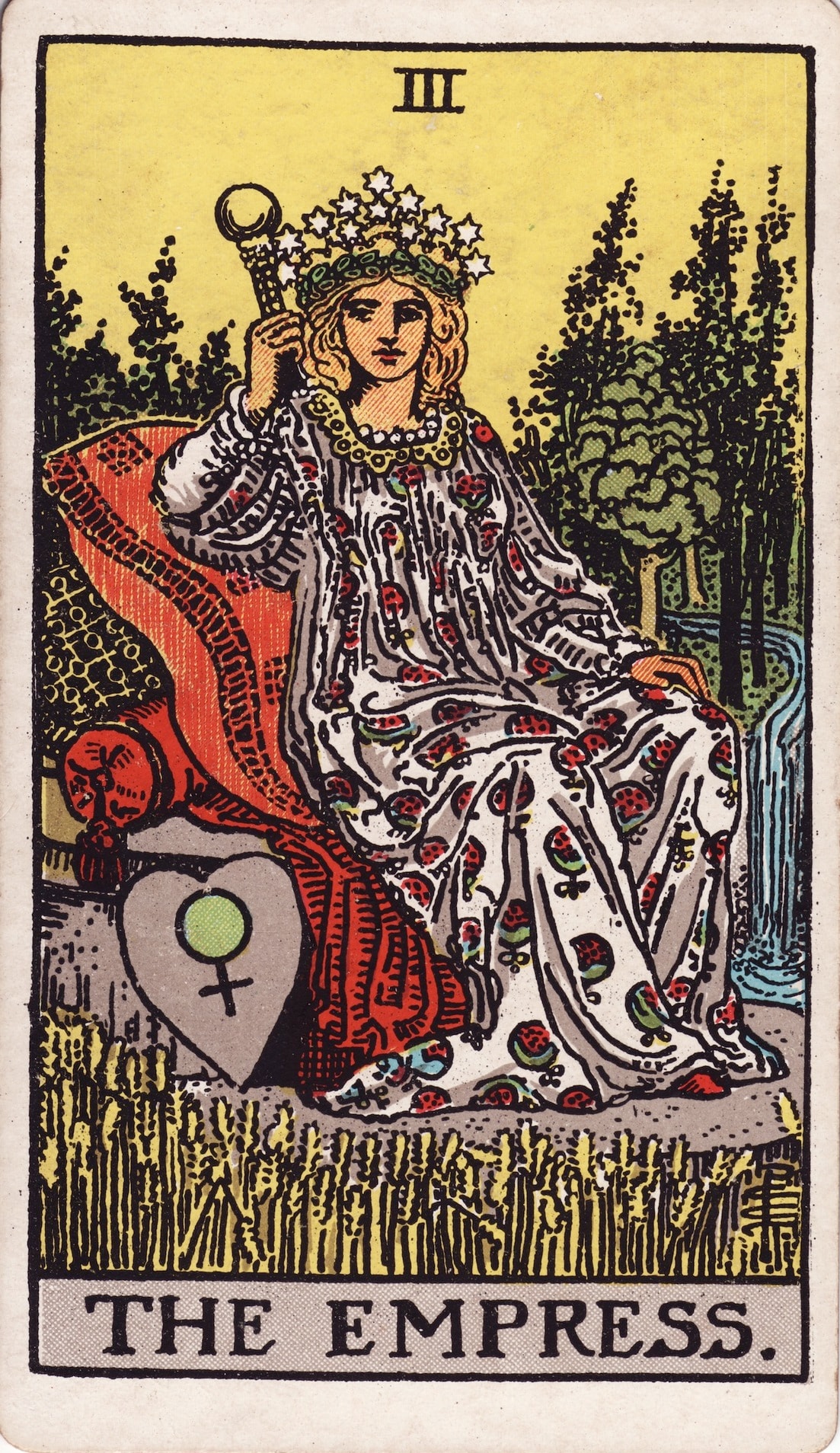
The orange sky makes it hard to tell the time of day. It could be sunrise or sunset. Now look at the foot of the mountains. A thin stream runs there, far below the throne. You could imagine that the Empress's waterfall has followed him this far.
The armour tells you something too. Under the robe of a ruler, he still dresses for a fight. You could ask what he is ready to defend.
The inner journey
Carl Jung saw the father, like the mother, as an archetype, one of the great patterns of the mind. On this card the pattern sits as a ruler, the one who sets limits and makes laws.
Here the road meets order. The Emperor draws lines: mine and yours, allowed and not allowed. A house needs walls, and so does a city. A child needs some walls to grow up inside.
Walls can harden, though. Stone doesn't bend. An emperor who never gets up from his throne can turn into the throne. Jung warned about this. If you identify completely with a great power inside you, he thought, you swell up, and it takes you over. He called this inflation.
You could stay with this card when you are building something: a habit, a plan, a boundary. Ask what shape it needs, and how firm. You could also stay with it when a rule feels too tight. Ask who set it, and whether he is still sitting on it.
Across traditions
In the tables of the Golden Dawn the Emperor gets He, the fifth of the Hebrew letters, and Aries, the sign of the ram. The rams on his throne match. Aries is the first sign of the zodiac, and the Sun enters it in March, at the start of the northern spring. Book T gives the Emperor a bright title: "Sun of the Morning, chief among the Mighty". Its short note on him is darker: "War, conquest, victory, strife, ambition."
A famous poem shows where that road can end. In 1818 the poet Percy Bysshe Shelley published Ozymandias. A traveller tells of "two vast and trunkless legs of stone" standing in the desert. Nearby lies a broken face with a "sneer of cold command". On the pedestal are the words: "My name is Ozymandias, king of kings: / Look on my works, ye Mighty, and despair!" Then the poem turns: "Nothing beside remains." Around the wreck, "the lone and level sands stretch far away".
You could read the poem beside the card. The Emperor also sits in stone, among bare mountains. He is still alive, though, and still holding the ankh. What would help him keep hold of it? Maybe the Empress could, or the stream at the foot of the mountains.
Try this
Sit on a hard chair with both feet flat and your back straight, like the Emperor. Hold something heavy in one hand. Stay for a minute and notice what your body wants to do. Then look back at the card and find its edges and walls. Where does something stop? Who decided where the line goes? See whether each line protects something or shuts something out.
Questions to sit with
- What is the Emperor guarding with his armour?
- Which rules in your life did you choose, and which did you inherit?
- Where do you need a firmer line? Where could one soften?
- What would the Empress say to him?
- If the Fool asked him for a map, what would he draw?
The film
No film for this card yet.
Sources
- Waite on the Crux ansata sceptre, the globe, the throne fronted by rams' heads, and the power of this world.Arthur Edward Waite, The Pictorial Key to the Tarot (London, 1911), Part II, The Emperor, p. 84
- The Emperor and the Empress full of strange experience, but not consciously the wisdom of a higher world.Arthur Edward Waite, The Pictorial Key to the Tarot (London, 1911), Part II, The Emperor, p. 87
- The crux ansata is the ankh, an emblem of life.Webster's Revised Unabridged Dictionary (1913), ankh
- Jung on the father as an archetype.C. G. Jung, The Significance of the Father in the Destiny of the Individual (1909, revised 1949), Collected Works 4
- Jung on inflation.C. G. Jung, The Relations between the Ego and the Unconscious (1928), part I, ch. 2, Collected Works 7
- The Golden Dawn gave the Emperor He and Aries; Book T's title and short note for him.Book T, The Equinox I.8 (1912), table of the Keys and brief meanings of the trumps
- Aries is the first sign of the zodiac, entered by the Sun about 21 March.Webster's Revised Unabridged Dictionary (1913), Aries
- Ozymandias: the legs of stone, the sneer of cold command, the inscription and the lone and level sands.Percy Bysshe Shelley, Ozymandias (1818), in The Complete Poetical Works, edited by Thomas Hutchinson (1914)
Around this card
Before and after it in the deck
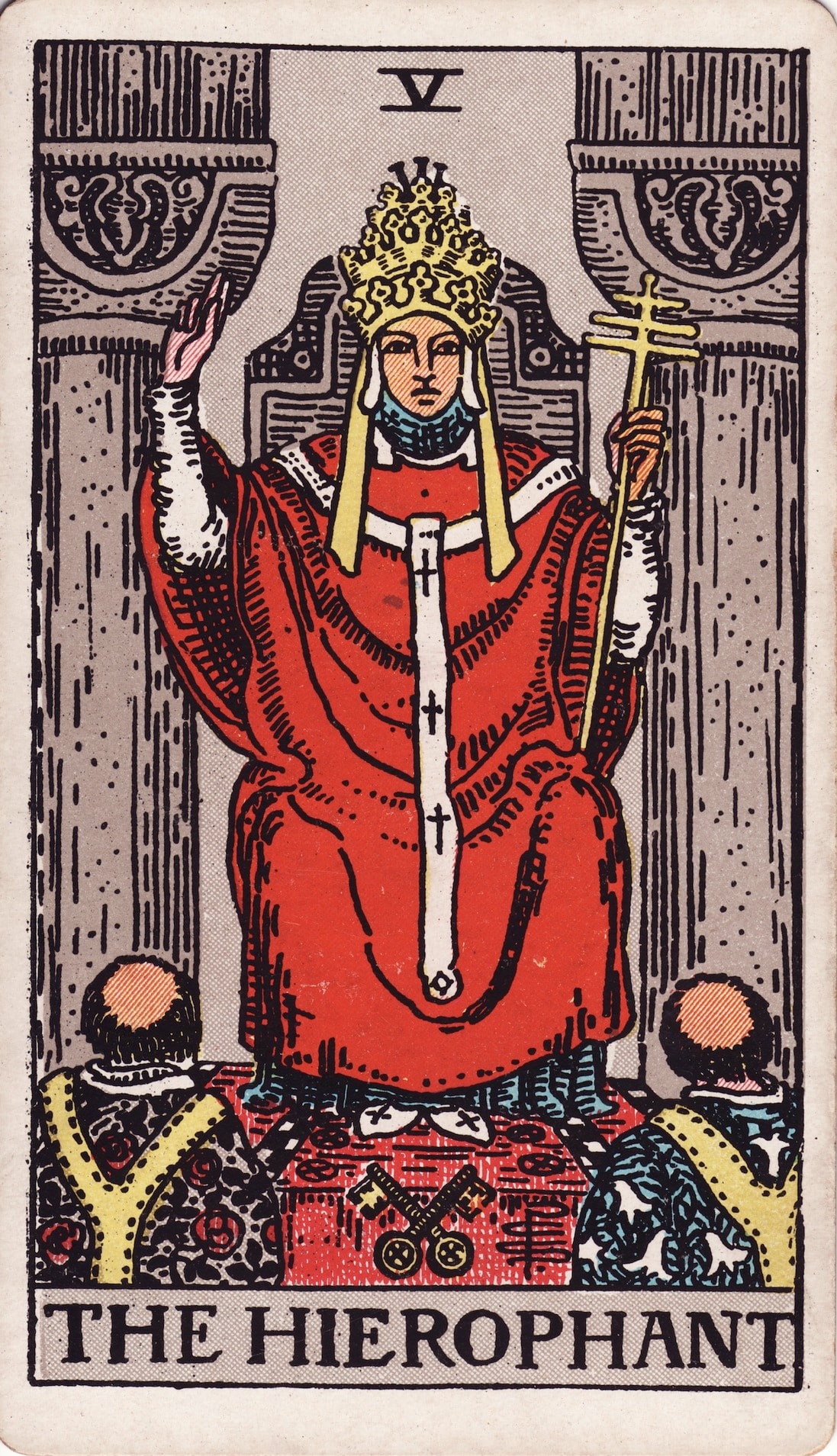
The first row of the Fool's journey
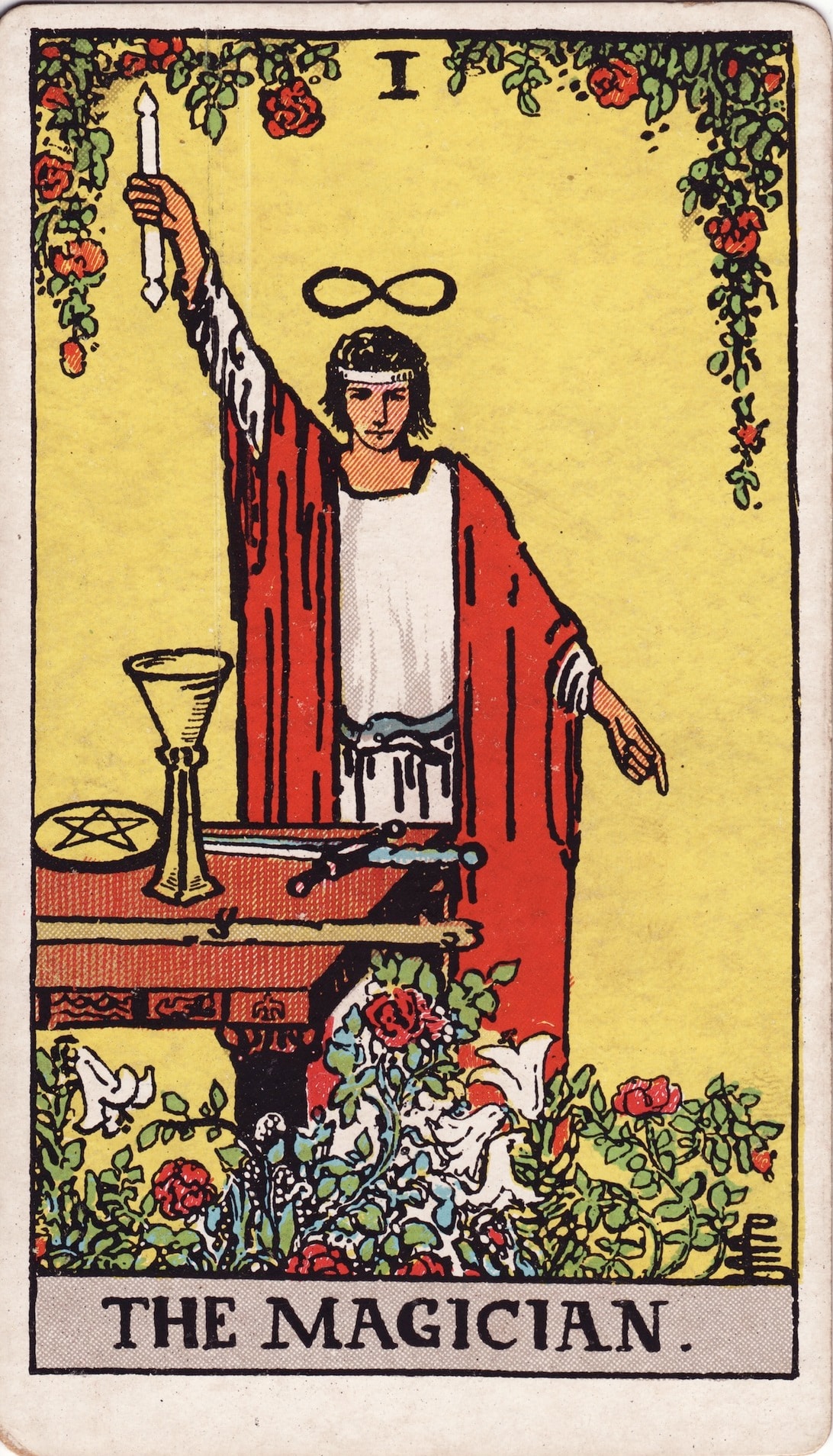

All the cards of the Major Arcana, or the whole deck.