Trump I, Major Arcana
The Magician
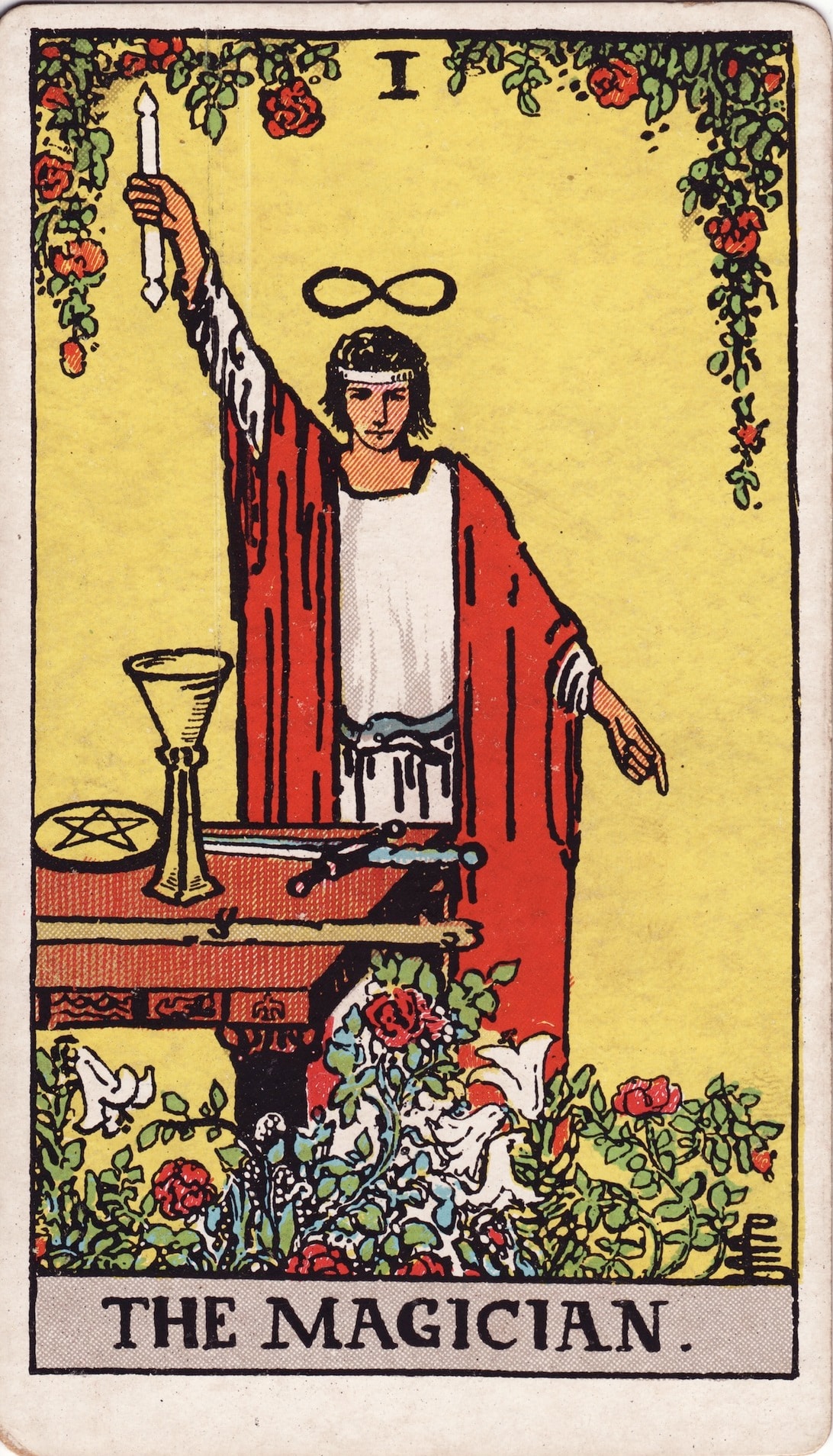
Trump I is the Magician, drawn by Pamela Colman Smith in 1909 for Arthur Edward Waite's deck. A young man in a red robe raises a white wand in one hand and points at the ground with the other, and a cup, a sword, a coin with a star and a wooden wand lie on the table before him.
What Waite wrote it means (1910)
- Divinatory meanings
Skill, diplomacy, address, subtlety; sickness, pain, loss, disaster, snares of enemies; self-confidence, will; the Querent, if male.
- Reversed
Physician, Magus, mental disease, disgrace, disquiet.
Arthur Edward Waite, The Pictorial Key to the Tarot (London, 1911), p. 283. Read it in the chapter
A youthful figure in the robe of a magician, having the countenance of divine Apollo, with smile of confidence and shining eyes. Above his head is the mysterious sign of the Holy Spirit, the sign of life, like an endless cord, forming the figure 8 in a horizontal position ∞. About his waist is a serpent-cincture, the serpent appearing to devour its own tail. This is familiar to most as a conventional symbol of eternity, but here it indicates more especially the eternity of attainment in the spirit. In the Magician's right hand is a wand raised towards heaven, while the left hand is pointing to the earth. This dual sign is known in very high grades of the Instituted Mysteries; it shews the descent of grace, virtue and light, drawn from things above and derived to things below. The suggestion throughout is therefore the possession and communication of the Powers and Gifts of the Spirit. On the table in front of the Magician are the symbols of the four Tarot suits, signifying the elements of natural life, which lie like counters before the adept, and he adapts them as he wills. Beneath are roses and lilies, the flos campi and lilium convallium, changed into garden flowers, to shew the culture of aspiration. This card signifies the divine motive in man, reflecting God, the will in the liberation of its union with that which is above. It is also the unity of individual being on all planes, and in a very high sense it is thought, in the fixation thereof. With further reference to what I have called the sign of life and its connexion with the number 8, it may be remembered that Christian Gnosticism speaks of rebirth in Christ as a change "unto the Ogdoad." The mystic number is termed Jerusalem above, the Land flowing with Milk and Honey, the Holy Spirit and the Land of the Lord. According to Martinism, 8 is the number of Christ.
What's in the picture
- The white wand. He holds it up in his right hand, high above his head. It is white, with a small knob near each end, and pointed at both tips.
- The figure eight. A loop lying on its side floats over his head, drawn in a single black line, where a halo would be.
- The face and headband. A white band holds back his dark hair. He looks straight out of the card, calm, with his mouth closed.
- The belt. A blue-grey band is tied around the waist of his white tunic, under the open red robe. Waite described it as a serpent that seems to swallow its own tail.
- The pointing hand. His left arm hangs down and away from his body, and one finger points at the ground.
- The cup. A tall golden cup stands at the left end of the table, the sign of the suit of cups.
- The pentacle. A golden disc with a five-pointed star lies at the corner of the table, the sign of the pentacles.
- The sword. A sword lies flat on the table behind the cup, its dark hilt toward the right, where his robe hangs.
- The wooden wand. A plain stick lies along the front edge of the table and sticks out past its corner. With the cup, the pentacle and the sword, all four suits are on the table.
- The roses and lilies. Red roses and white lilies grow up in front of the table, and more roses hang from a vine across the top of the card. The sky behind him is plain yellow.
The card in brief
- In the deck
- Card 2 of 78
- Arcana
- Major Arcana
- Number
- Trump I
- Hebrew letter (Golden Dawn)
- Beth
- Astrology (Golden Dawn)
- Mercury
- Title in Book T
- The Magus of Power
- Drawn by
- Pamela Colman Smith
- Planned by
- Arthur Edward Waite
- Published
- London, William Rider & Son, 1909
- Scan
- Pam-A printing, c. 1910, Wikimedia Commons
In the old books
Book T (1912)
Skill, wisdom, adaptation, craft, cunning, or occult wisdom or power.
Book T, “A Description of the Cards of the Tarot”, The Equinox I.8 (London, 1912), p. 203. See the source Papus (1892)
The top of the figure is occupied by the divine sign of Universal Life ∞ placed upon the head of the Juggler.
The bottom of the figure represents the Earth ornamented with its productions, the symbol of Nature.
Lastly, the centre is occupied by the Man himself, placed behind a table covered with divers objects.
The right and left of the figure are occupied by the hands of the Juggler, one of them bent towards the Earth, the other raised towards Heaven.
The position of the hands represents the two principles, active and passive, of the Great All, and it corresponds with the two columns Jakin and Bohas of the temple of Solomon and of Freemasonry.
Man with one hand seeks for God in heaven, with the other he plunges below, to call up the demon to himself, and thus unites the divine and the diabolic in humanity. In this way the Tarot shows us the rôle of universal mediator accorded to the Adam-Kadmon.
Papus, The Tarot of the Bohemians, tr. A. P. Morton (London, 1892), p. 106. See the source
Before 1909
The older cards and pictures behind this one will be shown here once their licences are checked.
The Magician: one hand up
The Magician stands behind a table. One arm is raised, and in that hand is a white wand. His other hand points at the ground. On the table lie a cup, a sword, a coin with a star and a plain wooden wand, the signs of the four suits. Over his head Pamela Colman Smith drew a figure eight lying on its side, and red roses and white lilies grow around him.
He comes straight after the Fool, as trump I. Walk through the Major Arcana in order, as one road, and he is the first person the traveller meets. You could look at this card as the moment someone picks up a tool for the first time.
The image
Start with his arms. Arthur Edward Waite described the pose in his guide to the deck. The wand is "raised towards heaven, while the left hand is pointing to the earth". Waite said the gesture brings light down "from things above" to "things below". So the Magician stands like a lightning rod. You could trace the line with your eyes, from the tip of the wand, down through his body, to the pointing finger.
Over his head floats the eight on its side. Waite called it "the sign of life, like an endless cord". He also said the Magician's belt is a snake eating its own tail. Both shapes loop back on themselves and never end.
Now look at the table. Waite wrote that the four signs lie "like counters before the adept", and that "he adapts them as he wills". Counters are the pieces you push around a board in a game. That word keeps the scene light. The Magician may be playing.
The flowers have a story too. Waite named them after a line in the Bible's Song of Songs: the flower of the field and the lily of the valleys. On this card they are "changed into garden flowers". Someone has planted them.
Older cards drew a rougher man at this table. Waite listed the old names: "the Magus, Magician, or Juggler, the caster of the dice and mountebank". A mountebank was a showman who sold cures in the market square. Old French cards called him Le Bateleur, a juggler. Painters knew him well.
In The Conjurer, painted in the early 1500s by a follower of Hieronymus Bosch, he does the cups-and-balls trick at a small table. One man in the crowd bends so far forward to watch that he misses another man lifting his purse. Waite wanted to lift the Magician far above tricks like these. Smith kept the table, though. You could let both men stand behind it: the one who draws light down, and the one who fools the eye.
The inner journey
The psychologist Carl Jung thought most of the mind is unknown to itself. The small lit part that says "I" he called the ego. It notices things and makes choices. Many readers see the Magician as this "I" waking up. The Fool was pure possibility. Now someone says, "I can." The four suits lie on the table, and so the whole deck is within reach.
Jung also wrote about the trickster, a figure who turns up in myths all over the world. The trickster is clever and shameless, and he breaks the rules. Jung called figures like this archetypes, patterns that shape images in every mind. He linked the trickster to Mercurius, the quick, slippery spirit of the old alchemists. The Magician has some of that in him. The same hands can make a thing and fake it.
So the first power the Fool meets comes with a question. What happens once you can make things happen?
You could hurry on to the next card. You could also stay a while at this table, where everything is still being tried out. Try treating your own day as a set of tools laid out in front of you: a cup, a blade, a coin and a stick. Which one do your hands reach for first? Let the picture grow richer before you put it to use.
Across traditions
The Golden Dawn gave the Magician Beth, the second of the Hebrew letters, and the planet Mercury. In Book T, the order's own handbook of the cards, his secret title is "The Magus of Power".
Mercury is the Roman name for Hermes, the messenger of the Greek gods. An old Greek poem, the Homeric Hymn to Hermes, tells how he was born at dawn. By midday he had made the first lyre, out of a tortoise shell. By evening he had stolen fifty of his brother Apollo's cows. When Apollo caught him, Hermes played the lyre. Apollo loved the music so much that he made peace. The brothers swapped gifts. Hermes gave Apollo the lyre. Apollo gave Hermes his shining whip, and later promised him a golden staff.
Now look back at the Magician's face. Waite gave him "the countenance of divine Apollo". The Golden Dawn gave him the planet of Hermes. So the two brothers of the story meet in one figure: the bright god and the clever thief. He has Apollo's calm face and Hermes' quick hands. See which one you notice first.
Try this
Clear a small table, or a corner of one. Put four things on it: something to drink from, something that cuts, a coin and a pen or a stick. Stand behind them for a minute, one hand up and one hand pointing down, the way he does. Notice how your body feels in that pose. Then look back at the card. Which of the four would you pick up first, and which would you leave lying there, waiting for a hand?
Questions to sit with
- What is the Magician about to do with the things on his table?
- Where in your life are you the one who makes things happen?
- When did you last fool yourself, and what gave it away?
- If the Fool walked up to this table, what would the Magician hand him?
- Which is closer to you today: Apollo's calm or Hermes' quick hands?
The film
No film for this card yet.
Sources
- Waite planned the deck; Smith drew and coloured the cards.Arthur Edward Waite, The Pictorial Key to the Tarot (London, 1911), Part II, The Tarot and Secret Tradition, p. 67
- Waite on the pose, the figure eight, the serpent belt, the four signs as counters, the roses and lilies, and the face of Apollo.Arthur Edward Waite, The Pictorial Key to the Tarot (London, 1911), Part II, The Magician, p. 72
- The flower of the field and the lily of the valleys.Song of Songs 2:1 (Latin Vulgate: "ego flos campi et lilium convallium"; King James Version: "I am the rose of Sharon, and the lily of the valleys")
- The old names: the Magus, Magician or Juggler, the caster of the dice and mountebank.Arthur Edward Waite, The Pictorial Key to the Tarot (London, 1911), Part I, Trumps Major, no. 1, p. 12
- Old French cards call him Le Bateleur.Jean Dodal, Tarot de Marseille (Lyon, 1701–1715), card I, LE BATELEVR; Bibliothèque nationale de France, via Wikimedia Commons
- A mountebank sold cures from a bench in the market.Webster's Revised Unabridged Dictionary (1913), mountebank
- The Conjurer: the cups-and-balls trick, and the purse taken from a man in the crowd.Follower of Hieronymus Bosch, The Conjurer (c. 1500–1525), Musée municipal, Saint-Germain-en-Laye, inv. 872.1.87; Wikimedia Commons
- Jung on the ego, the small conscious part of a mind mostly unknown to itself.C. G. Jung, Aion (1951), ch. 1, The Ego (Collected Works 9ii)
- Many readers see the Magician as the conscious "I" waking up.A common Jungian reading; for example Sallie Nichols, Jung and Tarot: An Archetypal Journey (1980)
- Jung on the trickster, and his link to the alchemists' Mercurius.C. G. Jung, On the Psychology of the Trickster-Figure (1954), Collected Works 9i, §456; The Spirit Mercurius (1943/1948), Collected Works 13
- The Golden Dawn gave the Magician Beth and Mercury; Book T calls him the Magus of Power.Book T, The Equinox I.8 (1912), table of the Keys
- Mercury is the Roman name of Hermes.William Smith, Dictionary of Greek and Roman Biography and Mythology (1849), Hermes
- Hermes born at dawn, the first lyre, Apollo's fifty cows, the lyre and the whip exchanged, the golden staff promised.Homeric Hymn to Hermes, lines 17–51, 74, 496–502 and 526–532, translated by Hugh G. Evelyn-White (1914)
Around this card
Before and after it in the deck
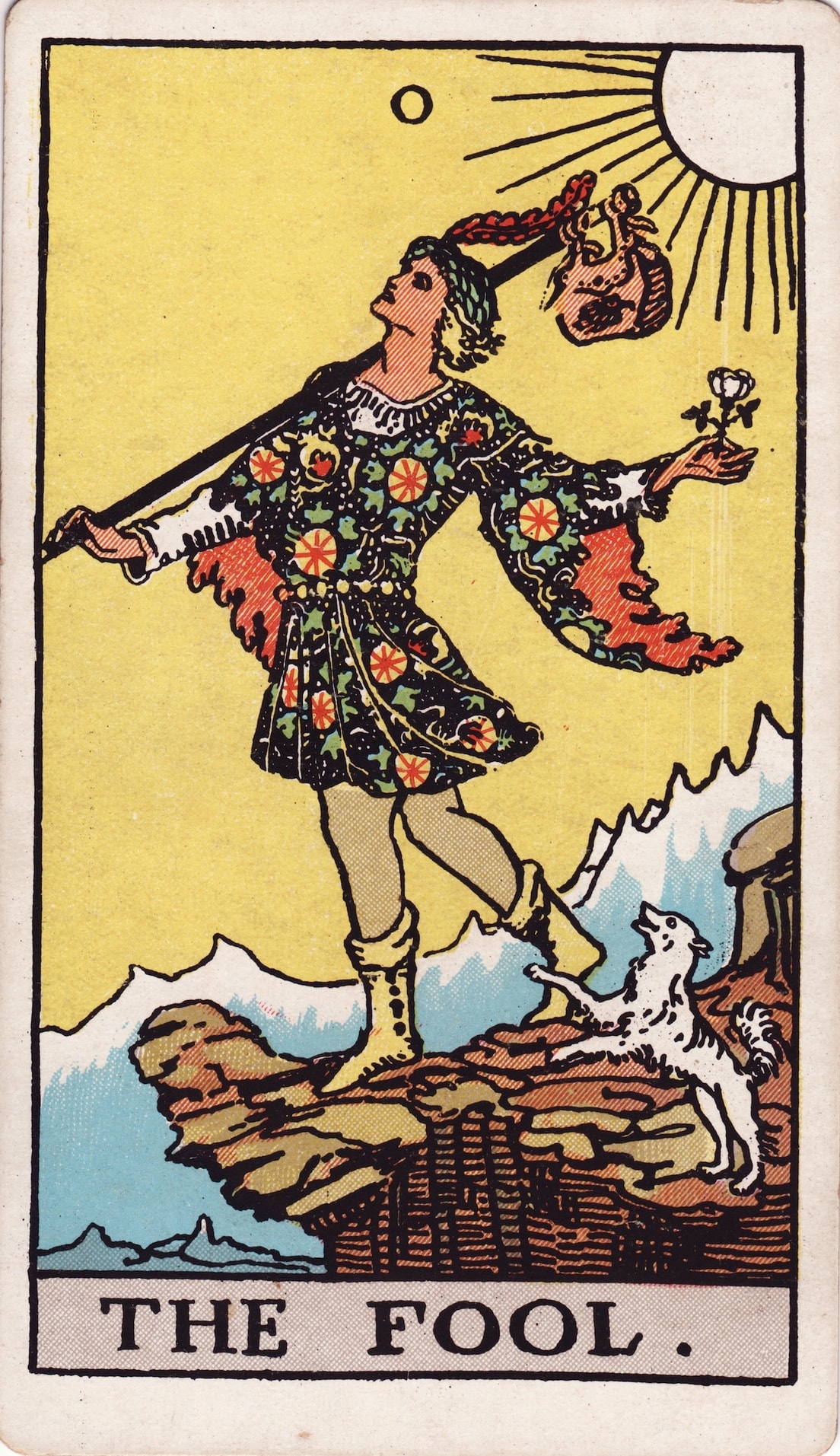
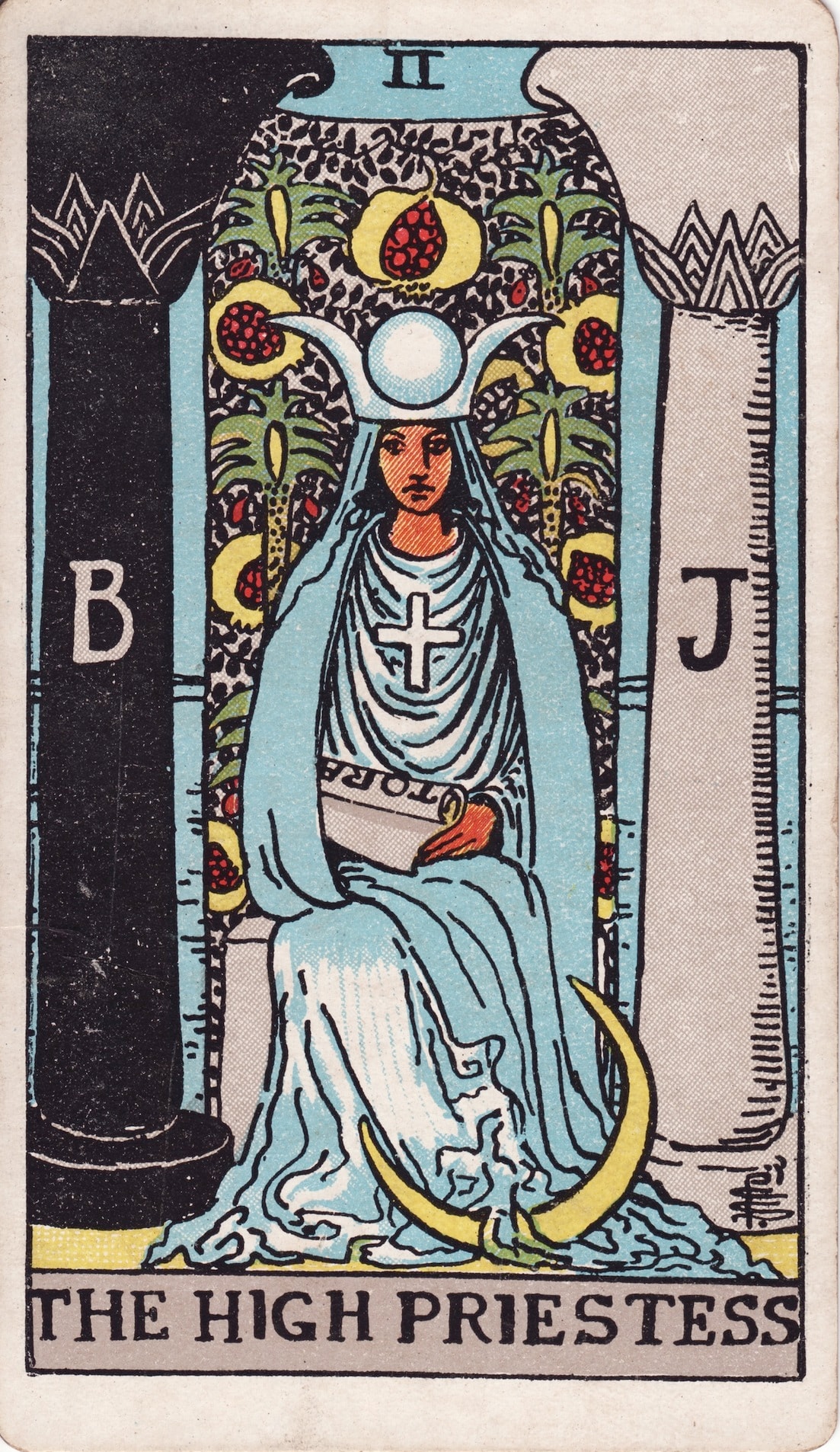
The first row of the Fool's journey
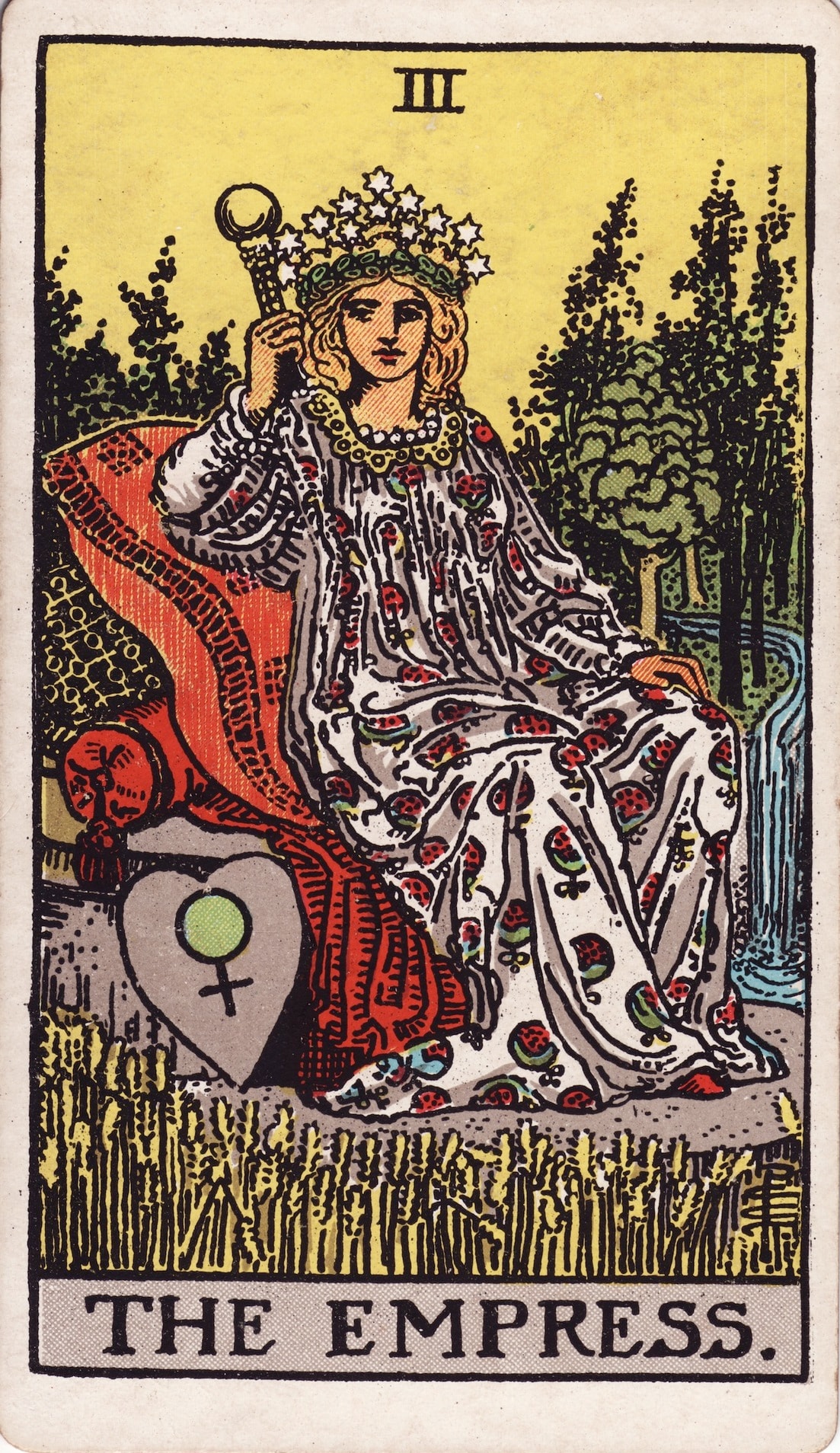


All the cards of the Major Arcana, or the whole deck.