Trump VI, Major Arcana
The Lovers
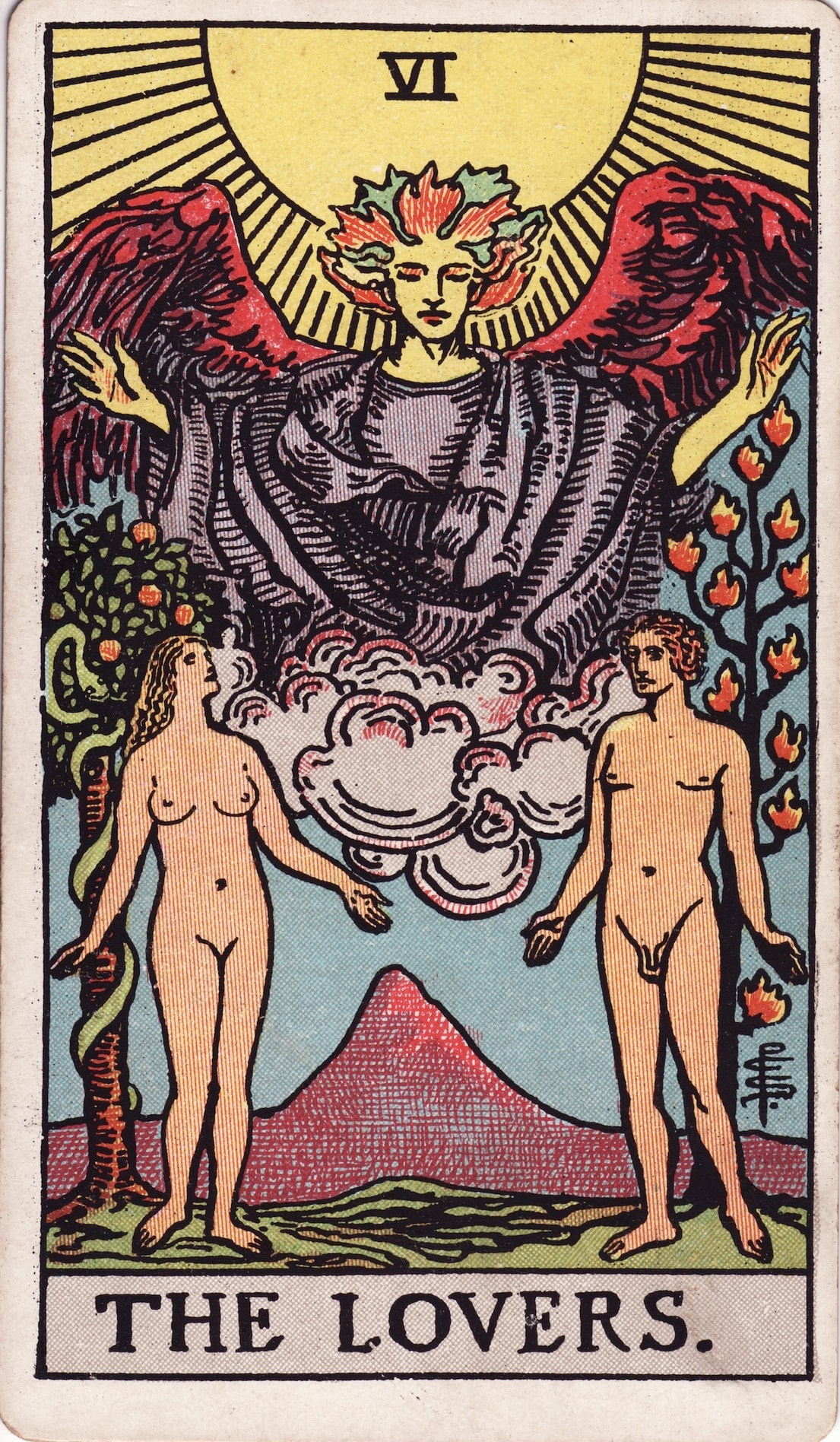
Pamela Colman Smith drew trump VI, the Lovers, in 1909 as a naked man and woman standing apart in a garden under a winged angel and a great sun. A snake winds up the fruit tree behind the woman, a tree of flames stands behind the man, and a single mountain rises between them.
What Waite wrote it means (1910)
- Divinatory meanings
Attraction, love, beauty, trials overcome.
- Reversed
Failure, foolish designs. Another account speaks of marriage frustrated and contrarieties of all kinds.
Arthur Edward Waite, The Pictorial Key to the Tarot (London, 1911), p. 284. Read it in the chapter
The sun shines in the zenith, and beneath is a great winged figure with arms extended, pouring down influences. In the foreground are two human figures, male and female, unveiled before each other, as if Adam and Eve when they first occupied the paradise of the earthly body. Behind the man is the Tree of Life, bearing twelve fruits, and the Tree of the Knowledge of Good and Evil is behind the woman; the serpent is twining round it. The figures suggest youth, virginity, innocence and love before it is contaminated by gross material desire. This is in all simplicity the card of human love, here exhibited as part of the way, the truth and the life. It replaces, by recourse to first principles, the old card of marriage, which I have described previously, and the later follies which depicted man between vice and virtue. In a very high sense, the card is a mystery of the Covenant and Sabbath.
The suggestion in respect of the woman is that she signifies that attraction towards the sensitive life which carries within it the idea of the Fall of Man, but she is rather the working of a Secret Law of Providence than a willing and conscious temptress. It is through her imputed lapse that man shall arise ultimately, and only by her can he complete himself. The card is therefore in its way another intimation concerning the great mystery of womanhood. The old meanings fall to pieces of necessity with the old pictures, but even as interpretations of the latter, some of them were of the order of commonplace and others were false in symbolism.
What's in the picture
- The sun. A huge pale sun fills the top of the card, its rays fanning out behind the angel's head and wings.
- The angel's face. The angel's hair stands up in green and red tongues, like flames. Its eyes look closed, or turned down.
- The wings and arms. Wide red and purple wings spread across the sky, and the angel holds both arms out, palms open, over the two people.
- The cloud. The angel rises out of a white cloud that hangs in the middle of the card, between the two heads.
- The woman. She stands on the left with her long fair hair down her back. Her face is turned up, past the man, toward the angel.
- The man. He stands on the right with short curly hair. His face turns toward the woman, and his open hands hang at his sides.
- The tree with fruit. Behind the woman grows a dark leafy tree with round orange fruit. A green snake winds up its trunk, its head near the top.
- The tree of flames. Behind the man grows a tree whose fruits are little orange flames, set along thin black branches.
- The mountain. A single red mountain rises from the low ground between the two figures, its peak right under the cloud.
- Smith's monogram. Pamela Colman Smith's small knot-like mark stands on the right, just past the man's hand.
The card in brief
- In the deck
- Card 7 of 78
- Arcana
- Major Arcana
- Number
- Trump VI
- Hebrew letter (Golden Dawn)
- Zayin
- Astrology (Golden Dawn)
- Gemini
- Title in Book T
- The Children of the Voice; the Oracles of the Mighty Gods
- Drawn by
- Pamela Colman Smith
- Planned by
- Arthur Edward Waite
- Published
- London, William Rider & Son, 1909
- Scan
- Pam-A printing, c. 1910, Wikimedia Commons
In the old books
Book T (1912)
Inspiration (passive, mediumistic), motive power, action.
Book T, “A Description of the Cards of the Tarot”, The Equinox I.8 (London, 1912), p. 203. See the source Papus (1892)
A beardless youth (our Juggler of the 1st arcanum), but without a hat, is standing motionless in the angle where two roads meet. His arms form a diagonal cross upon his breast.
The repetition of the 1st arcanum under another form. Here the man is not one of the Initiates. He does not know how to direct the magnetic currents of the Astral Light; he is therefore plunged in the antagonism of the different ideas which he cannot master.
Papus, The Tarot of the Bohemians, tr. A. P. Morton (London, 1892), p. 128. See the source
Before 1909
The older cards and pictures behind this one will be shown here once their licences are checked.
The Lovers under the angel
The Lovers stand in a garden under a huge sun. Above them, a winged angel with flaming hair spreads its arms over a cloud. Below stand a woman and a man, naked, a little apart, with a mountain rising between them. Behind the woman is a tree with fruit, and a snake winds up its trunk. Behind the man is a tree whose fruits are small flames. Now follow the eyes. The man looks at the woman. The woman looks up at the angel.
This is trump VI. If you walk the trumps in order, it is where the Fool meets another person. You could let the card be about love, and also about seeing through someone else's eyes.
The image
Arthur Edward Waite described the scene: "The sun shines in the zenith, and beneath is a great winged figure with arms extended, pouring down influences." The two people stand "as if Adam and Eve when they first occupied the paradise of the earthly body".
The trees come from the Garden of Eden, in the Book of Genesis. Waite named them. "Behind the man is the Tree of Life, bearing twelve fruits." Behind the woman stands "the Tree of the Knowledge of Good and Evil", with the serpent "twining round it". Pamela Colman Smith drew the fruits of the man's tree as little flames.
Waite called this "in all simplicity the card of human love". He said it replaced two older ways of seeing the card. In one, it showed married life: a father, a mother and their child, with Cupid above "in the act of flying his shaft". In the other, a man stood between vice and virtue. Waite called that second reading one of "the later follies".
You can see the older card in Jean Dodal's Tarot de Marseille, printed in Lyon in the early 1700s. There a young man stands between two women, and one of them has a hand on his shoulder. Above them, from a blazing sun, Cupid aims his arrow. Is this a family, or a choice? The old question hasn't quite left Smith's card. She drew two trees, and in Genesis everything turns on the fruit of one of them.
The inner journey
So far the Fool has met powers: making, knowing, growing, ruling and teaching. Now he meets someone who could say no.
Jung thought each of us carries an inner figure of the other sex. In a man he called it the anima, and in a woman the animus. When you fall in love, he thought, part of what you see is this inner figure. You throw it onto a real person, like a picture onto a screen. The work of love, in his view, is to tell the two apart: the person in front of you, and the picture you carry.
Look at the eyes again. The man looks at the woman. The woman looks past him, up to the angel. Each of them sees something the other can't. You could read that as a small drama of love. Two people look at each other, and each one is also looking beyond.
Along the road the Lovers can seem like a choice to make and leave behind. You could also treat the card as a place to live for a while. Being close to someone has its own weather. So does being torn between two people, or two lives. See what this card shows you about the people you look at, and about what you see through them.
Across traditions
For the Golden Dawn the Lovers belong to Zain, the seventh of the Hebrew letters, and to Gemini, the twins. Book T gives the card a long title, "The Children of the Voice; the Oracles of the Mighty Gods". Its short note speaks of inspiration: "Inspiration (passive, mediumistic), motive power, action."
Gemini is the sign of Castor and Pollux, twin brothers in Greek myth. In Homer's Odyssey they lie under the earth and yet stay alive. They "die and come to life again, each one of them every other day throughout all time". Two figures, bound together, take turns in two worlds. You could look at the man and the woman on the card through that story too.
Waite read the woman through Genesis. He saw in her the pull toward the life of the senses, the pull that led to the Fall. He added that she is no willing temptress, and that "only by her can he complete himself". In Waite's reading the man needs the woman to become whole. You could turn that round and ask what she needs from him, or what both of them need from the angel.
Try this
Choose two people or things you care about that pull you different ways. Set an object that reminds you of each one to the left and the right of the card. Look at the card from the left side for a minute, then from the right. Does it change? Then look at it from above, where the angel is. Notice which view feels most like yours today.
Questions to sit with
- Who is the man looking at? Who is the woman looking at?
- What would the angel say if it opened its eyes?
- When did you last see someone clearly, and not the picture you had of them?
- Which tree would you stand under?
- What does the Fool learn here that no power could teach him?
The film
No film for this card yet.
Sources
- Waite on the sun in the zenith, the winged figure, Adam and Eve, the two trees and the serpent, the card of human love that replaced the old card of marriage and the later follies.Arthur Edward Waite, The Pictorial Key to the Tarot (London, 1911), Part II, The Lovers, p. 92
- The woman as the pull toward the sensitive life, no willing temptress; only by her can he complete himself.Arthur Edward Waite, The Pictorial Key to the Tarot (London, 1911), Part II, The Lovers, p. 95
- The older card of married life, with Cupid flying his shaft.Arthur Edward Waite, The Pictorial Key to the Tarot (London, 1911), Part I, Trumps Major, no. 6, pp. 14–15
- The tree of life and the tree of knowledge of good and evil.Genesis 2:9, King James Version
- Dodal's card: a young man between two women, Cupid aiming from a sun.Jean Dodal, Tarot de Marseille (Lyon, 1701–1715), card VI, L'AMOVREVX; Bibliothèque nationale de France, via Wikimedia Commons
- Jung on the anima and animus, and their projection in love.C. G. Jung, Aion (1951), ch. 3, The Syzygy: Anima and Animus (Collected Works 9ii); Marriage as a Psychological Relationship (1925), Collected Works 17
- The Golden Dawn gave the Lovers Zain and Gemini; Book T's title and short note for the card.Book T, The Equinox I.8 (1912), table of the Keys and brief meanings of the trumps
- Gemini, the constellation of Castor and Pollux.Webster's Revised Unabridged Dictionary (1913), Gemini
- Castor and Pollux die and come to life again every other day.Homer, The Odyssey, Book XI, translated by Samuel Butler (1900)
Around this card
Before and after it in the deck
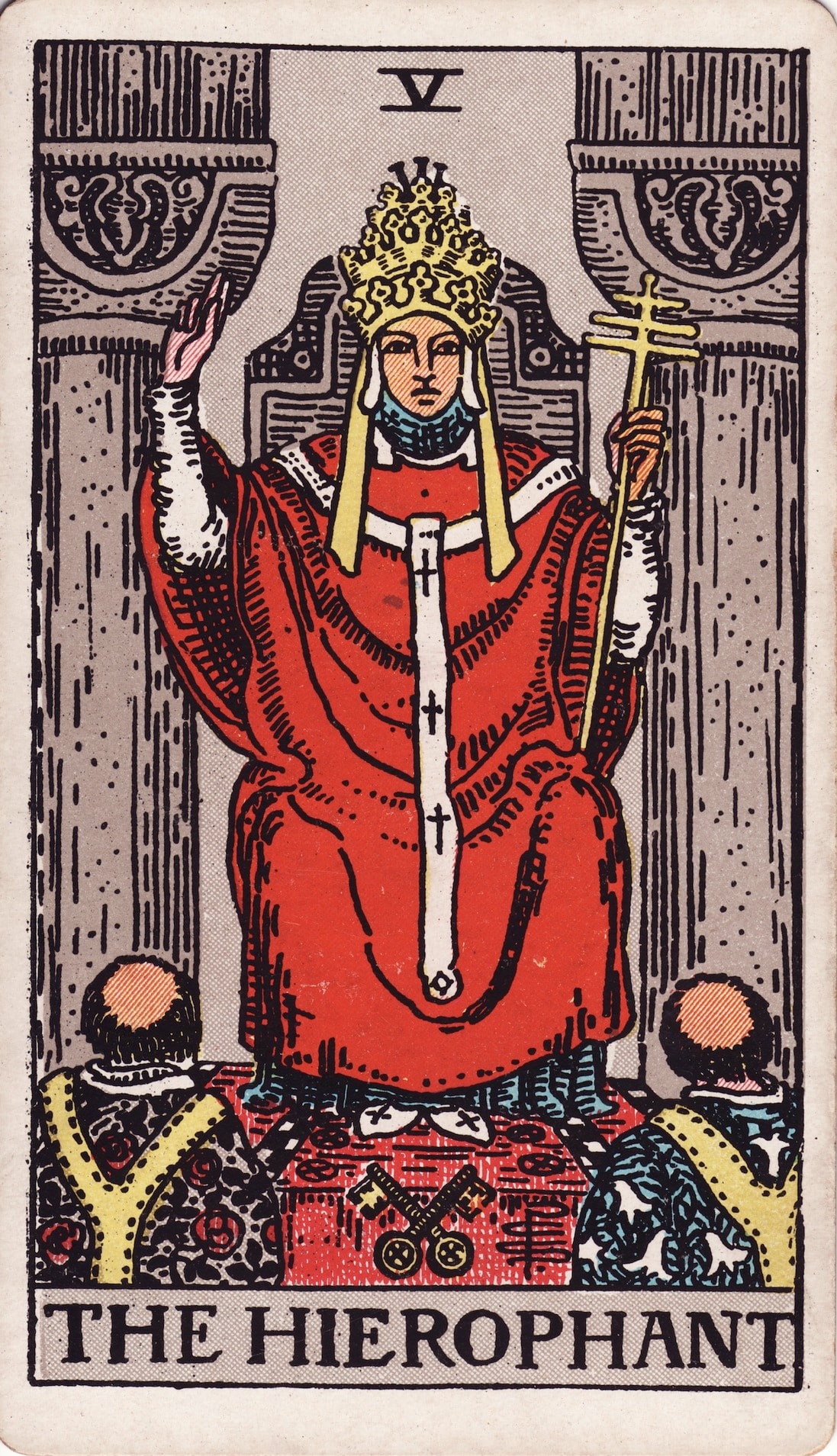
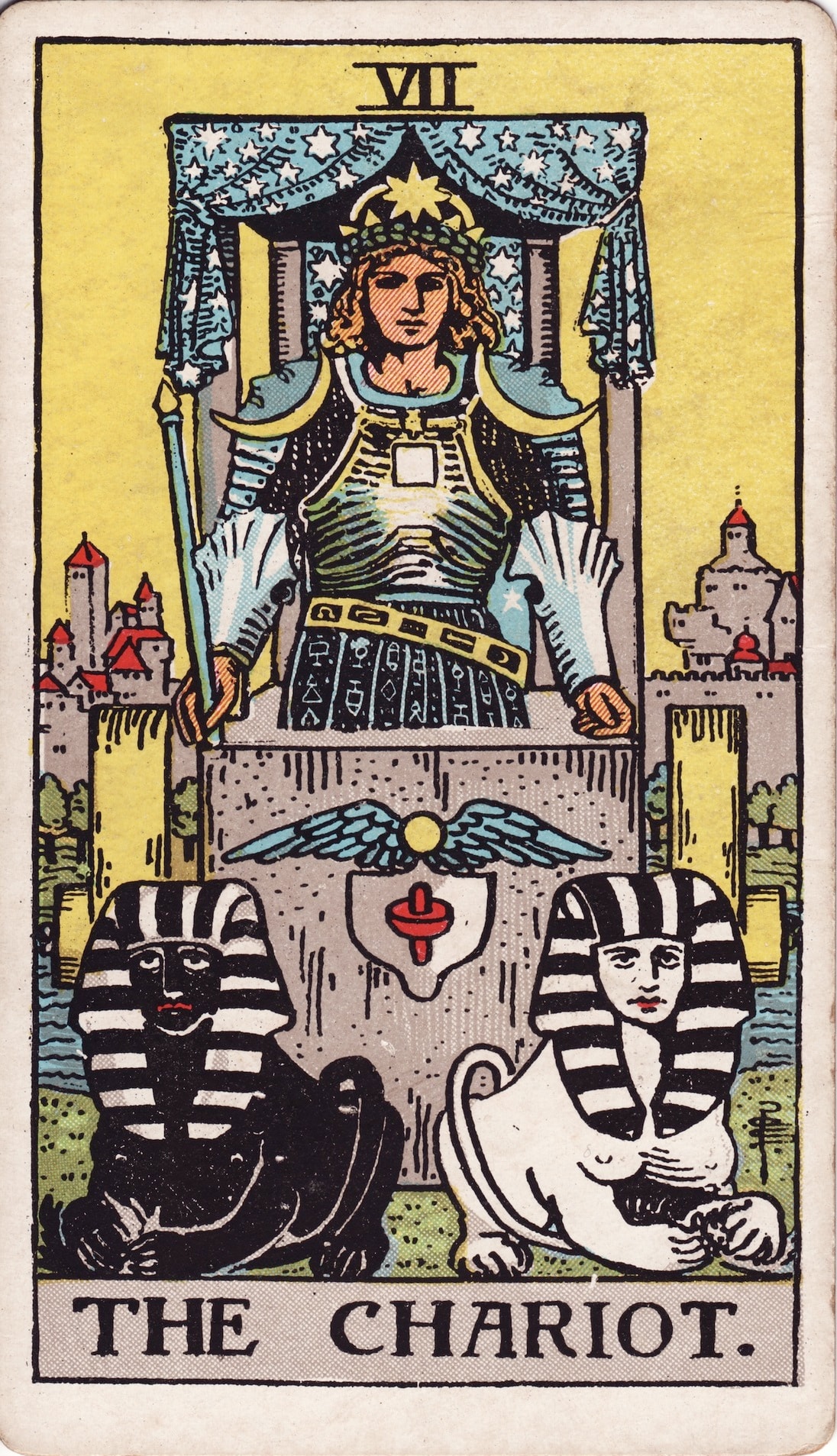
The first row of the Fool's journey
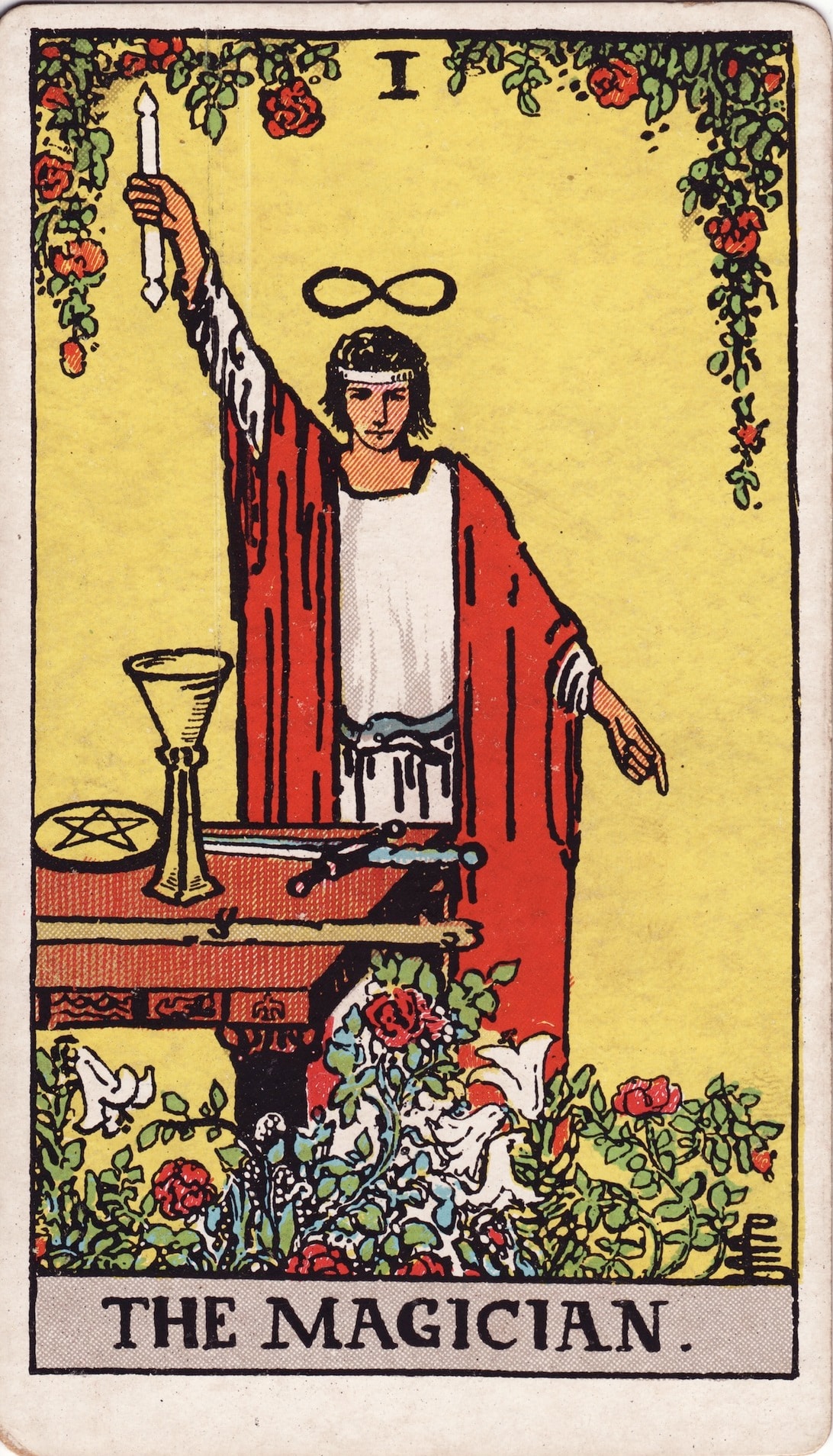


All the cards of the Major Arcana, or the whole deck.