Trump III, Major Arcana
The Empress
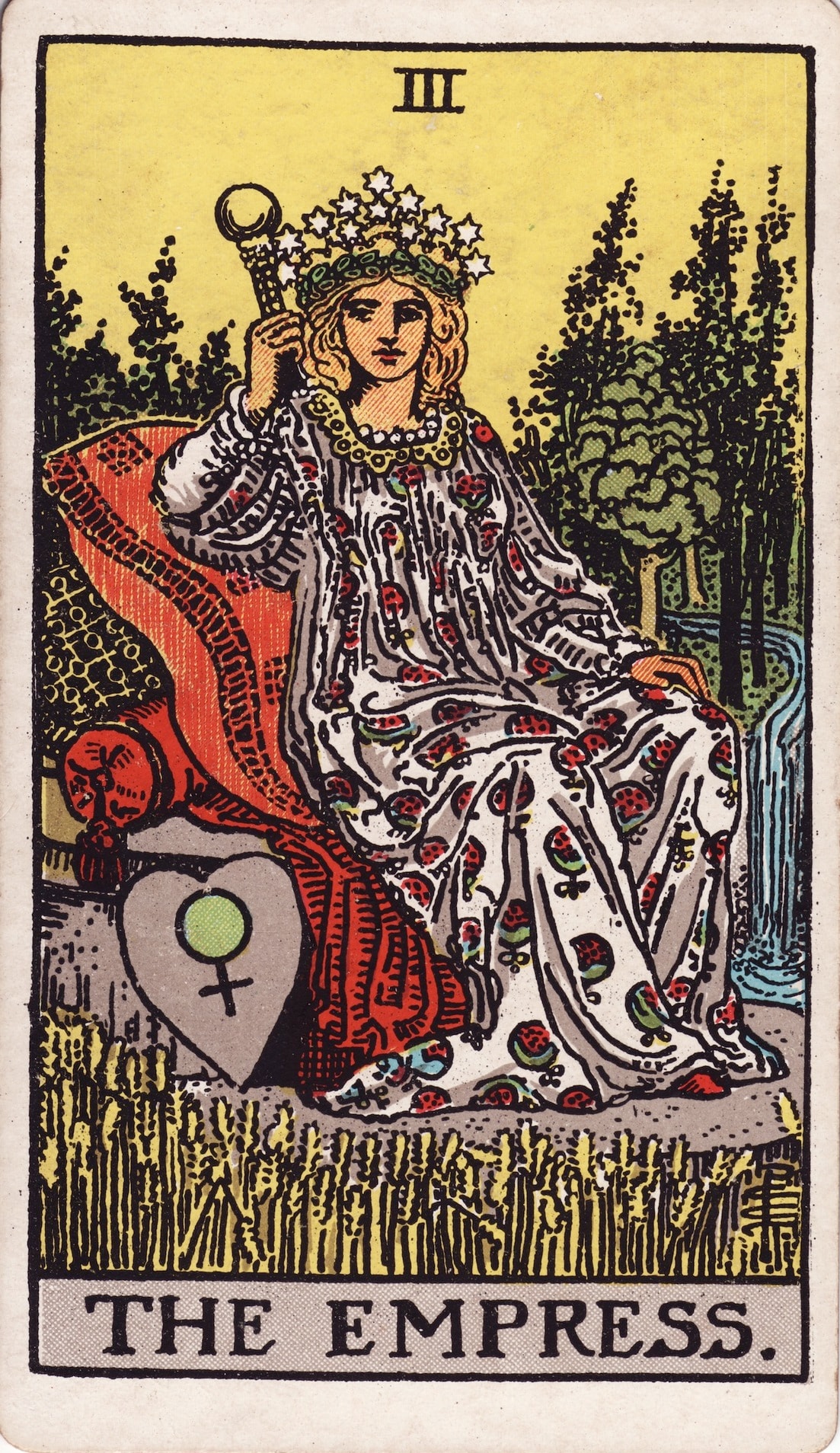
The Empress is trump III, and Pamela Colman Smith drew her in 1909 sitting on deep red cushions out of doors, with ripe wheat at her feet. She wears a crown of stars and a white robe printed with red fruit, holds up a sceptre topped with a globe, and has a heart-shaped shield with the sign of Venus beside her.
What Waite wrote it means (1910)
- Divinatory meanings
Fruitfulness, action, initiative, length of days; the unknown, clandestine; also difficulty, doubt, ignorance.
- Reversed
Light, truth, the unravelling of involved matters, public rejoicings; according to another reading, vacillation.
Arthur Edward Waite, The Pictorial Key to the Tarot (London, 1911), p. 283. Read it in the chapter
A stately figure, seated, having rich vestments and royal aspect, as of a daughter of heaven and earth. Her diadem is of twelve stars, gathered in a cluster. The symbol of Venus is on the shield which rests near her. A field of corn is ripening in front of her, and beyond there is a fall of water. The sceptre which she bears is surmounted by the globe of this world. She is the inferior Garden of Eden, the Earthly Paradise, all that is symbolized by the visible house of man. She is not Regina coeli, but she is still refugium peccatorum, the fruitful mother of thousands. There are also certain aspects in which she has been correctly described as desire and the wings thereof, as the woman clothed with the sun, as Gloria Mundi and the veil of the Sanctum Sanctorum; but she is not, I may add, the soul that has attained wings, unless all the symbolism is counted up another and unusual way. She is above all things universal fecundity and the outer sense of the Word. This is obvious, because there is no direct message which has been given to man like that which is borne by woman; but she does not herself carry its interpretation.
In another order of ideas, the card of the Empress signifies the door or gate by which an entrance is obtained into this life, as into the Garden of Venus; and then the way which leads out therefrom, into that which is beyond, is the secret known to the High Priestess: it is communicated by her to the elect. Most old attributions of this card are completely wrong on the symbolism—as, for example, its identification with the Word, Divine Nature, the Triad, and so forth.
What's in the picture
- The crown of stars. White six-pointed stars stand in a cluster above a wreath of green leaves in her fair hair. Waite counted twelve.
- The sceptre. She holds up a patterned sceptre in her right hand. Its top is a round globe.
- The necklace. A string of large pale beads lies around her neck, at the top of the robe.
- The red cushions. She leans back into deep red cushions piled on her seat, with a round red cushion at the end. She sits outdoors, with no throne room around her.
- The shield. A grey shield shaped like a heart leans against the seat. In its middle is the sign of Venus, a green circle over a small cross.
- The robe. Her long white robe is printed with red fruit dotted with seeds, each with green leaves, and falls in folds to her red shoes.
- The trees. Tall dark trees stand close together behind her, thickest on the right, with a yellow sky above.
- The waterfall. At the right edge a stream of blue water falls down past the trees and spreads into a pool at the bottom.
- The wheat. Ripe wheat stands tall and gold across the whole bottom of the card, right up to her feet.
- Smith's monogram. Hidden among the wheat stalks at the bottom right is Pamela Colman Smith's small knot-like mark.
The card in brief
- In the deck
- Card 4 of 78
- Arcana
- Major Arcana
- Number
- Trump III
- Hebrew letter (Golden Dawn)
- Daleth
- Astrology (Golden Dawn)
- Venus
- Title in Book T
- The Daughter of the Mighty Ones
- Drawn by
- Pamela Colman Smith
- Planned by
- Arthur Edward Waite
- Published
- London, William Rider & Son, 1909
- Scan
- Pam-A printing, c. 1910, Wikimedia Commons
In the old books
Book T (1912)
Beauty, happiness, pleasure, success. But with very bad dignity it means luxury, dissipation.
Book T, “A Description of the Cards of the Tarot”, The Equinox I.8 (London, 1912), p. 203. See the source Papus (1892)
A woman seen full face.
The human being becomes corporeal in the womb of a woman.
Papus, The Tarot of the Bohemians, tr. A. P. Morton (London, 1892), p. 116. See the source
Before 1909
The older cards and pictures behind this one will be shown here once their licences are checked.
The Empress in the wheat
The Empress sits outdoors, on red cushions, at the edge of a field. Ripe wheat grows at her feet. Behind her rise tall trees, and a waterfall pours into a stream. Her crown has twelve stars. Her long white robe is printed with red fruit. A heart-shaped shield leans beside her with the sign of Venus on it, a circle over a small cross. She holds a sceptre topped with a ball. Everything here grows, and nothing is in a hurry.
She is trump III. Walk the trumps in order and the Fool has met a maker and a keeper of secrets by now. Here, for the first time, the world itself feeds him. You could spend a few minutes looking only at what grows on this card.
The image
Start at the bottom. The wheat stands tall and gold, ready to cut. Arthur Edward Waite wrote: "A field of corn is ripening in front of her, and beyond there is a fall of water." In his English, corn meant any grain. On the card it is wheat.
Waite called her "a stately figure, seated", "as of a daughter of heaven and earth". Her crown, he said, is "of twelve stars, gathered in a cluster". Her sceptre is topped with "the globe of this world".
Now the shield. It is shaped like a heart, with the sign of Venus in the middle. Venus was the Roman goddess of love and beauty. Look at the robe next. It is printed with red fruit among green leaves, and the fruit is dotted with seeds. They could be pomegranates. If they are, the fruit from the High Priestess's veil has moved onto the Empress's dress. What was hidden behind a curtain is now out in the sun, on a body at ease.
Set the two cards side by side. The High Priestess sat in a temple, between pillars, in moonlight. Her robe ran off the card like water. Here the water runs free, down a real waterfall, under a yellow sky. The High Priestess sat upright. The Empress leans back into her cushions.
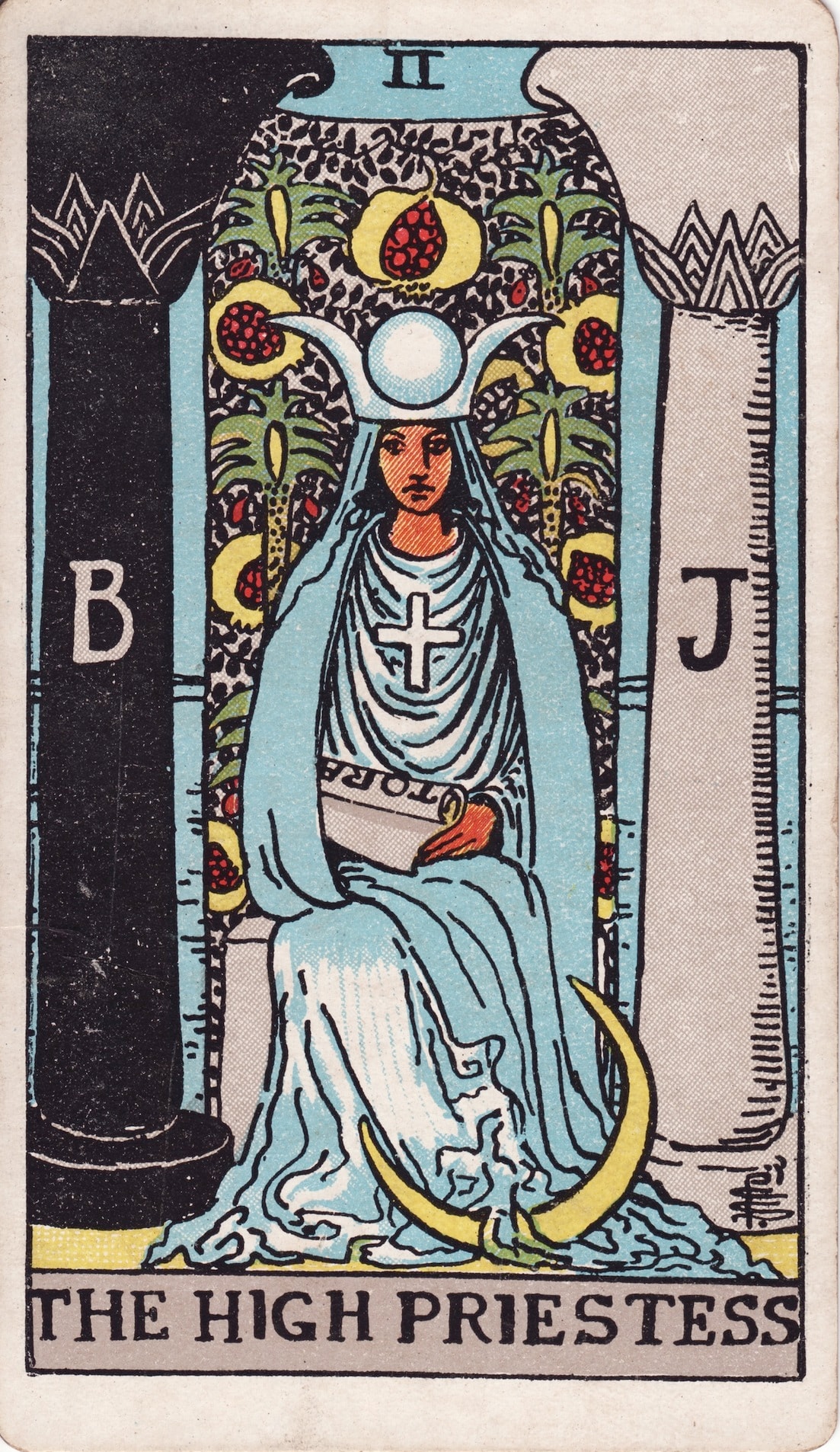
Waite called this card the door or gate "by which an entrance is obtained into this life". The way back out, he added, is a secret the High Priestess keeps. So the two women stand at the two doors of a life: the way in and the way out.
The inner journey
Jung wrote about the mother as an archetype, a pattern deep in the mind that shapes many images. Your own mother is one form of it. The earth is another, and so are a garden, a city and a cave. A ploughed field is one too. He thought the mother pattern has two faces. One feeds and protects. The other holds on and won't let go.
On this card you see mostly the first face. After the Magician's skill and the High Priestess's secret, the Empress offers the Fool a body and a world to live in. There is food here, and time to rest.
You could hurry past her on the road. Growing things take their time, though. Wheat needs a whole season. You could stay with the Empress for a while and see what it is like to let something grow at its own speed. It might be a garden, a friendship or a piece of work. It might be your own body, resting.
Some days the second face may show as well. Is there something in your life that feeds you so well it is hard to leave? You can hold that question lightly, next to the pleasure of the field.
Across traditions
The Golden Dawn matched the Empress with Daleth, the fourth of the Hebrew letters, and with the planet Venus, the sign on her shield. Book T names her "Daughter of the Mighty Ones".
Waite heard another voice in her. He wrote that she has been called "the woman clothed with the sun". The phrase comes from the Book of Revelation. There a woman appears in the sky, "clothed with the sun, and the moon under her feet, and upon her head a crown of twelve stars". Pamela Colman Smith gave the Empress the twelve stars and the High Priestess the moon at her feet. So the woman of Revelation is split across two cards.
The Greeks had a goddess of grain, Demeter. An old Greek poem, the Homeric Hymn to Demeter, tells how her daughter Persephone was carried down to the underworld. Demeter grieved, and while she grieved, nothing grew. "The ground would not make the seed sprout." In the fields, "the oxen drew many a curved plough in vain". At last the gods let Persephone come back for most of each year, and the fields grew again.
You could read the Empress's wheat through that story. A full field may be a field after a return, when the grieving is over. Then look back at the High Priestess, with pomegranates on the veil behind her. The two cards sit side by side, like a daughter and a mother.
Try this
Go outside, or to a window, and find one living thing that is growing. A weed in a crack counts. Look at it for two minutes without thinking about what it is for. Then look back at the Empress. How many growing things can you find in her picture? Is anyone being fed, or feeding someone else? Pick another card you know and ask what it would need before anything could grow in it.
Questions to sit with
- What in your life is ripening, like the wheat?
- Who or what has fed you this week?
- Where is the water on this card coming from? Where is it going?
- What grows best when you leave it alone?
- What would the Empress give the Fool to take with him?
The film
No film for this card yet.
Sources
- Waite on the stately figure, the crown of twelve stars, the field of corn and the fall of water, the sceptre with the globe of this world, the woman clothed with the sun, and the door into this life whose way out the High Priestess knows.Arthur Edward Waite, The Pictorial Key to the Tarot (London, 1911), Part II, The Empress, pp. 80–83
- Corn as grain in general.Webster's Revised Unabridged Dictionary (1913), corn, sense 2
- Jung on the mother archetype, its forms and its two faces.C. G. Jung, Psychological Aspects of the Mother Archetype (1938/1954), Collected Works 9i, §156–158
- The Golden Dawn gave the Empress Daleth and Venus; Book T calls her Daughter of the Mighty Ones.Book T, The Equinox I.8 (1912), table of the Keys
- A woman clothed with the sun, the moon under her feet, a crown of twelve stars.Revelation 12:1, King James Version
- Demeter's grief, the seed kept hidden, the ploughs drawn in vain, and the fields growing again after Persephone's return.Homeric Hymn to Demeter, lines 305–309, 399–403 and 470–473, translated by Hugh G. Evelyn-White (1914)
Around this card
Before and after it in the deck
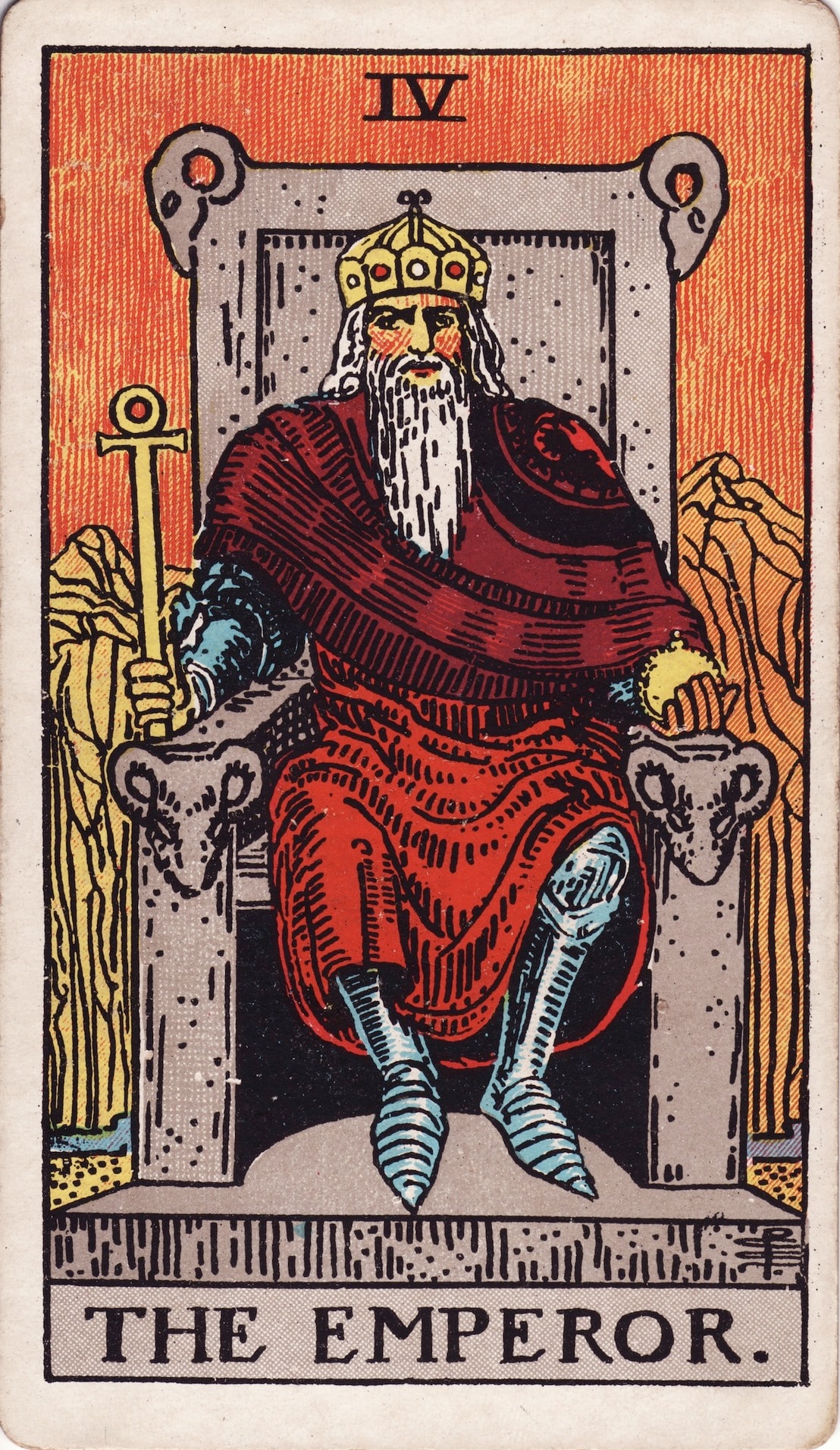
The first row of the Fool's journey
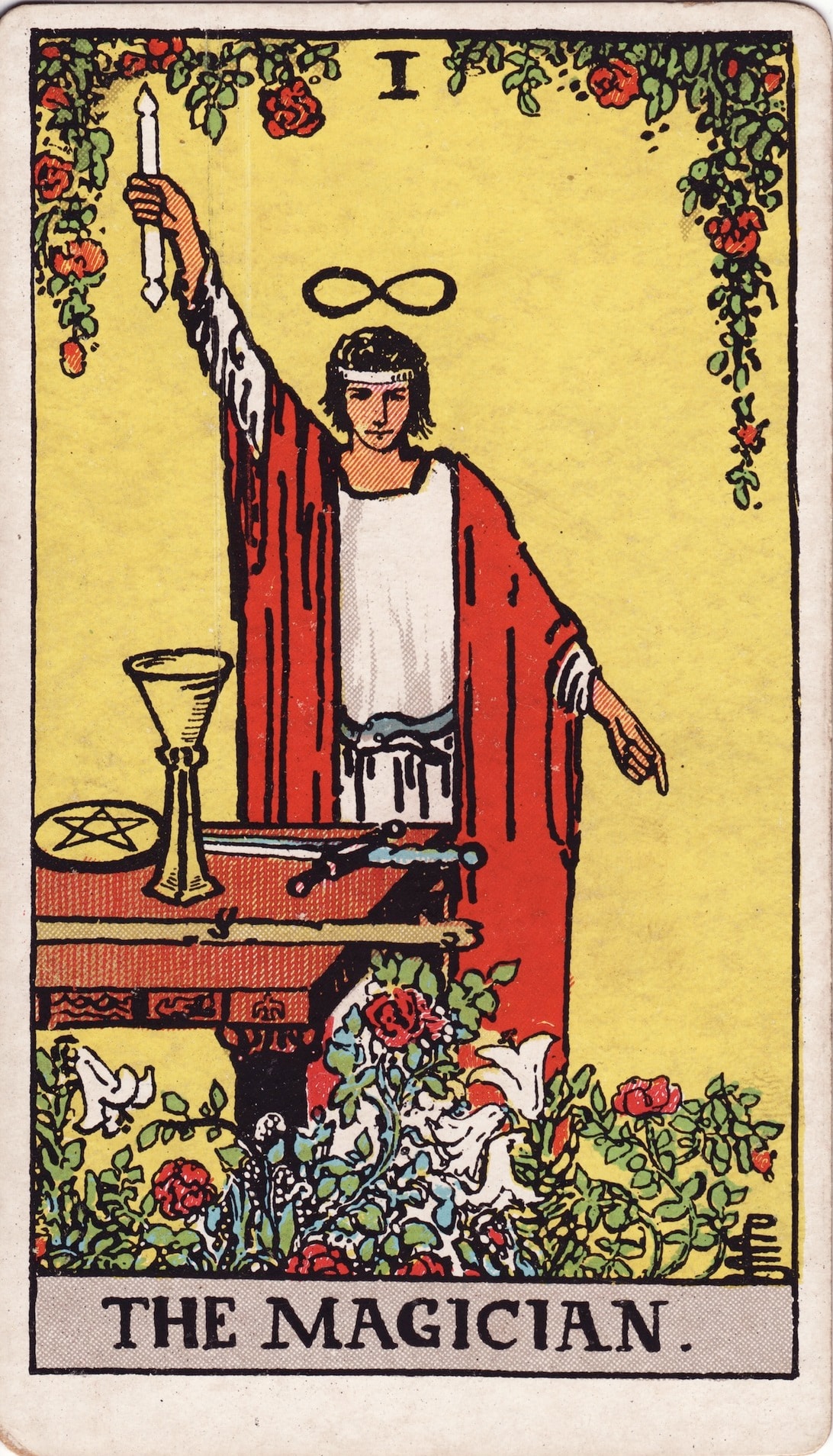

All the cards of the Major Arcana, or the whole deck.