Trump V, Major Arcana
The Hierophant
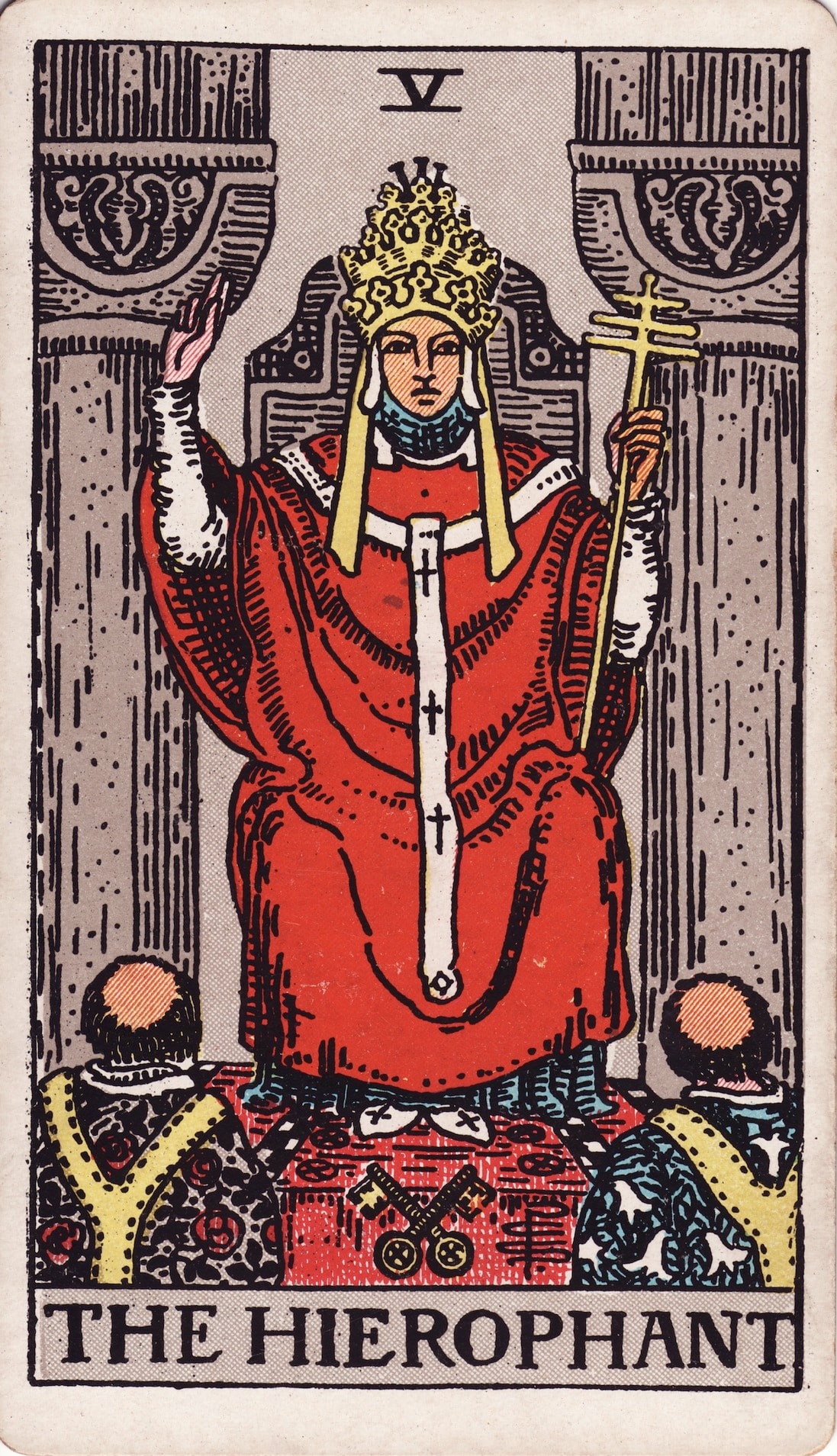
Trump V, the Hierophant, is the card older decks called the Pope. Pamela Colman Smith drew him in 1909 as a priest in a triple crown between two grey pillars, raising one hand in blessing over two kneeling men with shaved heads, with a pair of crossed keys at his feet.
What Waite wrote it means (1910)
- Divinatory meanings
Marriage, alliance, captivity, servitude; by another account, mercy and goodness; inspiration; the man to whom the Querent has recourse.
- Reversed
Society, good understanding, concord, over-kindness, weakness.
Arthur Edward Waite, The Pictorial Key to the Tarot (London, 1911), p. 284. Read it in the chapter
He wears the triple crown and is seated between two pillars, but they are not those of the Temple which is guarded by the High Priestess. In his left hand he holds a sceptre terminating in the triple cross, and with his right hand he gives the well-known ecclesiastical sign which is called that of esotericism, distinguishing between the manifest and concealed part of doctrine. It is noticeable in this connexion that the High Priestess makes no sign. At his feet are the crossed keys, and two priestly ministers in albs kneel before him. He has been usually called the Pope, which is a particular application of the more general office that he symbolizes. He is the ruling power of external religion, as the High Priestess is the prevailing genius of the esoteric, withdrawn power. The proper meanings of this card have suffered woeful admixture from nearly all hands. Grand Orient says truly that the Hierophant is the power of the keys, exoteric orthodox doctrine, and the outer side of the life which leads to the doctrine; but he is certainly not the prince of occult doctrine, as another commentator has suggested.
He is rather the summa totius theologiæ, when it has passed into the utmost rigidity of expression; but he symbolizes also all things that are righteous and sacred on the manifest side. As such, he is the channel of grace belonging to the world of institution as distinct from that of Nature, and he is the leader of salvation for the human race at large. He is the order and the head of the recognized hierarchy, which is the reflection of another and greater hierarchic order; but it may so happen that the pontiff forgets the significance of this his symbolic state and acts as if he contained within his proper measures all that his sign signifies or his symbol seeks to shew forth. He is not, as it has been thought, philosophy—except on the theological side; he is not inspiration; and he is not religion, although he is a mode of its expression.
What's in the picture
- The triple crown. He wears a tall gold crown built up in three tiers, with long yellow bands hanging down on either side of his face.
- The raised hand. His right hand is raised beside his head, palm out and fingers up, in a sign of blessing.
- The triple cross. In his other hand he holds a long golden staff. Its top has three crossbars, one above the other.
- The pillars. Two plain grey pillars stand behind the throne, one on each side, with carved tops. They carry no letters, and no veil hangs between them.
- The white stole. A white band runs down the front of his red robe to his feet, marked with small black crosses.
- The crossed keys. Two keys lie crossed on the red carpet at his feet, their round handles at the bottom. Nobody holds them.
- The student with roses. A man kneels on the left with his back to us. His dark robe is patterned with red roses, and a yellow band forms a Y across his back.
- The student with lilies. The man on the right kneels the same way. His robe is blue-black, scattered with white lilies, with the same yellow Y.
- The shaved heads. The tops of both men's heads are shaved in a round patch, the way monks once wore their hair.
- Smith's monogram. Pamela Colman Smith's small knot-like mark sits on the red carpet, just right of the keys.
The card in brief
- In the deck
- Card 6 of 78
- Arcana
- Major Arcana
- Number
- Trump V
- Hebrew letter (Golden Dawn)
- Vav
- Astrology (Golden Dawn)
- Taurus
- Title in Book T
- The Magus of the Eternal
- Drawn by
- Pamela Colman Smith
- Planned by
- Arthur Edward Waite
- Published
- London, William Rider & Son, 1909
- Scan
- Pam-A printing, c. 1910, Wikimedia Commons
In the old books
Book T (1912)
Divine wisdom, manifestation, explanation, teaching, occult force voluntarily invoked.
Book T, “A Description of the Cards of the Tarot”, The Equinox I.8 (London, 1912), p. 203. See the source Papus (1892)
The Initiate of the mysteries of Isis is seated between the two columns of the sanctuary. He leans upon a triple cross, and makes the sign of Esoterism with his left hand.
The triple Cross represents the triple Lingam of Indian theogony ; that is to say, the penetration of the creative power throughout the Divine, the Intellectual, and the Physical Worlds, which causes all the manifestations of universal life to appear (first idea).
Papus, The Tarot of the Bohemians, tr. A. P. Morton (London, 1892), p. 124. See the source
Before 1909
The older cards and pictures behind this one will be shown here once their licences are checked.
The Hierophant and the keys
The Hierophant sits between two grey pillars. He wears a tall triple crown and red robes. His right hand is raised in blessing. His left hand holds a staff topped with a triple cross. At his feet lie two crossed keys. Two men kneel in front of him with their backs to you, the tops of their heads shaved. You stand behind them, as if you had come in late to a lesson.
Take the trumps as stations of one long walk, and trump V is where the Fool meets a tradition: something handed down to him, older than he is. You could look at the card first as one of the students, and then as the teacher.
The image
The word hierophant comes from Greek words for "holy" and "to show". The Greeks used it for the priest who led people into the Mysteries of Eleusis, a secret rite for Demeter and Persephone. Older decks gave this card a plainer name. Arthur Edward Waite noted that the figure "has been usually called the Pope".
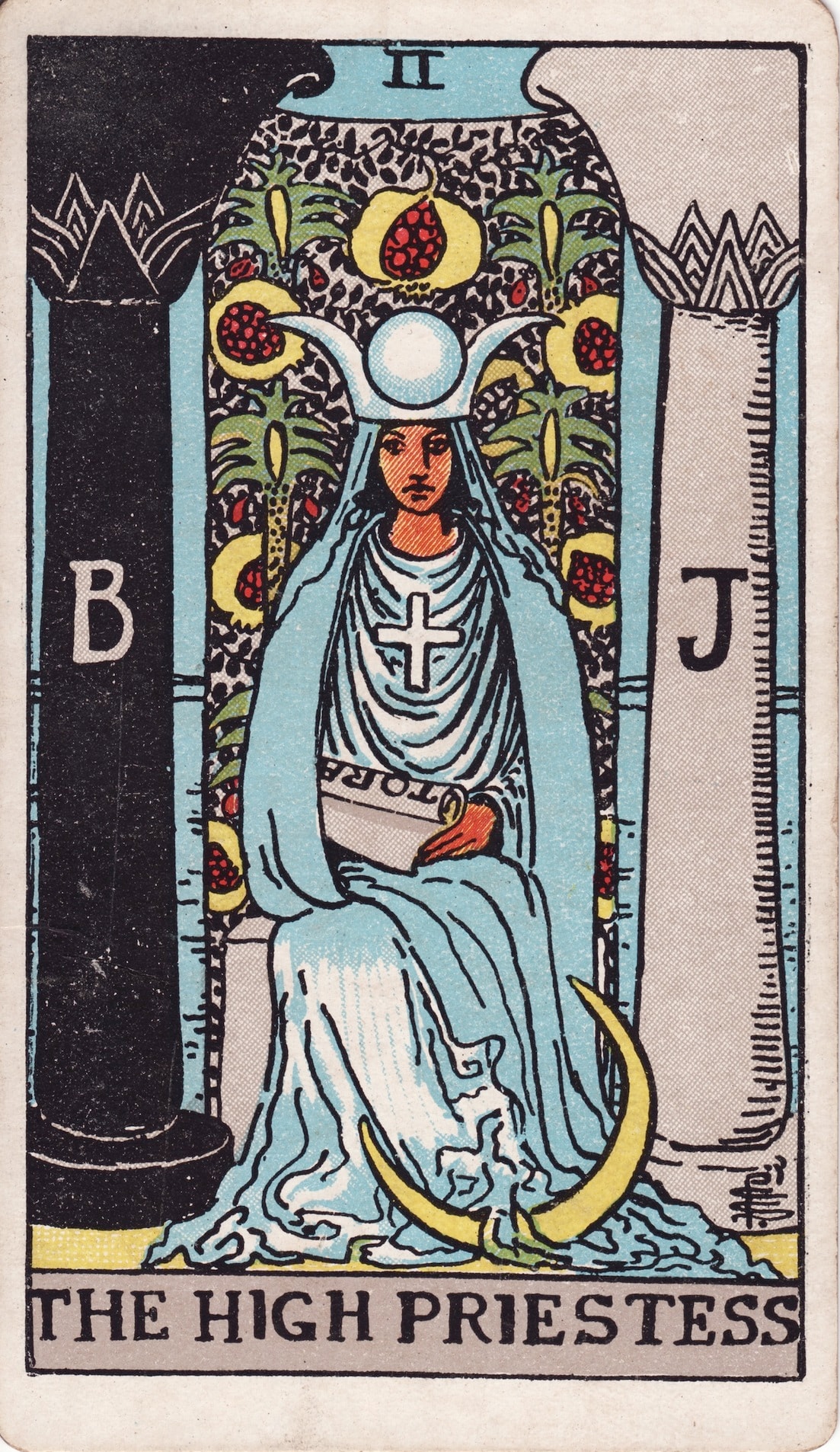
The raised hand, Waite said, is a sign of the church "distinguishing between the manifest and concealed part of doctrine". It separates what can be shown from what stays hidden. Then Waite noticed something about the High Priestess, three cards back: she "makes no sign". So these two figures face each other across the row. She keeps the hidden, inner side. He holds the outer, shared side. Waite called him "the ruling power of external religion".
Look at the pillars. They are plain and grey, with no letters and no veil. Waite said so too: they "are not those of the Temple which is guarded by the High Priestess".
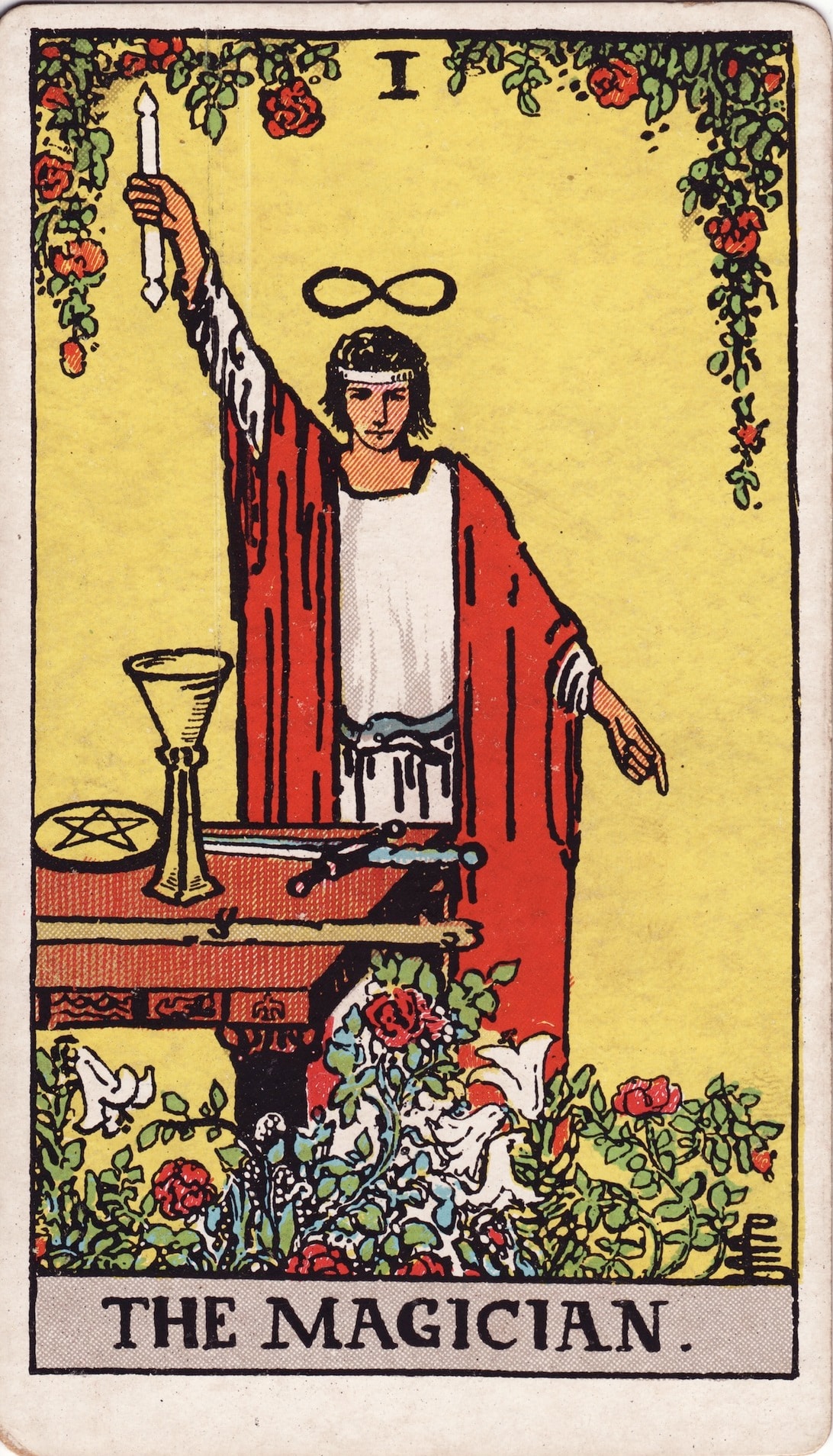
Now look at the two men kneeling. One wears a robe patterned with roses, the other a robe with lilies. Those are the Magician's two flowers again, worn this time as clothes. Yellow bands form a Y across each man's back.
Then there are the keys. They lie crossed on the carpet, between the teacher and the students. Nobody holds them.
The inner journey
The Magician found his own power. The High Priestess held a secret no one can hand you. Now the Fool meets the other way of knowing: learning from people who went before. The Hierophant is a teacher, a school or a craft with its masters. Somebody has walked this road already and left words behind.
The Swiss psychologist Carl Jung thought hard about religion. He saw creeds and rituals as forms that can hold strong inner experience safely, the way a riverbed holds water. They give a shape to what might otherwise flood a person. He also saw the cost. A creed can end up standing in for the experience it was meant to hold.
Waite saw the same danger in this very card. The pontiff, he wrote, may forget what his office points to. He may then act "as if he contained within his proper measures" everything his sign is about.
On the walk through the trumps the Fool kneels here for a while, then moves on. You could also stay. Think of a tradition you belong to, or once did. It might be a family way of doing things, a school, a practice or a faith. What has it given you that you couldn't have found alone? What in it has gone stiff? Both answers can be true on the same day.
Across traditions
Look the Hierophant up in the Golden Dawn's tables and you find Vau, the sixth of the Hebrew letters, and Taurus, the bull. Book T calls him "The Magus of the Eternal". Two other trumps share the title there: the Magician is "The Magus of Power", and the Hermit "The Magus of the Voice of Power". Three wise men of the deck.
One of his old titles is pontiff, from the Latin pontifex. Even the Romans weren't sure where that word came from. The usual guess is "bridge-maker", from pons, a bridge. You could look at the Hierophant as a bridge. He stands between the students and something older, between the world you can see and the one you can't.
The keys have a story too. In the Gospel of Matthew, Jesus says to Peter, "I will give unto thee the keys of the kingdom of heaven". Crossed keys became the sign of the popes. On a wall of the Sistine Chapel in Rome, Pietro Perugino painted the moment itself in 1481 and 1482, in The Delivery of the Keys. Peter kneels and reaches up for the keys in Christ's hand.
Pamela Colman Smith put the keys on the ground instead, between the Hierophant and his students. You could wonder who picks them up next.
Try this
Think of something you learned from another person that you still use: a recipe, a way of tying a knot, a prayer or a saying. Do it once, slowly, or say it out loud. Notice whose voice you hear in it. Then look back at the card. The two students have their backs to you, so you never see their faces. Imagine one of them is you. What did you come here to learn, and who might you pass it on to?
Questions to sit with
- Who handed you the keys you carry?
- What do the two students want from the Hierophant?
- Which tradition in your life still holds water, and which has run dry?
- What would you teach, if someone knelt in front of you?
- What would the High Priestess say about his blessing?
The film
No film for this card yet.
Sources
- Waite on the triple crown, the sign of esotericism, the High Priestess who makes no sign, the pillars that are not hers, the crossed keys and the two ministers, the ruling power of external religion, and the name the Pope.Arthur Edward Waite, The Pictorial Key to the Tarot (London, 1911), Part II, The Hierophant, p. 88
- The pontiff may act as if he contained all that his sign points to.Arthur Edward Waite, The Pictorial Key to the Tarot (London, 1911), Part II, The Hierophant, p. 91
- Hierophant: the priest who showed the holy things at Eleusis.Henry George Liddell and Robert Scott, A Greek-English Lexicon, hierophantēs
- The Mysteries of Eleusis, rites for Demeter and Persephone.William Smith, A Dictionary of Greek and Roman Antiquities (London, 1875), Eleusinia
- Jung on creed and ritual as forms that hold, and can replace, inner experience.C. G. Jung, Psychology and Religion (the Terry Lectures, 1938), Collected Works 11, §§75–76
- The Golden Dawn gave the Hierophant Vau and Taurus; Book T calls him The Magus of the Eternal, and the Magician and the Hermit Magi too.Book T, The Equinox I.8 (1912), table of the Keys
- Pontifex, probably from pons and facio, of obscure first meaning.Charlton T. Lewis and Charles Short, A Latin Dictionary (1879), pontifex
- The keys of the kingdom of heaven given to Peter.Matthew 16:19, King James Version
- The tiara and crossed keys as the emblems of the papacy.A. C. Fox-Davies, Ecclesiastical Heraldry, The Catholic Encyclopedia (New York, 1913)
- Perugino's fresco: Peter kneels and takes the keys from Christ.Pietro Perugino, The Delivery of the Keys (1481–1482), Sistine Chapel, Vatican City; Wikimedia Commons
Around this card
Before and after it in the deck
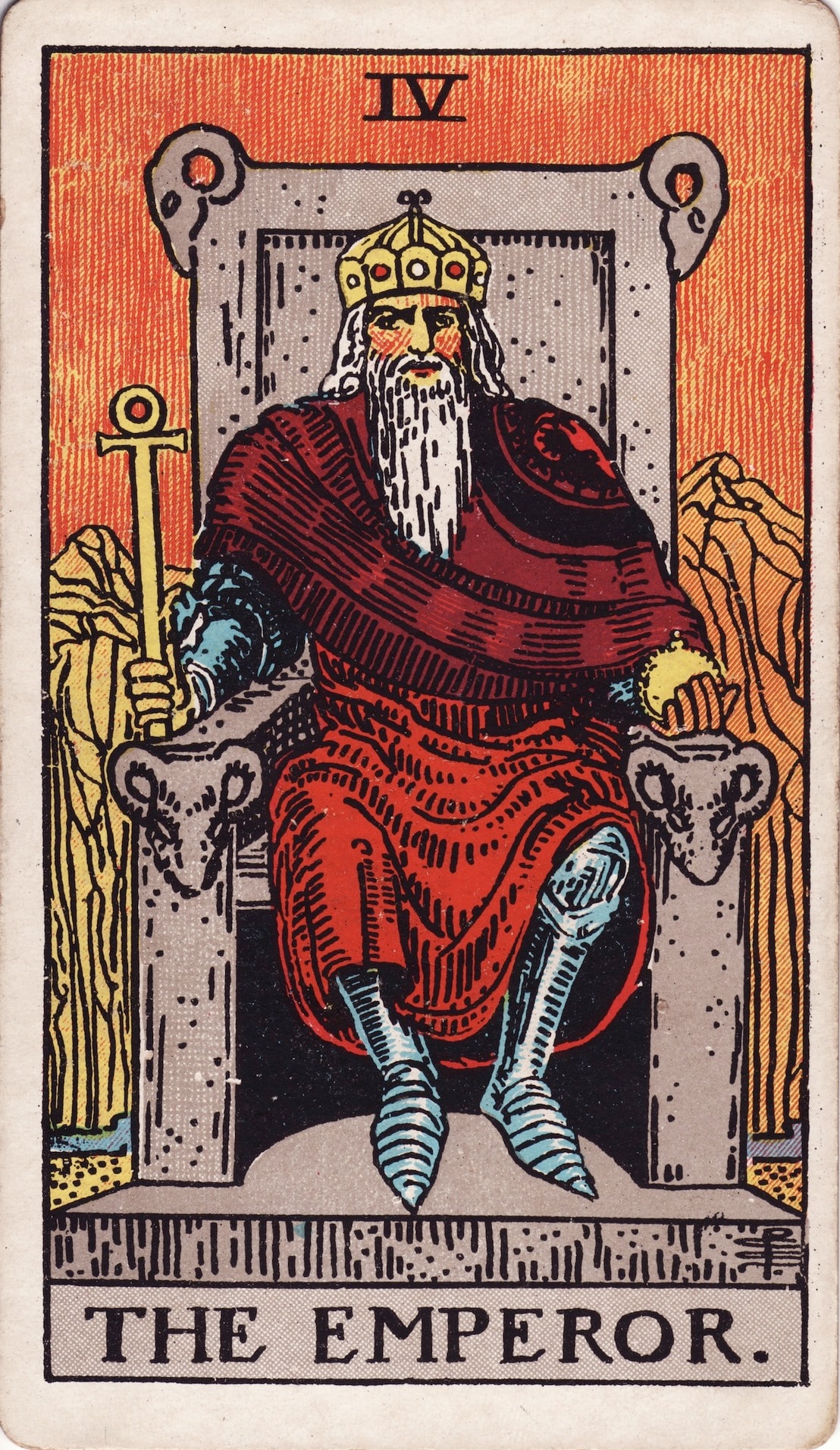
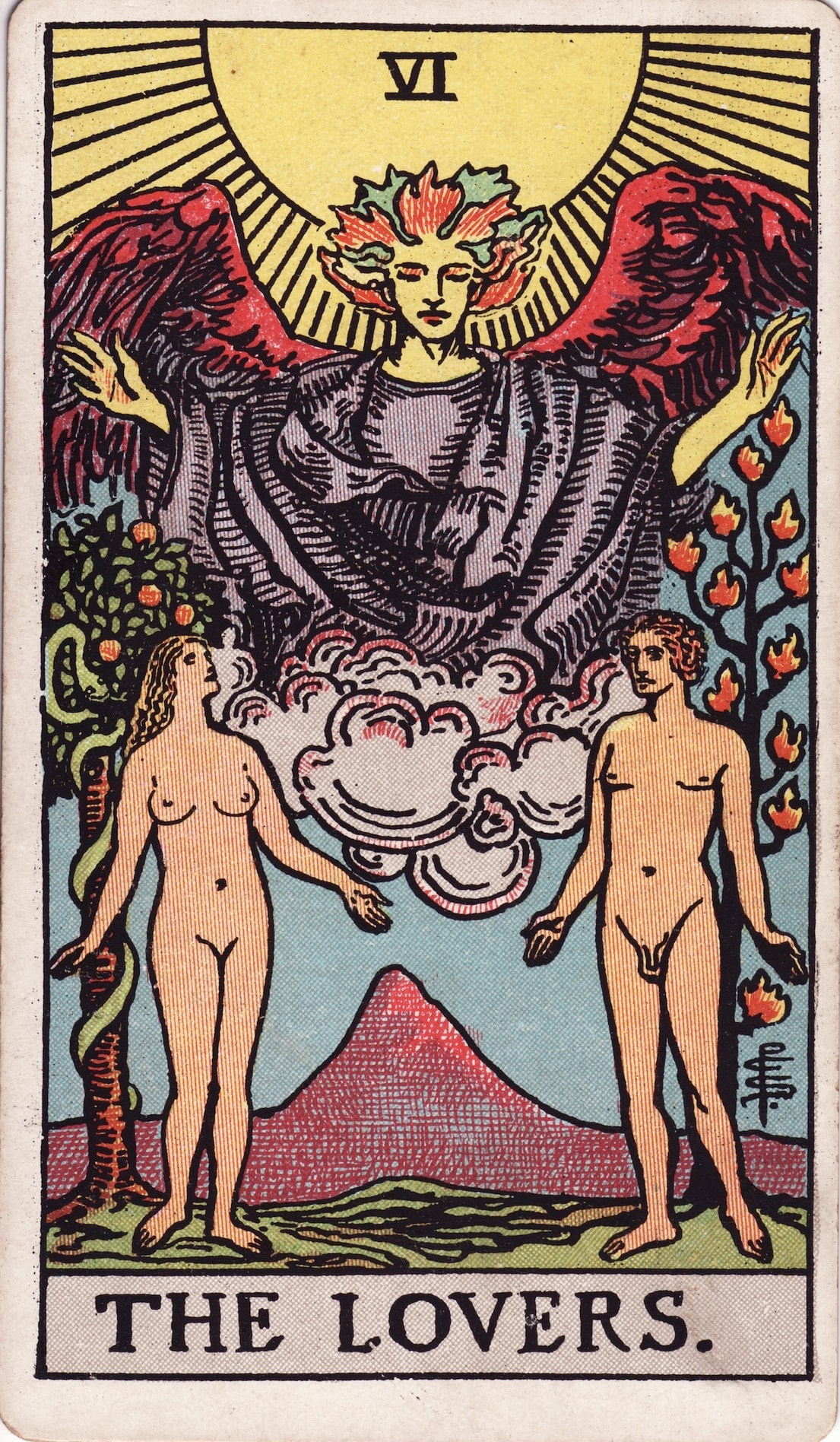
The first row of the Fool's journey


All the cards of the Major Arcana, or the whole deck.