Trump VII, Major Arcana
The Chariot
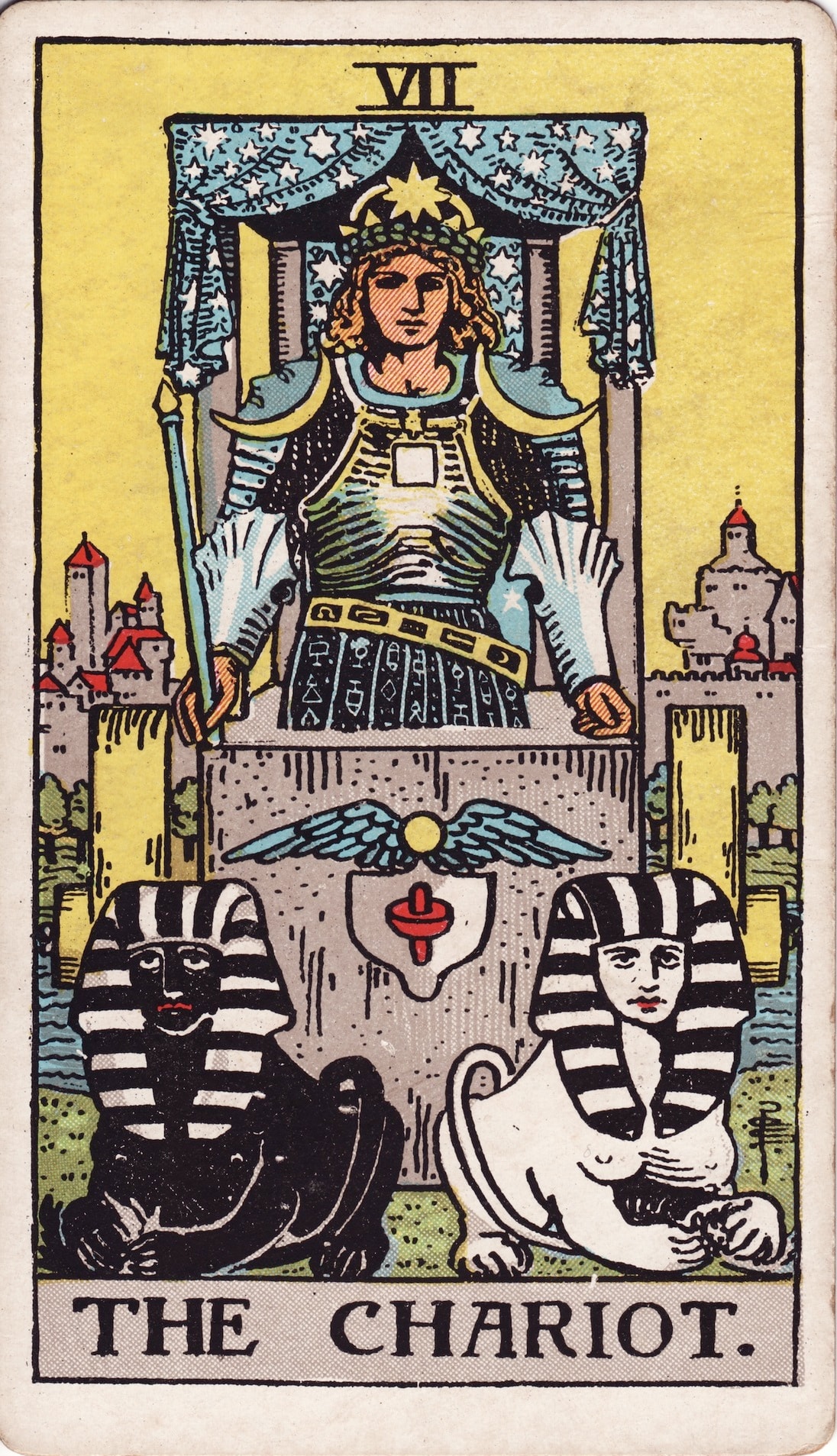
Trump VII, the Chariot, is a crowned young man in armour standing in a stone chariot under a canopy of stars. In Pamela Colman Smith's 1909 drawing two sphinxes lie in front of the car, one black and one white, and no reins run from them to the driver.
What Waite wrote it means (1910)
- Divinatory meanings
Succour, providence; also war, triumph, presumption, vengeance, trouble.
- Reversed
Riot, quarrel, dispute, litigation, defeat.
Arthur Edward Waite, The Pictorial Key to the Tarot (London, 1911), p. 284. Read it in the chapter
An erect and princely figure carrying a drawn sword and corresponding, broadly speaking, to the traditional description which I have given in the first part. On the shoulders of the victorious hero are supposed to be the Urim and Thummim. He has led captivity captive; he is conquest on all planes—in the mind, in science, in progress, in certain trials of initiation. He has thus replied to the sphinx, and it is on this account that I have accepted the variation of Éliphas Lévi; two sphinxes thus draw his chariot. He is above all things triumph in the mind.
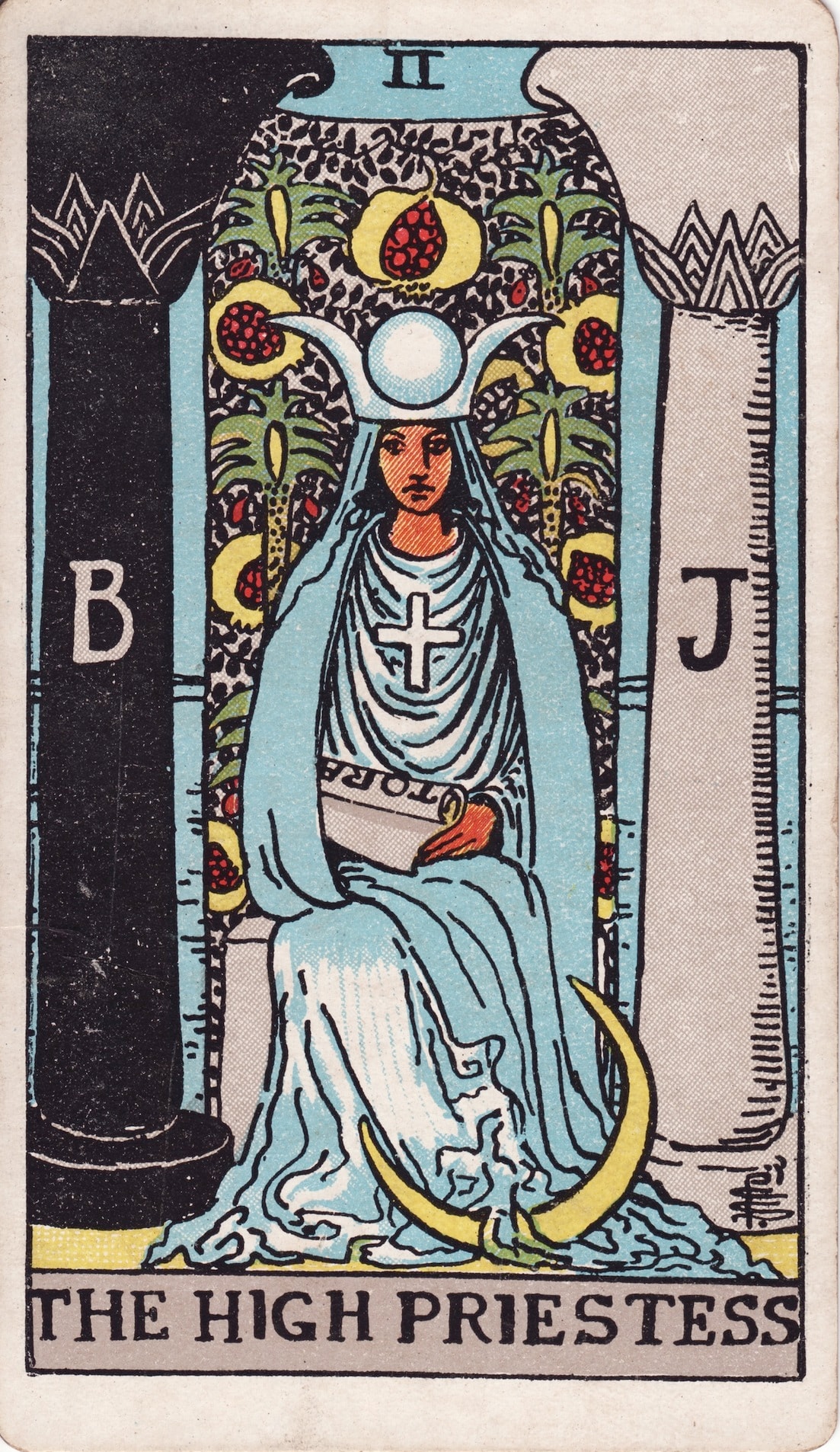
It is to be understood for this reason (a) that the question of the sphinx is concerned with a Mystery of Nature and not of the world of Grace, to which the charioteer could offer no answer; (b) that the planes of his conquest are manifest or external and not within himself; (c) that the liberation which he effects may leave himself in the bondage of the logical understanding; (d) that the tests of initiation through which he has passed in triumph are to be understood physically or rationally; and (e) that if he came to the pillars of that Temple between which the High Priestess is seated, he could not open the scroll called Tora, nor if she questioned him could he answer. He is not hereditary royalty and he is not priesthood.
What's in the picture
- The starry canopy. A blue cloth covered in white stars hangs over him like a roof, gathered at both sides like a curtain. Two grey pillars stand behind him under it.
- The crown. He wears a green wreath with a gold crown above it, and on the crown stands a gold star with many points.
- The moons on his shoulders. Two yellow crescent moons sit on his shoulders like shoulder pieces. Each has a small face in profile, with an eye and a nose.
- The square on his chest. His breastplate is gold and shines in the middle. A small white square sits high on it, just below the collar.
- The wand. In his right hand he holds a long, pale wand with a pointed tip. His other hand rests on the edge of the chariot. Neither hand holds reins.
- The belt and skirt. A belt of gold squares runs round his waist. Below it, his dark skirt is covered in small white signs.
- The winged disc and the shield. On the front of the chariot a yellow disc spreads two blue wings. Under it is a white shield with a red shape on it, like a spinning top.
- The black sphinx. A black sphinx with a striped headcloth lies on the left, paws out. Its face is black too, with red lips.
- The white sphinx. Its white twin lies on the right with the same striped headcloth and red lips, and its tail curls up beside it.
- The city and the river. Behind the chariot stands a walled city with towers and red roofs. A blue river with small waves runs along the bottom of the walls, just behind the sphinxes.
The card in brief
- In the deck
- Card 8 of 78
- Arcana
- Major Arcana
- Number
- Trump VII
- Hebrew letter (Golden Dawn)
- Cheth
- Astrology (Golden Dawn)
- Cancer
- Title in Book T
- The Child of the Powers of the Waters; the Lord of the Triumph of Light
- Drawn by
- Pamela Colman Smith
- Planned by
- Arthur Edward Waite
- Published
- London, William Rider & Son, 1909
- Scan
- Pam-A printing, c. 1910, Wikimedia Commons
In the old books
Book T (1912)
Triumph, victory, health (sometimes unstable).
Book T, “A Description of the Cards of the Tarot”, The Equinox I.8 (London, 1912), p. 203. See the source Papus (1892)
A Conqueror, crowned with a coronet, upon which rise three shining Pentagrams of gold, advances in a cubical chariot, surmounted by an azure, star-decked canopy supported by four columns.
This symbol reproduces the 1st and 21st arcana in another order of ideas. The four columns represent the four animals of the 21st arcanum, and the four symbols of the 1st arcanum, symbols of the quaternary in all its acceptations.
Papus, The Tarot of the Bohemians, tr. A. P. Morton (London, 1892), p. 135. See the source
Before 1909
The older cards and pictures behind this one will be shown here once their licences are checked.
The Chariot without reins
A young man stands in a chariot under a canopy of stars. He wears armour, a crown with a star, and two crescent moons on his shoulders. In his right hand is a wand. Two sphinxes lie in front of the chariot, one black and one white. Behind him are a walled city with red roofs and a river. Now look for the reins. There are none. Whatever steers this chariot, he isn't holding it.
He is trump VII. Follow the Major Arcana in order, as a road the Fool walks, and by this card the boy from the cliff edge has grown up and is heading out into the world. You could look at this card as the moment of setting out, and ask what drives it.
The image
The chariot is a block of stone, more like a small building than a cart. Its wheels barely show. On its front is a shield with a red shape on it, and above that a yellow disc with blue wings.
In his guide to the deck, Arthur Edward Waite described the driver as "an erect and princely figure carrying a drawn sword". On the card, though, he holds a wand. Here Pamela Colman Smith went her own way. The moons on his shoulders have faces. Waite wrote that they "are supposed to be the Urim and Thummim". In the Bible, those were mysterious objects kept in the breastplate of the high priest.
The sphinxes came from a French writer on magic, Éliphas Lévi. Waite wrote that he had "accepted the variation of Éliphas Lévi; two sphinxes thus draw his chariot". On older cards, white horses pulled the car. So the black and white pair are newcomers. They lie still, paws out, and look in slightly different directions. Nothing on the card says they will move together.
Waite called the driver "triumph in the mind". Then he listed what this hero can't do. His conquests, Waite wrote, are "manifest or external and not within himself". If he came to the High Priestess's pillars, "he could not open the scroll called Tora". He has won the world outside, and the world inside is still ahead of him.
The inner journey
In Carl Jung's psychology, the everyday "I" is the ego. It is the part of you that says my name, my plans, my life. In the first half of life, Jung thought, the ego's task is to grow strong, to find a place in the world and hold it. The Chariot shows that task done. By now the Fool has learned to make things, to rule and to love. Now he rides out, armoured and crowned.
Jung also wrote about the face we show the world. He called it the persona, after the Latin word for an actor's mask. You need a persona to live among people. Trouble starts when you forget it is a mask. The charioteer's armour shines. Two moon faces sit on his shoulders, like masks of their own. What is underneath?
Look at the sphinxes again. One is black and one is white, and the driver has no reins. Something holds the two together for now. It might be his will, or plain good luck. Many readers see this as the hero's hidden problem: the opposites in him are harnessed, and they aren't yet at peace. On later cards the Fool may meet them one by one.
You could also stay here a while. A good run has its own joy, when things go your way. You could try to enjoy the ride fully, and still ask what is pulling the chariot.
Across traditions
The Golden Dawn paired the Chariot with Cheth, the eighth of the Hebrew letters, and with Cancer, the crab. A crab carries its armour on its back, like the charioteer. Book T gives the driver a long title of his own: "The Child of the Powers of the Waters; the Lord of the Triumph of Light". Look behind the chariot and you find the water: a river runs past the city walls. Book T's short note on the card adds a warning: "Triumph, victory, health (sometimes unstable)."
The Greek philosopher Plato imagined a chariot too. In his dialogue Phaedrus, he pictures the soul as "a pair of winged horses and a charioteer". One horse is white and noble. It "needs no touch of the whip, but is guided by word and admonition only". The other is dark, "a crooked lumbering animal", "hardly yielding to whip and spur". The driver's whole job is to make the two pull together.
Smith's sphinxes are black and white as well. Plato's driver had reins and a whip, and still struggled. Smith's has neither. You could look at the card through Plato's eyes and wonder how this driver steers at all.
Try this
Think of something you are pushing forward right now. Name the two forces pulling it, such as wanting and fearing, or work and rest. Picture them as the two sphinxes, one black and one white. For a minute, sit still and imagine driving them without reins. What keeps them moving together? Then look back at the scan. Find anything in it that moves, or is about to, and ask what drives it.
Questions to sit with
- Where is the chariot going? Does the driver know?
- What would happen if the two sphinxes stood up?
- Where in your life are you winning on the outside?
- What is under your armour today?
- What would the charioteer do in front of the High Priestess's scroll?
The film
No film for this card yet.
Sources
- Waite planned the deck; Smith drew and coloured the cards.Arthur Edward Waite, The Pictorial Key to the Tarot (London, 1911), Part II, The Tarot and Secret Tradition, p. 67
- Waite on the princely figure with a drawn sword, the Urim and Thummim, the sphinxes taken from Lévi, triumph in the mind, the outward conquests and the scroll called Tora.Arthur Edward Waite, The Pictorial Key to the Tarot (London, 1911), Part II, The Chariot, p. 96
- In the eighteenth century white horses drew the car.Arthur Edward Waite, The Pictorial Key to the Tarot (London, 1911), Part I, Trumps Major, no. 7, p. 15
- The Urim and Thummim were put in the high priest's breastplate.Exodus 28:30, King James Version
- Jung on the ego, and its task in the first half of life.C. G. Jung, Aion (1951), ch. 1, The Ego (Collected Works 9ii); The Stages of Life (1930/31), Collected Works 8
- Jung's persona, named after the actor's mask.C. G. Jung, The Relations between the Ego and the Unconscious (1928), Part I, ch. 3 (Collected Works 7); Lewis and Short, A Latin Dictionary (1879), persona
- Many readers see the unreined sphinxes as opposites held together only for now, to be faced on later cards.Rachel Pollack, Seventy-Eight Degrees of Wisdom (1980), Part One, ch. 5, Turning Inwards
- The Golden Dawn gave the Chariot Cheth and Cancer; Book T's title for it, and its brief meaning.Book T, The Equinox I.8 (1912), table of the Keys and brief meanings of the trumps
- Plato's soul as a charioteer with a white horse and a dark one.Plato, Phaedrus 246a–b and 253d–e, translated by Benjamin Jowett (1892)
Around this card
Before and after it in the deck
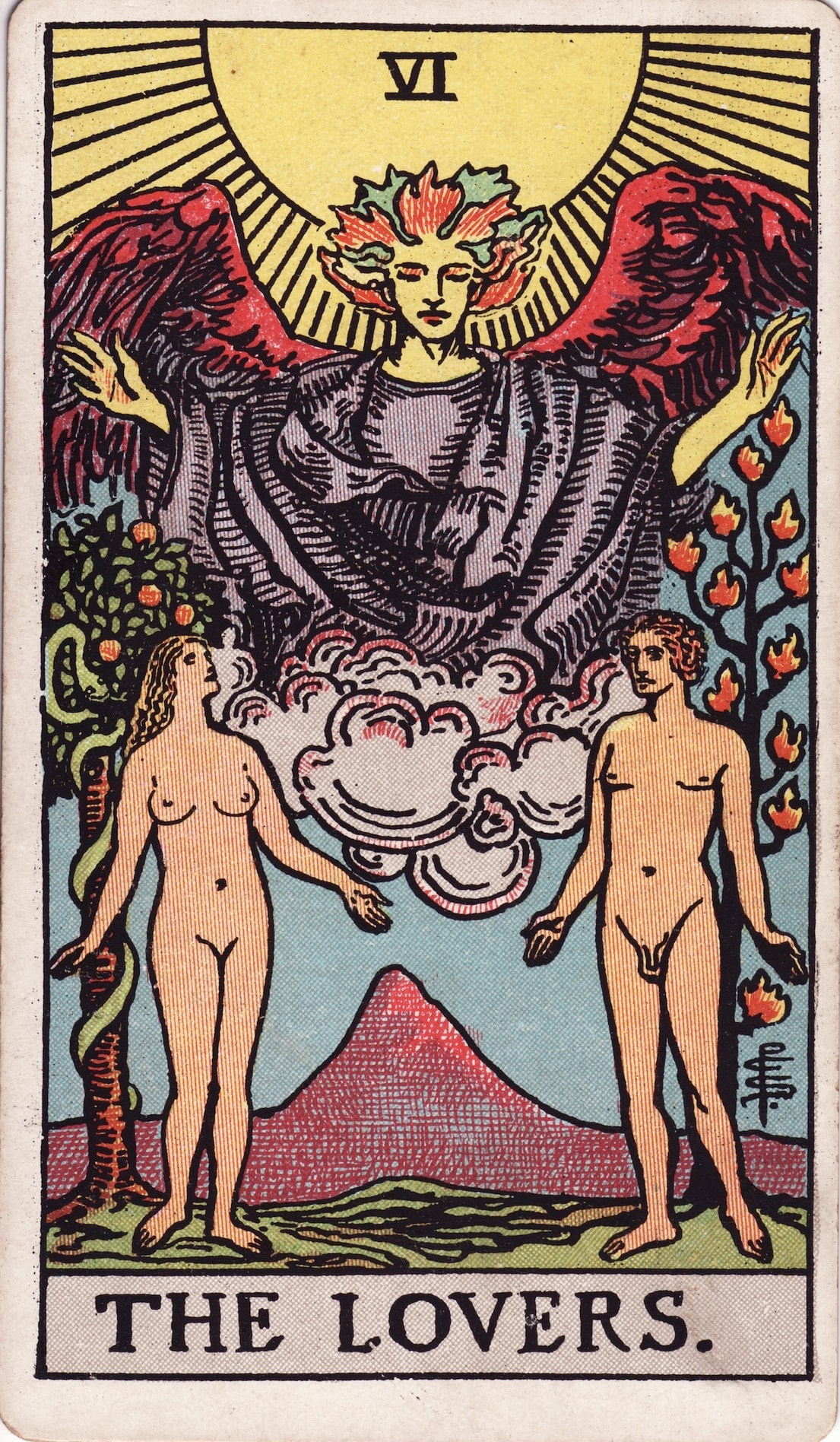
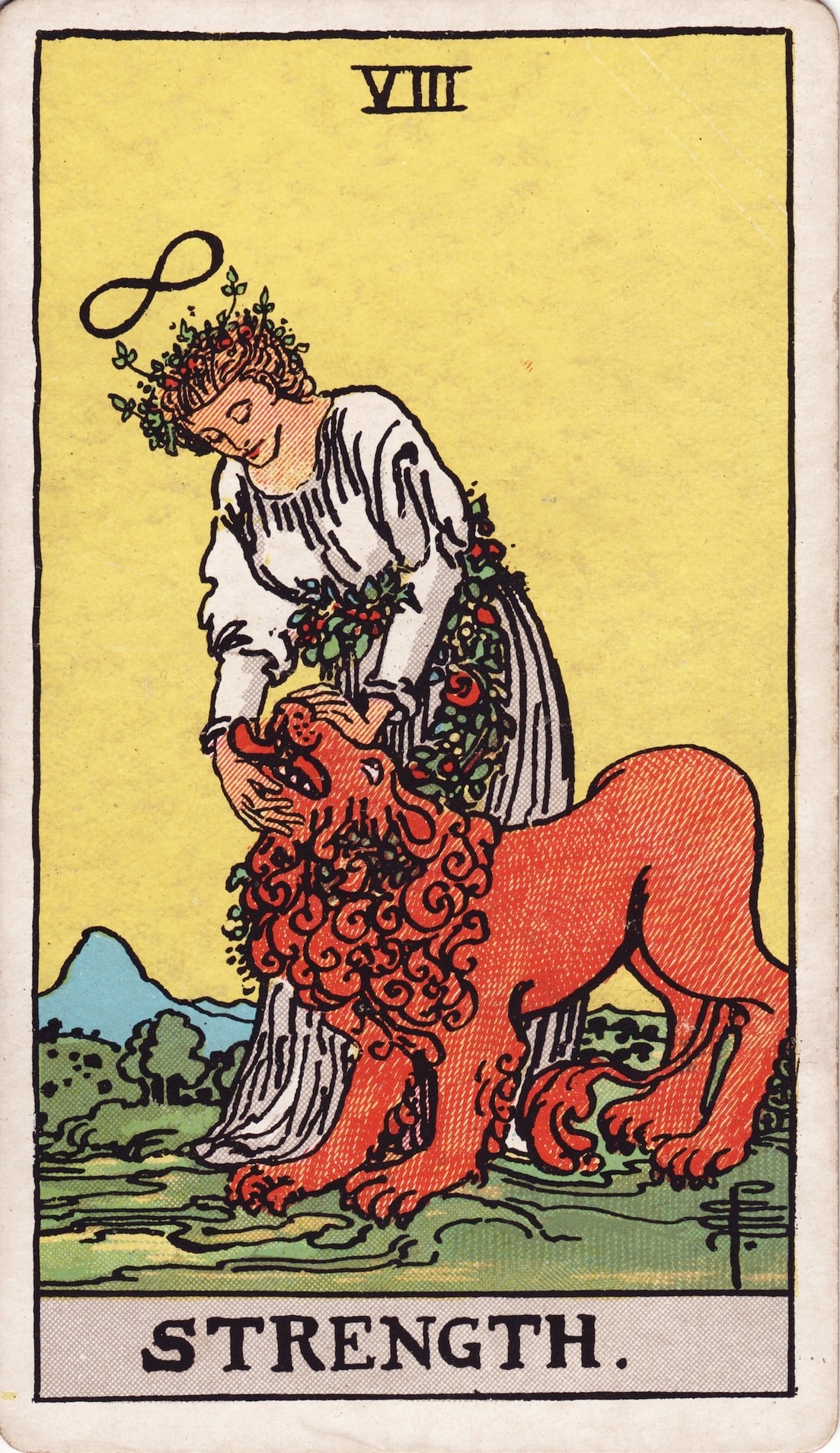
The first row of the Fool's journey
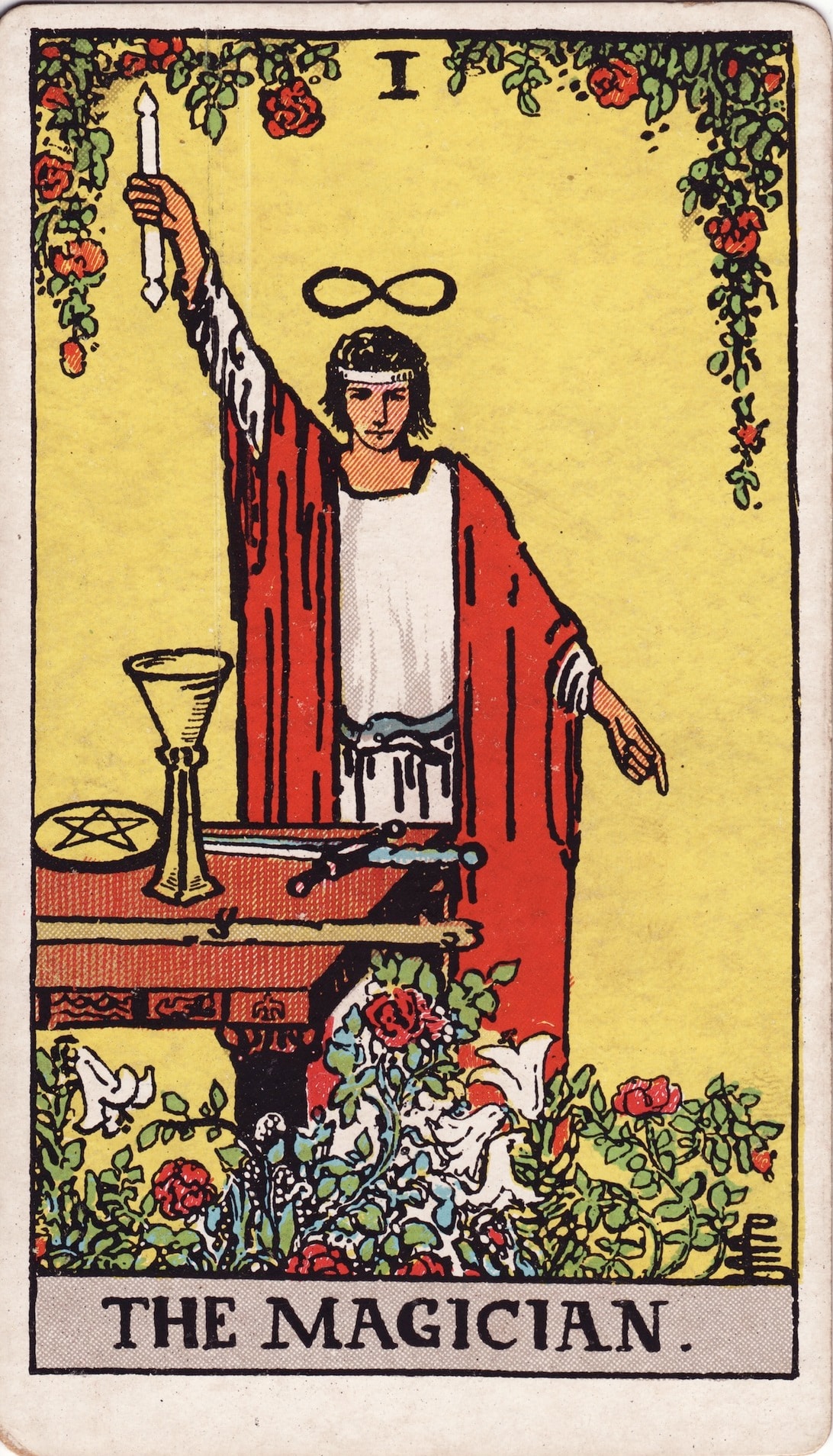

All the cards of the Major Arcana, or the whole deck.