Trump IX, Major Arcana
The Hermit
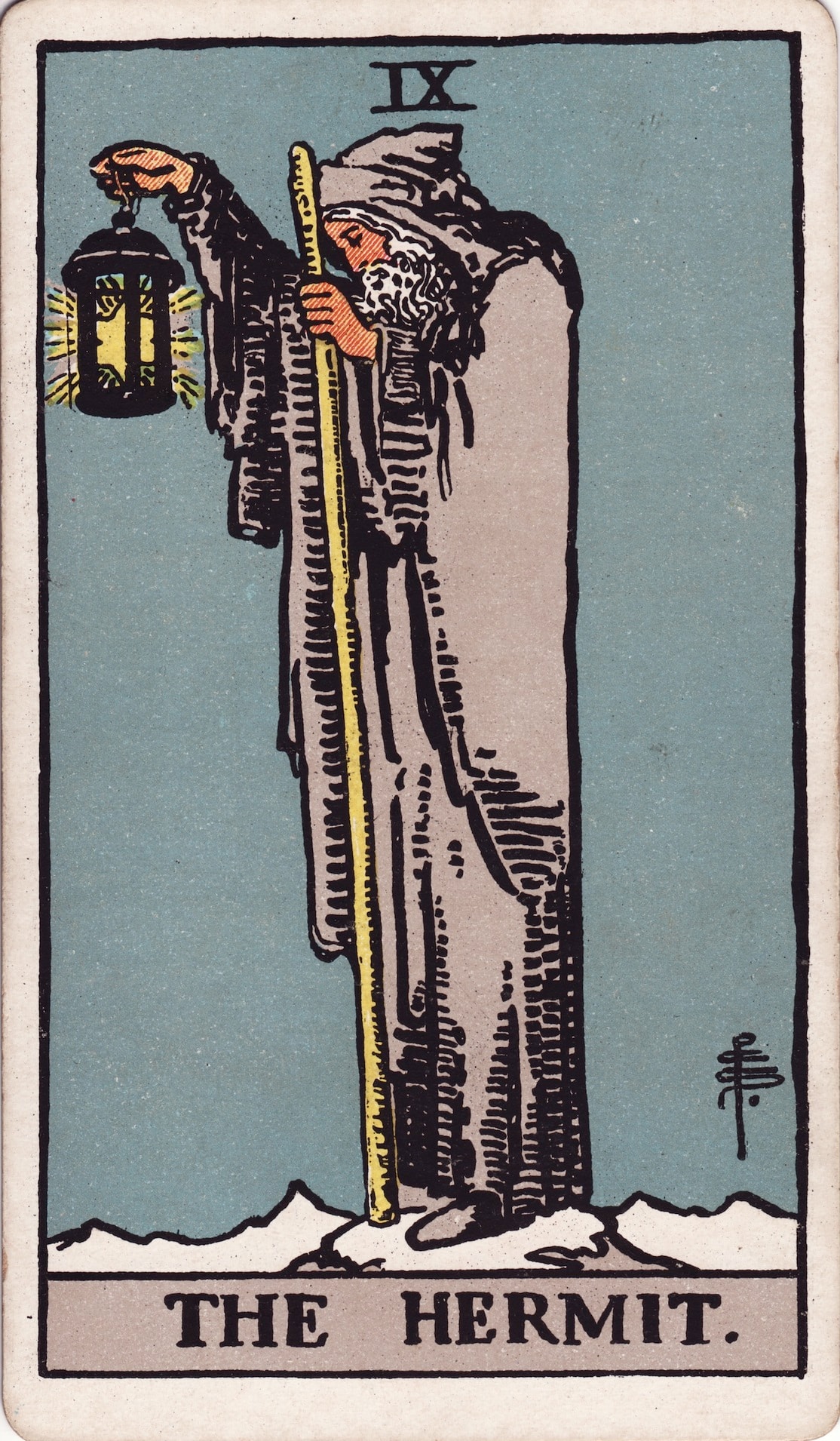
The Hermit, trump IX, is an old man in a grey hooded cloak standing alone on a snowy peak. Pamela Colman Smith drew him in 1909 leaning on a tall yellow staff and holding up a lantern with a star shining inside it.
What Waite wrote it means (1910)
- Divinatory meanings
Prudence, circumspection; also and especially treason, dissimulation, roguery, corruption.
- Reversed
Concealment, disguise, policy, fear, unreasoned caution.
Arthur Edward Waite, The Pictorial Key to the Tarot (London, 1911), p. 284. Read it in the chapter
The variation from the conventional models in this card is only that the lamp is not enveloped partially in the mantle of its bearer, who blends the idea of the Ancient of Days with the Light of the World. It is a star which shines in the lantern. I have said that this is a card of attainment, and to extend this conception the figure is seen holding up his beacon on an eminence. Therefore the Hermit is not, as Court de Gebelin explained, a wise man in search of truth and justice; nor is he, as a later explanation proposes, an especial example of experience. His beacon intimates that "where I am, you also may be."
It is further a card which is understood quite incorrectly when it is connected with the idea of occult isolation, as the protection of personal magnetism against admixture. This is one of the frivolous renderings which we owe to Éliphas Lévi. It has been adopted by the French Order of Martinism and some of us have heard a great deal of the Silent and Unknown Philosophy enveloped by his mantle from the knowledge of the profane. In true Martinism, the significance of the term Philosophe inconnu was of another order. It did not refer to the intended concealment of the Instituted Mysteries, much less of their substitutes, but—like the card itself—to the truth that the Divine Mysteries secure their own protection from those who are unprepared.
What's in the picture
- The lantern. A black lantern hangs from his raised hand. Its panes glow yellow, and short rays of light spill out at both sides.
- The star inside. Behind the dark bars of the lantern shines a star. Only parts of its points show between the bars.
- The raised hand. His right arm is lifted high and bent at the elbow. The lantern hangs from his fist, out in front of him and clear of his cloak.
- The face. Under the hood his eyes are lowered, almost closed. A long white beard covers his chin and chest.
- The hood. His grey hood is pulled up over his head and comes to a point at the back.
- The staff. A tall yellow staff, taller than he is, runs from above his head down to the snow. His left hand grips it at chest height.
- The cloak. A long grey cloak falls straight to his feet. The side toward the lantern is cut with heavy black folds.
- The snowy peak. He stands on white ground at the very top, with a row of low peaks around him. Nothing on the card is higher than he is.
- The empty sky. The sky is one flat grey-blue from edge to edge, with no sun, moon, cloud or bird.
- Smith's monogram. Low on the right, against the sky, is Pamela Colman Smith's small mark, a knot of looped lines on a stem.
The card in brief
- In the deck
- Card 10 of 78
- Arcana
- Major Arcana
- Number
- Trump IX
- Hebrew letter (Golden Dawn)
- Yod
- Astrology (Golden Dawn)
- Virgo
- Title in Book T
- The Magus of the Voice of Power, the Prophet of the Eternal
- Drawn by
- Pamela Colman Smith
- Planned by
- Arthur Edward Waite
- Published
- London, William Rider & Son, 1909
- Scan
- Pam-A printing, c. 1910, Wikimedia Commons
In the old books
Book T (1912)
Wisdom from on high. Active divine inspiration. Sometimes "unexpected current."
Book T, “A Description of the Cards of the Tarot”, The Equinox I.8 (London, 1912), p. 203. See the source Papus (1892)
An old man walking supported by a stick. He carries before him a lighted lamp, half hidden by the great mantle which envelopes him.
This symbol is midway between the sixth and the twelfth.
Papus, The Tarot of the Bohemians, tr. A. P. Morton (London, 1892), p. 143. See the source
Before 1909
The older cards and pictures behind this one will be shown here once their licences are checked.
The Hermit's lantern
An old man in a long grey cloak stands on a snowy peak. He leans on a tall yellow staff. In his raised hand he holds a lantern, and inside it shines a six-pointed star. His hood is up and his eyes are lowered. The sky around him is a flat grey-blue, with nothing else in it.
Count the trumps from zero and this is the ninth step up. By now the Fool has climbed a long way from his first cliff, and here he meets an old man on a height, holding up a light. You could look at the light first, and then ask who it is for.
The image
The Hermit stands above everything else on his card. The ground under his feet is white with snow. Waite's text has him "holding up his beacon on an eminence", on a height.
Waite pointed out one change from older cards: "the lamp is not enveloped partially in the mantle of its bearer". On older cards, the Hermit shaded his lamp with his cloak. Here the lantern hangs out in the open. "It is a star which shines in the lantern," Waite wrote. Pamela Colman Smith, who drew the deck, gave it six points.
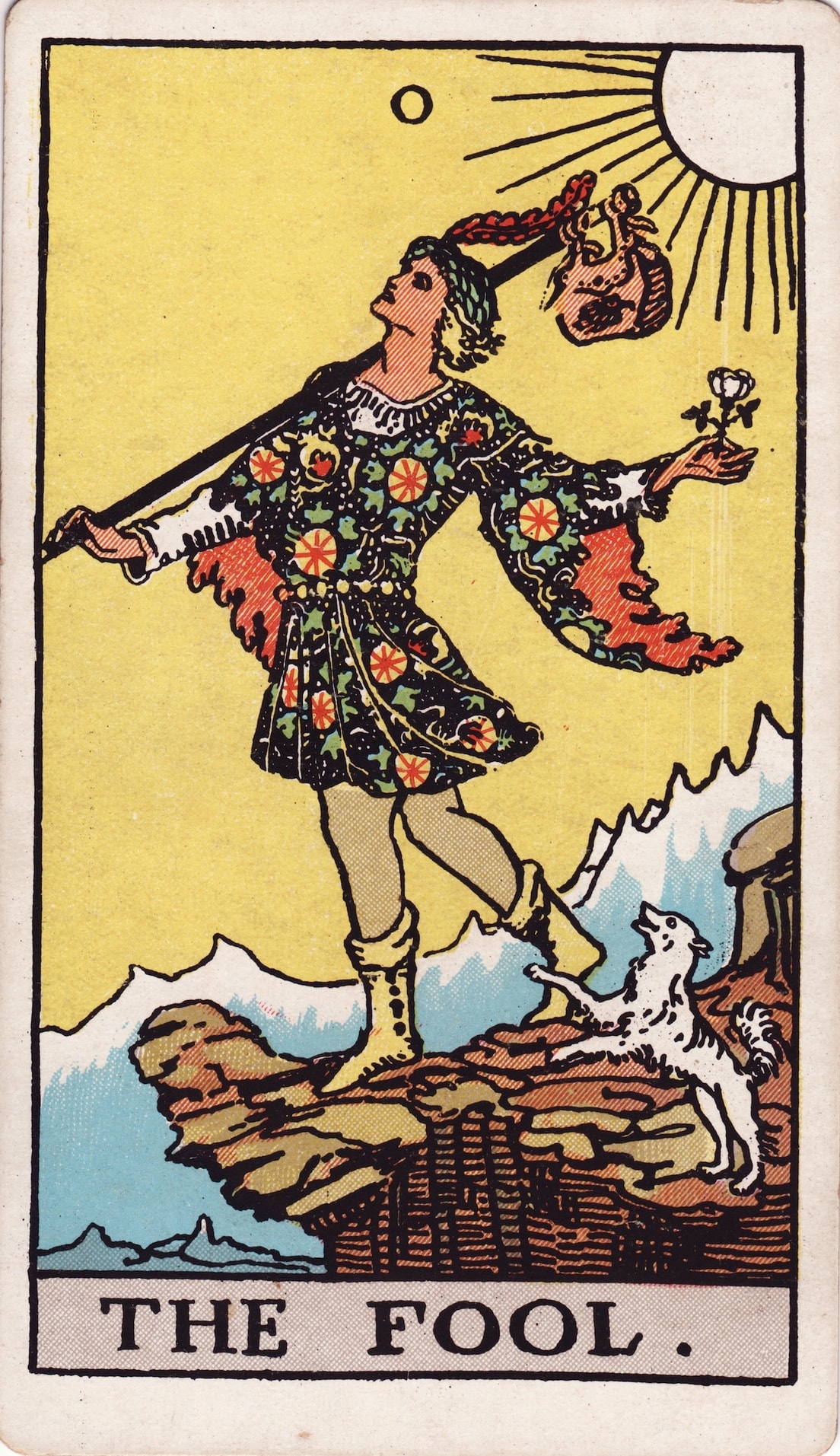
Put the Fool's card beside this one. The Fool was young and bright and looked up, with snowy peaks far behind him. The Hermit is old and grey and looks down, standing on the peak itself. He might be the Fool, much later. Or he might be the one the Fool has been climbing toward.
Waite said the figure blends "the idea of the Ancient of Days with the Light of the World". The Ancient of Days is God as an old man on a throne, in the Book of Daniel. "The light of the world" is what Jesus calls himself in the Gospel of John. In Waite's England it was also the title of a well-known painting.
William Holman Hunt painted The Light of the World in the 1850s and again in 1900–04; the late version hangs in St Paul's Cathedral in London. In it Christ stands at night with a lantern and knocks at a door overgrown with weeds. Hunt took its motto from the Book of Revelation: "Behold, I stand at the door, and knock". His figure brings the light to someone's door. You could ask the same of the Hermit. Where is he taking his?
The inner journey
Jung kept meeting a figure like this, in dreams and in fairy tales, and called him the wise old man. In Jung's view, this figure turns up when the hero is stuck and can't go on alone. He asks a question, or points the way.
The Hermit is often read as a time of withdrawal. You go quiet, turn inward and walk alone for a while. That is a real part of the card. After meeting the lion, the Fool needs somewhere quiet to take in what he met.
Waite pushed back on one version of that reading, though. He wrote that the card "is understood quite incorrectly when it is connected with the idea of occult isolation". For him this is "a card of attainment", and the Hermit is someone who has arrived. His lantern says, "where I am, you also may be". So the light isn't only for the Hermit. He holds it up so that someone further down can find the path.
You could hold both readings at once. You might go apart to find your own light. You might also carry it back to others. The road goes on from here, but you could stay a while on this peak. Try walking somewhere slowly today, without talking, and notice what a small light shows you.
Across traditions
The Golden Dawn's tables give the Hermit Yod, the tenth of the Hebrew letters, and Virgo. Yod is the smallest Hebrew letter, a single short stroke. In Book T, yods turn up as little flames: round the club on the Ace of Wands are "Two-and-twenty leaping Flames, or Yodh". So the Hermit's letter is a small flame, like the light in his lantern. Book T calls him "The Magus of the Voice of Power, the Prophet of the Eternal". Its short note on him begins: "Wisdom from on high. Active divine inspiration."
The Greeks told of another old man with a light. Diogenes the Cynic lived in Athens in the 300s BC. One day, the story goes, he walked through the streets with a candle lit in broad daylight. "I am looking for a man," he said.
His light was for searching. Waite reports that the French scholar Court de Gébelin read the Hermit the same way, as "a wise man in search of truth and justice". Waite disagreed. He called it "a card of attainment … rather than a card of quest". You could hold the two lights side by side: the one that searches, and the one that shows the way.
Try this
This evening, turn off the lights and use one small light: a candle, a torch or a phone screen turned low. Walk once through your home by that light. Notice what it shows and what it leaves in shadow. Then look at the Hermit again by the same light. What does the small light pick out first? Is there anyone below him who could use a light held up for them?
Questions to sit with
- Who is the Hermit's light for?
- Is he still climbing, or has he arrived?
- What have you learned alone that you could hold up for someone else?
- Where do you go when you need to be quiet?
- What would the Fool ask him?
The film
No film for this card yet.
Sources
- Waite planned the deck; Smith drew and coloured the cards.Arthur Edward Waite, The Pictorial Key to the Tarot (London, 1911), Part II, The Tarot and Secret Tradition, p. 67
- Waite on the beacon held up on a height, the lamp no longer wrapped in the mantle, the star in the lantern, the Ancient of Days and the Light of the World, the card of attainment, "where I am, you also may be", the reading of occult isolation he rejected, and Court de Gébelin's wise man in search of truth and justice.Arthur Edward Waite, The Pictorial Key to the Tarot (London, 1911), Part II, The Hermit, p. 104
- A card of attainment rather than a card of quest.Arthur Edward Waite, The Pictorial Key to the Tarot (London, 1911), Part I, Trumps Major, no. 9, p. 17
- The Ancient of Days; "I am the light of the world".Daniel 7:9 and John 8:12, King James Version
- Holman Hunt's The Light of the World: Christ with a lantern at a door overgrown with weeds, painted more than once, with its motto from Revelation 3:20.William Holman Hunt, The Light of the World (1900–04), St Paul's Cathedral, London, via Wikimedia Commons; Hunt, Pre-Raphaelitism and the Pre-Raphaelite Brotherhood (London, 1905), vols. 1 and 2; Revelation 3:20, King James Version
- Jung's wise old man, who appears when the hero is stuck and helps with a question or a direction.C. G. Jung, The Phenomenology of the Spirit in Fairytales (1945/1948), Collected Works 9i, §§401–404
- The Golden Dawn gave the Hermit Yod and Virgo; Book T's title and brief meaning for him; the yods as flames on the Ace of Wands.Book T, The Equinox I.8 (1912), table of the Keys, brief meanings of the trumps, and the Ace of Wands
- Yod is the smallest Hebrew letter, the "jot" of Matthew 5:18.Adam Clarke, Commentary and Critical Notes on the Bible, on Matthew 5:18
- Diogenes lit a candle in the daytime and said, "I am looking for a man."Diogenes Laertius, Lives of Eminent Philosophers VI.41, translated by C. D. Yonge (1853)
Around this card
Before and after it in the deck
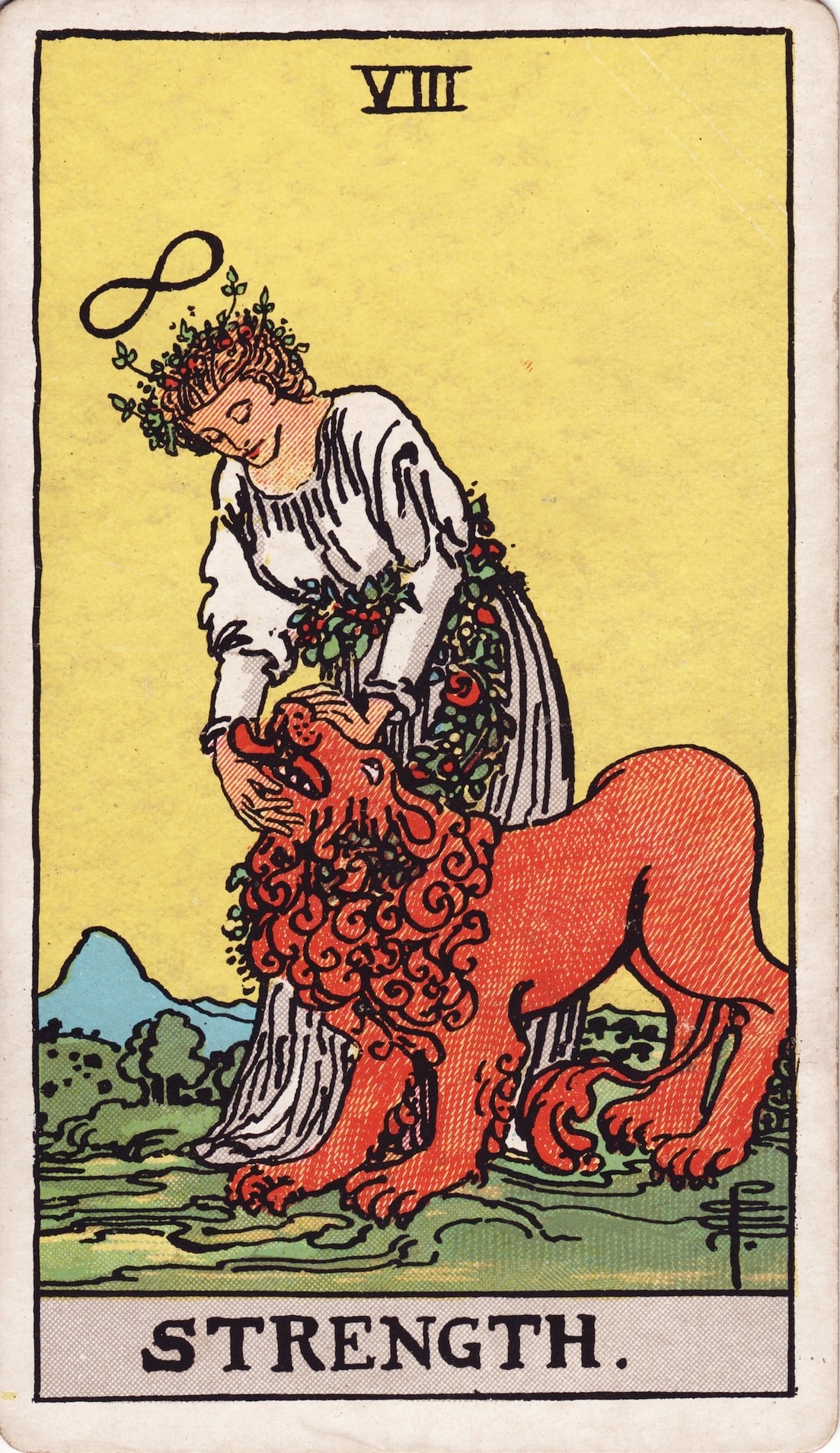
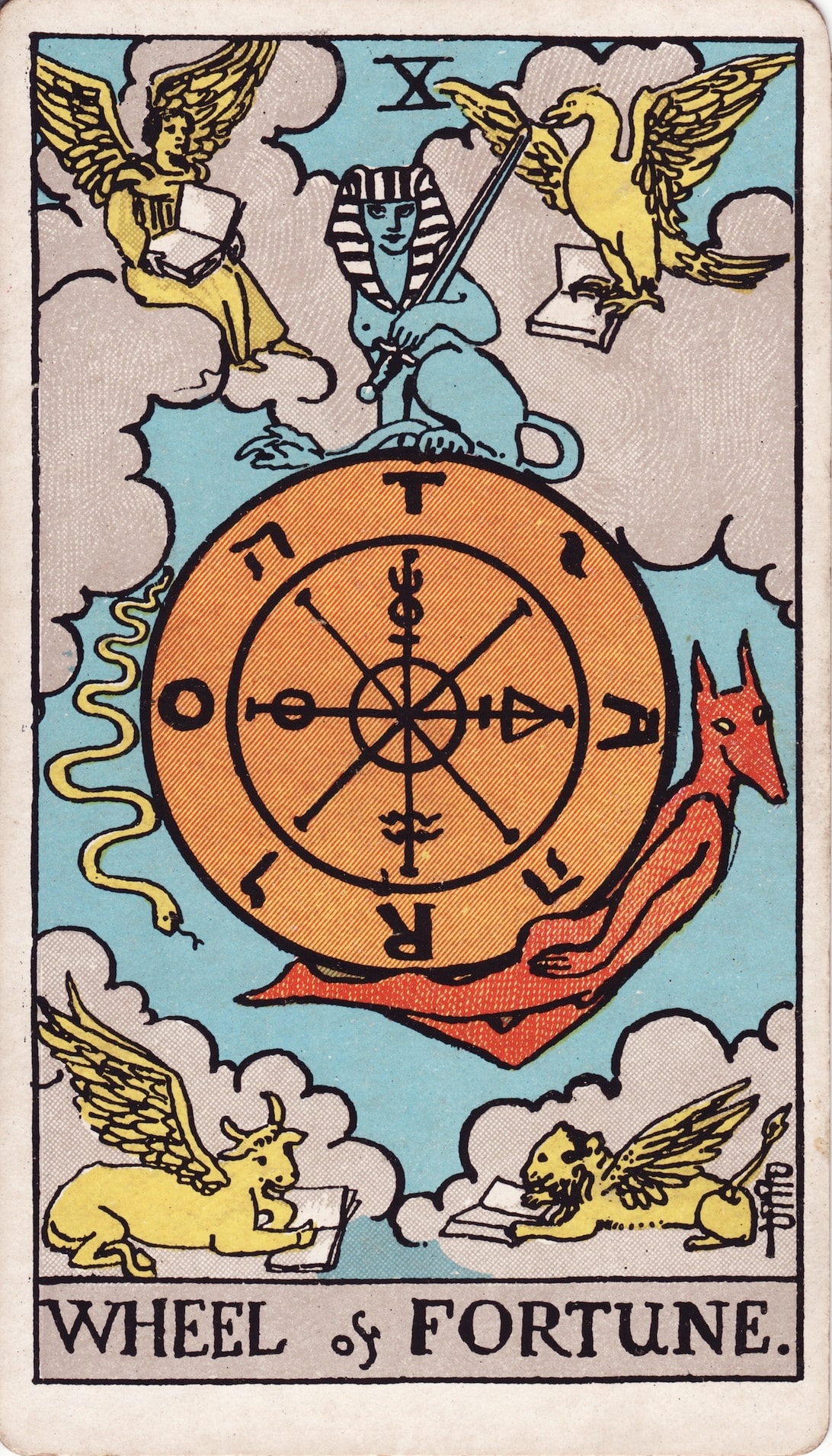
The second row of the Fool's journey
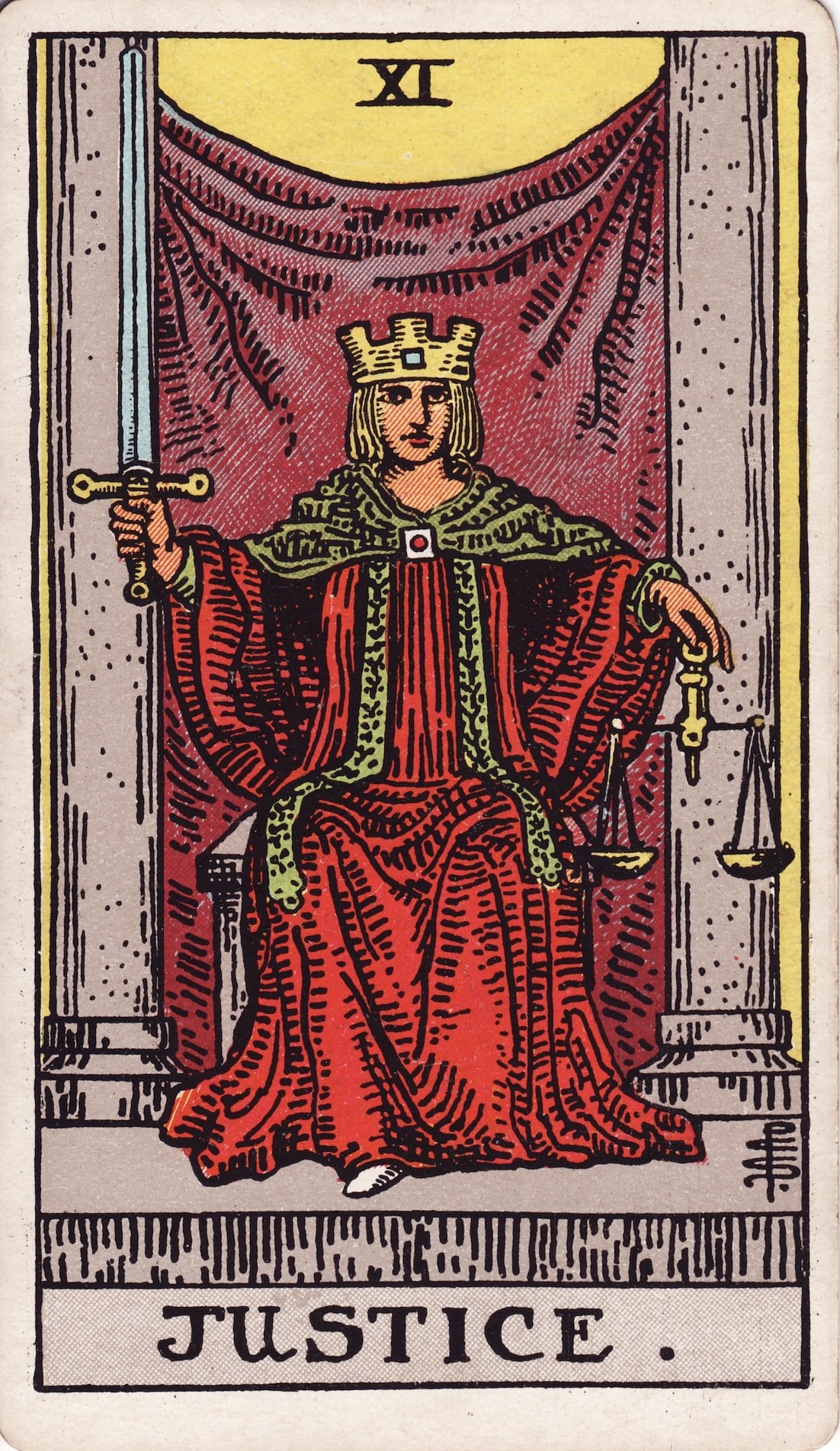
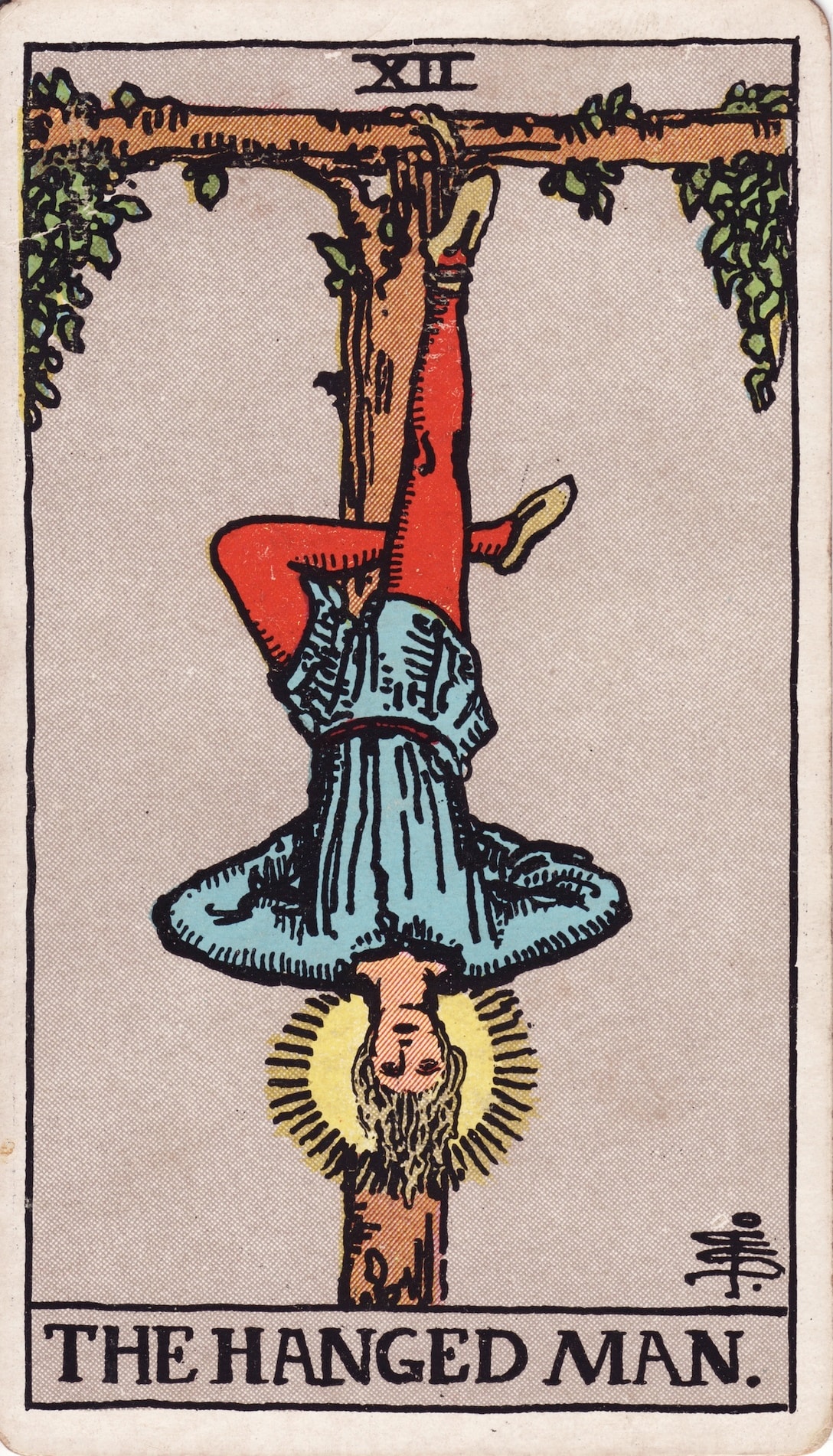
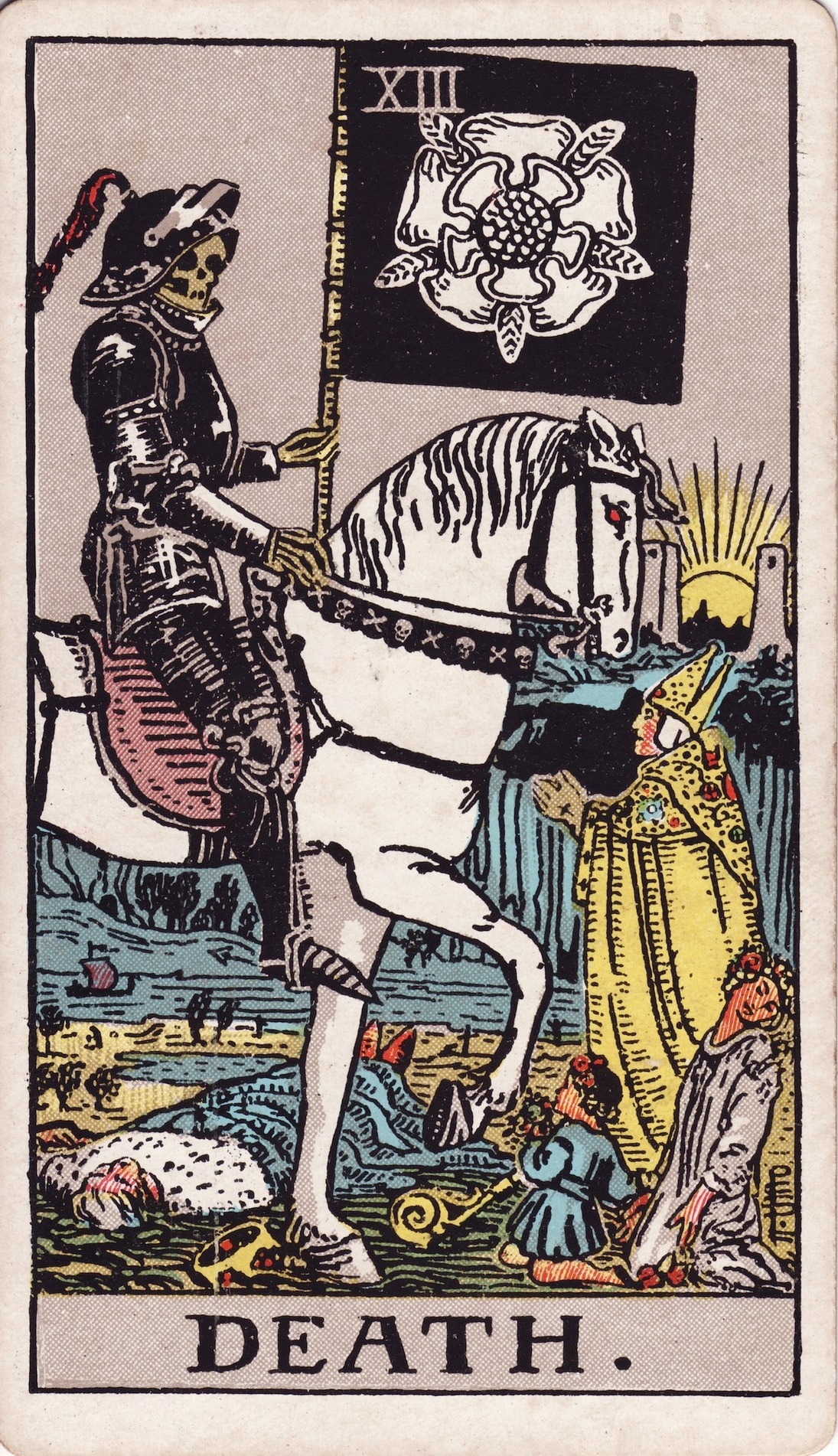
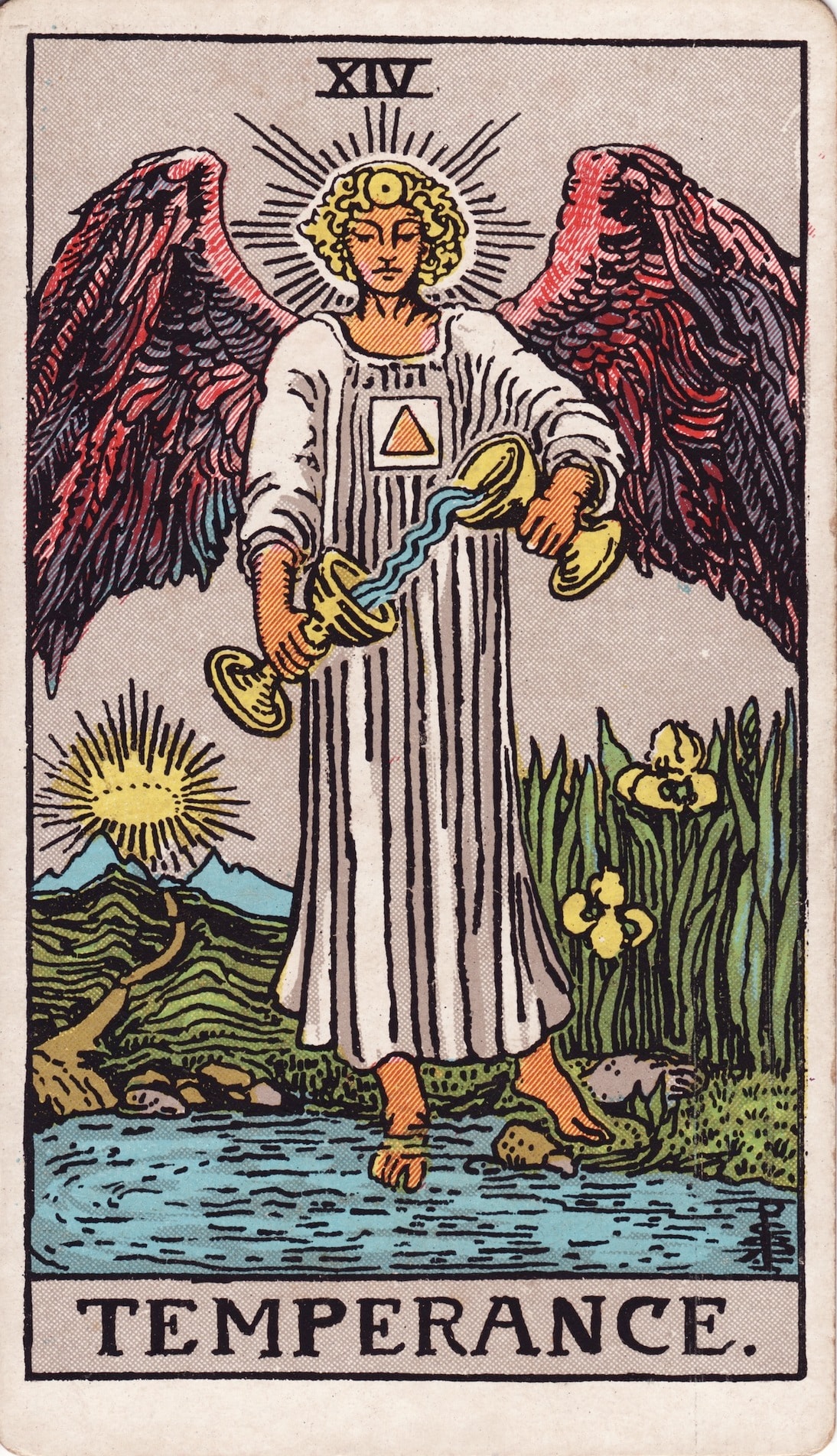

All the cards of the Major Arcana, or the whole deck.