Trump XIII, Major Arcana
Death
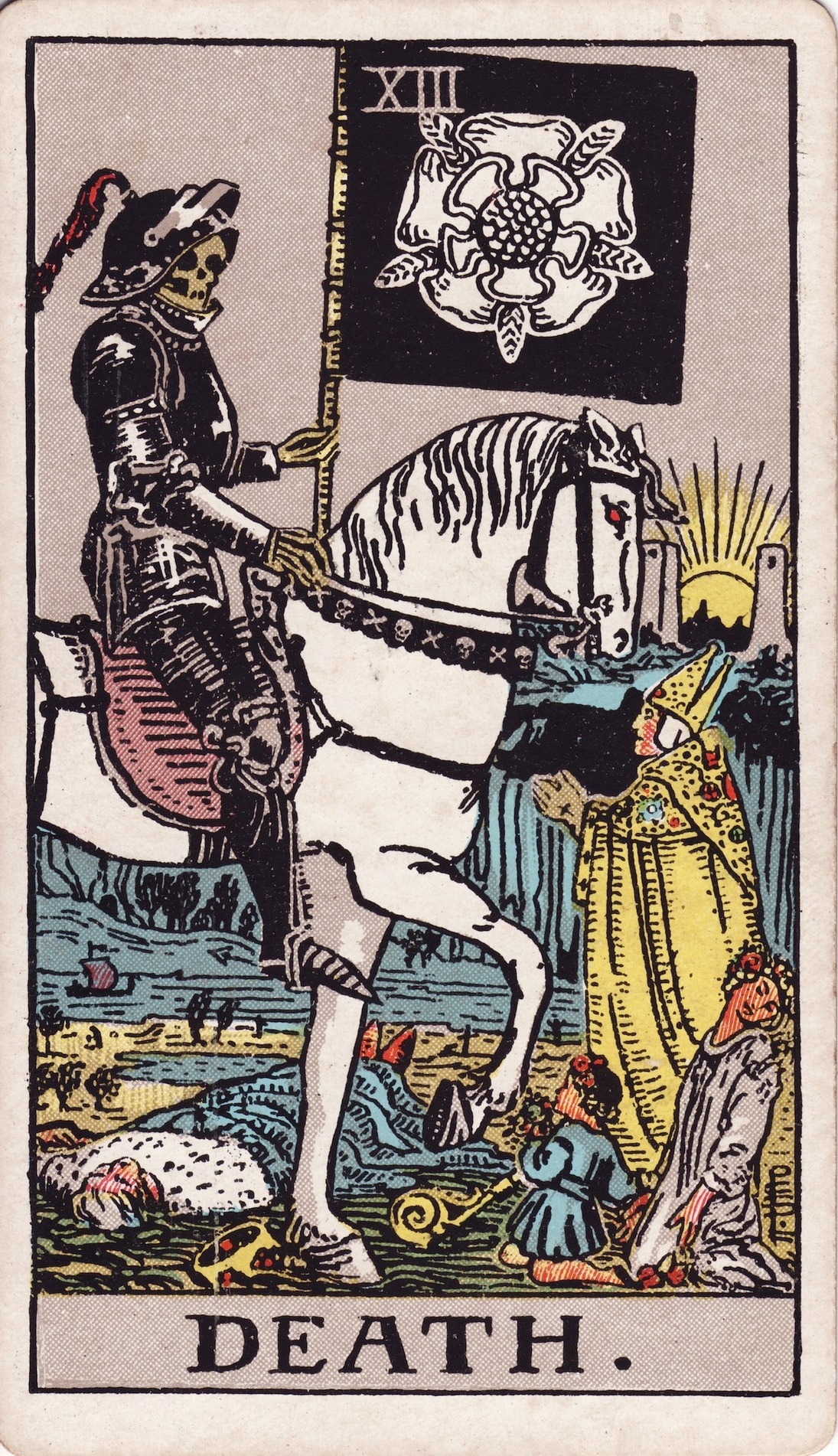
Death, trump XIII, is a skeleton in black armour on a white horse, carrying a black banner with a white rose. In Pamela Colman Smith's 1909 picture a king lies fallen before the horse, a bishop stands with his hands pressed together, and a young woman and a child kneel.
What Waite wrote it means (1910)
- Divinatory meanings
End, mortality, destruction, corruption; also, for a man, the loss of a benefactor; for a woman, many contrarieties; for a maid, failure of marriage projects.
- Reversed
Inertia, sleep, lethargy, petrifaction, somnambulism; hope destroyed.
Arthur Edward Waite, The Pictorial Key to the Tarot (London, 1911), p. 285. Read it in the chapter
The veil or mask of life is perpetuated in change, transformation and passage from lower to higher, and this is more fitly represented in the rectified Tarot by one of the apocalyptic visions than by the crude notion of the reaping skeleton. Behind it lies the whole world of ascent in the spirit. The mysterious horseman moves slowly, bearing a black banner emblazoned with the Mystic Rose, which signifies life. Between two pillars on the verge of the horizon there shines the sun of immortality. The horseman carries no visible weapon, but king and child and maiden fall before him, while a prelate with clasped hands awaits his end.
There should be no need to point out that the suggestion of death which I have made in connection with the previous card is, of course, to be understood mystically, but this is not the case in the present instance. The natural transit of man to the next stage of his being either is or may be one form of his progress, but the exotic and almost unknown entrance, while still in this life, into the state of mystical death is a change in the form of consciousness and the passage into a state to which ordinary death is neither the path nor gate. The existing occult explanations of the 13th card are, on the whole, better than usual, rebirth, creation, destination, renewal, and the rest.
What's in the picture
- The banner. The biggest shape on the card is a black flag on a long pole. A white rose with five petals and a dotted centre fills it, and the number XIII sits in its top corner.
- The rider. Under a black helmet with a red plume, his face is a bare skull. He wears black armour, and his armoured hand grips the pole of the banner. He carries no weapon.
- The white horse. A white horse with a red eye walks to the right, one front leg bent as it steps.
- The harness. Small white skulls and crossed bones take turns along the black strap across the horse's chest.
- The sun and the towers. Far off on the right, a sun with long rays sits low between two grey towers, half hidden behind dark hills. Nothing on the card says whether it is rising or setting.
- The bishop. In a tall yellow mitre and a long yellow robe, he faces the rider with his hands pressed together.
- The king. He lies on his back in the grass below the horse, in a white robe spotted with black, like ermine. His gold crown has rolled off and lies near him.
- The child. A small child in blue kneels, a red flower in its hair, and turns toward the rider, with a few flowers in its hands.
- The young woman. At the right edge a young woman kneels in a pale dress, a wreath of red roses on her head. She leans back and turns her face away, her eyes closed.
- The river and the boat. A blue river winds across the middle of the card, and on it sails a small boat with a red sail.
The card in brief
- In the deck
- Card 14 of 78
- Arcana
- Major Arcana
- Number
- Trump XIII
- Hebrew letter (Golden Dawn)
- Nun
- Astrology (Golden Dawn)
- Scorpio
- Title in Book T
- The Child of the Great Transformers: the Lord of the Gates of Death
- Drawn by
- Pamela Colman Smith
- Planned by
- Arthur Edward Waite
- Published
- London, William Rider & Son, 1909
- Scan
- Pam-A printing, c. 1910, Wikimedia Commons
In the old books
Book T (1912)
Time, age, transformation, change involuntary (as opposed to 18, ♓︎). Or death, destruction (only latter with special cards).
Book T, “A Description of the Cards of the Tarot”, The Equinox I.8 (London, 1912), pp. 203–204. See the source Papus (1892)
A skeleton mows down heads in a field, from which hands and feet spring up on all sides, as the scythe pursues its work.
The works of the head (conception) become immortal as soon as they are realized (heads and feet).
Papus, The Tarot of the Bohemians, tr. A. P. Morton (London, 1892), p. 159. See the source
Before 1909
The older cards and pictures behind this one will be shown here once their licences are checked.
Death: the rider and the rose
A rider in black armour comes slowly across a field. Under his helmet is a skeleton's face. He rides a white horse, and he carries no weapon. In his hand is a black banner with a large white rose on it. In front of him, four people meet him in four different ways. A king has fallen. A bishop stands with his hands together. A young woman turns her face away. A small child looks straight up at him.
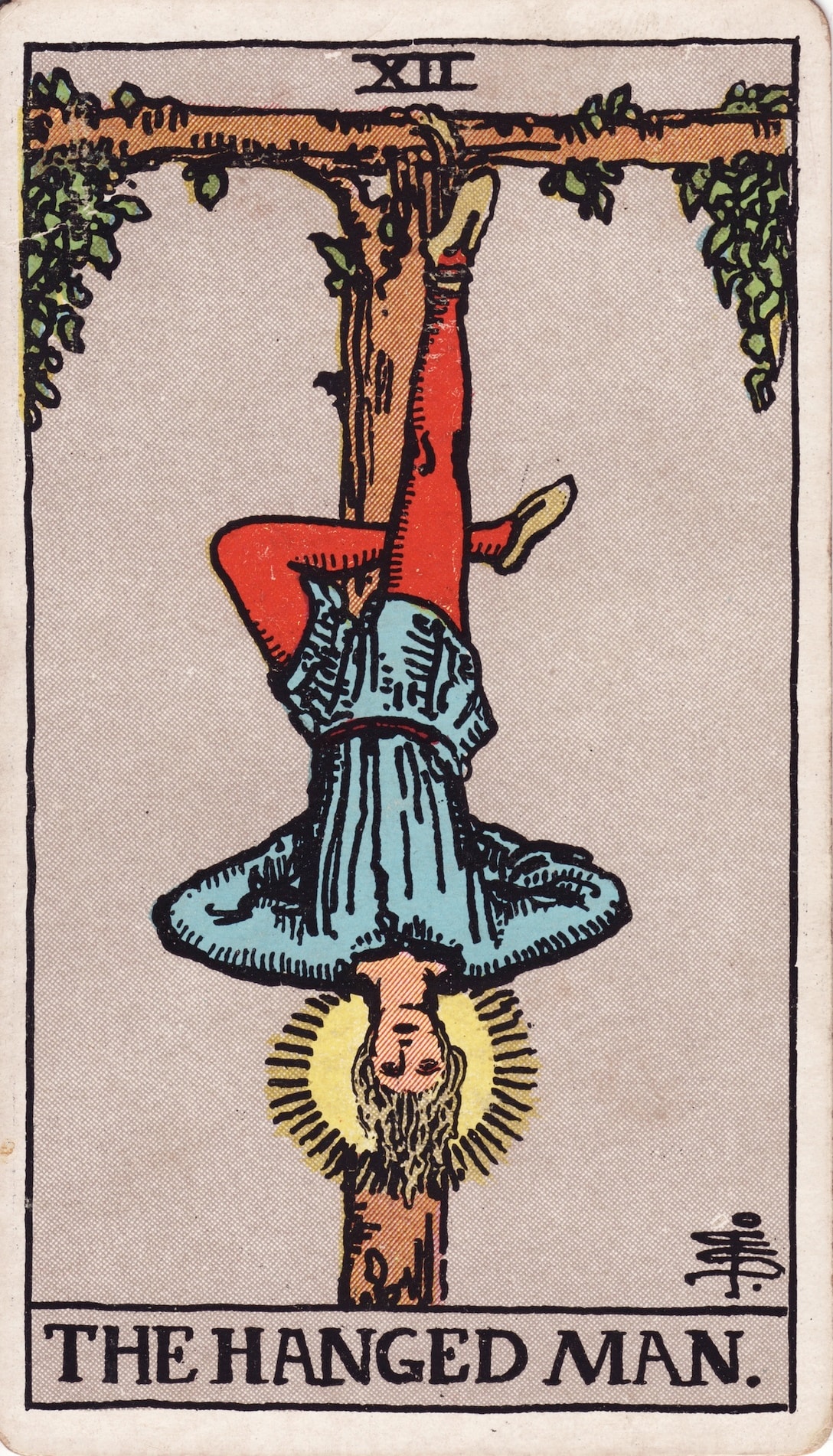
Death is trump XIII, and it comes right after the Hanged Man. Follow the Fool through the trumps as one road, and this is the place where he meets the end of something. Far behind the rider, a sun is shining.
The image
Start with the banner. It is the biggest shape on the card. The rose has five white petals around a dotted heart. Arthur Edward Waite, who wrote the guide to these cards, called it "the Mystic Rose" and said it "signifies life". The card's number, XIII, is written in the corner of the banner, as if it rides along with him.
Now look at the four people again. The king lies on the ground, and his crown has fallen off. The bishop in his tall yellow hat faces the rider. The young woman kneels and looks away. The child kneels too, and turns toward the rider, curious. Which of them is closest to you today?
Behind them a river runs, and a small boat sails on it. Far away, on the horizon, a sun shines between two towers. Waite called it "the sun of immortality". Is it rising or setting? The card doesn't say. You can keep both.
Waite also said the horseman "moves slowly". On older cards, he wrote, a skeleton with "a great scythe" mows a field where heads and arms stick up out of the ground, and one of the heads wears a crown. Waite didn't like that "crude notion of the reaping skeleton". He wanted a card about "change, transformation and passage from lower to higher". He even found the usual occult explanations of this card "better than usual": "rebirth, creation, destination, renewal".
The inner journey
On the card before this one, the Hanged Man hangs upside down and lets go. Now something ends. It might be a role you played, or an old picture of yourself that you have outgrown. The king and the bishop are here too. You could see power and certainty as among the first things to fall.
Waite read this card as change. On this road, the endings are the kind that come many times in a life. A school year finishes, or a belief stops fitting.
The psychologist James Hillman wrote a whole book about this ground, The Dream and the Underworld (1979). For him, going down into the dark was one of the soul's own movements. It could be a way of seeing further down. You could try looking at an ending in your life that way. What did it take you down into? What did you find there?
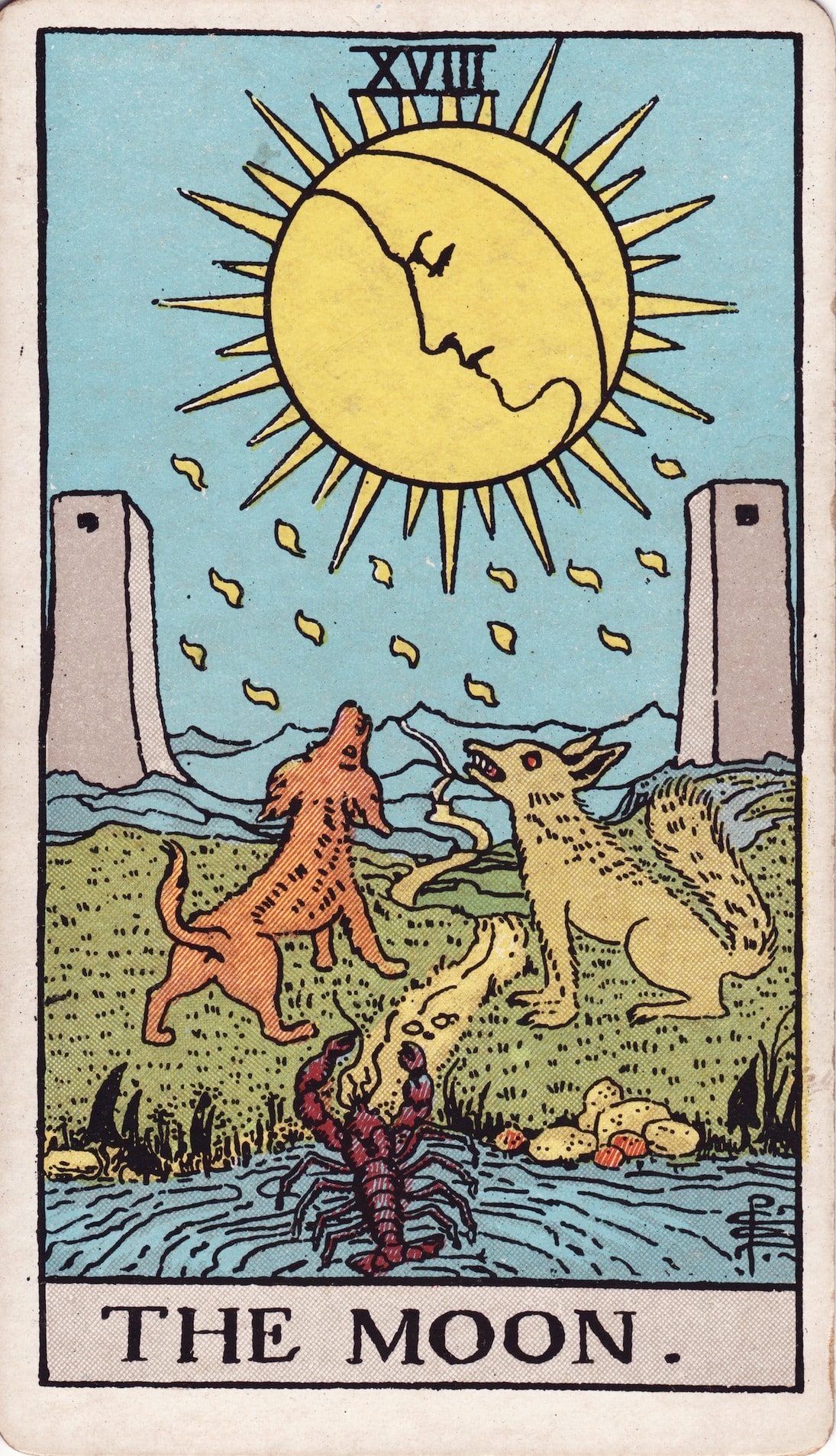
Then look at the sun between the towers. Two towers like these come back later, on the Moon, with a path running between them. So the road goes on. The rider is passing through, and so is the Fool.
You could also stay here a while. An ending has its own quiet, and the next beginning can wait.
Across traditions
The Golden Dawn gave this card the Hebrew letter Nun and Scorpio, a sign of the zodiac. Its title in Book T, the order's private text on the trumps, is a long one: "The Child of the Great Transformers: the Lord of the Gates of Death".
The sun passes through Scorpio from late October to late November. In much of the northern half of the world, that is the season of falling leaves. The bare trees wait out the winter and bud again in spring.
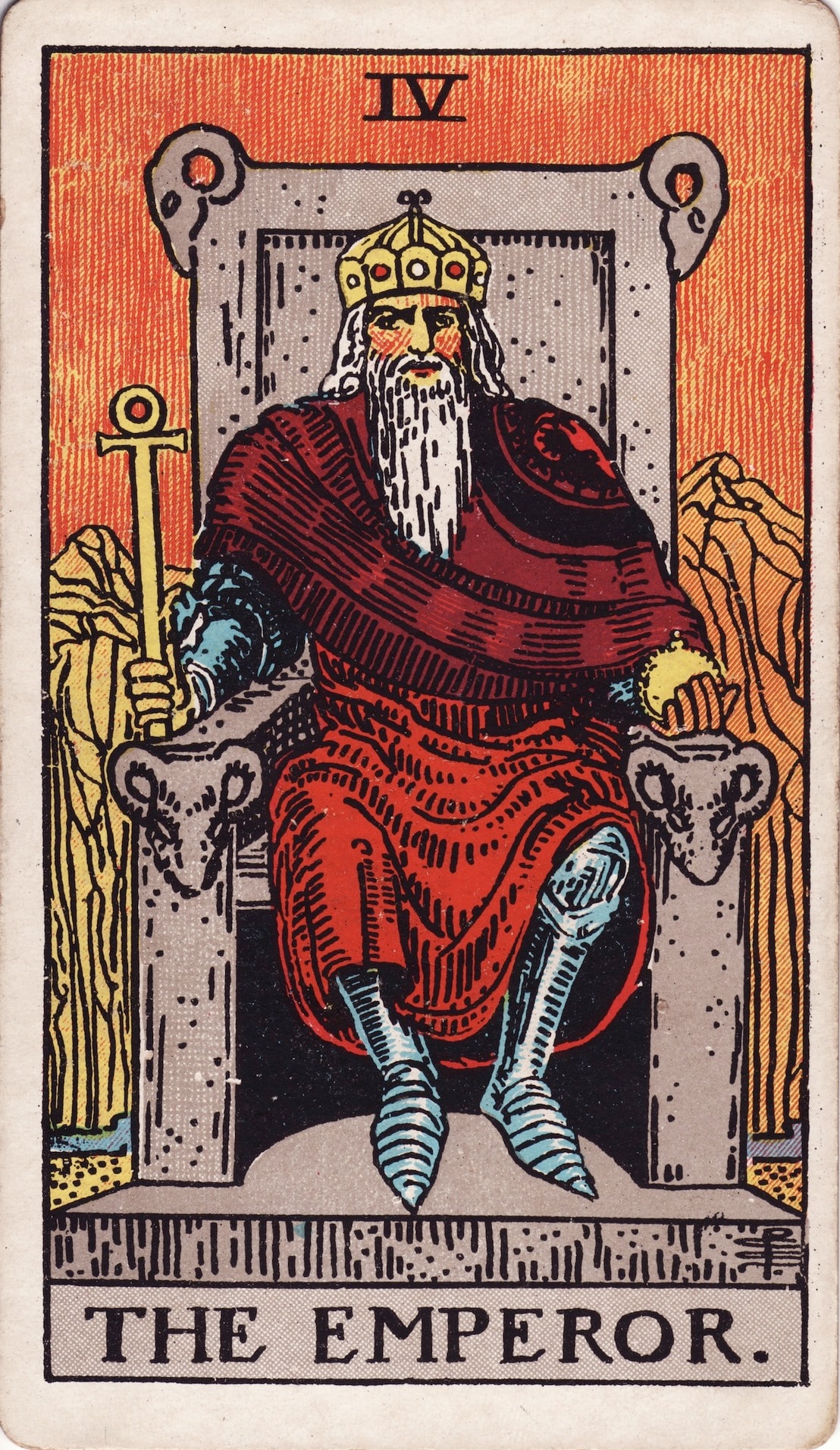
Add the two digits of XIII and you get 4, the number of the Emperor. He sits on his throne with his crown on his head. Here a king lies in the grass, and his crown has rolled away. What happens to a crown once it falls?
Try this
Think of one small ending from this year. Keep it small. Picture the rider passing it slowly, on his white horse. Which of the four people are you as he goes by: the king, the bishop, the young woman or the child? Try being each of them for a moment. Then look past the rider to the sun between the towers. What might be on the other side of this ending?
Questions to sit with
- Why a rose, and why is it white?
- Is the sun on the horizon rising or setting?
- What is the child looking at?
- What in your life has already ended without a sound?
- What could you let the river carry away?
The film
No film for this card yet.
Sources
- Waite on the slow horseman, the Mystic Rose that signifies life, the sun of immortality between two pillars, the reaping skeleton, change and transformation, and the explanations he found better than usual.Arthur Edward Waite, The Pictorial Key to the Tarot (London, 1911), Part II, Death, pp. 120–123
- On older cards a skeleton with a great scythe mows a field of heads and arms, one of them crowned.Arthur Edward Waite, The Pictorial Key to the Tarot (London, 1911), Part I, Trumps Major, no. 13, p. 23
- Hillman on the underworld: going down as one of the soul's movements.James Hillman, The Dream and the Underworld (New York, 1979)
- Two towers with a path between them come back on the Moon.Arthur Edward Waite, The Pictorial Key to the Tarot (London, 1911), Part II, The Moon, p. 140
- The Golden Dawn gave Death Nun and Scorpio; Book T's title for it.Book T, The Equinox I.8 (1912), table of the Keys
- The sun enters Scorpio about 23 October and Sagittarius about 22 November.Webster's Revised Unabridged Dictionary (1913), Scorpio and Sagittarius
Around this card
Before and after it in the deck
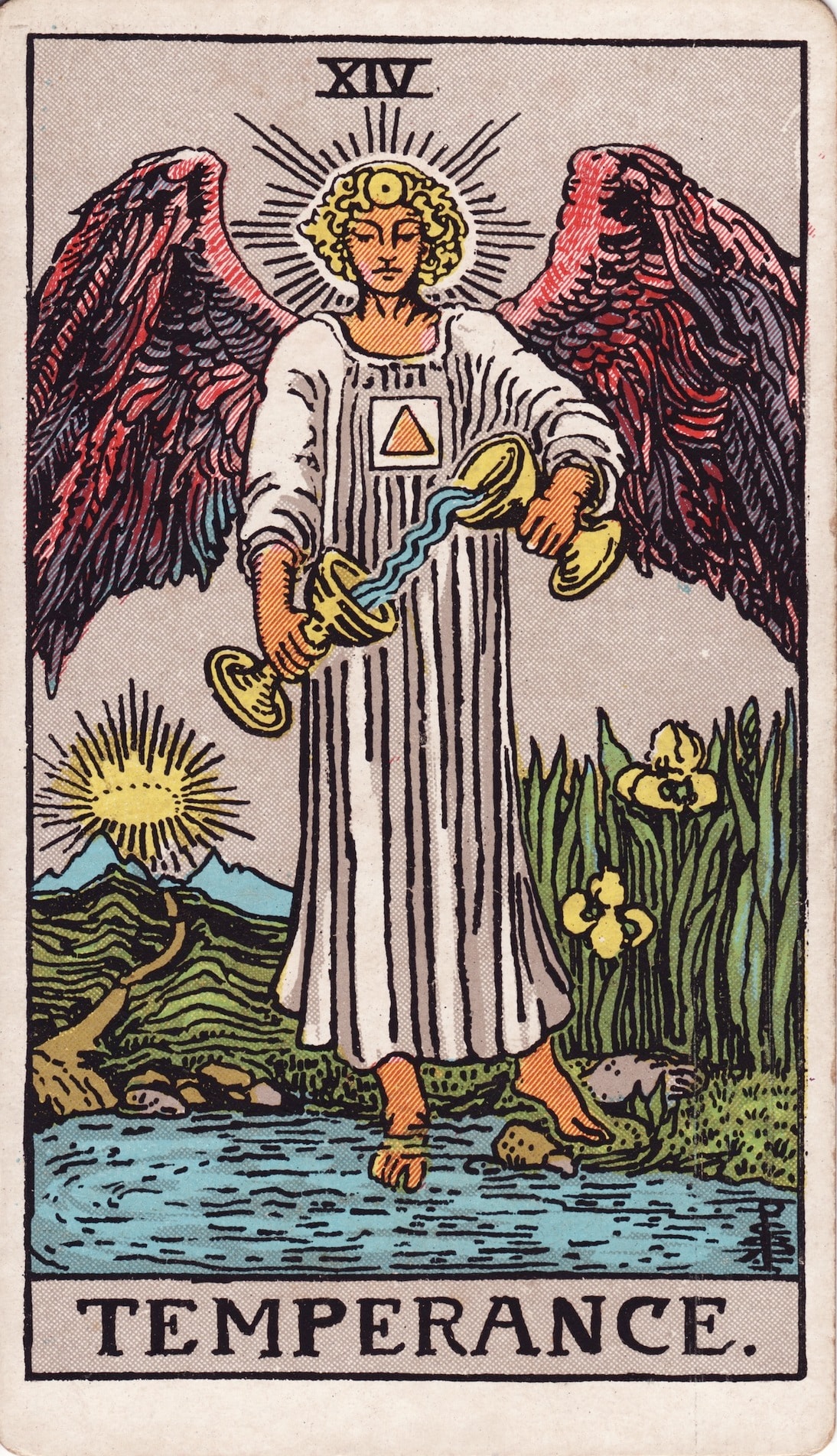
The second row of the Fool's journey
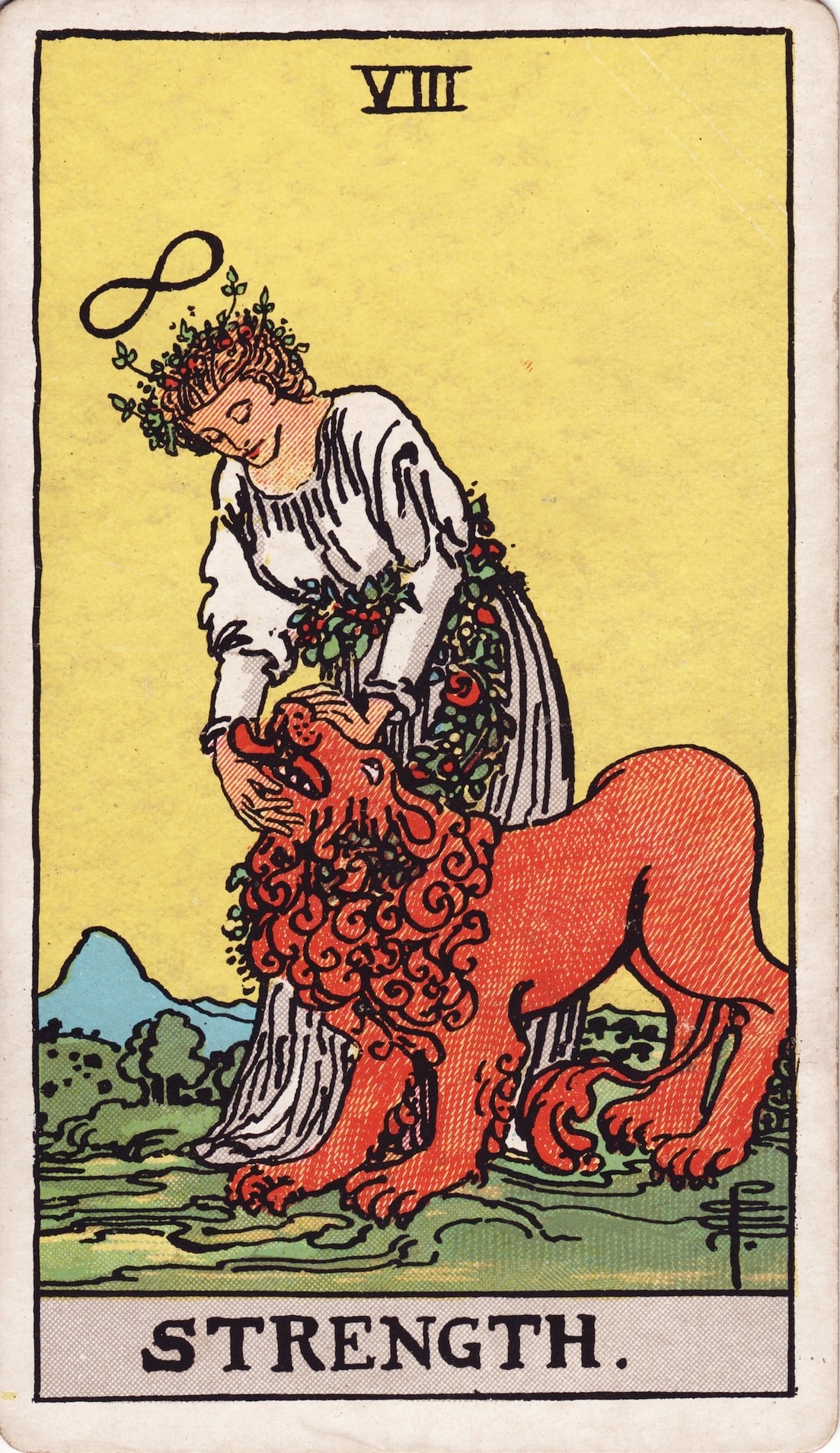
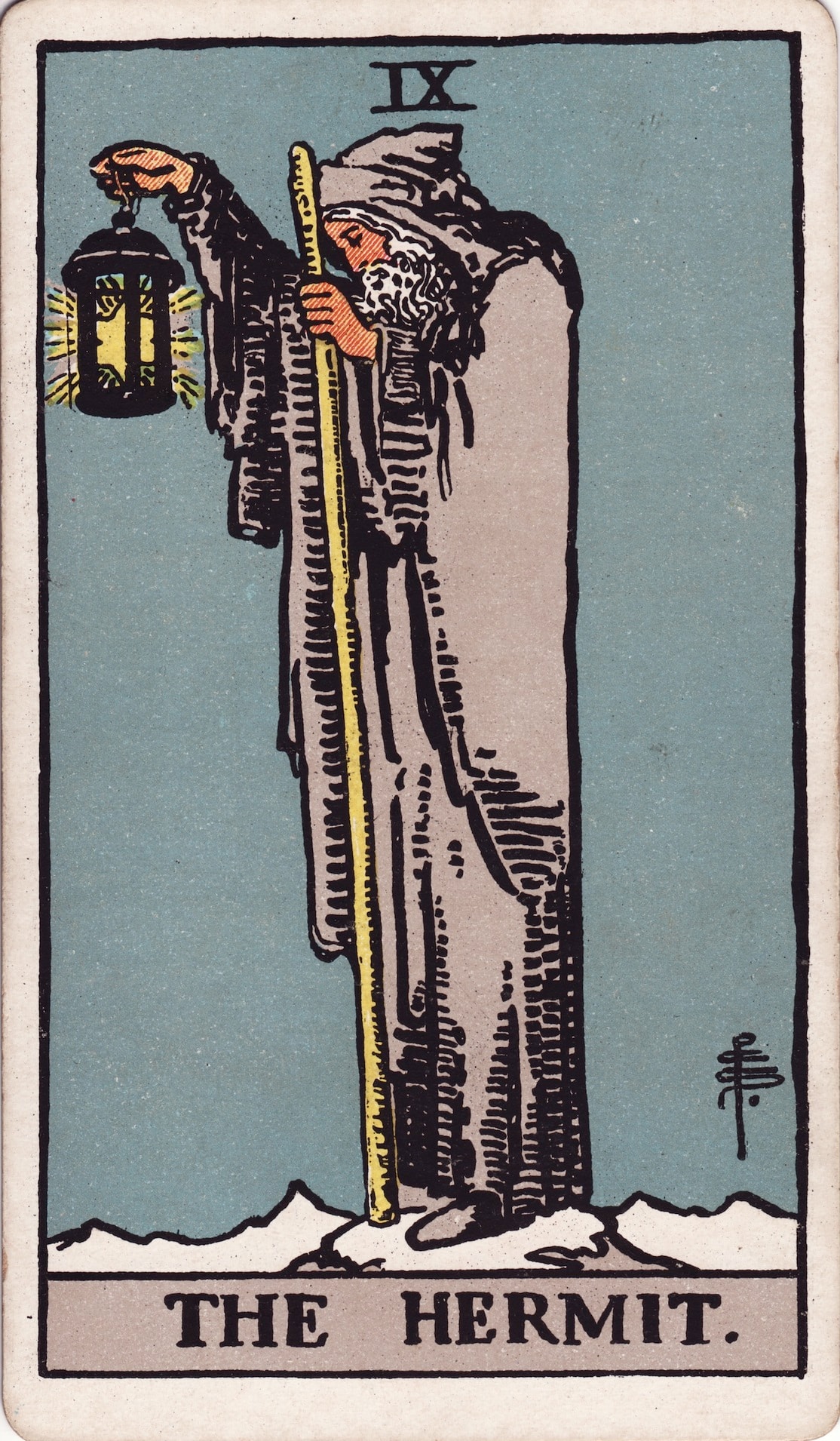
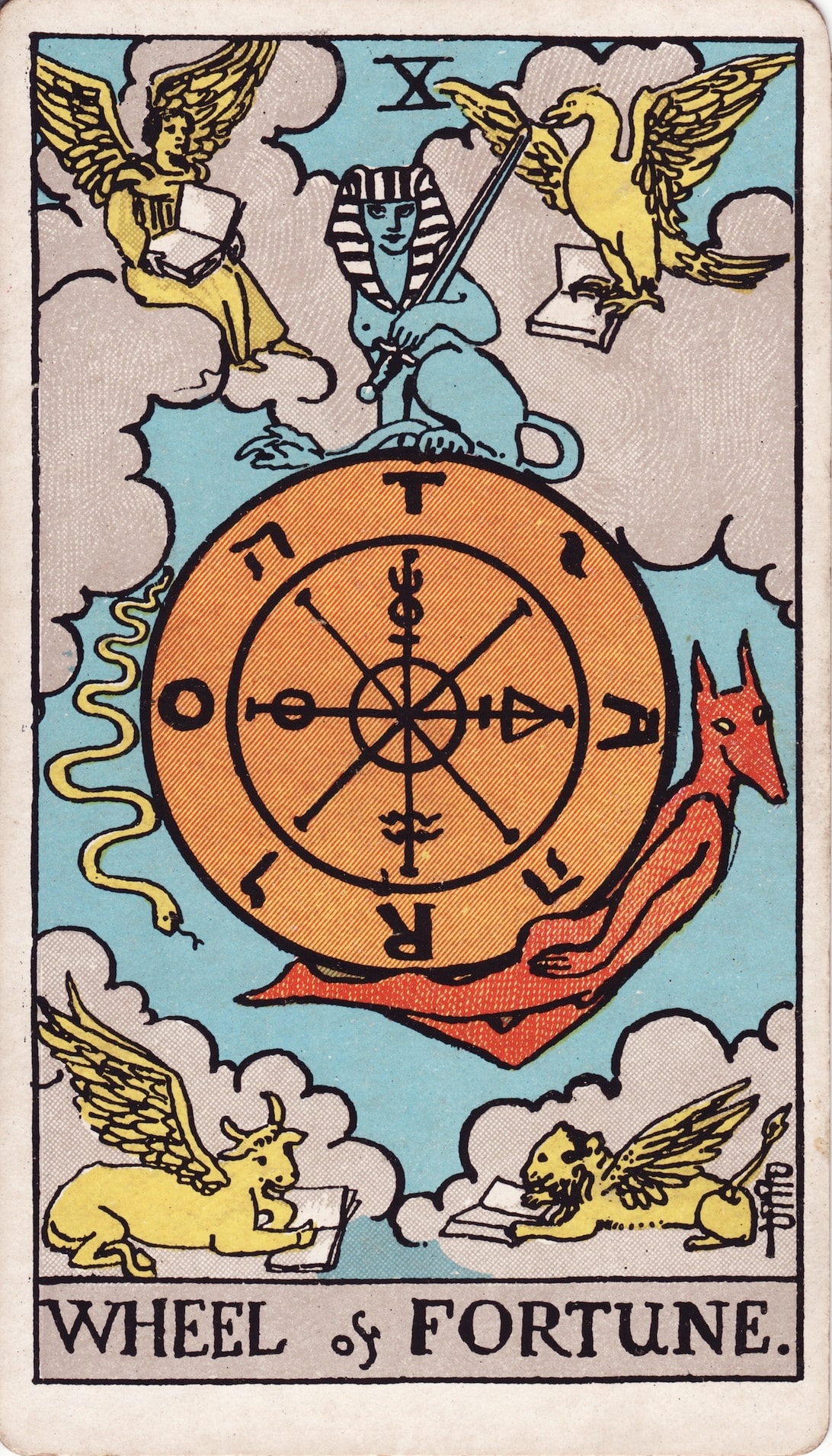

All the cards of the Major Arcana, or the whole deck.