Trump XIV, Major Arcana
Temperance
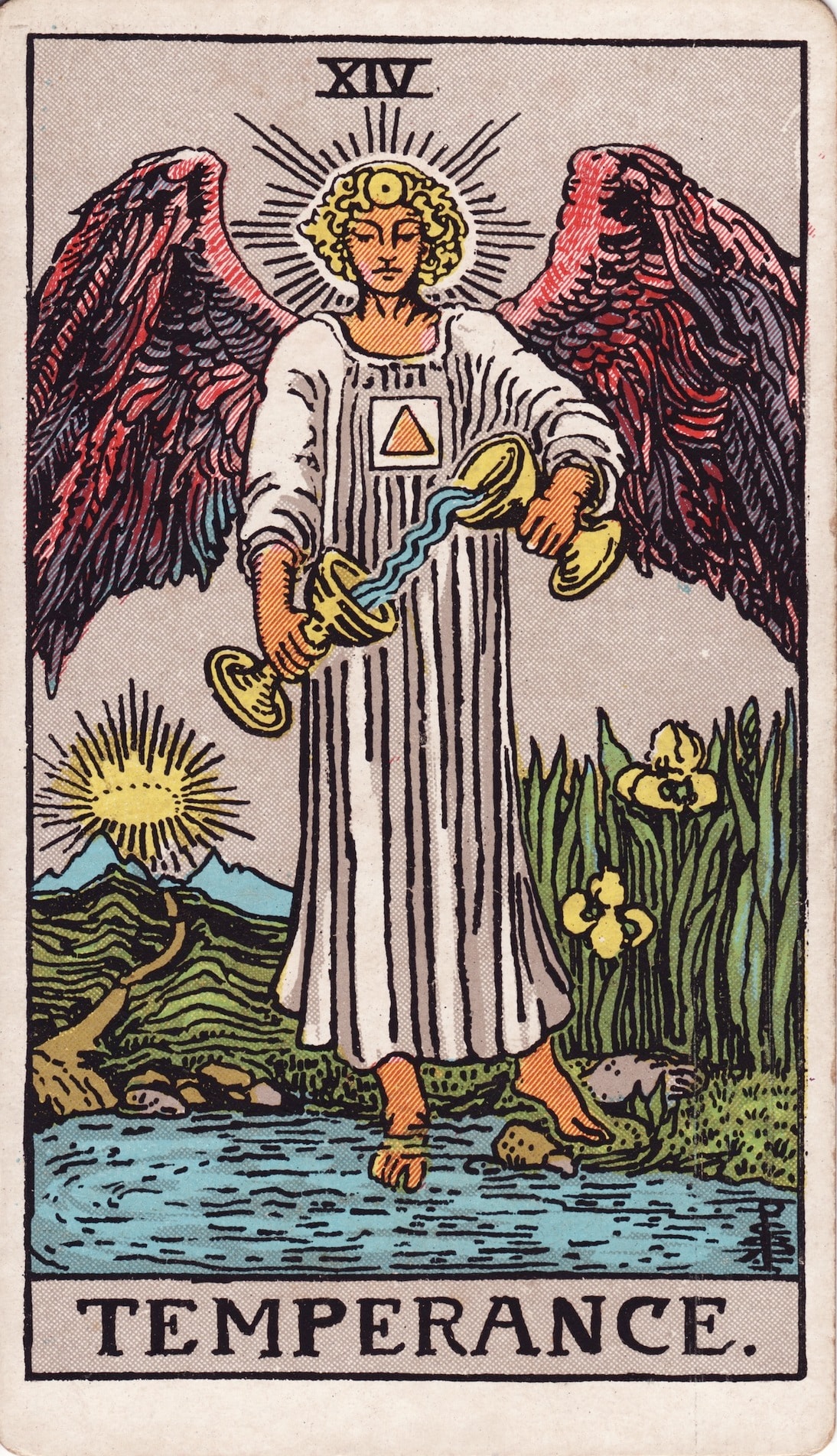
In trump XIV, Temperance, a winged angel in a white robe pours a stream from one golden cup into another, with one foot in a pool and the other on the bank. Pamela Colman Smith's 1909 drawing adds yellow irises by the water and a path that climbs to a sun between two mountains.
What Waite wrote it means (1910)
- Divinatory meanings
Economy, moderation, frugality, management, accommodation.
- Reversed
Things connected with churches, religions, sects, the priesthood, sometimes even the priest who will marry the Querent; also disunion, unfortunate combinations, competing interests.
Arthur Edward Waite, The Pictorial Key to the Tarot (London, 1911), p. 285. Read it in the chapter
A winged angel, with the sign of the sun upon his forehead and on his breast the square and triangle of the septenary. I speak of him in the masculine sense, but the figure is neither male nor female. It is held to be pouring the essences of life from chalice to chalice. It has one foot upon the earth and one upon waters, thus illustrating the nature of the essences. A direct path goes up to certain heights on the verge of the horizon, and above there is a great light, through which a crown is seen vaguely. Hereof is some part of the Secret of Eternal Life, as it is possible to man in his incarnation. All the conventional emblems are renounced herein.
So also are the conventional meanings, which refer to changes in the seasons, perpetual movement of life and even the combination of ideas. It is, moreover, untrue to say that the figure symbolizes the genius of the sun, though it is the analogy of solar light, realized in the third part of our human triplicity. It is called Temperance fantastically, because, when the rule of it obtains in our consciousness, it tempers, combines and harmonises the psychic and material natures. Under that rule we know in our rational part something of whence we came and whither we are going.
What's in the picture
- The sun on the forehead. A small gold circle with a dot in the middle sits on the angel's forehead, among blond curls. Thin rays spread out from the head like a halo, and the eyes are lowered.
- The wings. Two huge wings in red and dark purple open behind the angel and fill the top of the card from edge to edge.
- The letters at the neckline. Just below the collar of the robe, four tiny Hebrew letters are written in black.
- The square and triangle. On the chest, a white square holds an orange triangle pointing up.
- The two cups. The angel holds a golden cup in each hand: one high on our right, tipped over, and one lower on our left, held up to catch.
- The water. A blue stream runs from the higher cup to the lower one. It doesn't fall straight down. It slides sideways in a little zigzag, across the front of the robe.
- The feet. The angel's right foot stands in the pool. The left foot rests on the grassy bank, with a brown stone in the water just in front of it.
- The irises. Tall yellow irises grow among green reeds on the right, beside the pool.
- The sun and the path. On the left, a sun with long black rays sits between two blue mountain tops, and a faint dotted arc inside it looks like a crown. A pale path winds up to it from the edge of the pool.
- Smith's monogram. At the bottom right, on the water by the edge of the card, is the small knot-like mark Smith signed many of her cards with.
The card in brief
- In the deck
- Card 15 of 78
- Arcana
- Major Arcana
- Number
- Trump XIV
- Hebrew letter (Golden Dawn)
- Samekh
- Astrology (Golden Dawn)
- Sagittarius
- Title in Book T
- The Daughter of the Reconcilers: the Bringer-Forth of life
- Drawn by
- Pamela Colman Smith
- Planned by
- Arthur Edward Waite
- Published
- London, William Rider & Son, 1909
- Scan
- Pam-A printing, c. 1910, Wikimedia Commons
In the old books
Book T (1912)
Combination of forces, realization, action (material effect, good or evil).
Book T, “A Description of the Cards of the Tarot”, The Equinox I.8 (London, 1912), p. 204. See the source Papus (1892)
The genius of the Sun pours the fluid of Life from a golden vase into a silver one.
(First idea.)
This essence passes from one vase to the other without one drop being spilt.
(Second idea.)
Papus, The Tarot of the Bohemians, tr. A. P. Morton (London, 1892), p. 162. See the source
Before 1909
The older cards and pictures behind this one will be shown here once their licences are checked.
Temperance: the art of mixing
A tall angel stands at the edge of a pool, pouring water from one golden cup into another. The water doesn't fall straight down. It flows sideways, in a little zigzag, from the higher cup to the lower one. The angel has red wings, a white robe and a gold circle on the forehead. One foot rests on the grassy bank. The other stands in the water. Behind the angel, a path climbs from the pool to the mountains, toward a golden light.
Temperance is trump XIV, and it comes after Death. If you follow the Fool through the Major Arcana as one road, the next person he meets is someone who mixes things. What came apart starts to blend.
The image
In The Pictorial Key to the Tarot, Arthur Edward Waite wrote that the angel is "pouring the essences of life from chalice to chalice". He called the angel "him", then took it back: "the figure is neither male nor female". So the card starts by mixing even that.
Look at the chest. A white square holds an orange triangle. Waite called them "the square and triangle of the septenary": four and three, which make seven. Just above them, at the neckline, are four tiny Hebrew letters: יהוה. They spell the four-letter name of God in the Hebrew Bible. Waite printed the same four letters when he wrote about the World, the last card.
On the right, tall yellow irises grow by the water. The iris takes its name from Iris, the Greek goddess of the rainbow and messenger of the gods. An angel is a messenger too. A rainbow joins the sky and the earth.
Follow the path from the pool. It winds up to two mountain peaks with a sun between them. Look closely at the sun. There is a faint crown inside it. Waite said "a crown is seen vaguely" there.
The inner journey
Waite gave a reason for the card's odd name. He said that when its rule holds in us, it "tempers, combines and harmonises" the soul and the body. Then he wrote that under this rule "we know … something of whence we came and whither we are going". He used almost the same words for the sun behind the Fool. That sun knows "whence he came, whither he is going". Seen as a stop on the Fool's road, this card is where he starts to learn what his sun already knew.
Carl Jung spent years reading the old alchemists. They tried to turn lead into gold in their workshops. Jung thought their recipes were also pictures of the soul, and that their great work was the joining of opposites. Temperance is full of opposites. There is land and water, earth and sky, one cup and another. Nothing is thrown away. It is all poured together.
After the ending of Death, this is a gentler kind of change. It happens a little at a time, at the speed of pouring water. Where in you are two things that have never met? What might happen if you let them mix?
The mountains can wait. You could stay by the pool with one foot in the water, and watch the pouring.
Across traditions
Temperance is one of the old virtues in the tarot, with Justice and Strength. Waite noticed that a fourth, Prudence, is missing. Around 1306, the painter Giotto painted seven virtues on the walls of the Scrovegni Chapel in Padua. His Temperance stands still. She has a bit in her mouth, like a horse, and her sword is tied into its sheath. That kind of temperance holds back.
Pamela Colman Smith's angel doesn't hold back. It pours. To temper can mean to hold back, but an old dictionary gives another sense first: "to mingle in due proportion". A smith tempers steel with fire and water, so that it is hard but doesn't snap.
The Golden Dawn gave the card the Hebrew letter Samekh and Sagittarius, the Archer. In the order's Book T it is "The Daughter of the Reconcilers" and "the Bringer-Forth of life". You could see the straight path to the mountains as the line of an arrow in flight.
Try this
Take two glasses and fill one with water. Pour it slowly into the other, then back again. Do it five or six times. Try to spill nothing. Notice what happens to your breathing and your attention while you pour. Then think of two sides of your life that feel far apart, like work and rest, or thinking and feeling. Pour a little of one into the other, in your mind. What changes?
Questions to sit with
- Which way is the water flowing, and could it flow back?
- Why does the angel keep one foot on land and one in the water?
- What would you pour from one cup into the other?
- What in your life needs mixing, and what needs tempering?
- What might the angel see at the top of that path, under the crown of light?
The film
No film for this card yet.
Sources
- Waite on the angel pouring from chalice to chalice, neither male nor female, the square and triangle of the septenary, the path and the crown seen vaguely in the light.Arthur Edward Waite, The Pictorial Key to the Tarot (London, 1911), Part II, Temperance, p. 124
- Waite on the name: it tempers, combines and harmonises; under its rule we know whence we came and whither we are going.Arthur Edward Waite, The Pictorial Key to the Tarot (London, 1911), Part II, Temperance, p. 127
- The sun behind the Fool knows whence he came, whither he is going.Arthur Edward Waite, The Pictorial Key to the Tarot (London, 1911), Part II, The Fool, p. 155
- The four Hebrew letters יהוה, the Holy Name, as Waite prints them for the World.Arthur Edward Waite, The Pictorial Key to the Tarot (London, 1911), Part I, Trumps Major, no. 22, p. 30
- The tarot has Justice, Temperance and Fortitude, but no Prudence.Arthur Edward Waite, The Pictorial Key to the Tarot (London, 1911), Part I, Trumps Major, no. 11, p. 22
- Iris, goddess of the rainbow and messenger of the gods, and the flower; to temper, to mingle in due proportion and to harden steel; alchemy, turning base metals into gold.Webster's Revised Unabridged Dictionary (1913), Iris, Temper and Alchemy
- Jung on alchemy as a picture of inner change, and its work of joining opposites.C. G. Jung, Psychology and Alchemy (1944), Collected Works 12; Mysterium Coniunctionis (1955–1956), Collected Works 14
- Giotto's Temperance in the Scrovegni Chapel, about 1306: a bit in her mouth, her sword bound into its sheath.Giotto, Temperance, the Seven Virtues, Scrovegni Chapel, Padua (c. 1306); Wikimedia Commons
- The Golden Dawn gave Temperance Samekh and Sagittarius; Book T's titles for it.Book T, The Equinox I.8 (1912), table of the Keys
Around this card
Before and after it in the deck
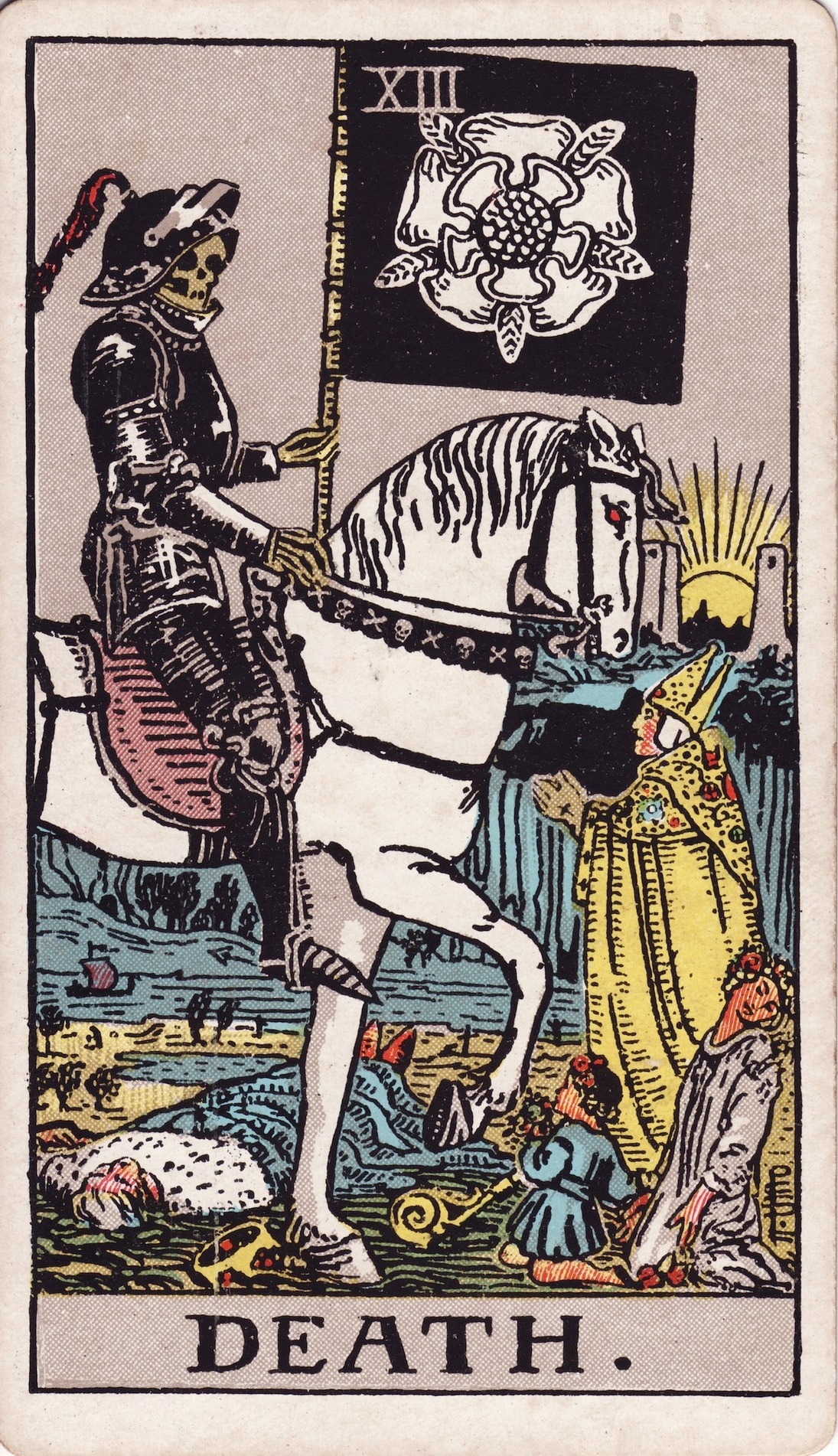
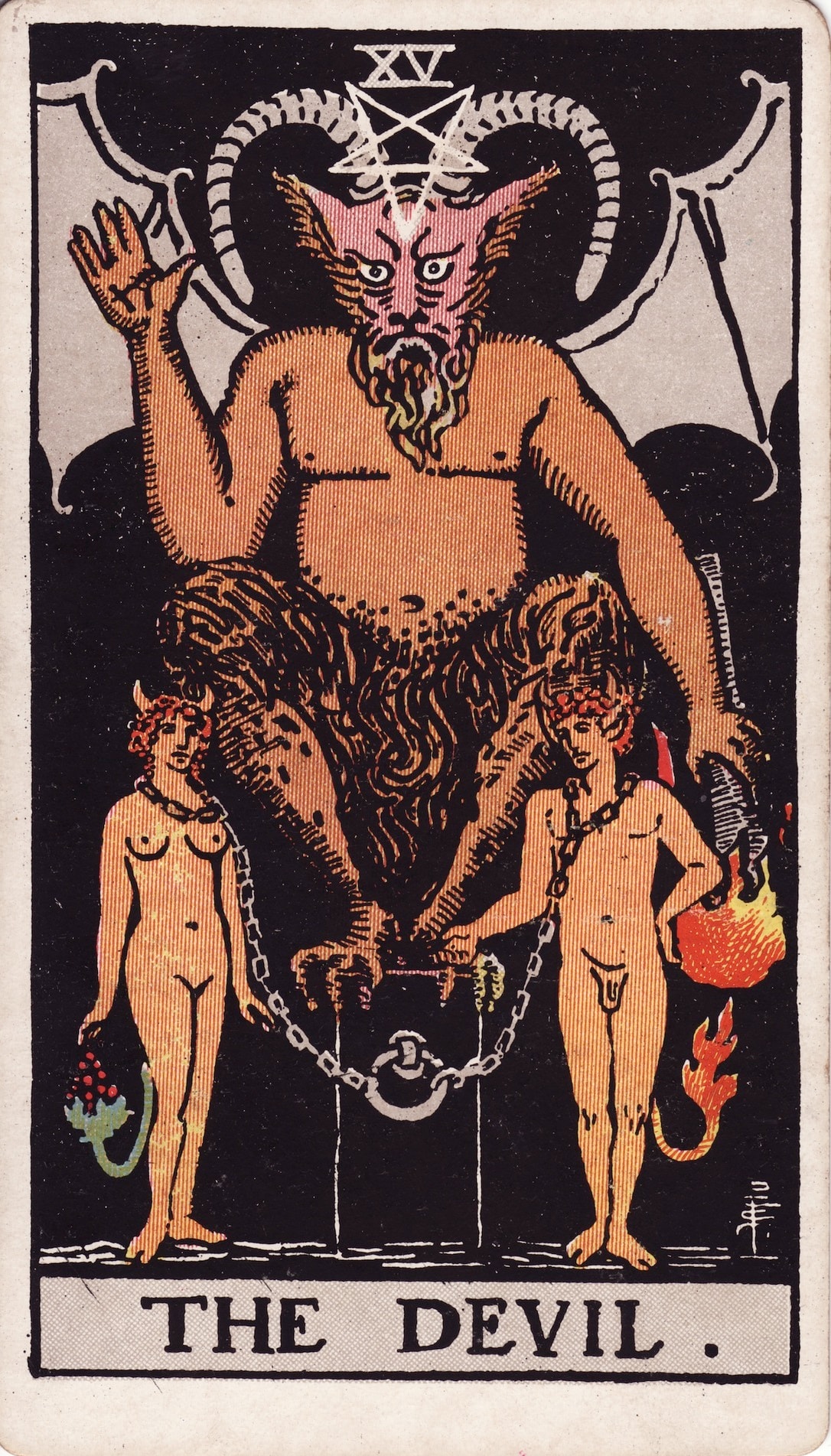
The second row of the Fool's journey
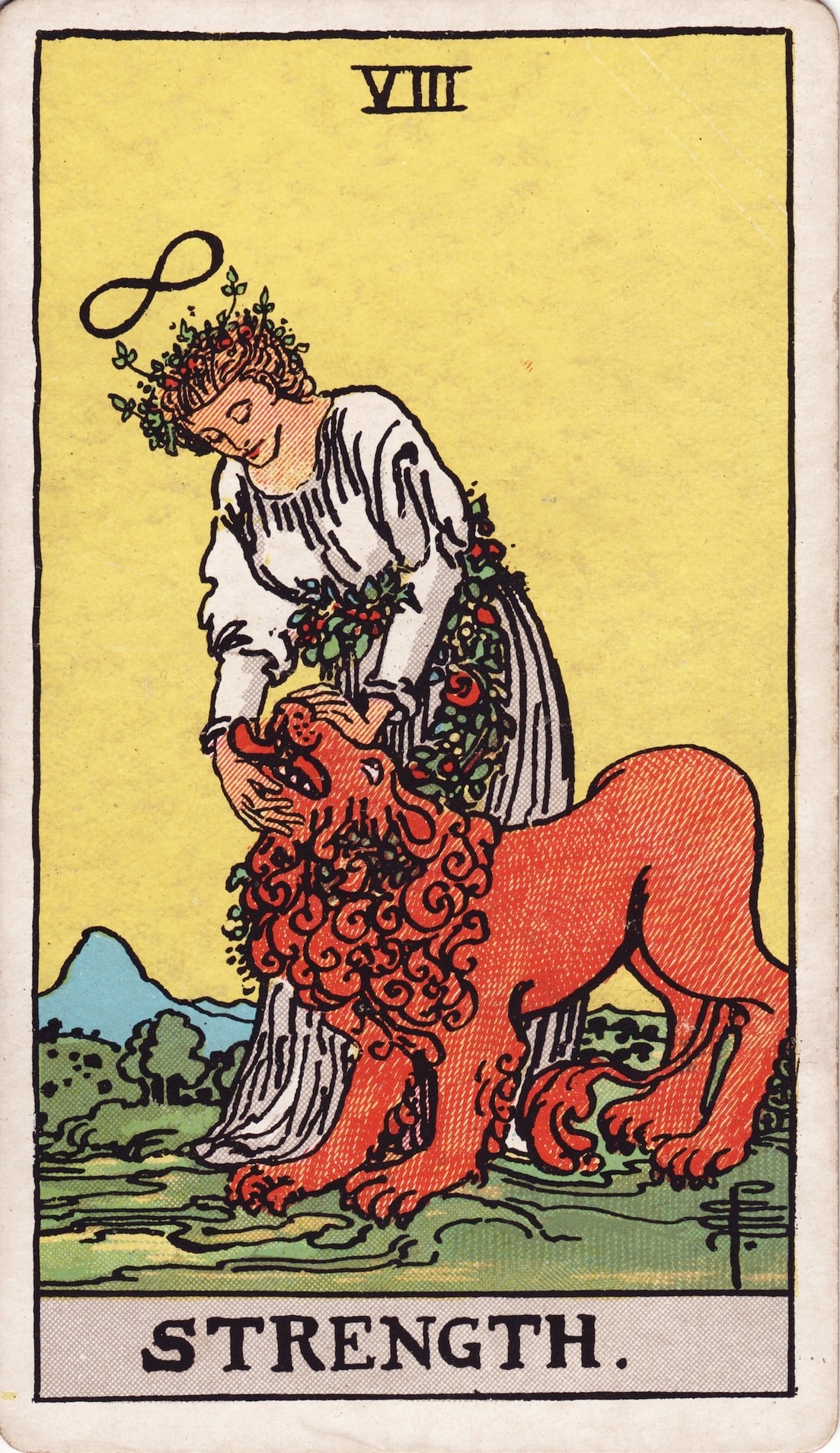


All the cards of the Major Arcana, or the whole deck.