Trump XI, Major Arcana
Justice
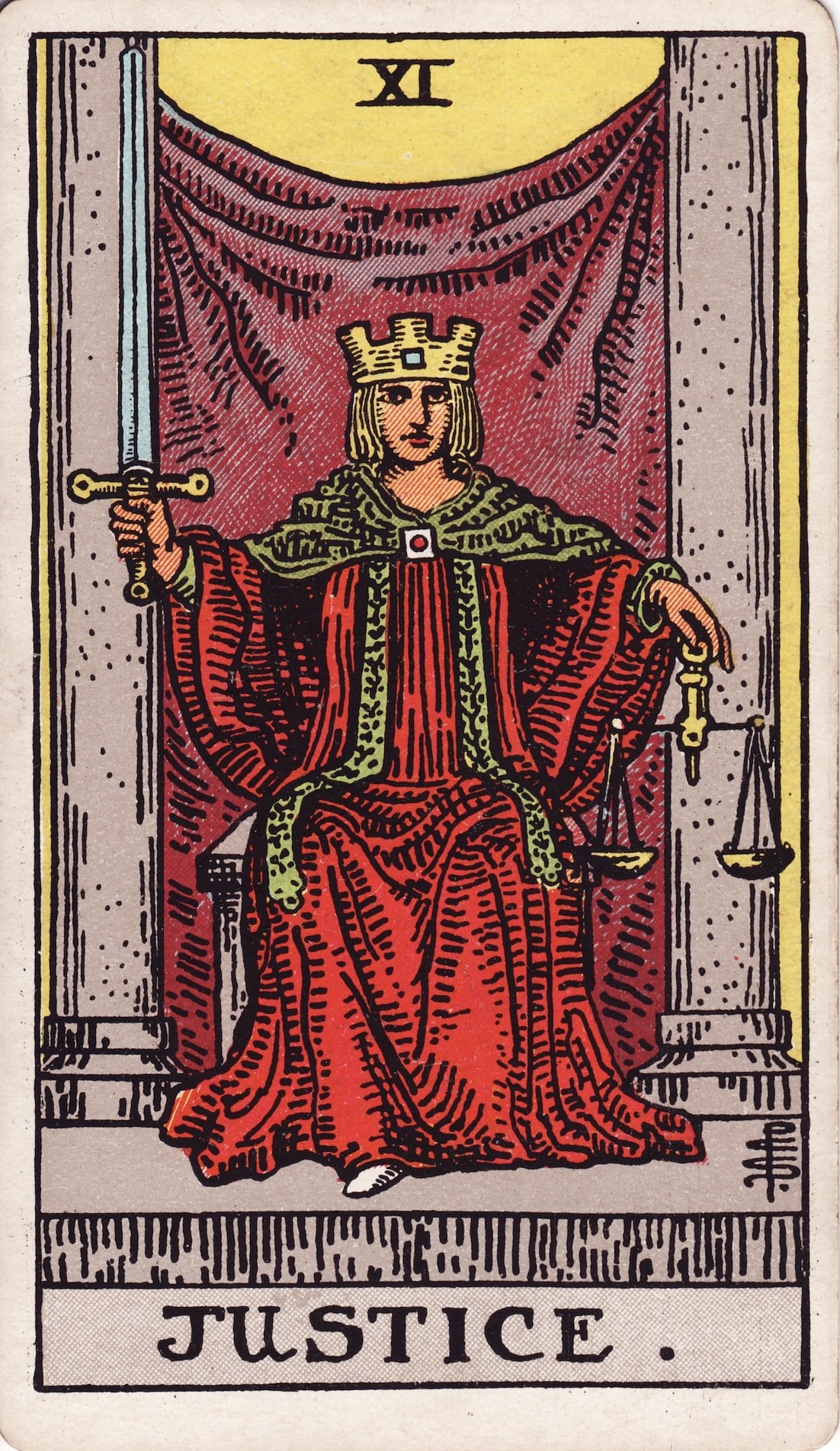
Justice is trump XI in Arthur Edward Waite's deck, where older cards had her at VIII. Pamela Colman Smith drew her in 1909 crowned between two grey pillars, with a sword held point up in one hand and a pair of scales in the other.
What Waite wrote it means (1910)
- Divinatory meanings
Equity, rightness, probity, executive; triumph of the deserving side in law.
- Reversed
Law in all its departments, legal complications, bigotry, bias, excessive severity.
Arthur Edward Waite, The Pictorial Key to the Tarot (London, 1911), p. 285. Read it in the chapter
As this card follows the traditional symbolism and carries above all its obvious meanings, there is little to say regarding it outside the few considerations collected in the first part, to which the reader is referred.
It will be seen, however, that the figure is seated between pillars, like the High Priestess, and on this account it seems desirable to indicate that the moral principle which deals unto every man according to his works—while, of course, it is in strict analogy with higher things—differs in its essence from the spiritual justice which is involved in the idea of election. The latter belongs to a mysterious order of Providence, in virtue of which it is possible for certain men to conceive the idea of dedication to the highest things. The operation of this is like the breathing of the Spirit where it wills, and we have no canon of criticism or ground of explanation concerning it. It is analogous to the possession of the fairy gifts and the high gifts and the gracious gifts of the poet: we have them or have not, and their presence is as much a mystery as their absence. The law of Justice is not however involved by either alternative. In conclusion, the pillars of Justice open into one world and the pillars of the High Priestess into another.
What's in the picture
- The sword. She holds a long sword straight up in her right hand. The blade is pale blue with a ridge down the middle, and the gold hilt has round knobs at the ends of its guard.
- The crown. Her gold crown is built like a little tower, with three square battlements on top and a small square jewel at the front.
- Her face. Her fair hair falls straight to her jaw. She looks straight out of the card, at whoever is looking at her.
- The red robe and green cape. She wears a long red robe that spreads over the floor. A green cape, speckled dark, lies over her shoulders and hangs down the front in two bands.
- The scales. From her left hand a pair of gold scales hangs by a short handle. The two pans hang at the same height, beside her knee.
- The pillars. Two grey stone pillars, speckled with black dots, stand on square bases at either side of her seat.
- The curtain. A purple-red cloth is hung between the pillars behind her and sags in heavy folds. Above it, at the top of the card, shows a band of plain yellow.
- The white shoe. At the bottom of her robe, near the middle, the toe of one white shoe sticks out from under the hem.
- The stone floor. She sits on a grey stone platform. Its front edge is drawn as a band of short dark upright strokes, like a low wall.
- Smith's monogram. In the lower right corner, just below the base of the right pillar, is Pamela Colman Smith's small mark.
The card in brief
- In the deck
- Card 12 of 78
- Arcana
- Major Arcana
- Number
- Trump XI
- Hebrew letter (Golden Dawn)
- Lamed
- Astrology (Golden Dawn)
- Libra
- Title in Book T
- The Daughter of the Lords of Truth: the Ruler of the Balance
- Drawn by
- Pamela Colman Smith
- Planned by
- Arthur Edward Waite
- Published
- London, William Rider & Son, 1909
- Scan
- Pam-A printing, c. 1910, Wikimedia Commons
In the old books
Book T (1912)
Eternal justice. Strength and force, but arrested as in act of judgment. May mean law, trial, etc.
Book T, “A Description of the Cards of the Tarot”, The Equinox I.8 (London, 1912), p. 203. See the source Papus (1892)
A woman seen full face, and wearing an iron coronet, is seated upon a throne. She is placed between the two columns of the temple. The solar cross is traced upon her breast.
Here we find the continuation of the symbolism of the 2nd and 5th arcana. The seated woman occupies the centre between the columns, the first idea of the equilibrium between Good and Evil.
Papus, The Tarot of the Bohemians, tr. A. P. Morton (London, 1892), p. 139. See the source
Before 1909
The older cards and pictures behind this one will be shown here once their licences are checked.
Justice: the moment of weighing
Justice sits still between two grey pillars. She looks straight out of the card, at you. In one hand she holds a sword, point up. From the other hang a pair of scales. A crown with three small towers sits on her head. Behind her, a purple cloth is stretched between the pillars, so you can't see what lies beyond.
Of the 21 numbered trumps, she is the middle one: ten come before her, and ten come after. Take the trumps as a road, and this is where the Fool stops to weigh what he has lived so far.
The image
The sword stands upright, and its blade is pale blue, with a ridge down the middle. The scales hang low, beside her knee. Waite never describes them. He wrote that there is "little to say" about this card, because it "follows the traditional symbolism". So the scales are left to the drawing by Pamela Colman Smith, and to your own eyes.
Look down at the hem of her red robe. A white shoe peeks out from under it. Is she about to stand up? Or has one foot slipped forward while she sits and thinks? You could read the shoe as a small hint that weighing ends in a step.
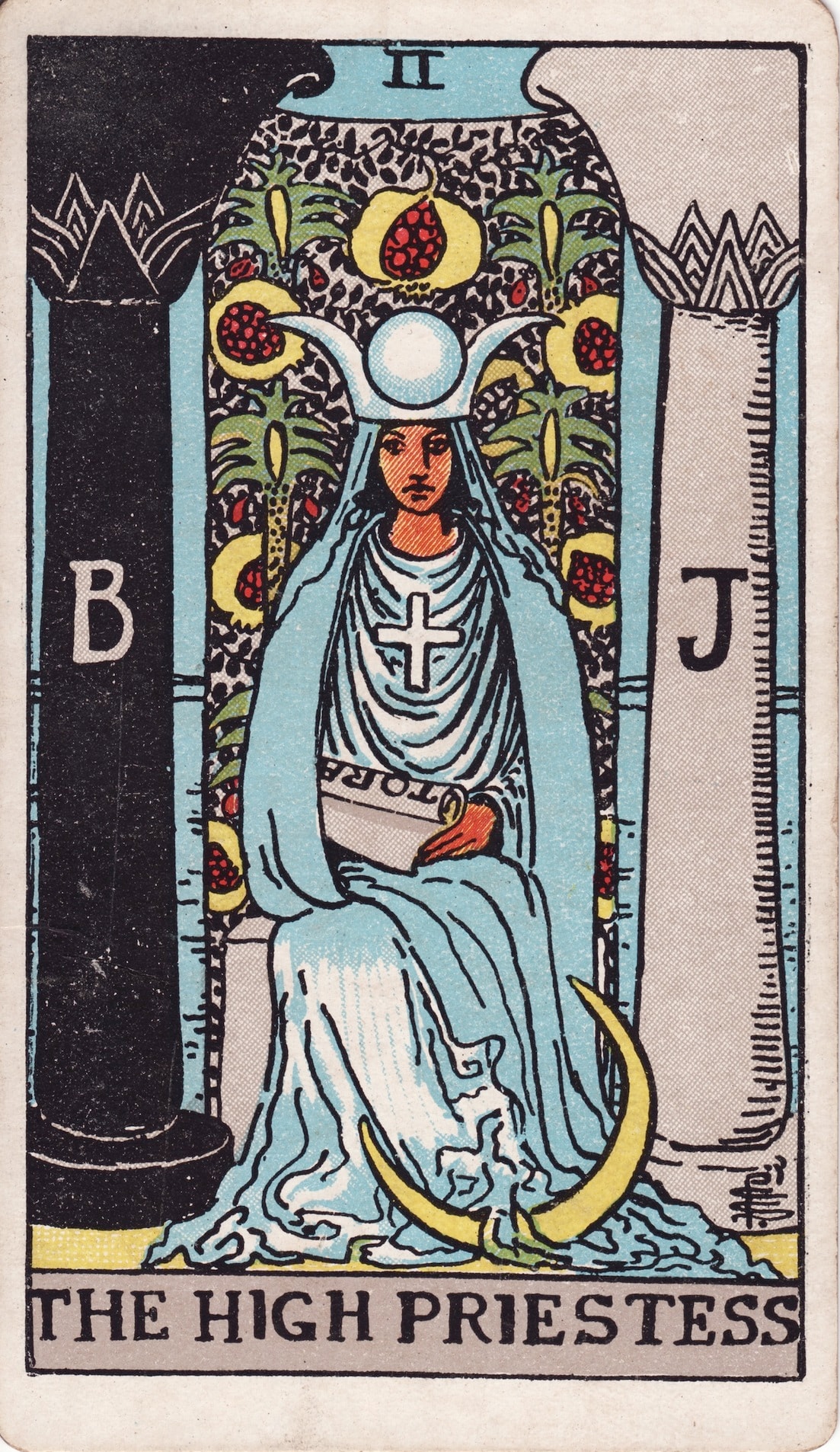
Waite noticed one thing about her. She sits between pillars, "like the High Priestess". Then he added that "the pillars of Justice open into one world and the pillars of the High Priestess into another". Both women sit in front of a curtain. Behind the Priestess hangs a veil sewn with palms and pomegranates. Behind Justice the cloth is plain purple, and above it glows a strip of yellow. What kind of world might open behind her?
The inner journey
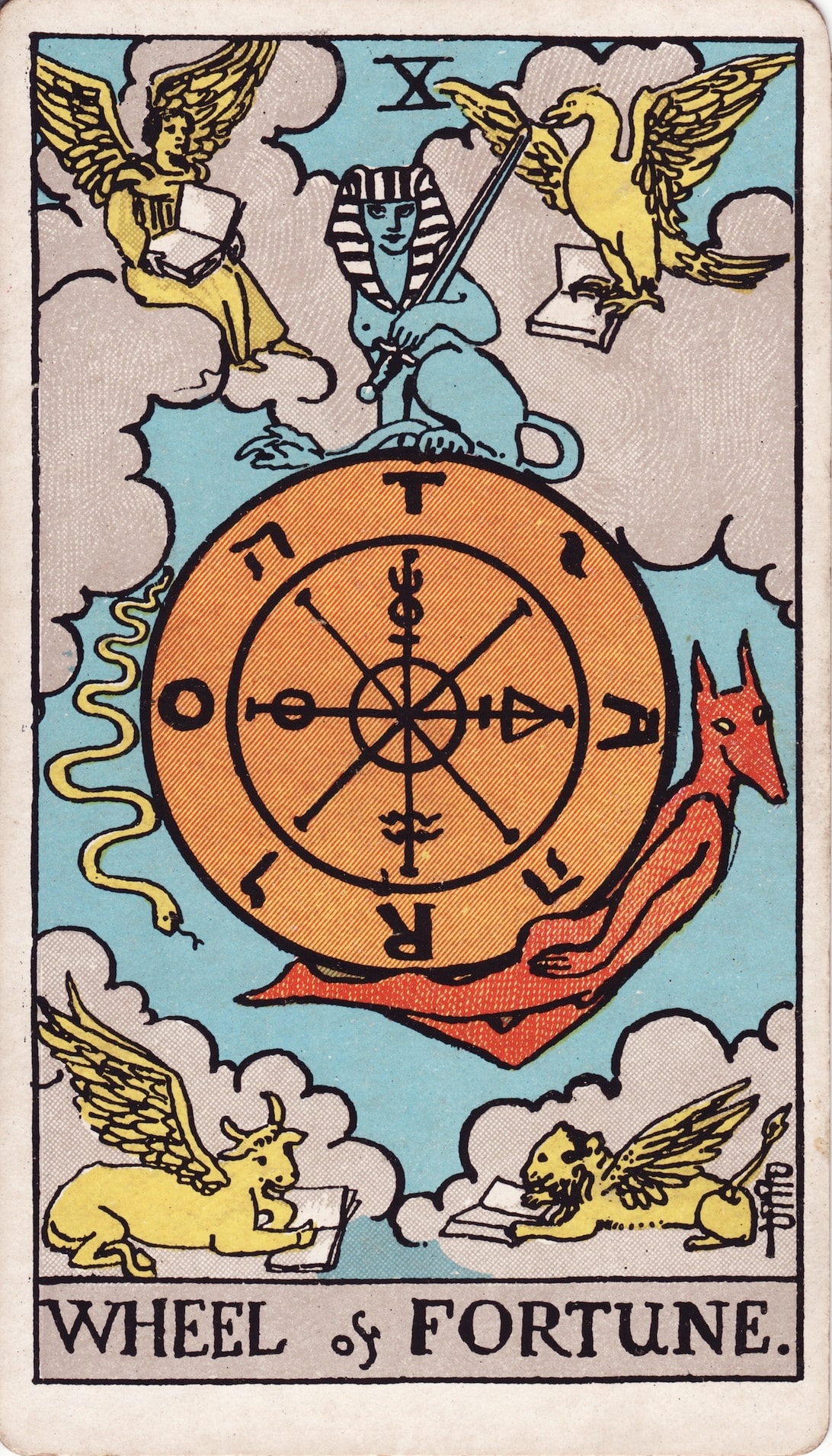
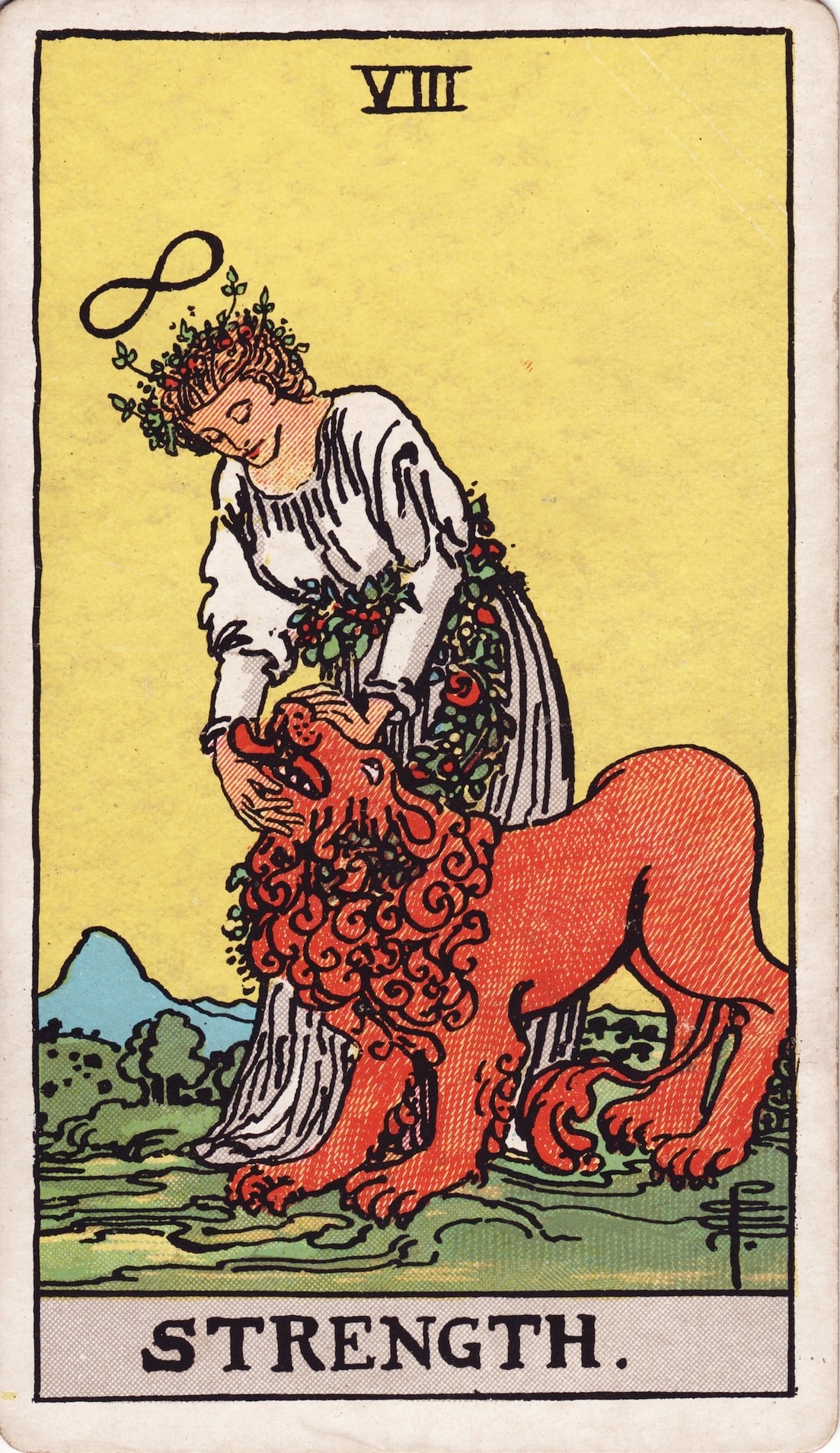
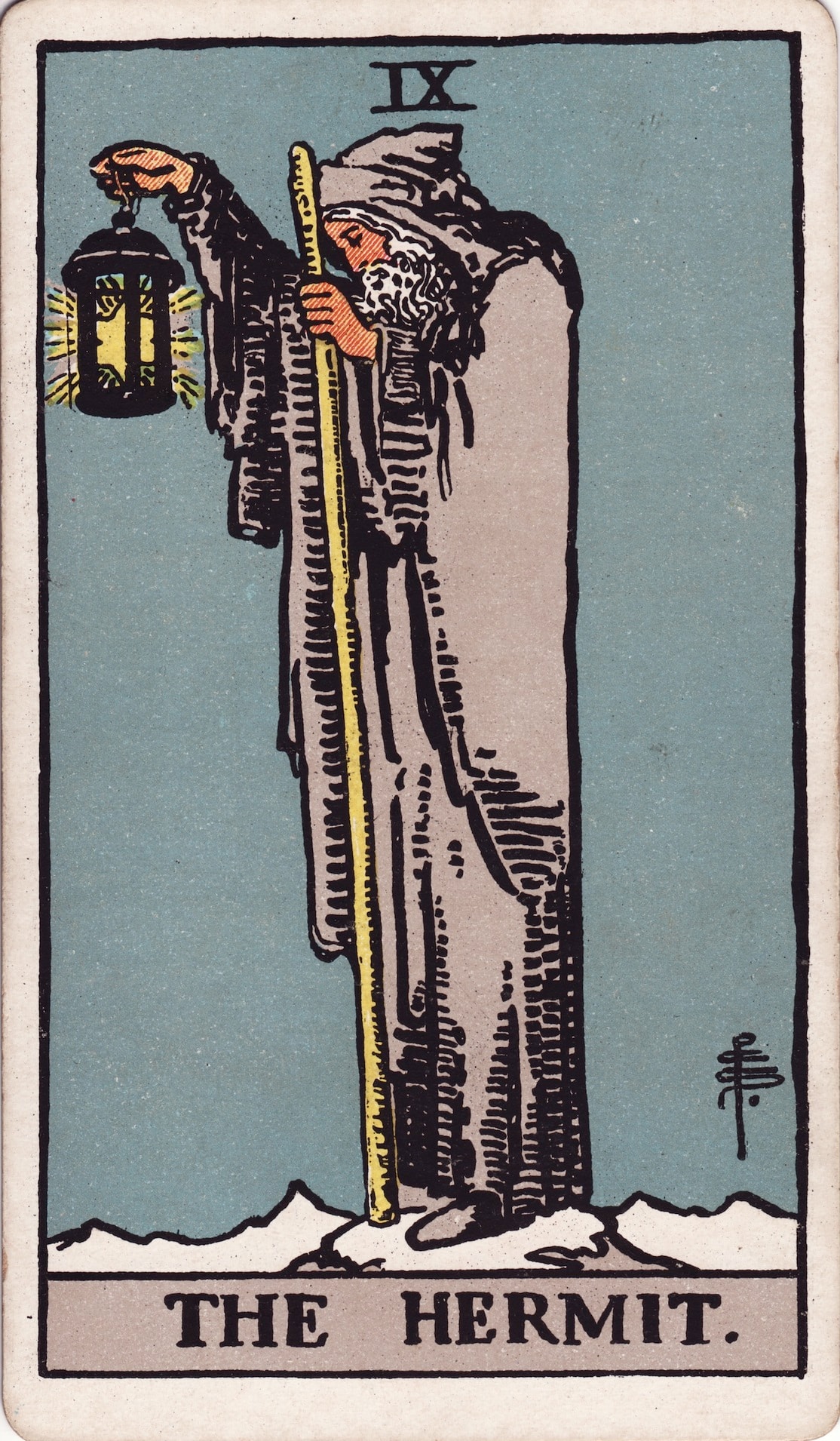
Before this card, the Fool's road runs through the world outside. He meets a magician, an empress, an emperor and a teacher. He falls in love and drives a chariot. He meets a woman with a lion, and a hermit with a lamp. Then the Wheel of Fortune turns, and things happen to him that he didn't choose.
At Justice the question changes. It becomes: what have I done, and what follows from it? Becoming yourself takes an honest look at who you have been. Justice holds two tools for that. One weighs, and one cuts. You could try both. First you weigh both sides. Then, at some point, you cut through and decide.
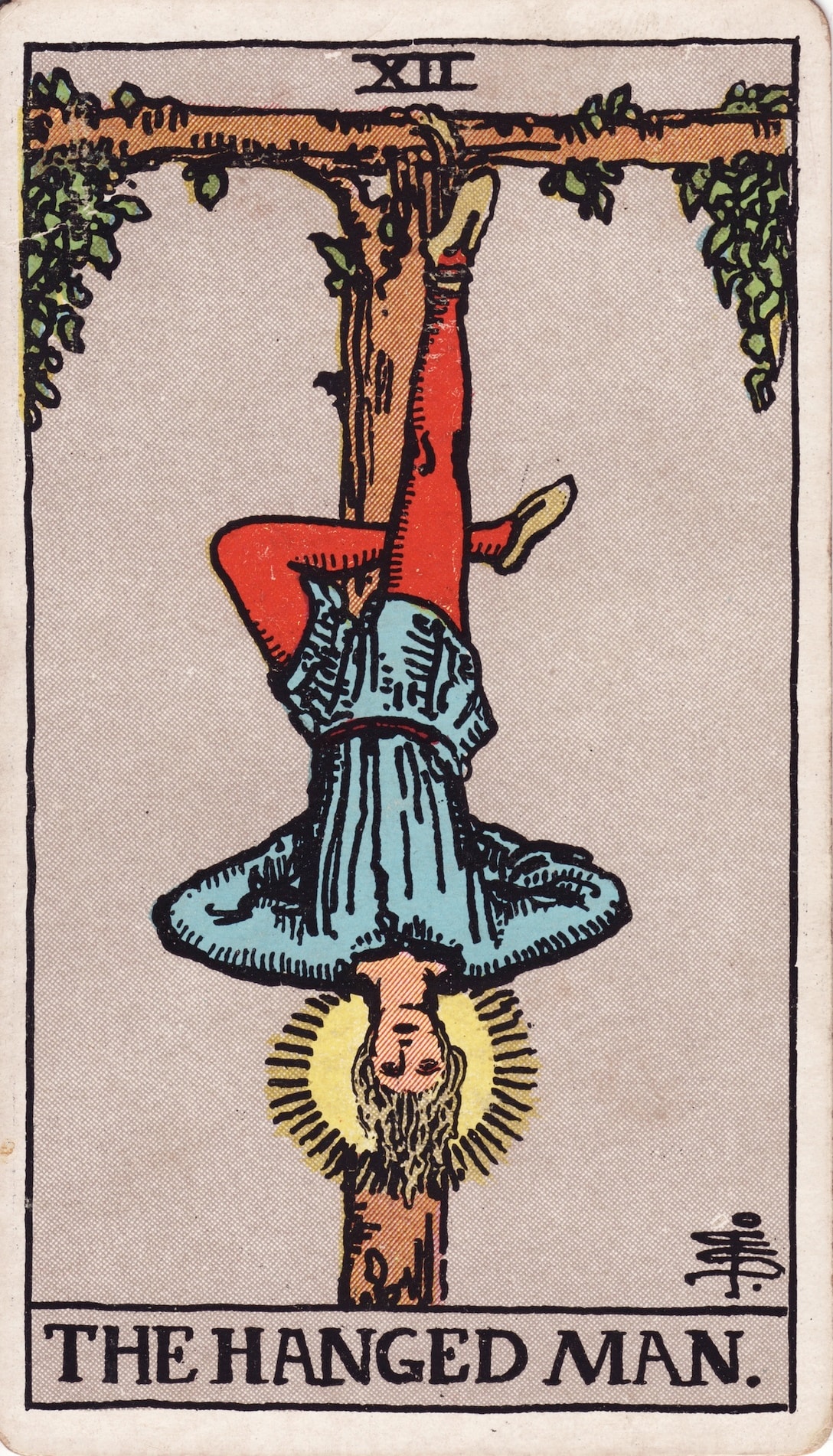
After Justice, the road turns inward. The very next card hangs a man upside down. So Justice may be a hinge, the moment before the world tips over.
You could also linger here and treat the card as a place to stay. It is a quiet court with a curtain, where nothing moves until it has been weighed.
Across traditions
On older French cards, Justice carries the number VIII, and Strength is XI. On the deck Jean Noblet printed in Paris in the mid-1600s, now in the Bibliothèque nationale de France, she is plainly marked VIII. Waite swapped the two. He gave no reason, only that it was "for reasons which satisfy myself". The Golden Dawn had gone halfway already. Book T, the order's text on the cards, keeps the old numbers, Justice 8 and Fortitude 11, but its table of the trumps lists Fortitude in the eighth place and Justice in the eleventh. Waite made the numbers match.
Book T gives Justice to Libra, the sign of the scales. It calls her "The Daughter of the Lords of Truth" and "the Ruler of the Balance". Libra is the seventh sign of the zodiac. The sun enters it at the September equinox, when day and night are nearly level. So her sign sits at a balance point of the year.
Waite mentions an older story, too. He wrote that the figure "is said to be Astræa". In Greek and Roman myth, Astraea stood for this same virtue. The Roman poet Ovid tells how people grew cruel in the age of iron. Astraea was the last of the gods to leave the earth. An old English translation adds a footnote about where she went: up into the stars, as the constellation of the Virgin. In the night sky, the Virgin stands right beside Libra, the Scales.
Try this
Sit like Justice for a minute. Keep your back straight, both feet flat, eyes forward. Hold something upright in one hand; a pen will do. Let the other hand rest open on your knee, as if it held a small weight. Now think of one thing from this week. Put it on one side of the scales. What would go on the other side? Leave the decision for later. For now, notice which way the scales want to tip.
Questions to sit with
- What might be behind the purple curtain?
- Is her white shoe about to step forward?
- What in your life is waiting to be weighed?
- Which do you reach for first, the sword or the scales?
- Where would the Fool sit, if he sat down in front of her?
The film
No film for this card yet.
Sources
- Smith drew and coloured the cards.Arthur Edward Waite, The Pictorial Key to the Tarot (London, 1911), Part II, The Tarot and Secret Tradition, p. 67
- Waite: little to say, as the card follows the traditional symbolism; she sits between pillars like the High Priestess; the two pairs of pillars open into different worlds.Arthur Edward Waite, The Pictorial Key to the Tarot (London, 1911), Part II, Justice, p. 112
- The High Priestess's veil, embroidered with palms and pomegranates.Arthur Edward Waite, The Pictorial Key to the Tarot (London, 1911), Part II, The High Priestess, p. 76
- Waite swapped Strength and Justice "for reasons which satisfy myself"; Justice was usually numbered eight.Arthur Edward Waite, The Pictorial Key to the Tarot (London, 1911), Part II, Strength, p. 100
- The figure of the eleventh card is said to be Astraea, who personified the same virtue.Arthur Edward Waite, The Pictorial Key to the Tarot (London, 1911), Part I, Trumps Major, no. 11, p. 21
- On Noblet's deck Justice is VIII and Strength XI.Jean Noblet, tarot (Paris, mid-1600s), cards VIII and XI; Bibliothèque nationale de France, via Wikimedia Commons
- Book T keeps the numbers Justice 8 and Fortitude 11 but lists Fortitude eighth and Justice eleventh; it gives Justice Libra and calls her the Daughter of the Lords of Truth, the Ruler of the Balance.Book T, The Equinox I.8 (1912), table of the Keys and brief meanings of the trumps
- Libra, the Balance, the seventh sign, entered by the sun at the September equinox, when day and night are nearly equal; in the sky it lies between Virgo and Scorpio.Webster's Revised Unabridged Dictionary (1913), Libra and equinox
- Astraea, last of the gods to leave the earth in the age of iron, and the translator's note that she became the constellation of the Virgin.Ovid, Metamorphoses I.149–150, translated by Henry T. Riley (1851), with his note
Around this card
Before and after it in the deck
The second row of the Fool's journey

All the cards of the Major Arcana, or the whole deck.