Trump XVIII, Major Arcana
The Moon
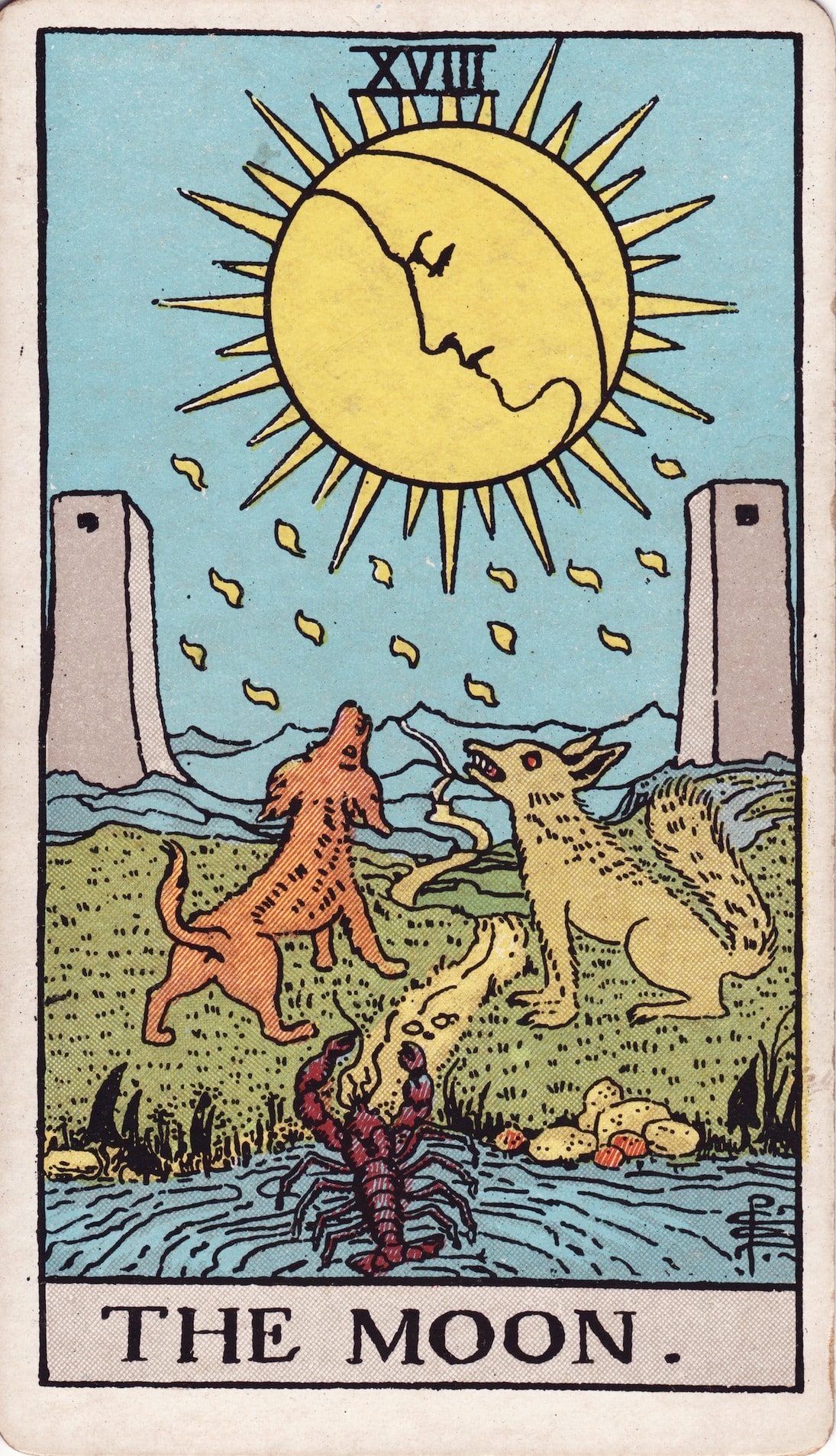
No person appears on trump XVIII, the Moon, as Pamela Colman Smith drew it in 1909. A yellow moon with a sleeping face sheds drops over a dog and a wolf, while a crayfish climbs out of a pool and a path winds between two towers toward the mountains.
What Waite wrote it means (1910)
- Divinatory meanings
Hidden enemies, danger, calumny, darkness, terror, deception, occult forces, error.
- Reversed
Instability, inconstancy, silence, lesser degrees of deception and error.
Arthur Edward Waite, The Pictorial Key to the Tarot (London, 1911), p. 286. Read it in the chapter
The distinction between this card and some of the conventional types is that the moon is increasing on what is called the side of mercy, to the right of the observer. It has sixteen chief and sixteen secondary rays. The card represents life of the imagination apart from life of the spirit. The path between the towers is the issue into the unknown. The dog and wolf are the fears of the natural mind in the presence of that place of exit, when there is only reflected light to guide it.
The last reference is a key to another form of symbolism. The intellectual light is a reflection and beyond it is the unknown mystery which it cannot shew forth. It illuminates our animal nature, types of which are represented below—the dog, the wolf and that which comes up out of the deeps, the nameless and hideous tendency which is lower than the savage beast. It strives to attain manifestation, symbolized by crawling from the abyss of water to the land, but as a rule it sinks back whence it came. The face of the mind directs a calm gaze upon the unrest below; the dew of thought falls; the message is: Peace, be still; and it may be that there shall come a calm upon the animal nature, while the abyss beneath shall cease from giving up a form.
What's in the picture
- The sleeping face. A crescent curves down the right side of the big yellow disc, and a face in profile lies along its inner edge. The eyes are shut, and the face is turned to the left.
- The rays. Long, sharp rays stand out all round the disc, with shorter ones between them. Waite counted sixteen of each.
- The drops. A scatter of yellow drops, shaped like small flames or tears, falls from the moon toward the ground.
- The two towers. Two plain grey towers stand at the left and right edges of the card, each with one small dark window near the top.
- The dog. On the left an orange dog stands with its head thrown back and its mouth open, howling at the moon.
- The wolf. On the right a pale, shaggy wolf sits back on its haunches. It has a red eye and bared teeth, and it howls at the same moon.
- The path. A pale path starts at the edge of the water and winds up between the two animals. It passes between the towers and gets smaller until it reaches the far blue mountains.
- The crayfish. A dark red crayfish, its claws raised, climbs out of the pool onto the bank, right where the path begins.
- The pool. The water fills the bottom of the card, drawn in wavy lines. Yellow and orange stones lie on the bank to the right, and dark spiky plants grow at both ends.
- Smith's monogram. Her small comb-like mark sits in the water in the lower right corner.
The card in brief
- In the deck
- Card 19 of 78
- Arcana
- Major Arcana
- Number
- Trump XVIII
- Hebrew letter (Golden Dawn)
- Qoph
- Astrology (Golden Dawn)
- Pisces
- Title in Book T
- The Ruler of Flux and Reflux: the Child of the Sons of the Mighty
- Drawn by
- Pamela Colman Smith
- Planned by
- Arthur Edward Waite
- Published
- London, William Rider & Son, 1909
- Scan
- Pam-A printing, c. 1910, Wikimedia Commons
In the old books
Book T (1912)
Dissatisfaction, voluntary change. Error, lying, falsity, deception. This card is very sensitive to dignity.
Book T, “A Description of the Cards of the Tarot”, The Equinox I.8 (London, 1912), p. 204. See the source Papus (1892)
A meadow feebly lighted by the moon.
The light, the symbol of the soul, no longer reaches us directly;the material world is only lighted by reflection.
Papus, The Tarot of the Bohemians, tr. A. P. Morton (London, 1892), p. 175. See the source
Before 1909
The older cards and pictures behind this one will be shown here once their licences are checked.
The Moon: a path by moonlight
A big yellow moon hangs in the sky, with a sleeping face drawn inside it. Drops of light fall from it like dew. Below, a dog and a wolf howl up at it. Out of a pool in front crawls a crayfish. A path winds from the water, between two grey towers, far off toward the mountains. There is no person on this card at all.
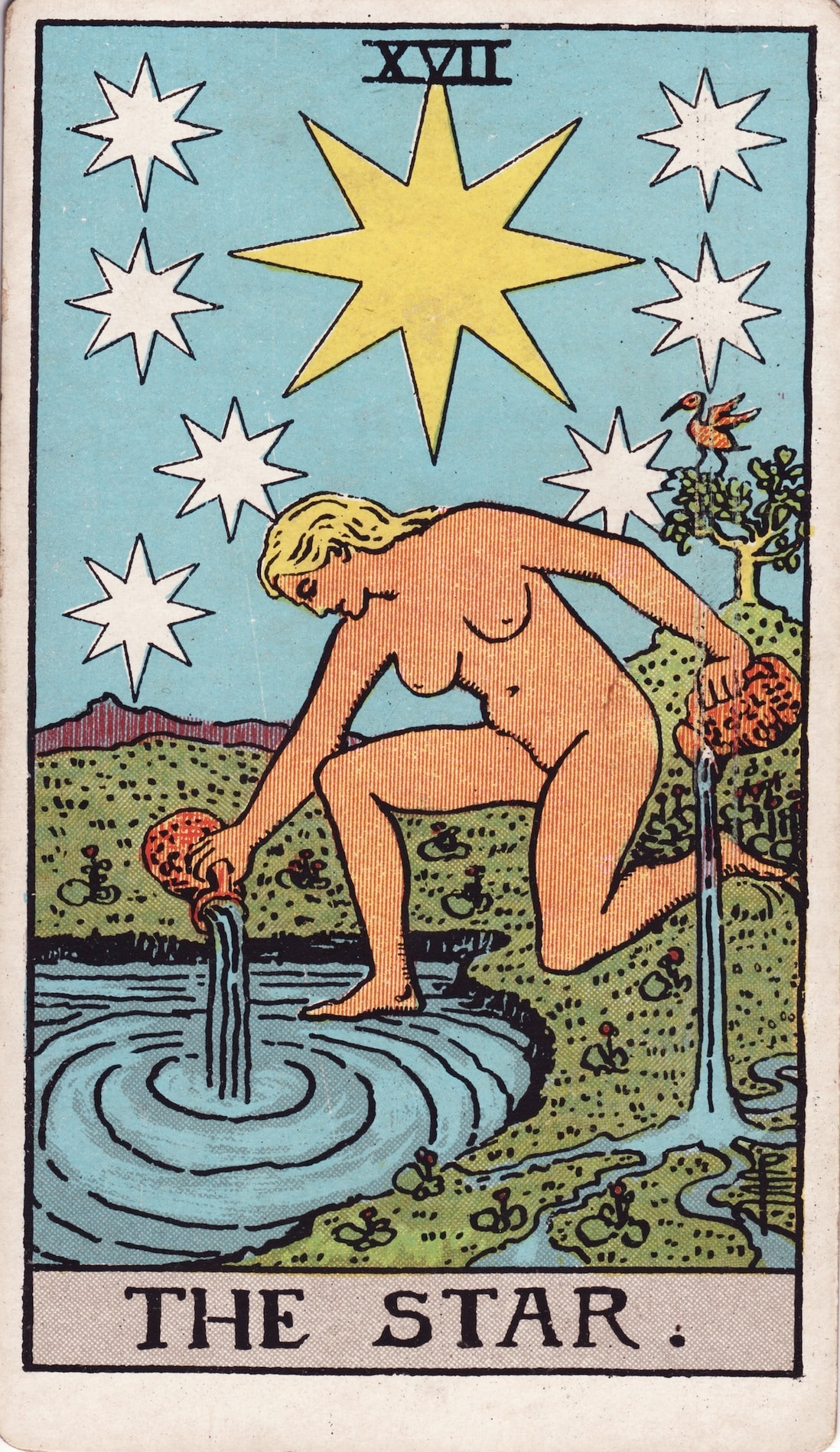
Follow the Major Arcana in order, as a road, and you have just left the open sky of the Star. Here the road goes on into the night. Whoever walks it now can only see by moonlight.
The image
Look at the moon's face. It is in profile, eyes closed, tucked inside the curve of a crescent. Waite counted its rays in his guide to the deck: "sixteen chief and sixteen secondary". Under it, the drops fall. He called them "the dew of thought".
The two animals look alike, but they aren't the same. The dog, on the left, is orange and tame. The wolf, on the right, is pale and wild. They howl at the same moon. Waite said they are "the fears of the natural mind", out here where "there is only reflected light to guide it".
The crayfish climbs out of the pool onto the land. Waite wrote that such creatures from the deep try to come up, and "as a rule" sink back. Will this one make it?
Most of this was on the card long before 1909. Waite noted that older Moon cards already had two towers, a path running between them to the horizon, "a wolf and dog" baying, and a crayfish moving "towards the land". Smith kept the old pieces and gave the wolf a red eye.
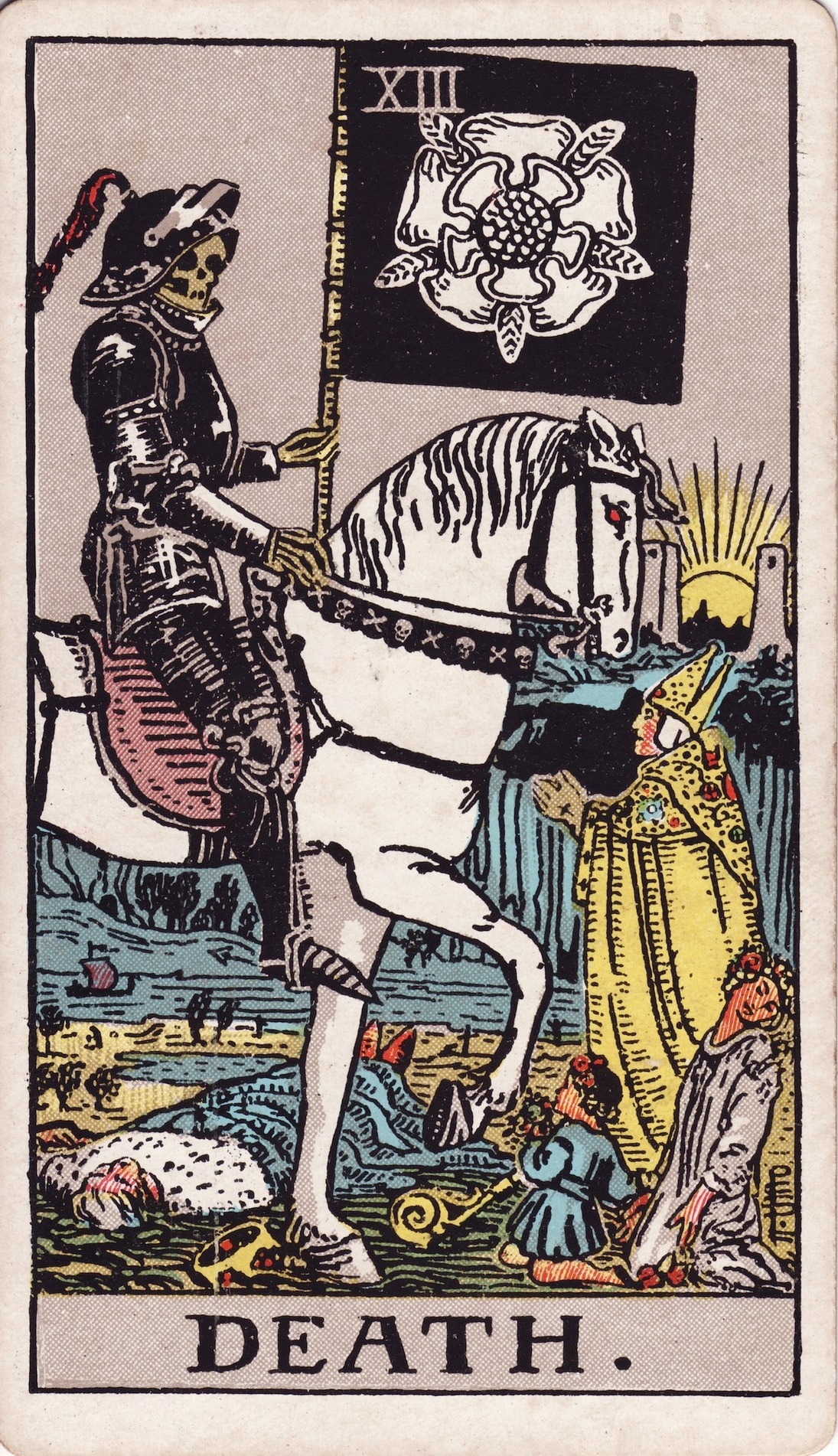
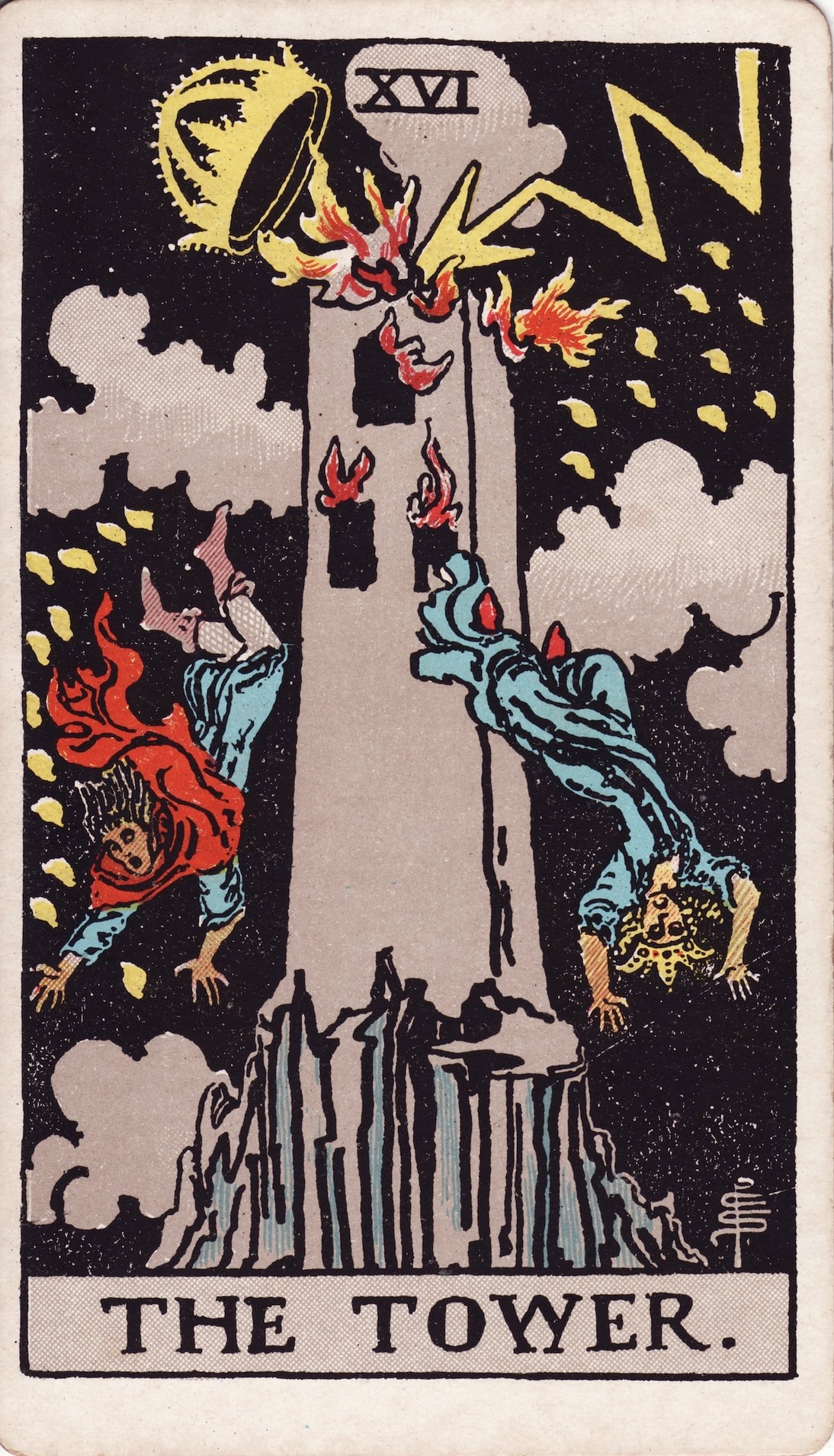
Then the path. It runs past the animals, between the towers and on, until it is too small to see. Waite called it "the issue into the unknown". You may have seen towers like these before. Two stand on the horizon of Death, with a sun between them. Here the sun is gone and the moon has come.
The inner journey
Taken in order, the trumps have passed the Tower and the Star to come here. Now the walk goes through the dark. Nothing is clear. Everything shines with borrowed light, and the path is hard to see.
Waite said this card shows "life of the imagination apart from life of the spirit". It can sound like a warning. You could turn that around. The Moon is where the imagination runs free. Dreams, moods, old fears and strange pictures come up here, like the crayfish from the pool.
James Hillman thought the soul speaks in images like these. He asked us to look through the literal, and to let an image stay strange and many-sided. By moonlight, a coat on a chair becomes a figure. A dog becomes a wolf. You could take that as a gift as well as a trick of the light. What does the night show you that the day hides?
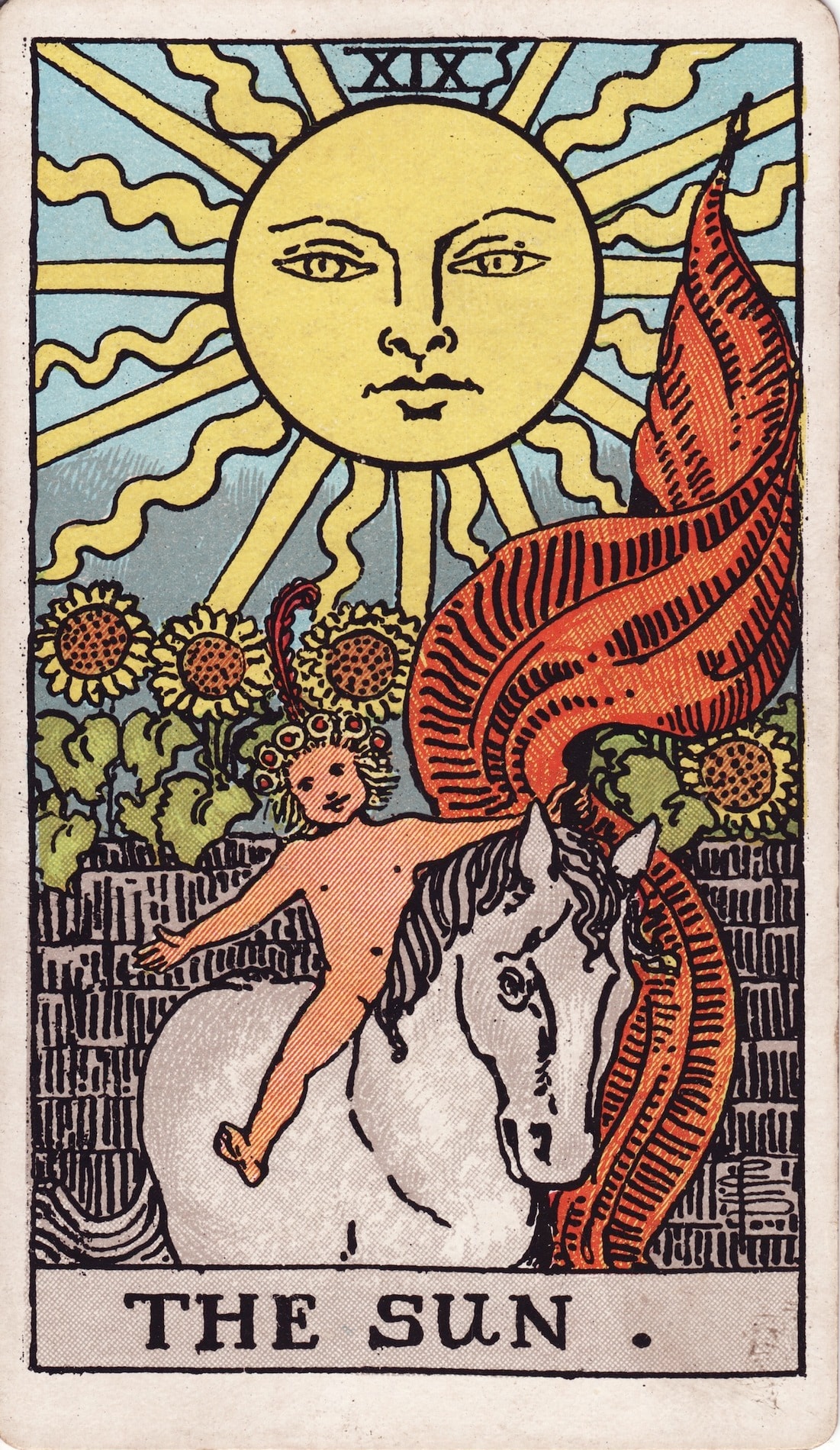
On this road the Moon is the last dark stretch before morning. Waite called the next card, the Sun, "the direct" light, the opposite of the reflected kind. You could also stay out on the path a while, listening to the dog and the wolf, and let the moon keep its secrets.
Across traditions
For all the howling, the moon's own face is calm. Waite heard a message in the card: "Peace, be still". Those are the words of Jesus in the Gospel of Mark. He and his friends are crossing a lake in a small boat when a storm blows up. The friends are terrified and wake him. He says to the sea, "Peace, be still." Then, in the old King James words, "the wind ceased, and there was a great calm."
In 1633 Rembrandt painted that storm as Christ in the Storm on the Sea of Galilee. The boat tips up on a huge wave. Men haul at the ropes and the flapping sail. At the back of the boat, in the shadow, Jesus sits among them. In 1990 thieves cut the painting from its frame at the Isabella Stewart Gardner Museum in Boston. It has never been found. Now we know it only from photographs, like a reflection of something no longer there.
The Golden Dawn's Book T gives this card the title "Ruler of Flux and Reflux", the ebb and flow of the tides. The order matched it with Pisces, the Fish, the twelfth and last sign of the zodiac, and with Qoph among the Hebrew letters.
Try this
Tonight, sit for a few minutes in a room lit only by one small light, or by the moon if you can. Let your eyes get used to it. Notice how shapes change. A chair, a coat, a plant: what do they become? Leave them as they are, and let them be what they seem for a while. Then come back to this card in the same dim light. Which parts of it come forward?
Questions to sit with
- Which is louder, the dog or the wolf?
- Will the crayfish reach the land, or sink back?
- Once the path is past the towers, where does it lead?
- What have you only ever seen by moonlight?
- What in you howls, and what stays calm?
The film
No film for this card yet.
Sources
- Waite on the moon's rays, the dew of thought, the dog and wolf as the fears of the natural mind, the creature that sinks back, the path into the unknown, imagination apart from spirit, and "Peace, be still".Arthur Edward Waite, The Pictorial Key to the Tarot (London, 1911), Part II, The Moon, pp. 140 and 143
- Older Moon cards: the dew, the two towers and the path, a wolf and a dog baying, the crayfish moving towards the land.Arthur Edward Waite, The Pictorial Key to the Tarot (London, 1911), Part I, Trumps Major, no. 18, p. 27
- Waite on the Sun as direct light, the opposite of reflected light.Arthur Edward Waite, The Pictorial Key to the Tarot (London, 1911), Part II, The Sun, p. 144
- James Hillman on the soul's images and on seeing through the literal.James Hillman, Re-Visioning Psychology (New York, 1975), ch. 1, Personifying or Imagining Things, and ch. 3, Psychologizing or Seeing Through
- The storm on the lake: "Peace, be still", and the great calm.Mark 4:37–39, King James Version (1611)
- Rembrandt's Christ in the Storm on the Sea of Galilee (1633), cut from its frame in the 1990 theft at the Gardner Museum and still missing.Isabella Stewart Gardner Museum, Boston, The Theft
- Book T's title for the Moon, Ruler of Flux and Reflux, Child of the Sons of the Mighty; Pisces and the letter Qoph.Book T, The Equinox I.8 (1912), table of the Keys
- Pisces is the twelfth sign of the zodiac.Webster's Revised Unabridged Dictionary (1913), Pisces
Around this card
Before and after it in the deck
The third row of the Fool's journey

All the cards of the Major Arcana, or the whole deck.