Trump XIX, Major Arcana
The Sun
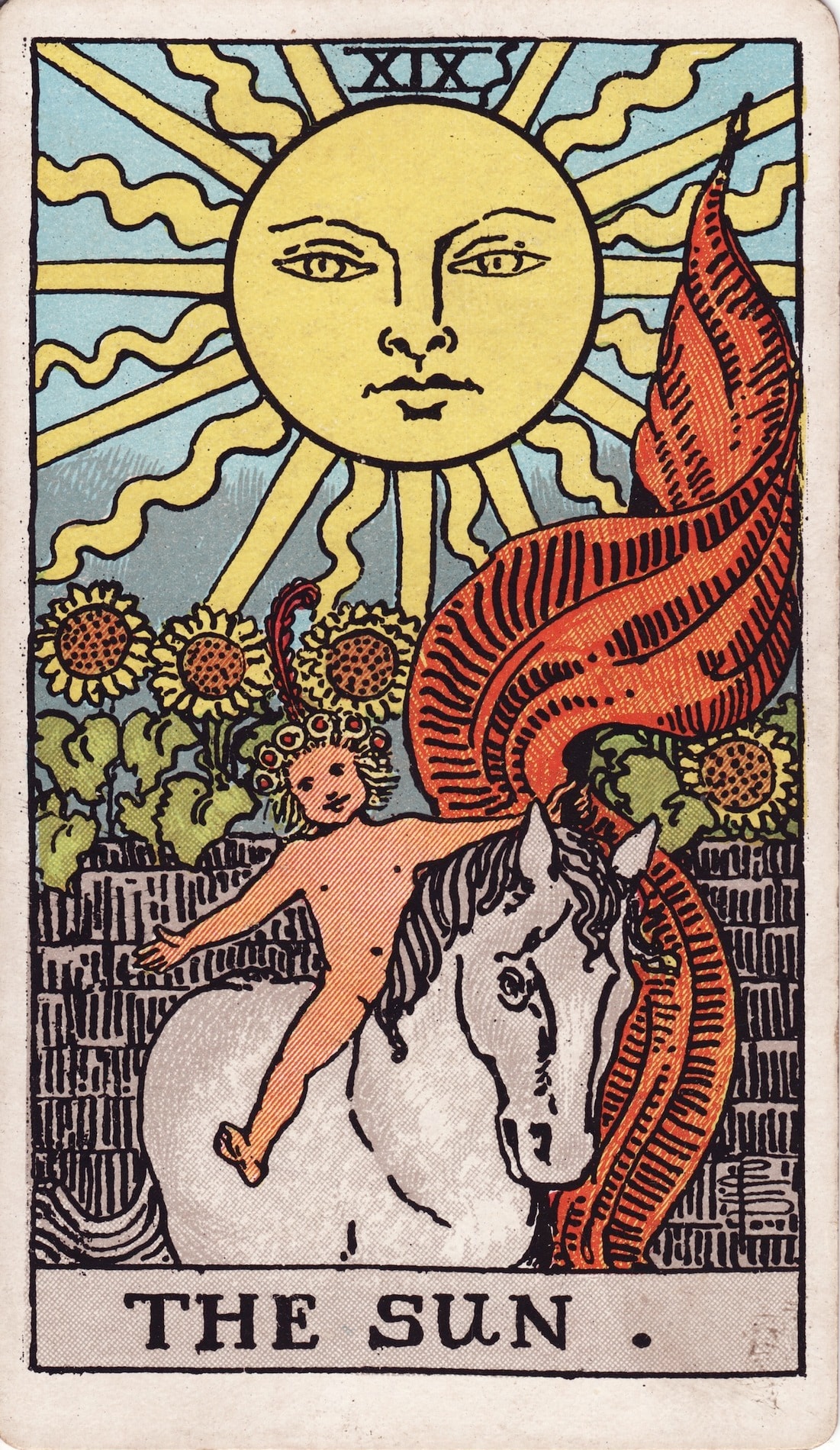
The Sun is trump XIX, and on it a naked child rides a white horse with no saddle or bridle, arms open wide, under a sun with a human face. Behind the child, in Pamela Colman Smith's 1909 drawing, four sunflowers rise over a grey wall, and a huge red banner billows beside the horse.
What Waite wrote it means (1910)
- Divinatory meanings
Material happiness, fortunate marriage, contentment.
- Reversed
The same in a lesser sense.
Arthur Edward Waite, The Pictorial Key to the Tarot (London, 1911), p. 286. Read it in the chapter
The naked child mounted on a white horse and displaying a red standard has been mentioned already as the better symbolism connected with this card. It is the destiny of the Supernatural East and the great and holy light which goes before the endless procession of humanity, coming out from the walled garden of the sensitive life and passing on the journey home. The card signifies, therefore, the transit from the manifest light of this world, represented by the glorious sun of earth, to the light of the world to come, which goes before aspiration and is typified by the heart of a child.
But the last allusion is again the key to a different form or aspect of the symbolism. The sun is that of consciousness in the spirit—the direct as the antithesis of the reflected light. The characteristic type of humanity has become a little child therein—a child in the sense of simplicity and innocence in the sense of wisdom. In that simplicity, he bears the seal of Nature and of Art; in that innocence, he signifies the restored world. When the self-knowing spirit has dawned in the consciousness above the natural mind, that mind in its renewal leads forth the animal nature in a state of perfect conformity.
What's in the picture
- The sun's face. A big golden sun fills the top of the card. Its face is calm, with open eyes that look straight out at you.
- The rays. The rays take turns all the way round: one straight, one wavy, then straight again.
- The sunflowers. Four sunflowers rise above the wall, with broad green leaves. Their faces are turned out of the card, toward the child and toward you, and away from the sun.
- The wall. A grey wall of stone runs right across the card behind the horse, drawn in short black strokes.
- The child. A naked child sits on the horse without holding on. One arm reaches out to the left, the other across the horse's mane, both open wide.
- The wreath and the feather. The child wears a ring of small red and white flowers, and a single red feather stands up from it.
- The white horse. The horse has no saddle and no bridle. We see its pale head with a dark mane, turned to the right, and the curve of its back under the child.
- The red banner. A huge orange-red banner billows down from the top right corner, past the sunflowers and beside the horse's head.
- Smith's monogram. Her small comb-like mark is drawn into the stones of the wall, low down on the right.
The card in brief
- In the deck
- Card 20 of 78
- Arcana
- Major Arcana
- Number
- Trump XIX
- Hebrew letter (Golden Dawn)
- Resh
- Astrology (Golden Dawn)
- The Sun
- Title in Book T
- The Lord of the Fire of the World
- Drawn by
- Pamela Colman Smith
- Planned by
- Arthur Edward Waite
- Published
- London, William Rider & Son, 1909
- Scan
- Pam-A printing, c. 1910, Wikimedia Commons
In the old books
Book T (1912)
Glory, gain, riches. With very evil cards it means arrogance, display, vanity.
Book T, “A Description of the Cards of the Tarot”, The Equinox I.8 (London, 1912), p. 204. See the source Papus (1892)
Two naked children are shut into a walled enclosure. The sun sends down his rays upon them, and drops of gold escape from him and fall upon the ground.
The spirit resumes its ascendancy. It is no longer a reflected light, as in the preceding arcanum, which illumines the figure, but the direct creative light of the God of our Universe, which floods it with his rays.
The walls indicate that we are still in the visible or material world. The two children symbolize the two creative fluids, positive and negative, of the new creature.
Papus, The Tarot of the Bohemians, tr. A. P. Morton (London, 1892), p. 180. See the source
Before 1909
The older cards and pictures behind this one will be shown here once their licences are checked.
The Sun: a child rides out
A great golden sun with a face fills the top of the card. Below it, a small child rides a white horse, with no saddle and no reins. The child's arms are spread wide open. A huge red banner waves beside them. Behind is a grey wall, and over the wall lean tall sunflowers. The child wears a ring of flowers and a single red feather.
Read the Major Arcana as one road and morning comes here, after the long night of the Moon. The traveller who set out as the Fool now rides out as a child.
The image
Look at the sun's rays. They take turns: one straight, one wavy, all the way round. Waite noticed the same pattern on older cards, with rays "waved and salient alternately".
Now the sunflowers. Sunflowers are known for turning toward the sun. These don't. Their faces look out of the card, toward the child, or toward you.
The horse has no saddle and no bridle. The child doesn't hold on. Waite wrote that here the mind "leads forth the animal nature in a state of perfect conformity". In plain words, the wild animal and the rider move as one. No one needs to be in control.
Then look at the child's head. There is a red feather in the wreath. The Fool wears one too, in his cap. He also has a white animal at his side, a small dog. Put the two cards side by side and see what else they share.
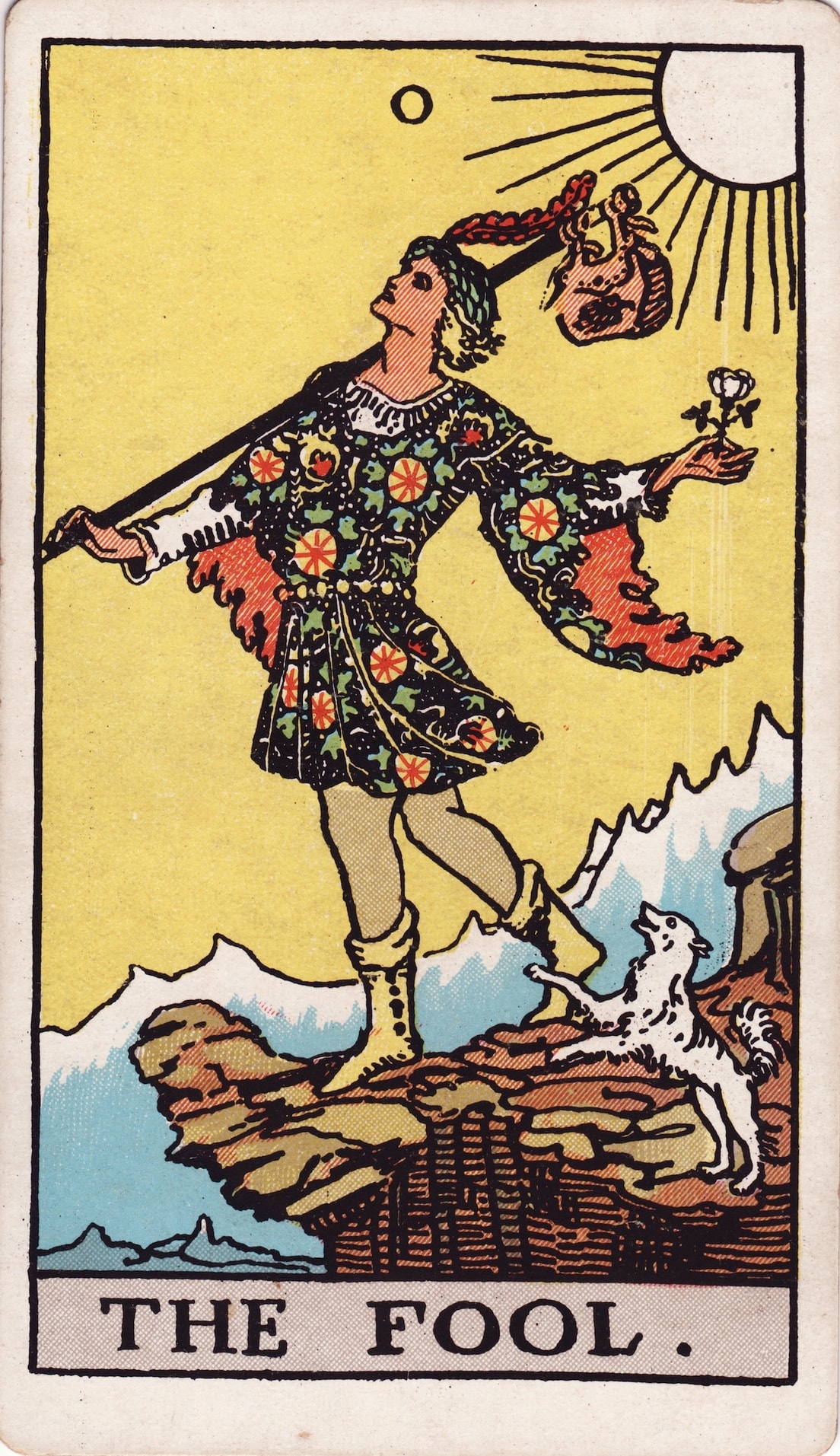
The Fool's sun is white and far behind him. This sun is golden, close and looking straight at you.
The inner journey
At the start of the trumps the Fool set out knowing nothing. Near their end he has become a child again. But this is a different child. Waite put it this way: "a child in the sense of simplicity and innocence in the sense of wisdom". The road has led through the Tower, Death and the long dark. Simplicity now comes from having seen a lot.
Jung wrote an essay on the child as an archetype, a figure that turns up in myths and dreams all over the world. For him the divine child often stands at a beginning. It can point toward a wholeness that is still on its way. This child, arms open, riding out of the walled garden, looks like a new start at the end of a long road.
Waite called the Moon's light reflected. The Sun, he said, is "the direct" light. After a night of guessing at shapes, you can see things as they are. That can feel like a great relief. It can also feel too bright.
You could sit in this sunlight as long as you like, and do nothing with it. The child doesn't seem to be in a hurry. Waite wrote of a procession "coming out from the walled garden of the sensitive life and passing on the journey home".
Across traditions
Older cards showed two children playing in a walled garden, by some water. Waite reports that the French writer Éliphas Lévi knew another version, "a naked child mounted on a white horse and displaying a scarlet standard", and he calls it "a much better symbol". Pamela Colman Smith drew that one.
The Golden Dawn titled this card "Lord of the Fire of the World" in its Book T. In the order's tables, seven trumps each get one of the seven classical planets. The Sun gets the sun itself, and the Hebrew letter Resh.
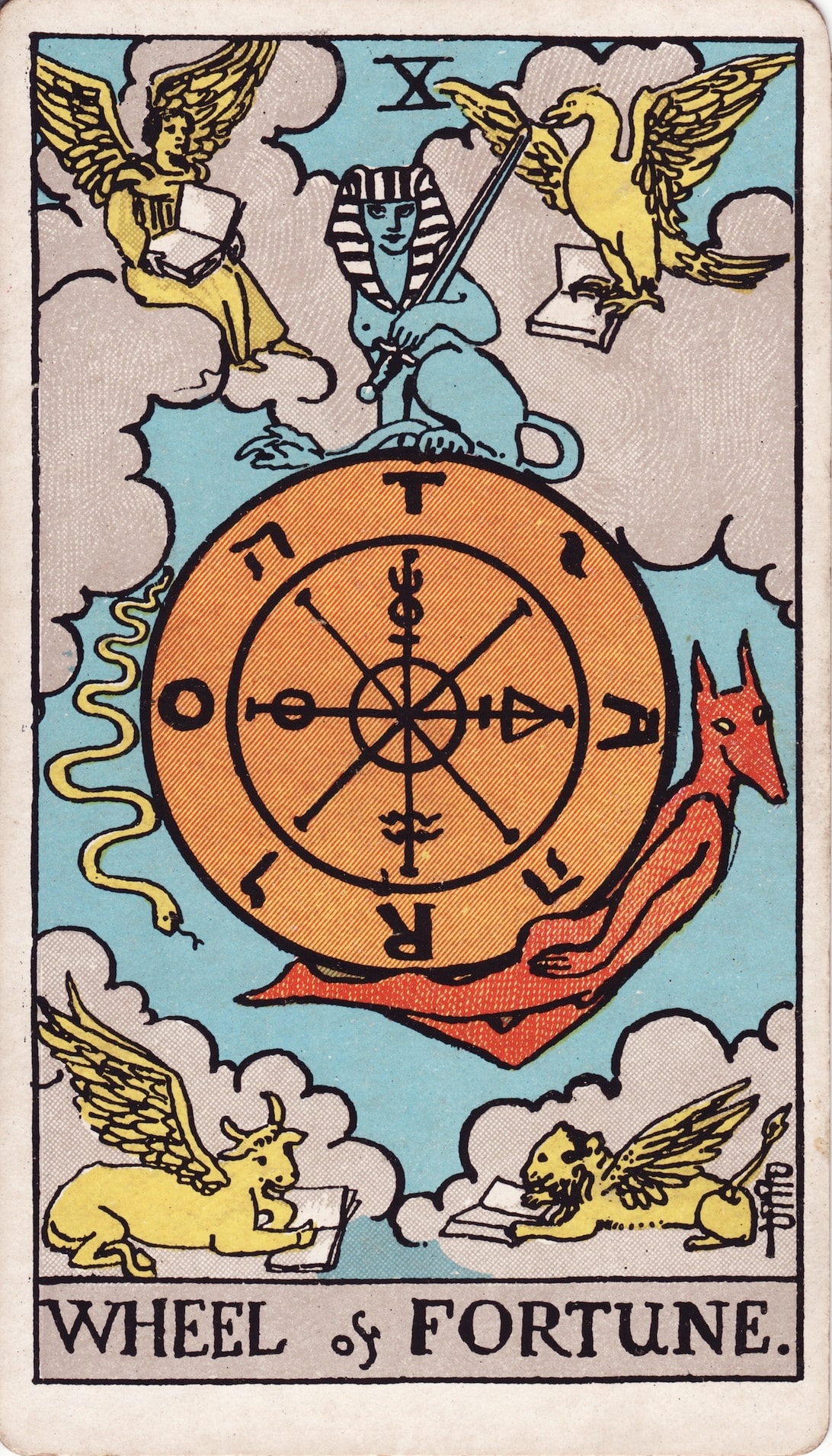
Add the two digits of XIX, 1 and 9, and you reach 10, the number of the Wheel of Fortune. Both cards are big circles. The Wheel turns, and you go up and down with it. The Sun shines on everyone at once.
Try this
Stand up, somewhere with light: by a window, or outside. Spread your arms wide like the child, palms open. Lift your face a little. Stay like that for ten slow breaths. Notice what your body does when it opens this far, with nothing to hold on to. Then look at this card again. What would it look like in full sunlight?
Questions to sit with
- Why don't the sunflowers face the sun?
- Where is the child riding to?
- What does the red feather remember from the start of the journey?
- What in your life could you now see in plain daylight?
- When did you last feel as open as the child?
The film
No film for this card yet.
Sources
- Waite on the child on the white horse, the walled garden and the journey home, the child of simplicity and wisdom, the direct light, and the animal nature led forth.Arthur Edward Waite, The Pictorial Key to the Tarot (London, 1911), Part II, The Sun, pp. 144 and 147
- Older Sun cards: rays waved and salient alternately, two children in a walled garden by a water; Lévi's child on a white horse with a scarlet standard, "a much better symbol".Arthur Edward Waite, The Pictorial Key to the Tarot (London, 1911), Part I, Trumps Major, no. 19, pp. 27–28
- Éliphas Lévi, a French writer on magic.Éliphas Lévi, Dogme et rituel de la haute magie (Paris, 1854–1856)
- Jung on the child archetype as a figure of beginnings and of a wholeness still to come.C. G. Jung, The Psychology of the Child Archetype (1940), Collected Works 9i, §§259–305
- Book T's title for the Sun, Lord of the Fire of the World; the Sun and the letter Resh; the seven planets given to seven trumps.Book T, The Equinox I.8 (1912), table of the Keys
Around this card
Before and after it in the deck
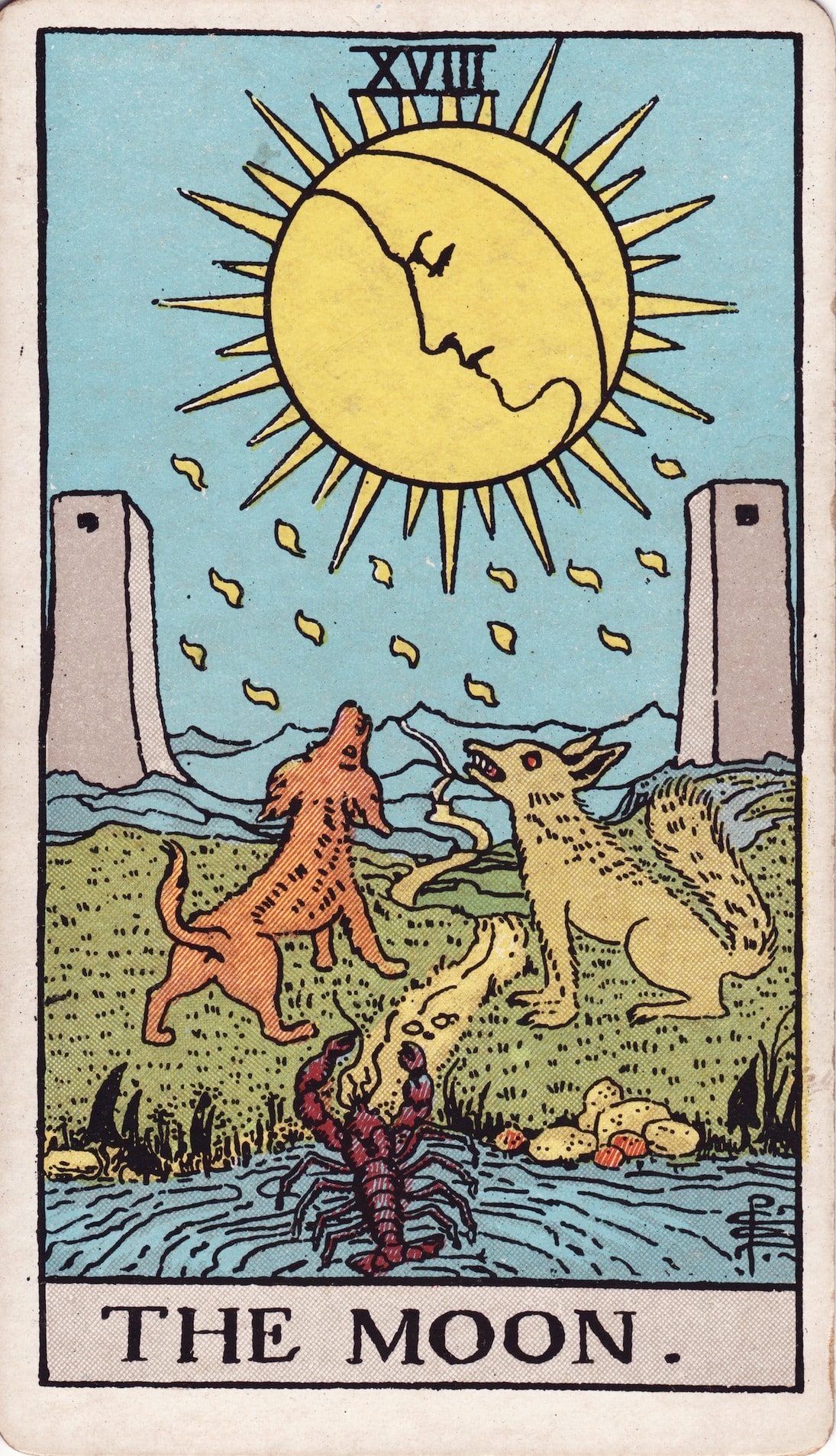
The third row of the Fool's journey

All the cards of the Major Arcana, or the whole deck.