Trump XVI, Major Arcana
The Tower
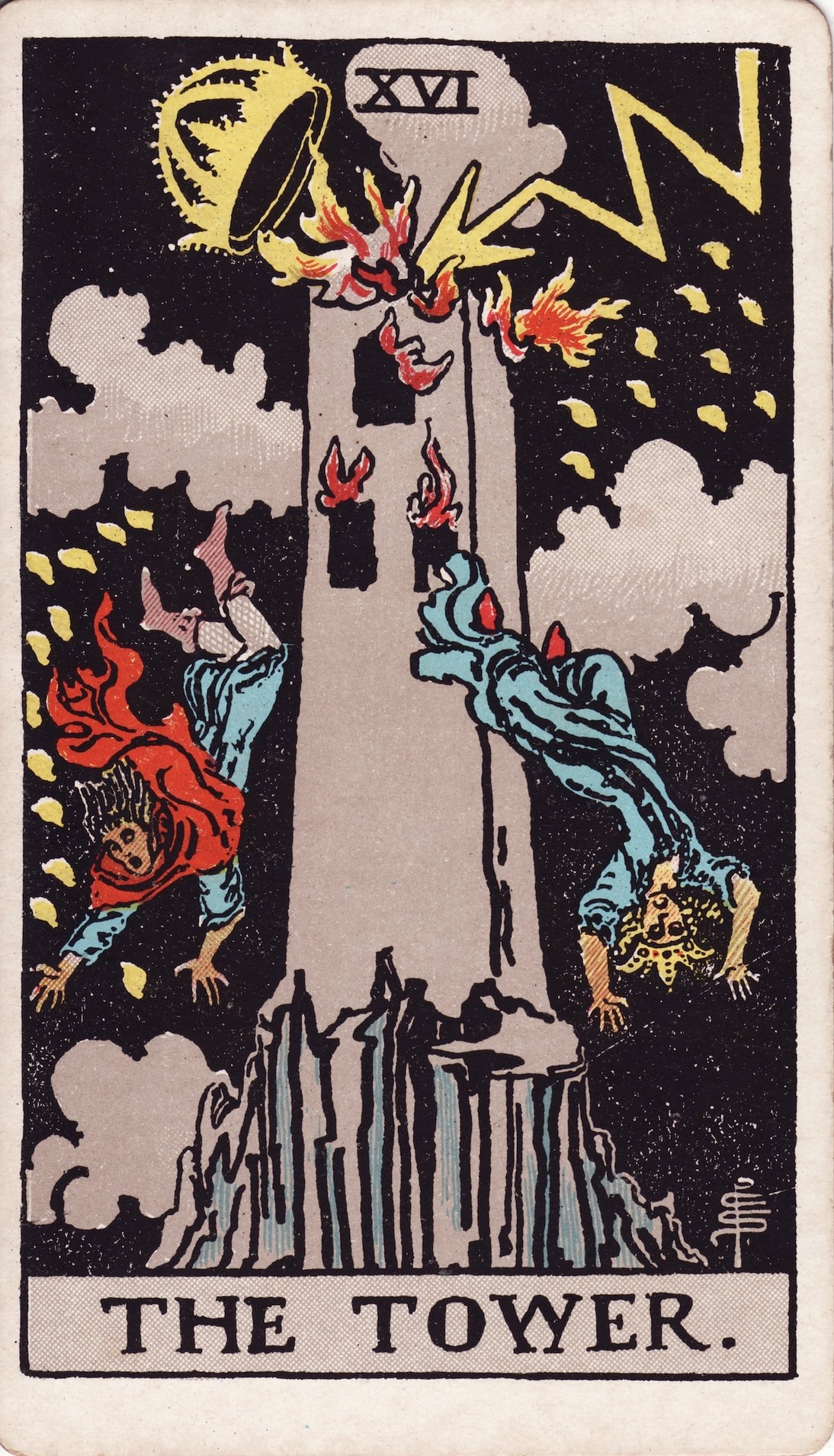
The Tower, trump XVI, is a grey tower on a rocky peak with a yellow bolt of lightning striking its top. Pamela Colman Smith drew it in 1909 with its golden crown flying off, flames bursting from the windows and two people falling head first through a black sky full of small yellow flames.
What Waite wrote it means (1910)
- Divinatory meanings
Misery, distress, indigence, adversity, calamity, disgrace, deception, ruin. It is a card in particular of unforeseen catastrophe.
- Reversed
According to one account, the same in a lesser degree; also oppression, imprisonment, tyranny.
Arthur Edward Waite, The Pictorial Key to the Tarot (London, 1911), p. 286. Read it in the chapter
Occult explanations attached to this card are meagre and mostly disconcerting. It is idle to indicate that it depicts ruin in all its aspects, because it bears this evidence on the surface. It is said further that it contains the first allusion to a material building, but I do not conceive that the Tower is more or less material than the pillars which we have met with in three previous cases. I see nothing to warrant Papus in supposing that it is literally the fall of Adam, but there is more in favour of his alternative—that it signifies the materialization of the spiritual word. The bibliographer Christian imagines that it is the downfall of the mind, seeking to penetrate the mystery of God. I agree rather with Grand Orient that it is the ruin of the House of Life, when evil has prevailed therein, and above all that it is the rending of a House of Doctrine. I understand that the reference is, however, to a House of Falsehood. It illustrates also in the most comprehensive way the old truth that "except the Lord build the house, they labour in vain that build it."
There is a sense in which the catastrophe is a reflection from the previous card, but not on the side of the symbolism which I have tried to indicate therein. It is more correctly a question of analogy; one is concerned with the fall into the material and animal state, while the other signifies destruction on the intellectual side. The Tower has been spoken of as the chastisement of pride and the intellect overwhelmed in the attempt to penetrate the Mystery of God; but in neither case do these explanations account for the two persons who are the living sufferers. The one is the literal word made void and the other its false interpretation. In yet a deeper sense, it may signify also the end of a dispensation, but there is no possibility here for the consideration of this involved question.
What's in the picture
- The lightning. A thick yellow zigzag comes down out of the black sky at the top right and strikes the top of the tower.
- The crown. The top of the tower was a golden crown. It is tipping off to the left, in mid-air, with nothing under it.
- The fire. Red and orange flames burst from the broken top, and one long tongue of fire blows out to the right.
- The windows. The tower has three small dark windows, with flames over the two lower ones. There is no door that you can see.
- The figure in the red cloak. One person falls head first on the left, a red cloak flying, eyes and mouth wide open, both hands spread toward the ground.
- The crowned figure. The other falls on the right in a long blue robe and red shoes. A small gold crown is still on the head, upside down now.
- The falling flames. Small yellow flames drift down on both sides of the tower, like drops or sparks.
- The clouds. Grey clouds hang on both sides of the tower, flat shapes against the black.
- The rock. The tower stands on a steep grey peak, cut with dark cracks, that fills the bottom of the card.
- Smith's monogram. At the bottom right, beside the rock, is the small knot-like mark Smith signed many of her cards with.
The card in brief
- In the deck
- Card 17 of 78
- Arcana
- Major Arcana
- Number
- Trump XVI
- Hebrew letter (Golden Dawn)
- Peh
- Astrology (Golden Dawn)
- Mars
- Title in Book T
- The Lord of the Hosts of the Mighty
- Drawn by
- Pamela Colman Smith
- Planned by
- Arthur Edward Waite
- Published
- London, William Rider & Son, 1909
- Scan
- Pam-A printing, c. 1910, Wikimedia Commons
In the old books
Book T (1912)
Ambition, fighting, war, courage, or destruction, danger, fall, ruin.
Book T, “A Description of the Cards of the Tarot”, The Equinox I.8 (London, 1912), p. 204. See the source Papus (1892)
This card bears the picture of a tower, with its battlements struck by lightning; two men, one crowned, the other uncrowned, are falling with the fragments of broken masonry ; the attitude of the former recalls the shape of the letter Ayin.
Papus, The Tarot of the Bohemians, tr. A. P. Morton (London, 1892), pp. 168–169. See the source
Before 1909
The older cards and pictures behind this one will be shown here once their licences are checked.
The Tower: a crown knocked off
A tall grey tower stands on a rocky peak. A zigzag of lightning strikes its top. A golden crown flies off into the air. Flames burst from the windows. Two people fall head first through the dark. Small yellow flames drift down around them like sparks.
On the long road of the Major Arcana, read as one story, this is where something the Fool has built comes down. It is a loud card. It is also a card about light breaking into a closed room.
The image
Look at the lightning first. It comes out of the black sky and hits the top of the tower. The top was a crown. Now the crown is tipping off, with nothing under it.
Then look at the tower itself. It has three windows and no door that you can see. Who built it, and how did they get in?
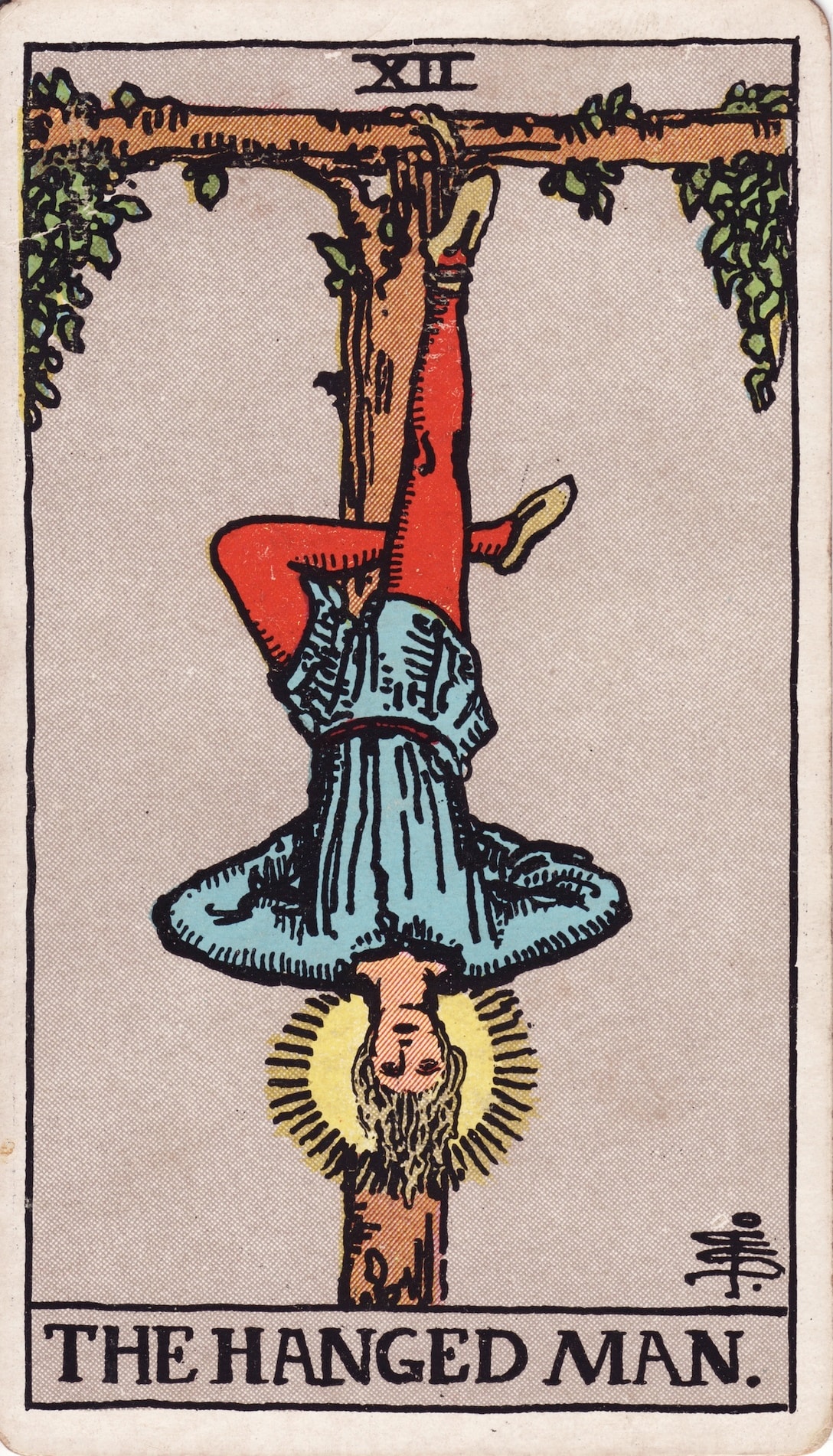
The two falling people wear fine clothes. One of them still has a crown on. Both fall head first, with their arms out. The Hanged Man also hung head down, but he had chosen to be there. These two had no time to choose.
Around them fall small yellow flames, like drops. The Golden Dawn had a name for small flames like these: Yodh, after a Hebrew letter. In Book T, "Two-and-twenty leaping Flames, or Yodh" surround the club on the Ace of Wands.
Arthur Edward Waite thought it "idle" to explain that the card shows ruin, because that is plain to see. He looked further. For him, the tower was "a House of Doctrine", even "a House of Falsehood": a set of ideas that could not stand. And he gave the two falling people a strange label. One is "the literal word made void". The other is "its false interpretation".
The inner journey
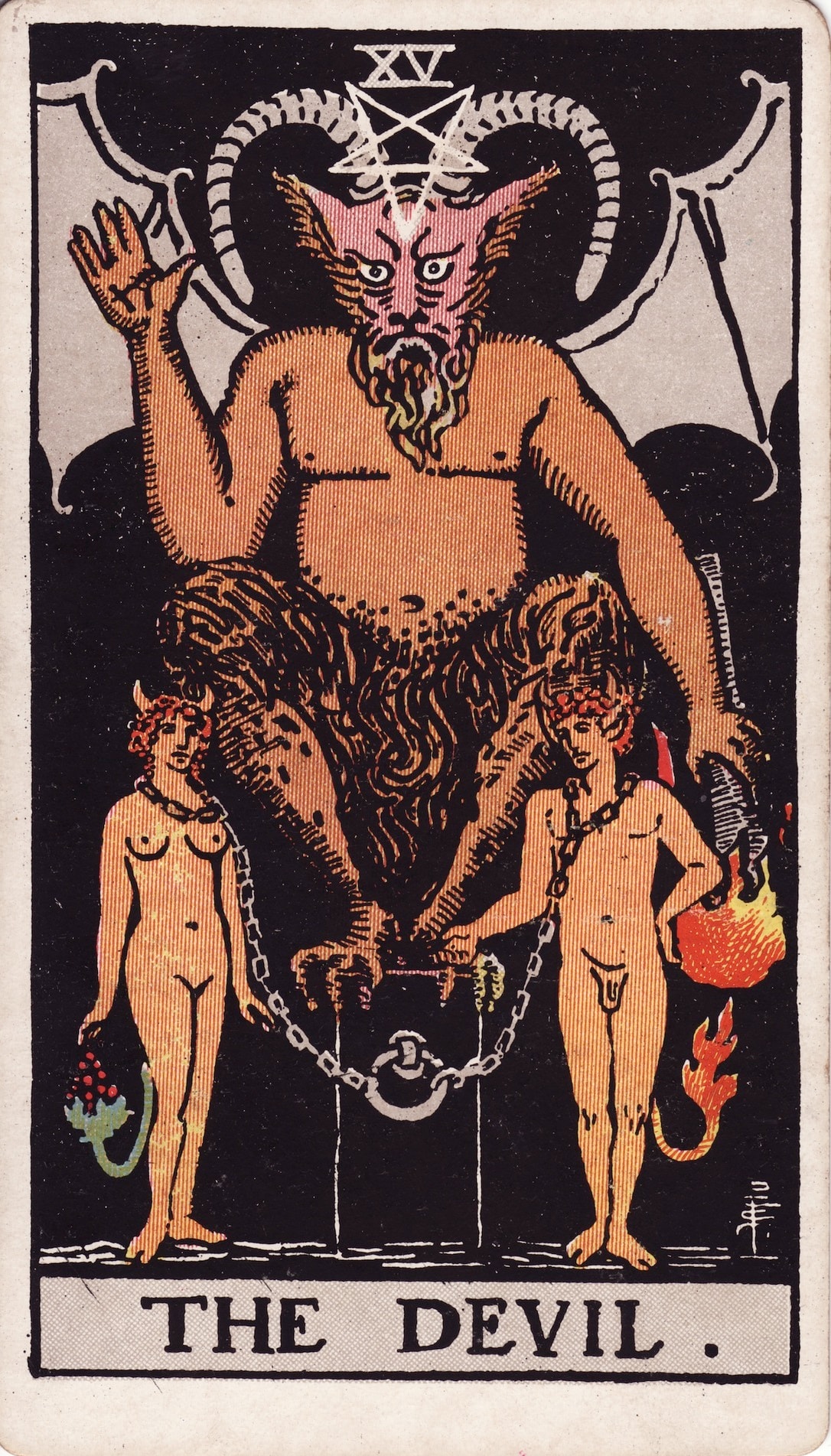
Just before this, on the Devil, the Fool met what he had kept in the dark. Now the lightning comes. Whatever he built on false ground can't hold.
You could see the tower as a picture of a self that has been built too high and too tight. It might be a story about who you are, or a role that grew into a fortress. You could also see the crack as the way something larger gets in.
That can hurt. But look at what the lightning does. It is also a flash of light. For one second, everything is seen. Looking back, a moment like this can turn out to be the start of something true. Waite's own words point the same way. What falls is the "literal word", the flat and fixed version of things.
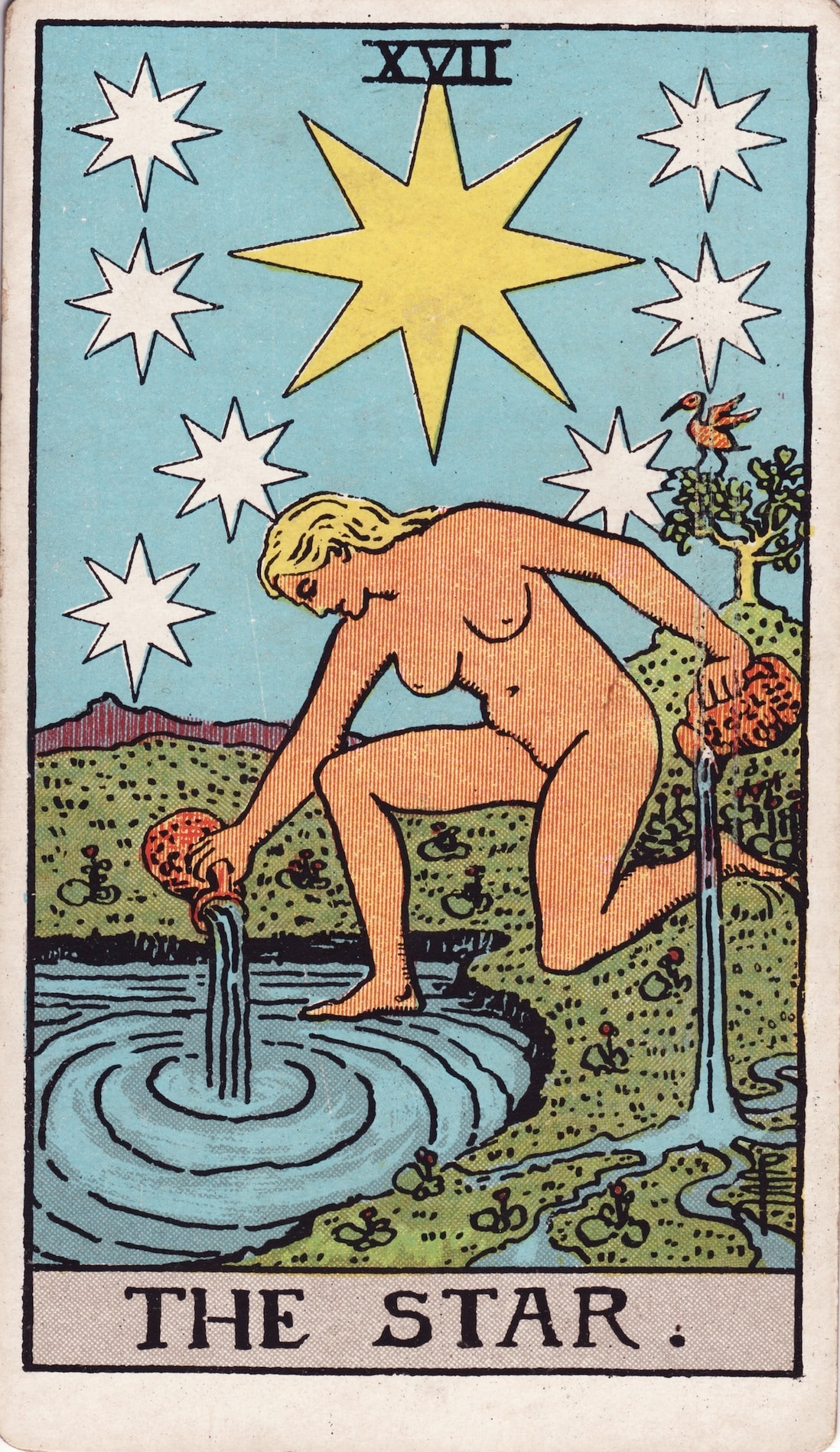
The next card is the Star, with an open sky and quiet water. The road runs on past the rubble.
You could also stay here for a moment, inside the flash. What does the world look like in that one second of light?
Across traditions
Old cards called this card by other names. On the tarot Jean Noblet printed in Paris in the mid-1600s it is La Maison Dieu, the House of God. There the top of the tower is shaped like a crown, and coloured balls fill the air instead of flames.
Waite also lists another old name, "the Tower of Babel". In the Book of Genesis, people build a tower "whose top may reach unto heaven", to make a name for themselves. God confuses their language, so they can no longer understand each other. The building stops. Genesis also says that Babel was where the kingdom of Nimrod began. Waite notes that the two falling men have been taken for Nimrod and his minister.
In 1563 the painter Pieter Bruegel the Elder pictured that tower still going up, in a painting now in Vienna. A king has come to look at it, and the stonecutters kneel to him.
Book T gives the Tower to Mars, one of the classical planets, with the Hebrew letter Peh, and calls it "Lord of the Hosts of the Mighty". One and six make seven, and VII is the Chariot, whose driver rides out in triumph. You could read the Tower as what happens when what we build grows too proud.
Try this
Sketch a quick tower on a piece of paper. Make it a tower you have built in your life: a plan, a belief, a picture of yourself. Give it windows. Put a crown on top. Now imagine a single flash of light touching the crown. Leave the tower standing. Look, by that light, at what is inside the windows. What can you see now that you couldn't see before?
Questions to sit with
- Who put the crown on top of the tower?
- Why is there no door?
- What in your life has been built too high to be comfortable?
- When has a sudden flash shown you something true?
- What might grow on the rock once the tower is gone?
The film
No film for this card yet.
Sources
- Waite: idle to say the card shows ruin; the rending of a House of Doctrine, a House of Falsehood; the two falling figures as the literal word made void and its false interpretation.Arthur Edward Waite, The Pictorial Key to the Tarot (London, 1911), Part II, The Tower, pp. 132–135
- Book T's “Two-and-twenty leaping Flames, or Yodh” round the Ace of Wands; the Tower's Mars, Peh and title.Book T, The Equinox I.8 (1912), the Ace of Wands and the table of the Keys
- The old names Castle of Plutus, God's House and Tower of Babel; the falling figures as Nimrod and his minister.Arthur Edward Waite, The Pictorial Key to the Tarot (London, 1911), Part I, Trumps Major, no. 16, p. 26
- Noblet's card XVI, La Maison Dieu: a crown-shaped top, coloured balls in the air, two falling figures.Jean Noblet, tarot (Paris, mid-1600s), card XVI, LA MAISON DIEV; Bibliothèque nationale de France, via Wikimedia Commons
- The tower whose top may reach unto heaven; the confusion of tongues at Babel; Babel as the beginning of Nimrod's kingdom.Genesis 10:8–10 and 11:4–9, King James Version
- Bruegel's Tower of Babel: the tower still being built, a king visiting, stonecutters kneeling.Pieter Bruegel the Elder, The Tower of Babel (1563), Kunsthistorisches Museum, Vienna, GG 1026; Wikimedia Commons
Around this card
Before and after it in the deck
The third row of the Fool's journey


All the cards of the Major Arcana, or the whole deck.