Trump XVII, Major Arcana
The Star
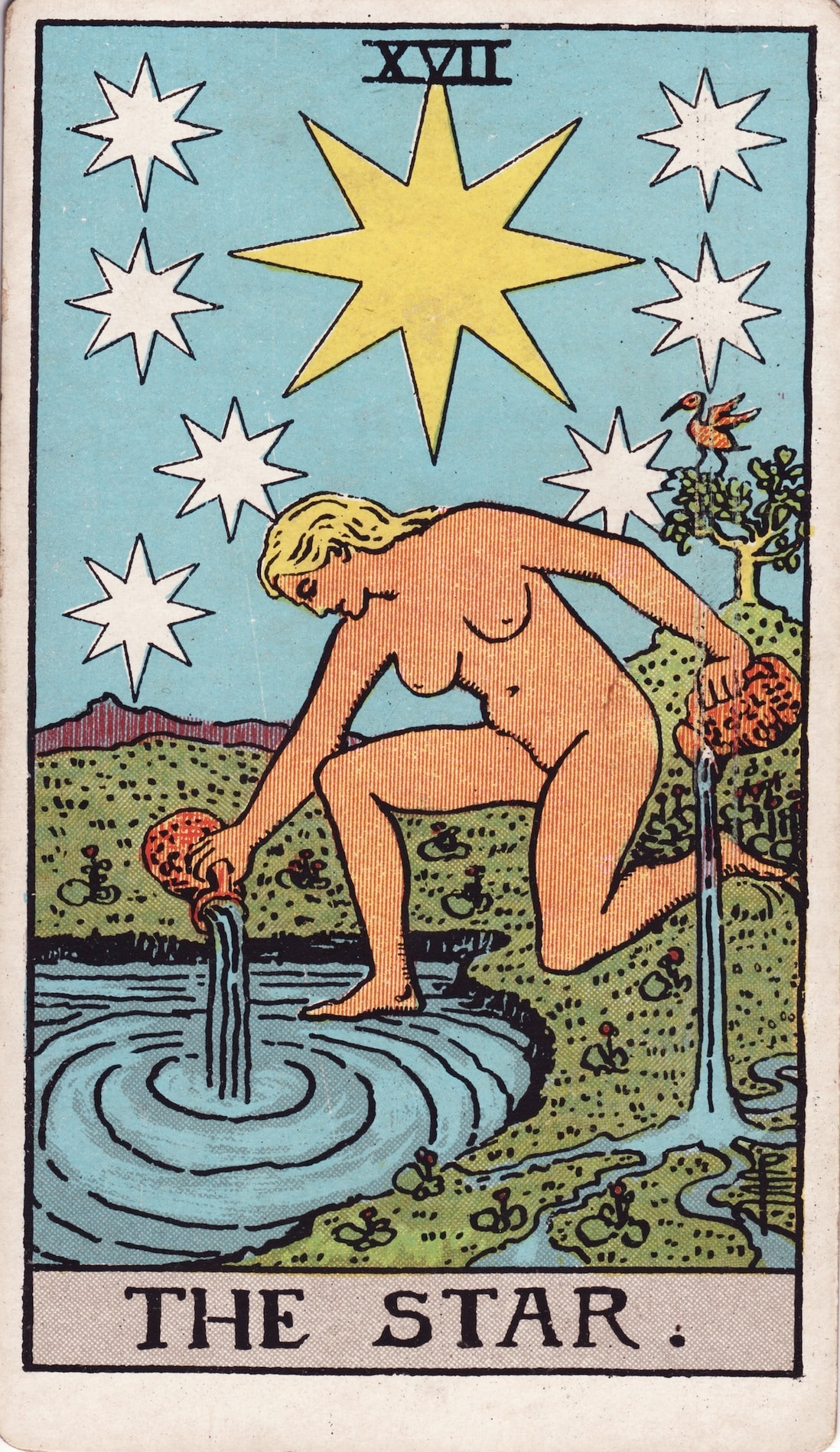
Trump XVII, the Star, puts one great yellow star and seven small white ones over a naked woman kneeling at the edge of a pool. Pamela Colman Smith drew her in 1909 pouring water from two jugs, one into the pool and one onto the land, with a red bird on a small tree behind her.
What Waite wrote it means (1910)
- Divinatory meanings
Loss, theft, privation, abandonment; another reading says—hope and bright prospects,
- Reversed
Arrogance, haughtiness, impotence.
Arthur Edward Waite, The Pictorial Key to the Tarot (London, 1911), p. 286. Read it in the chapter
A great, radiant star of eight rays, surrounded by seven lesser stars—also of eight rays. The female figure in the foreground is entirely naked. Her left knee is on the land and her right foot upon the water. She pours Water of Life from two great ewers, irrigating sea and land. Behind her is rising ground and on the right a shrub or tree, whereon a bird alights. The figure expresses eternal youth and beauty. The star is l'étoile flamboyante, which appears in Masonic symbolism, but has been confused therein. That which the figure communicates to the living scene is the substance of the heavens and the elements. It has been said truly that the mottoes of this card are "Waters of Life freely" and "Gifts of the Spirit."
The summary of several tawdry explanations says that it is a card of hope. On other planes it has been certified as immortality and interior light. For the majority of prepared minds, the figure will appear as the type of Truth unveiled, glorious in undying beauty, pouring on the waters of the soul some part and measure of her priceless possession. But she is in reality the Great Mother in the Kabalistic Sephira Binah, which is supernal Understanding, who communicates to the Sephiroth that are below in the measure that they can receive her influx.
What's in the picture
- The great star. A large yellow star with eight long points fills the top of the sky, just under the number XVII.
- The seven small stars. Seven smaller white stars, each with eight points as well, frame the big one: four down the left side and three on the right.
- The woman. She kneels with nothing on, and her long fair hair falls forward as she bends over the water.
- The first jug. In her right hand an orange jug tips over. Its water pours straight down into the pool and spreads out in wide rings.
- The foot on the water. Her right foot rests on the surface of the pool, as if the water could hold her.
- The knee on the land. Her left knee is down on the grassy bank, which is dotted with small plants.
- The second jug. With her left hand she pours from a second jug onto the land. Its stream falls to the grass and breaks into small streams that wind along the bottom of the card, back toward the pool.
- The bird. On a small tree at the top of the hill sits a red bird with a long, curved beak and its wings half raised.
- The far hills. Low purple hills run along the horizon behind her on the left, under a pale blue sky.
- Smith's monogram. In the bottom right corner, drawn among the little streams, is the knot-like mark Smith put on many of her cards.
The card in brief
- In the deck
- Card 18 of 78
- Arcana
- Major Arcana
- Number
- Trump XVII
- Hebrew letter (Golden Dawn)
- Tzaddi
- Astrology (Golden Dawn)
- Aquarius
- Title in Book T
- The Daughter of the Firmament, the dweller between the Waters
- Drawn by
- Pamela Colman Smith
- Planned by
- Arthur Edward Waite
- Published
- London, William Rider & Son, 1909
- Scan
- Pam-A printing, c. 1910, Wikimedia Commons
In the old books
Book T (1912)
Hope, faith, unexpected help. Or dreaminess, deceived hope, etc.
Book T, “A Description of the Cards of the Tarot”, The Equinox I.8 (London, 1912), p. 204. See the source Papus (1892)
A nude female figure pours the Water of Universal Life from two cups.
The genius of the Sun (14th arcanum) has now descended to earth under the form of this young girl, the image of eternal Youth. The fluids, which she formerly poured from one vase to the other, she now throws upon the ground (first idea).
Papus, The Tarot of the Bohemians, tr. A. P. Morton (London, 1892), p. 172. See the source
Before 1909
The older cards and pictures behind this one will be shown here once their licences are checked.
The Star: pouring out
Under a sky full of stars, a woman kneels at the edge of a pool. She pours water from two jugs. One stream falls into the pool and sends out rings. The other falls on the grass and runs back to the pool in little streams. One of her knees rests on the land. One foot rests on the water. Above her shines a great yellow star with eight points, and seven smaller white ones.
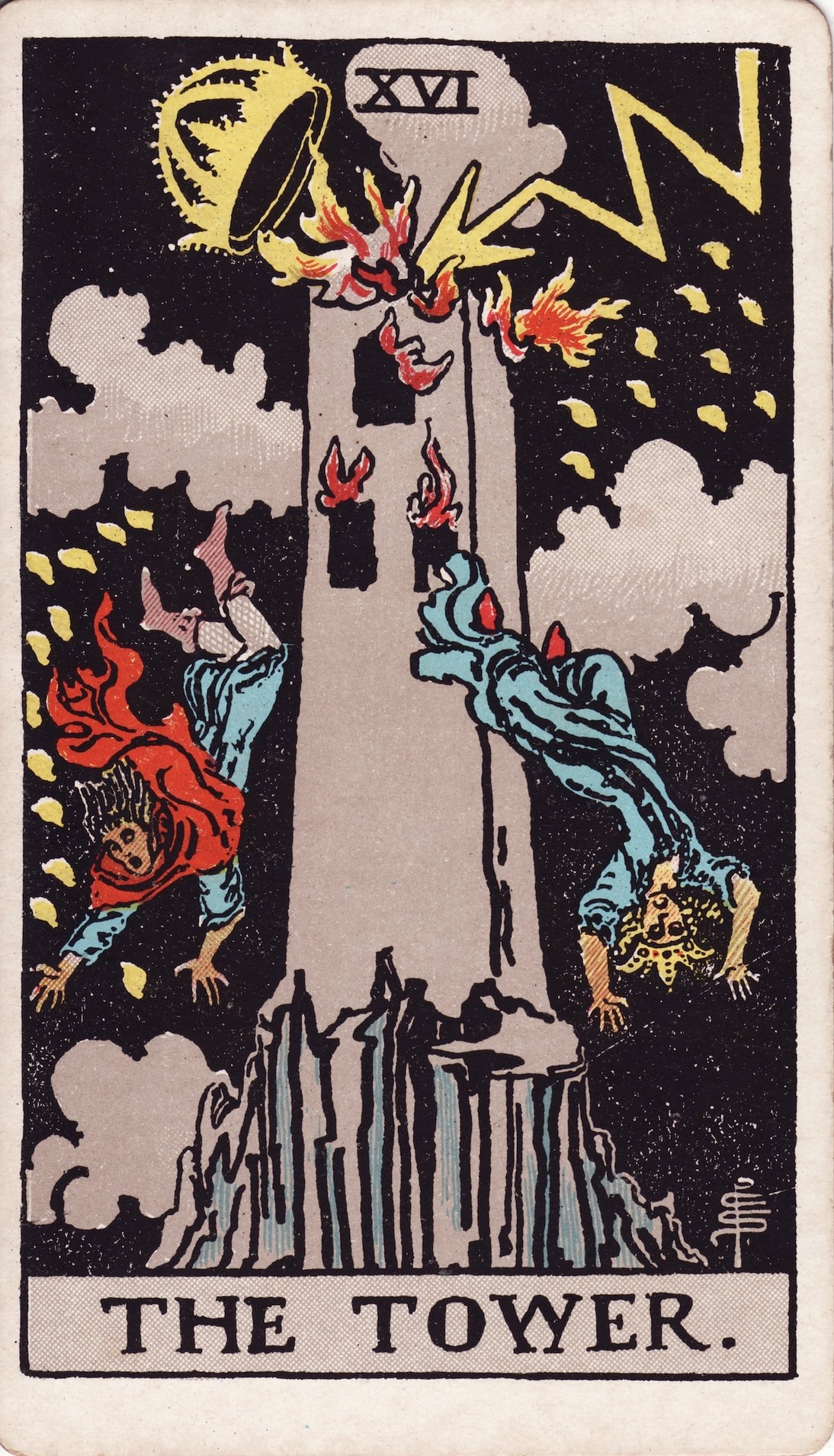
The Star is trump XVII, and it comes straight after the lightning and the falling tower. Here is open sky and quiet water. Nobody is building anything. Something is being given away.
The image
Count the stars. There is one big star and seven small ones, and every one has eight points. The big one is yellow. The small ones are white.
She kneels with nothing on. She hides nothing and holds nothing back. Look at where the water goes. Half goes to the pool, half to the dry land. Neither is left out.
On the hill behind her grows a small tree. A red bird with a long, curved beak sits on it. In his survey of older decks, Arthur Edward Waite noted that some later cards put a butterfly on a rose in the bird's place.
Waite agreed with two mottoes for the card: "Waters of Life freely" and "Gifts of the Spirit". The first sounds close to the last pages of the Bible. There, anyone who wants to "take the water of life freely" is invited to.
The inner journey
On the card before this one, the Fool saw his tower fall. Everything that kept him safe and closed is gone. Now he stands under the open sky, and something comes to him that he didn't make.
You could see the woman as a picture of the soul once the walls are down. She has nothing left to protect, so she can give. She pours without measuring.
Waite placed her in the Kabbalah, the Jewish mystical tradition. He called her "the Great Mother", who gives to those below her "in the measure that they can receive". That is a gentle idea. The water keeps coming, and each thing takes what it can hold.
Many people call this the card of hope. Waite was rude about that. He called the usual explanations "tawdry", and said hope was only their summary. You could hold both. Let the card be hope for a while. Then let it be something plainer: a person pouring water, under the stars, at night.
You could stay here as long as you like. Nothing on this card is in a hurry.
Across traditions
The Golden Dawn gave the Star the Hebrew letter Tzaddi and Aquarius, the Water-Bearer, a sign of the zodiac. In Book T her titles are "Daughter of the Firmament" and "the dweller between the Waters". The sun enters Aquarius around 20 January. An old dictionary says the sign was named for the rains of that season in Italy.
Old star maps drew Aquarius as a man pouring water from a jar. In Sidney Hall's Urania's Mirror, a set of star cards printed in London in 1825, his stream runs a long way across the sky, and stars are scattered along it.
Waite also wrote that the star has been called "the Dog-Star", Sirius. It is the brightest star in the night sky.
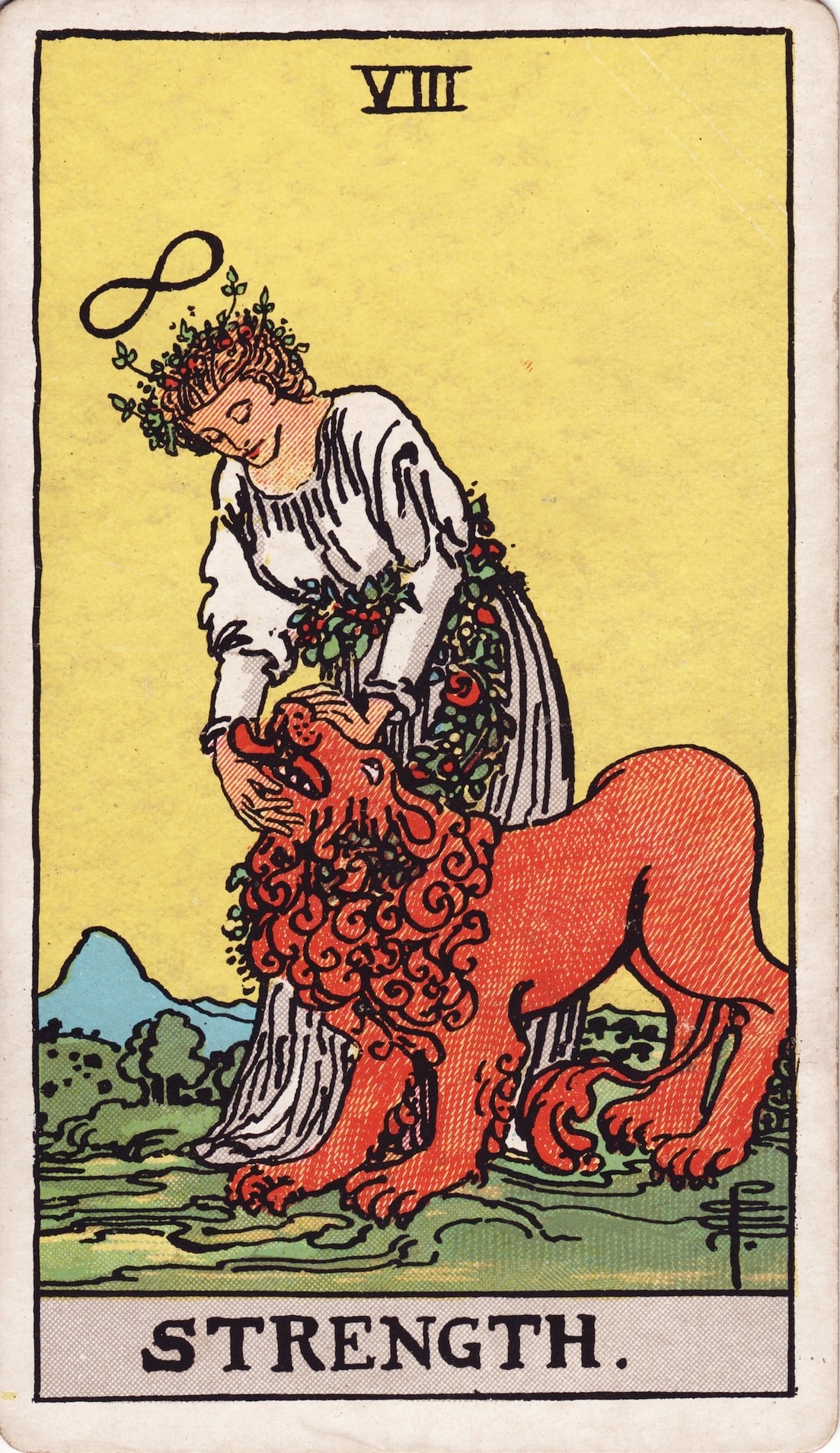
Seventeen's digits come to eight, the number of Strength. On one card a woman closes a lion's jaws. On the other, a woman pours water. Both are gentle, and both are strong.
Try this
Fill a glass with water. Go to a plant, or a patch of earth, or a sink. Pour half the water slowly onto the soil, and half into a bowl. Take your time. Notice how it feels to pour something out without keeping any back. Then, tonight if you can, go outside and find the brightest star you can see. Look at it for a minute. What would you ask it for, if you asked for nothing practical?
Questions to sit with
- Why does she pour onto the land as well as into the pool?
- What is the bird about to do?
- What in your life comes to you without your making it?
- What could you give away today, without measuring?
- Which of the eight stars is yours?
The film
No film for this card yet.
Sources
- Waite on the star of eight rays and the seven lesser stars, the knee on the land and the foot on the water, the two ewers, the bird on the tree, the mottoes Waters of Life freely and Gifts of the Spirit, the tawdry explanations of hope, and the Great Mother in Binah.Arthur Edward Waite, The Pictorial Key to the Tarot (London, 1911), Part II, The Star, pp. 136–139
- Whosoever will, let him take the water of life freely.Revelation 22:17, King James Version
- The Dog-Star or Sirius; the butterfly on a rose that replaces the bird on some later cards; the Star called that of Hope.Arthur Edward Waite, The Pictorial Key to the Tarot (London, 1911), Part I, Trumps Major, no. 17, p. 26
- The Golden Dawn gave the Star Tzaddi and Aquarius; Book T's titles for it.Book T, The Equinox I.8 (1912), table of the Keys
- Aquarius, the Water-bearer, entered by the sun about 20 January and named for the rains of that season in Italy; Sirius, the Dog Star, the brightest star in the heavens.Webster's Revised Unabridged Dictionary (1913), Aquarius and Dog Star
- Urania's Mirror: the Water-Bearer's long stream, with stars set along it.Sidney Hall, Urania's Mirror (London, 1825), plate 26, Aquarius; Library of Congress, via Wikimedia Commons
- On Strength a woman closes the mouth of a lion.Arthur Edward Waite, The Pictorial Key to the Tarot (London, 1911), Part I, Trumps Major, no. 8, p. 16
Around this card
Before and after it in the deck
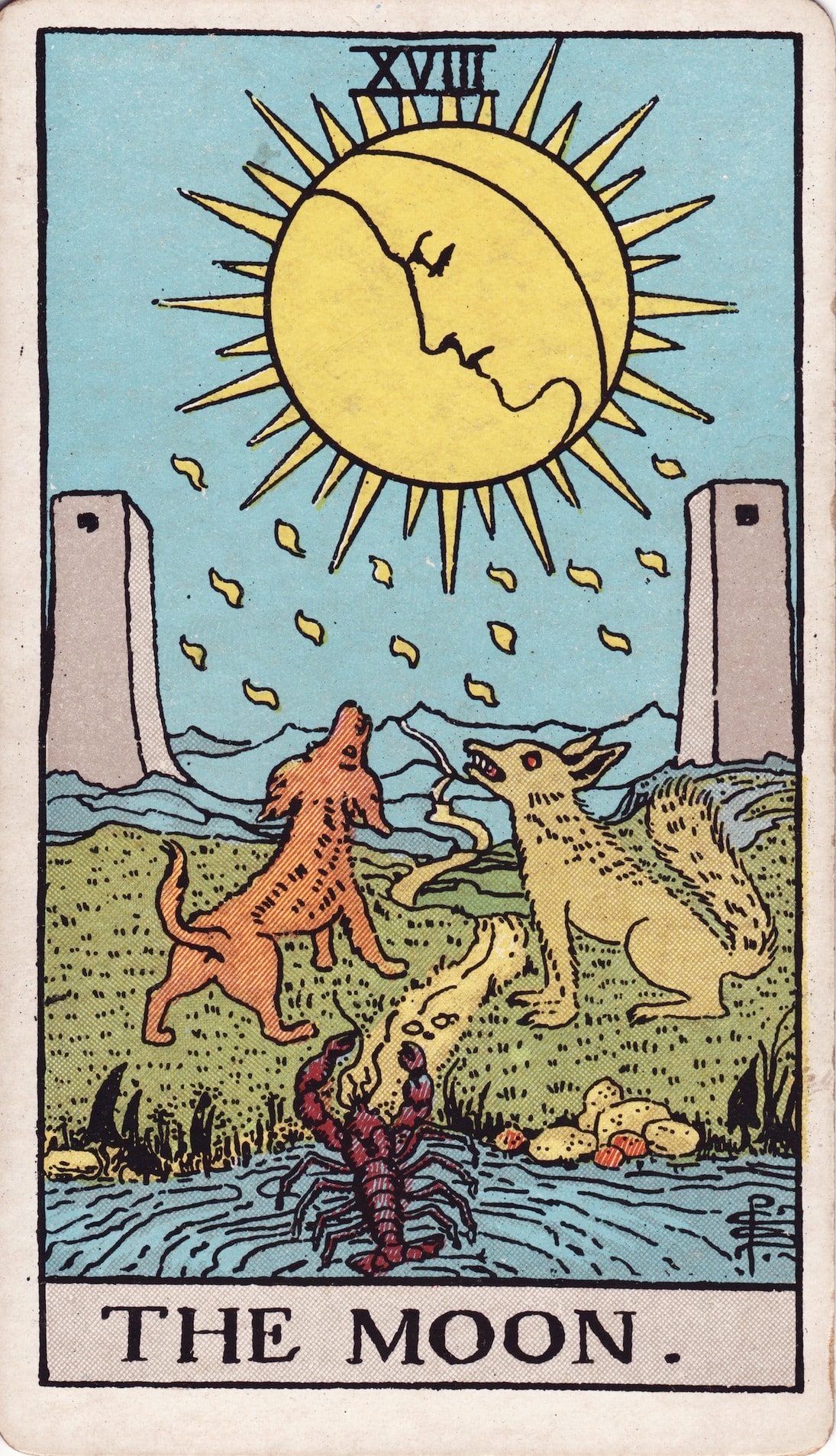
The third row of the Fool's journey


All the cards of the Major Arcana, or the whole deck.