Trump XV, Major Arcana
The Devil
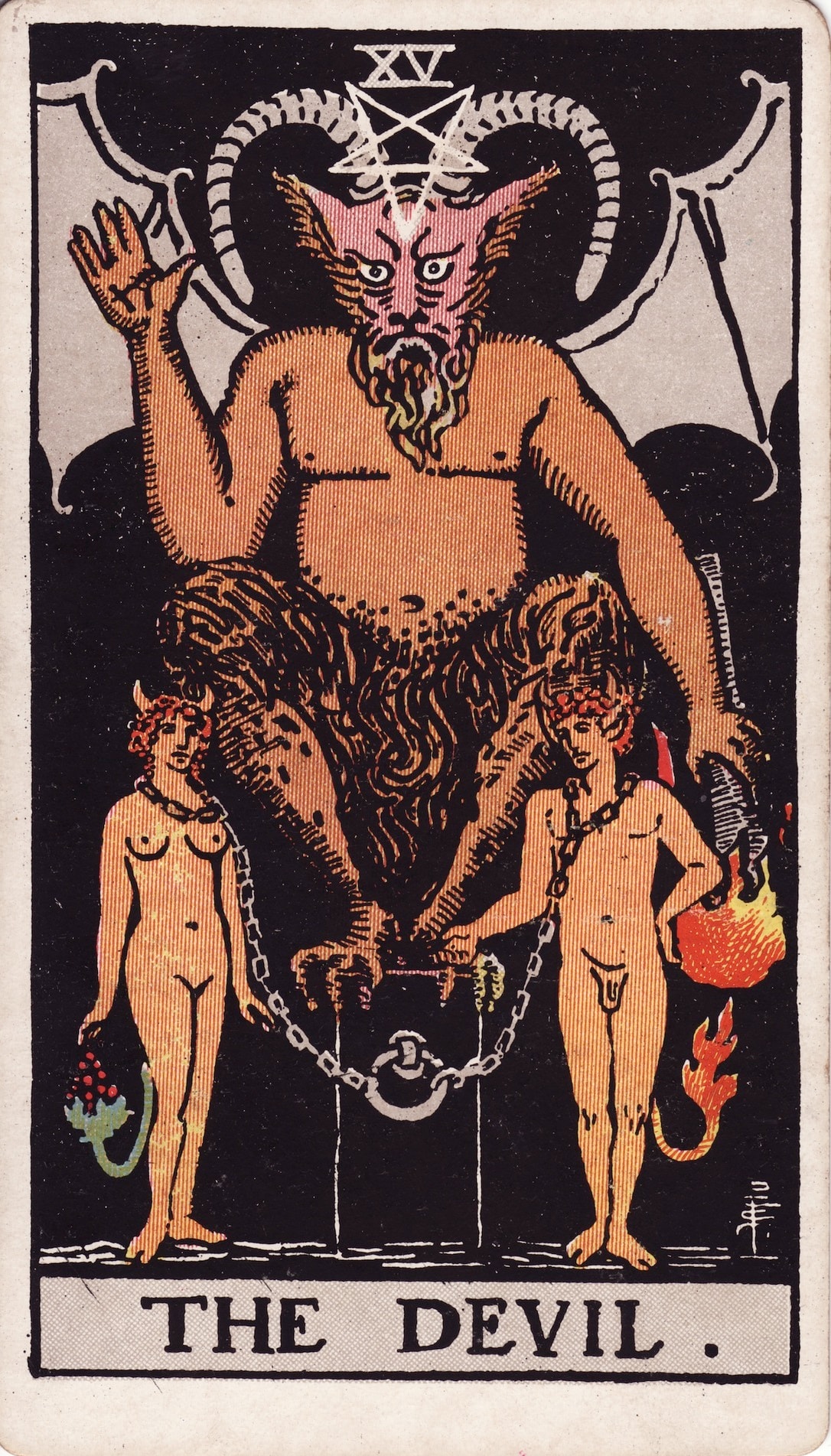
The Devil is trump XV: a huge horned figure with a goat's head and bat's wings squats on a black block, and a naked man and woman stand chained by the neck below him. Pamela Colman Smith drew it in 1909 and gave the two figures tails, one ending in red fruit like grapes and one in a flame.
What Waite wrote it means (1910)
- Divinatory meanings
Ravage, violence, vehemence, extraordinary efforts, force, fatality; that which is predestined but is not for this reason evil.
- Reversed
Evil fatality, weakness, pettiness, blindness.
Arthur Edward Waite, The Pictorial Key to the Tarot (London, 1911), p. 285. Read it in the chapter
The design is an accommodation, mean or harmony, between several motives mentioned in the first part. The Horned Goat of Mendes, with wings like those of a bat, is standing on an altar. At the pit of the stomach there is the sign of Mercury. The right hand is upraised and extended, being the reverse of that benediction which is given by the Hierophant in the fifth card. In the left hand there is a great flaming torch, inverted towards the earth. A reversed pentagram is on the forehead. There is a ring in front of the altar, from which two chains are carried to the necks of two figures, male and female. These are analogous with those of the fifth card, as if Adam and Eve after the Fall. Hereof is the chain and fatality of the material life.
The figures are tailed, to signify the animal nature, but there is human intelligence in the faces, and he who is exalted above them is not to be their master for ever. Even now, he is also a bondsman, sustained by the evil that is in him and blind to the liberty of service. With more than his usual derision for the arts which he pretended to respect and interpret as a master therein, Éliphas Lévi affirms that the Baphometic figure is occult science and magic. Another commentator says that in the Divine world it signifies predestination, but there is no correspondence in that world with the things which below are of the brute. What it does signify is the Dweller on the Threshold without the Mystical Garden when those are driven forth therefrom who have eaten the forbidden fruit.
What's in the picture
- The star on the forehead. A five-pointed star drawn in white lines stands upside down on his brow, with one point aimed down at his nose. Above it is the number XV.
- The face and horns. Two long ridged horns curl out from his head like a ram's. Below them he has a goat's ears, wide staring eyes and a pointed beard.
- The raised hand. His right hand is lifted high, palm open toward us, with the fingers a little apart.
- The wings. Grey wings like a bat's spread out behind him into the top corners, against a background that is black all over.
- The torch. In his other hand he holds a striped torch upside down, so that its flame burns toward the ground.
- The block and the ring. He squats on a black block with furry goat's legs, and his clawed feet grip its top edge. A round iron ring is fixed to its front.
- The chains. Two chains run from the ring up to the necks of the man and the woman. They hang in wide, slack loops.
- The woman's tail. The naked woman on the left has a small horn on her head. Her green tail curls up behind her and ends in a bunch of red fruit, like grapes.
- The man's tail. The naked man on the right stands near the torch. His tail curls out behind him and ends in a red flame.
- Smith's monogram. Low on the right, in the black by the man's feet, is the small knot-like mark Smith put on many of her cards.
The card in brief
- In the deck
- Card 16 of 78
- Arcana
- Major Arcana
- Number
- Trump XV
- Hebrew letter (Golden Dawn)
- Ayin
- Astrology (Golden Dawn)
- Capricorn
- Title in Book T
- The Lord of the Gates of Matter: the Child of the Forces of Time
- Drawn by
- Pamela Colman Smith
- Planned by
- Arthur Edward Waite
- Published
- London, William Rider & Son, 1909
- Scan
- Pam-A printing, c. 1910, Wikimedia Commons
In the old books
Book T (1912)
Materiality, material force, material temptation, obsession.
Book T, “A Description of the Cards of the Tarot”, The Equinox I.8 (London, 1912), p. 204. See the source Papus (1892)
The Devil has materialized upon his head the universal fluid which surrounded the head of the Juggler; this is indicated by the two six-pointed horns which adorn him.
He stands upon a cube placed upon a sphere, to indicate the domination of Matter (the cube) over the Spirit (the Sphere).
Papus, The Tarot of the Bohemians, tr. A. P. Morton (London, 1892), p. 166. See the source
Before 1909
The older cards and pictures behind this one will be shown here once their licences are checked.
The Devil: the loose chains
A huge horned figure squats on a black block. He has a goat's head, a bat's wings and a star upside down on his forehead. One hand is raised. The other holds a burning torch that points down at the ground. Chained to a ring on the block stand a naked man and woman, with tails of their own. Now look at the chains around their necks. They hang in wide, loose loops.
The Devil is trump XV. Take the Major Arcana as stations on one road, and here the Fool meets what he has kept in the dark. It is a strange card, and there is hope in it.
The image
The whole background is black, like a cellar with the lights off. Against it the figure looks enormous. Compare him with the two people. They are small, and they stand very still.
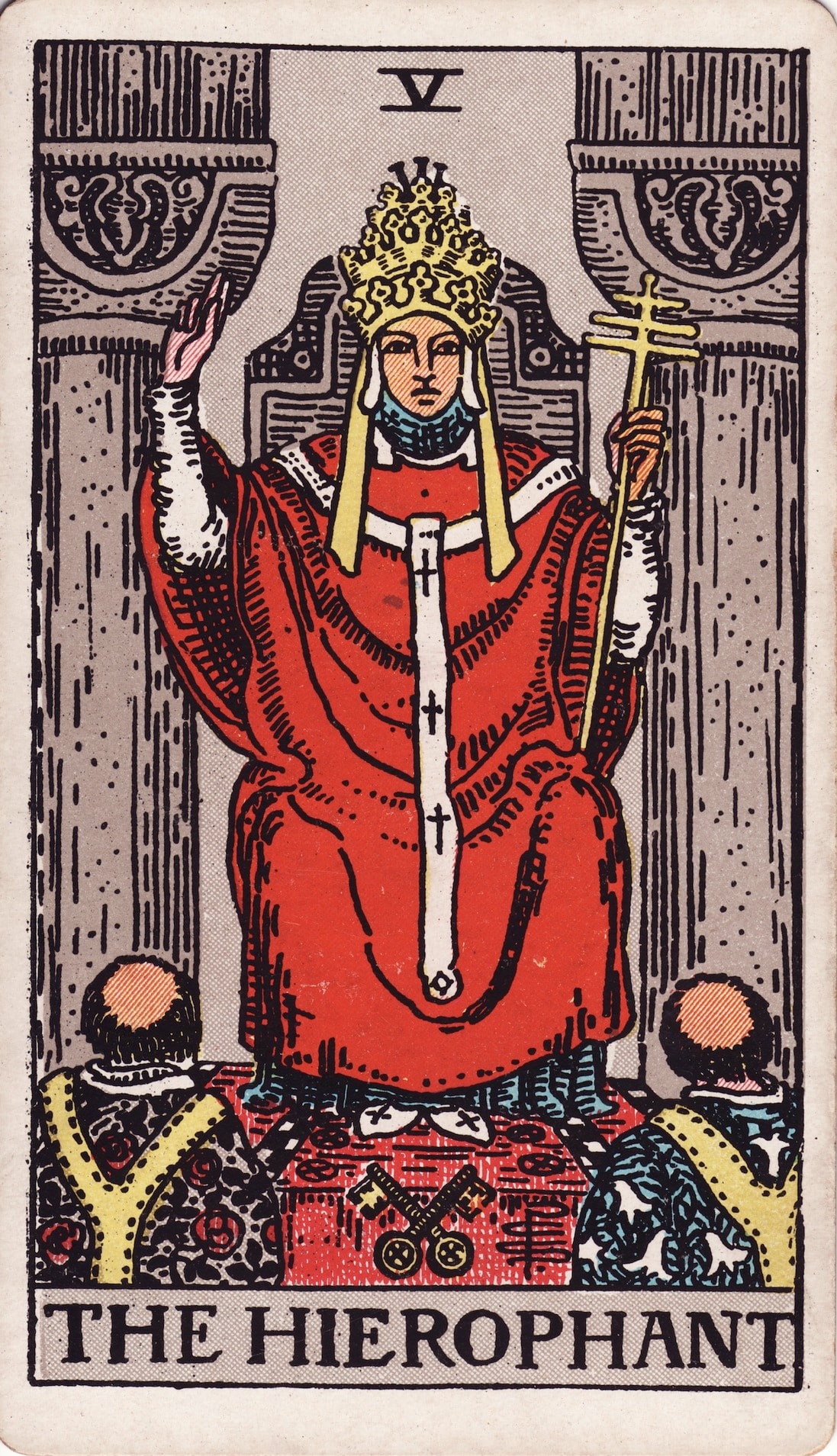
His raised hand is open, palm out. Arthur Edward Waite's book on the cards calls it "the reverse of that benediction", the blessing, given by the Hierophant, card V. Put the two cards side by side. Each has a large figure raised up high, with two smaller figures below. One blesses. The other holds a torch upside down.
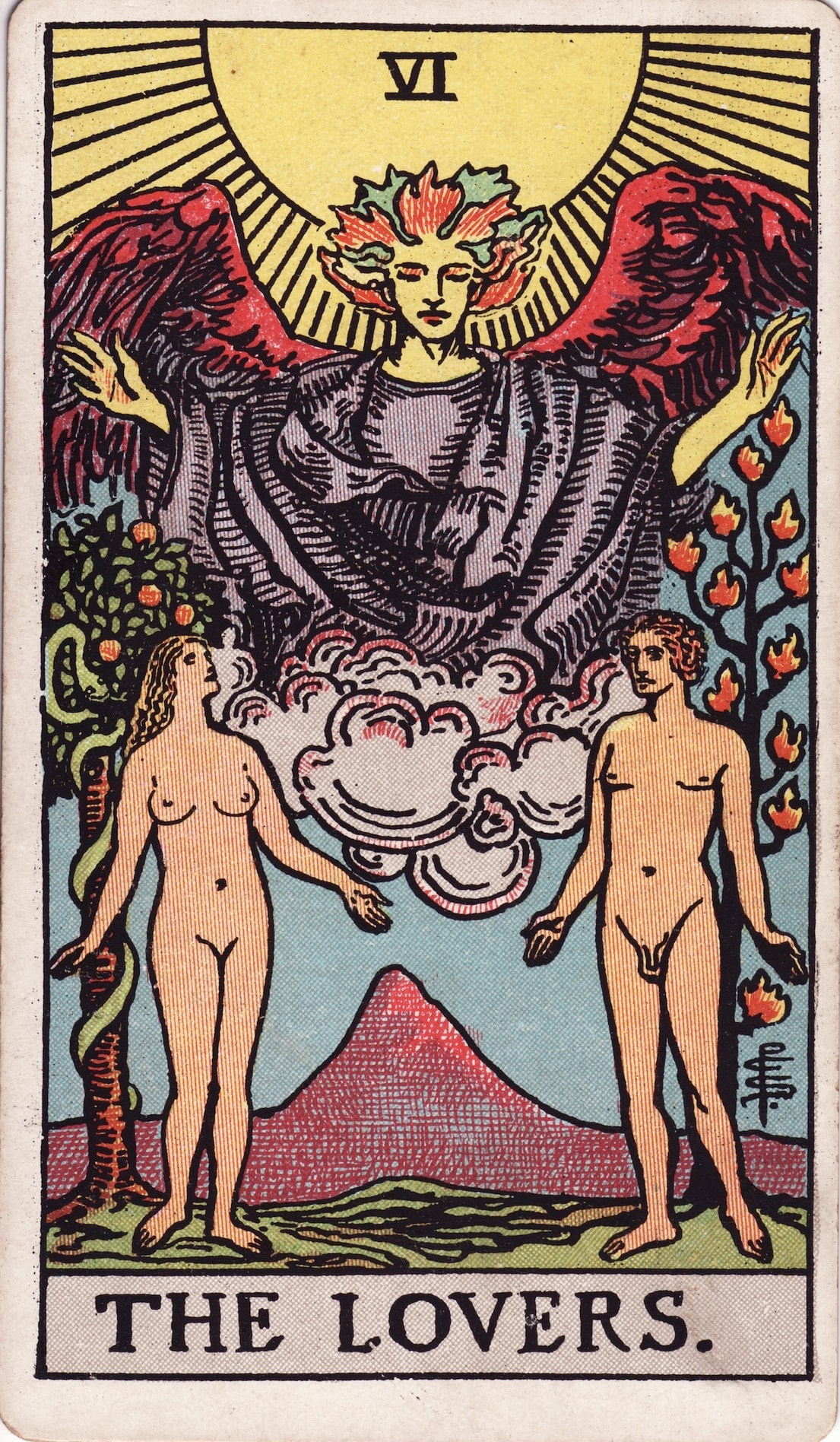
Now the two people. If you know the Lovers, card VI, you have seen them before. There a naked woman stands on the left, beside a tree full of fruit. A naked man stands on the right, beside a tree of flames. On this card the woman's tail ends in a bunch of fruit, like grapes. The man's tail ends in a flame. Waite said they are "as if Adam and Eve after the Fall".
He saw "human intelligence in the faces". And he added something hopeful about the figure on the block. He "is not to be their master for ever". Even now, Waite wrote, "he is also a bondsman", a kind of servant himself.
Look again at the chains. The loops are wide. Could the two lift them off over their heads?
The inner journey
On the card before, Temperance, the Fool learned to mix and balance. Now the road goes down into the basement.
Carl Jung had a name for what lives down there. He called it the shadow. It holds the parts of you that you would rather not see. It might be anger or greed. It might also be joy, or a wild streak you were told to hide. In Jung's view, what you don't look at doesn't go away. It tends to meet you from outside, in other people, and seems to pull your strings.
Seen this way, the Devil is a picture of what happens when parts of you are shut away in the dark. They grow large and strange. They seem to own you. But the chains are loose, and part of the work is noticing that.
You could try something gentler than a fight. Stay with the picture for a while. Look at his face. What does he want? What would he say if you asked? See what happens if you treat him as a figure with a mind of his own, and listen. Sometimes a shadow grows less frightening when you look straight at it.
Across traditions
The Golden Dawn's Book T gives this card two titles, "Lord of the Gates of Matter" and "Child of the Forces of Time". The order paired it with the Hebrew letter Ayin and with Capricorn, a sign of the zodiac. The name Capricorn comes from the Latin for "goat" and "horn". The sun enters Capricorn at the winter solstice. In the north, that is the longest night of the year. From there, the days start to grow longer again.
The old card was different. Waite described a devil from the 1700s that was "not particularly evil". Later came a book by the French writer Papus. In it, the two small demons became two people "yoked only to each other", and not to the devil's block. Waite liked that. He called it "improved symbolism".
The digits of XV add up to 6, the number of the Lovers, which ties the two cards even closer. It is the same man and woman. One card has an angel above them. The other has a devil. What changed?
Try this
Picture a light chain resting around your neck, loose, like the ones on the card. Where does it lead? Follow it with your eyes closed, back to whatever holds the other end. It might be a habit or an old promise. Leave it where it is for now, and notice how loose the chain is. Then, slowly, imagine lifting it over your head, and see how that feels.
Questions to sit with
- Could the two lift the chains off by themselves?
- What is the torch lighting, and why does it point down?
- What do you keep in your own cellar?
- What in you grows larger the less you look at it?
- If the Devil could speak, what would he ask you for?
The film
No film for this card yet.
Sources
- Waite on the raised hand as the reverse of the Hierophant's blessing, the torch turned toward the earth, the two figures as Adam and Eve after the Fall, the human intelligence in their faces, and the figure above as a bondsman who will not be their master for ever.Arthur Edward Waite, The Pictorial Key to the Tarot (London, 1911), Part II, The Devil, pp. 128–131
- Jung on the shadow: the side of ourselves we would rather not see, met first in other people.C. G. Jung, Aion (1951), ch. 2, The Shadow (Collected Works 9ii)
- The Golden Dawn gave the Devil Ayin and Capricorn; Book T's titles for it.Book T, The Equinox I.8 (1912), table of the Keys
- Capricorn, from Latin caper, goat, and cornu, horn; the sun enters it at the winter solstice, about 21 December.Webster's Revised Unabridged Dictionary (1913), Capricorn
- The winter solstice has the longest night of the year.US National Weather Service, Cleveland office, The Seasons, the Equinox, and the Solstices
- The eighteenth-century devil was not particularly evil; Papus's figures yoked only to each other, which Waite called improved symbolism.Arthur Edward Waite, The Pictorial Key to the Tarot (London, 1911), Part I, Trumps Major, no. 15, p. 25
Around this card
Before and after it in the deck
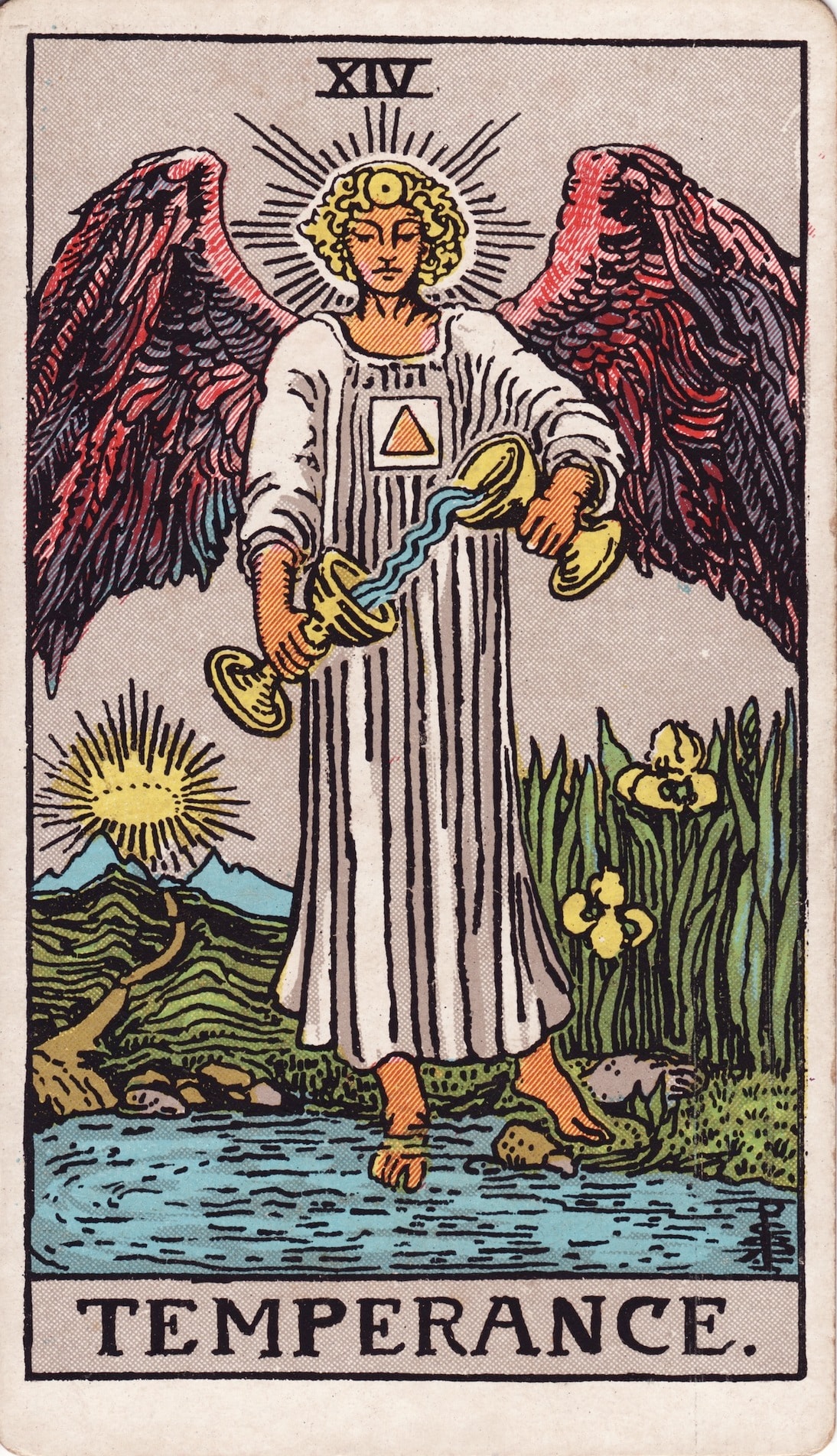
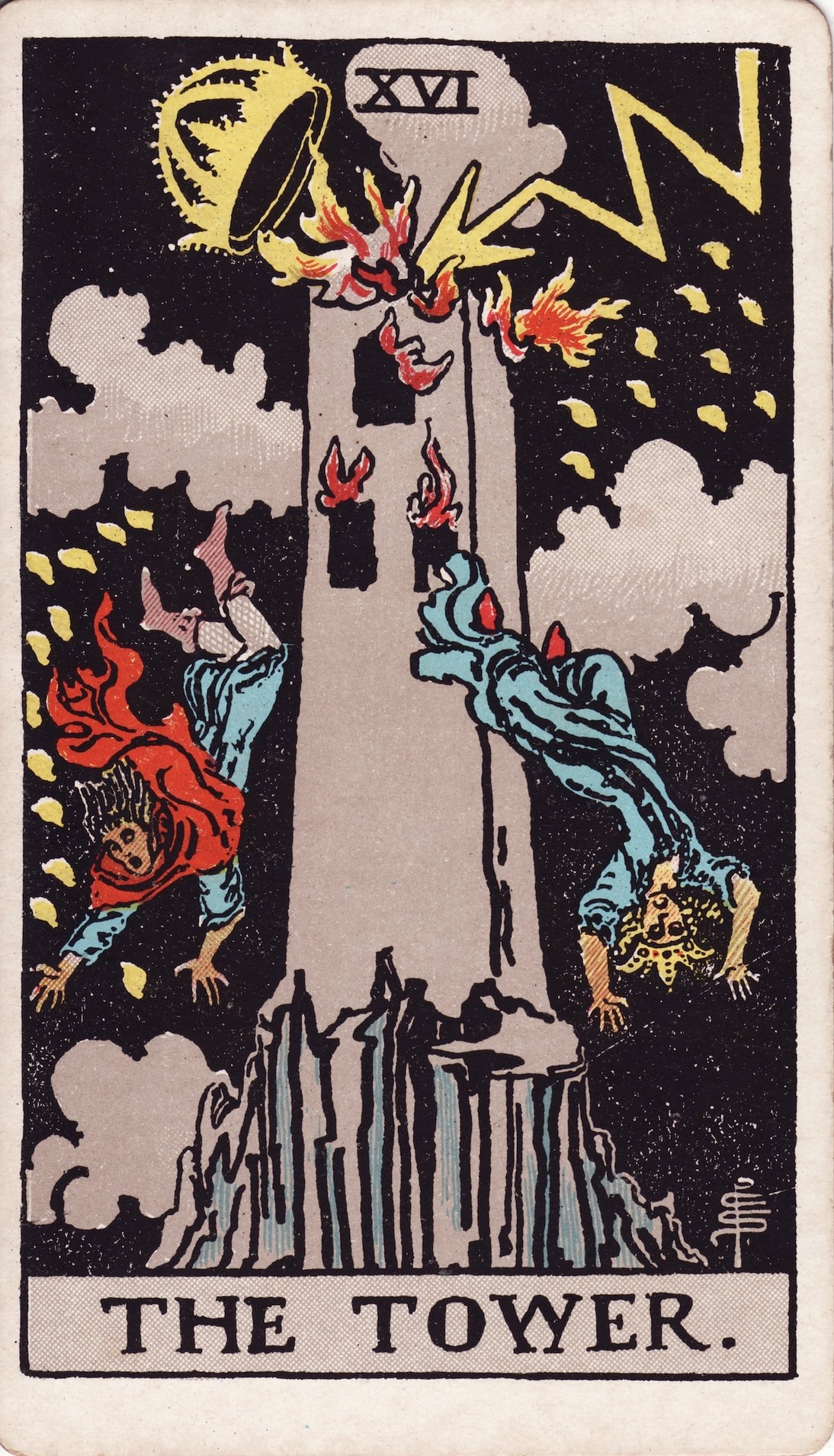
The third row of the Fool's journey
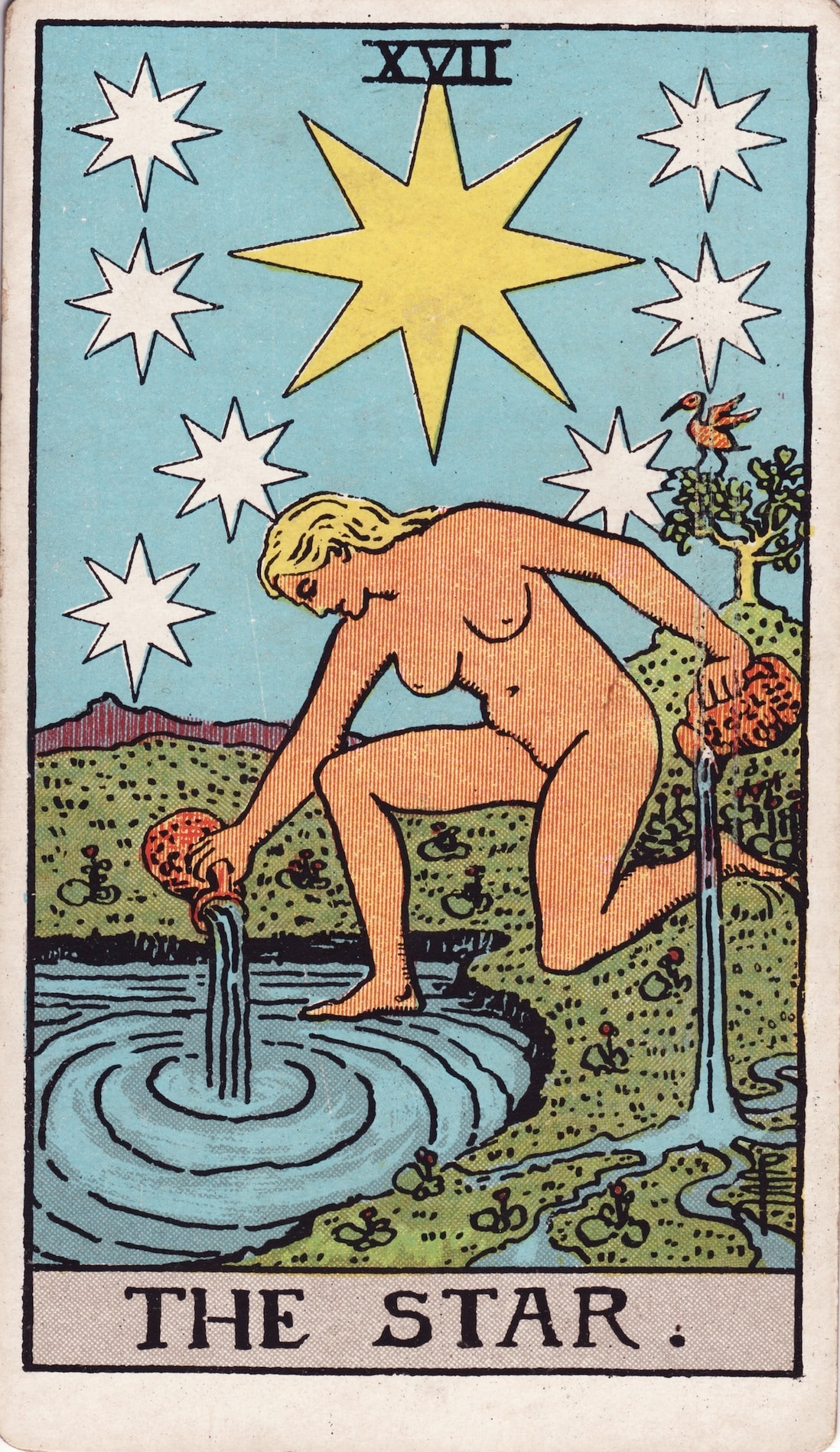
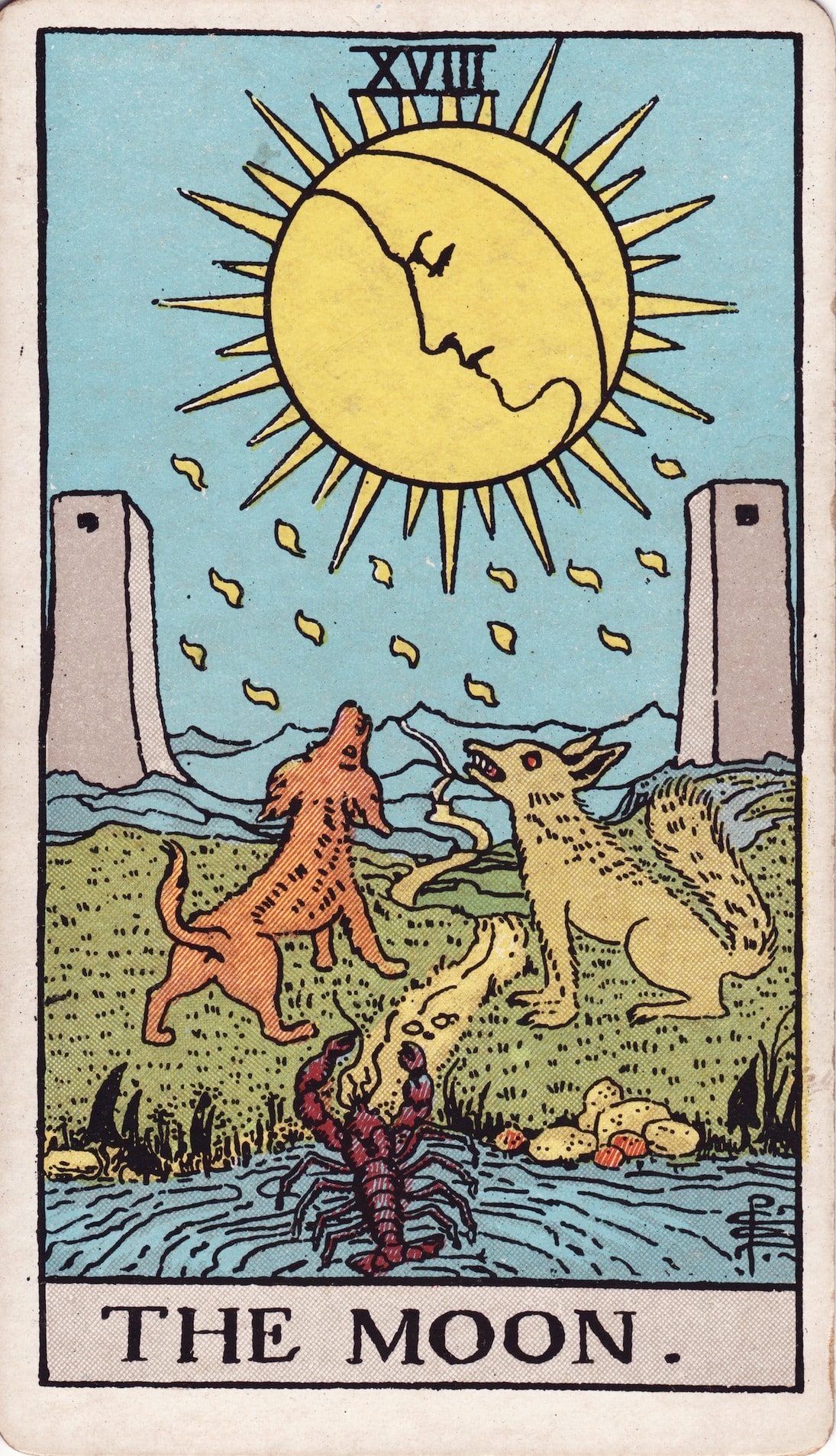
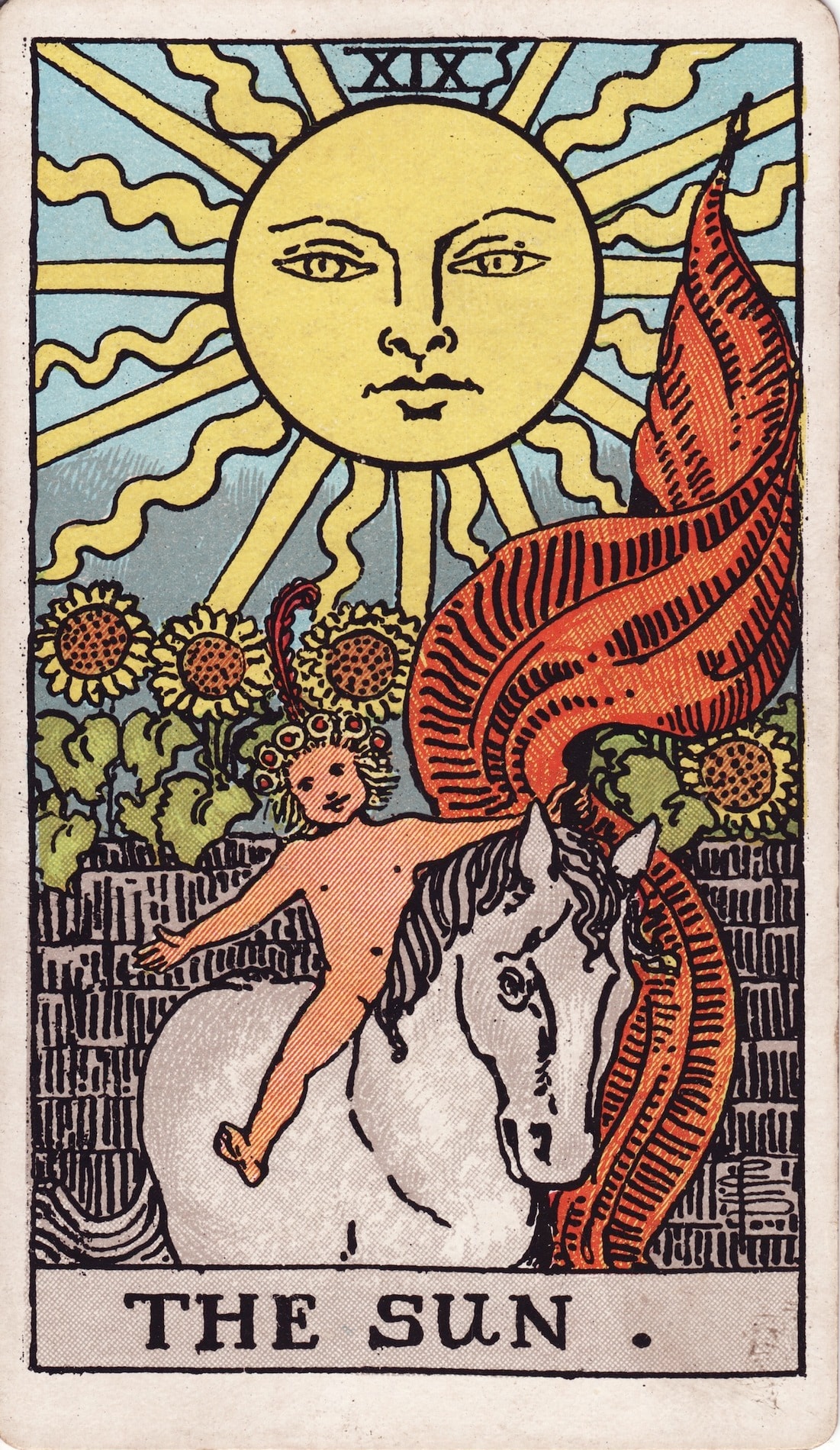

All the cards of the Major Arcana, or the whole deck.