Trump XXI, Major Arcana
The World
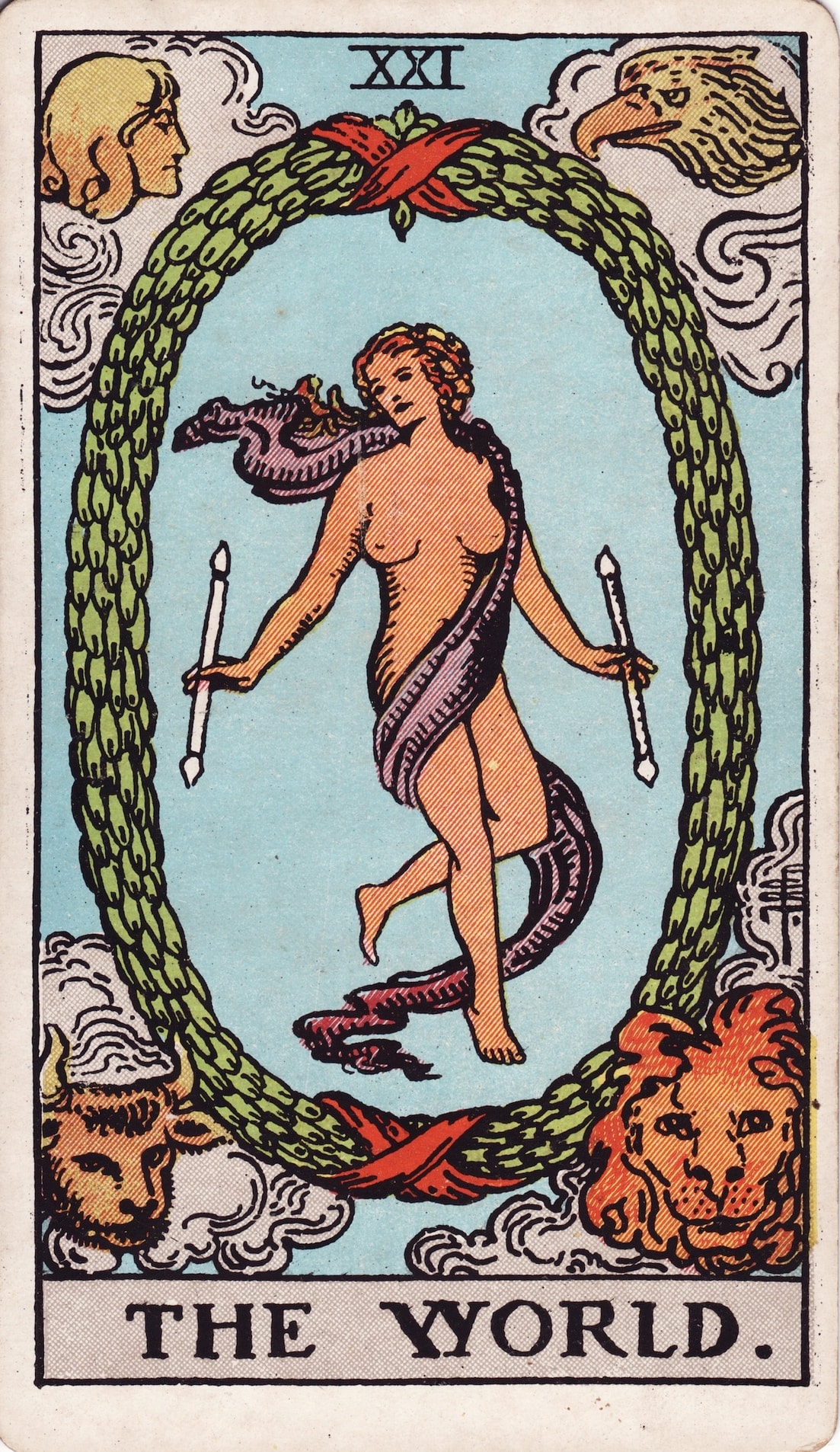
The World is trump XXI, the last of the Major Arcana, and Pamela Colman Smith drew it in 1909 as a dancer inside a tall oval wreath of green leaves. Wrapped only in a purple scarf, she holds a short white wand in each hand, while a human head, an eagle, a bull and a lion look on from the four corners.
What Waite wrote it means (1910)
- Divinatory meanings
Assured success, recompense, voyage, route, emigration, flight, change of place.
- Reversed
Inertia, fixity, stagnation, permanence.
Arthur Edward Waite, The Pictorial Key to the Tarot (London, 1911), p. 287. Read it in the chapter
As this final message of the Major Trumps is unchanged—and indeed unchangeable—in respect of its design, it has been partly described already regarding its deeper sense. It represents also the perfection and end of the Cosmos, the secret which is within it, the rapture of the universe when it understands itself in God. It is further the state of the soul in the consciousness of Divine Vision, reflected from the self-knowing spirit. But these meanings are without prejudice to that which I have said concerning it on the material side.
It has more than one message on the macrocosmic side and is, for example, the state of the restored world when the law of manifestation shall have been carried to the highest degree of natural perfection. But it is perhaps more especially a story of the past, referring to that day when all was declared to be good, when the morning stars sang together and all the Sons of God shouted for joy. One of the worst explanations concerning it is that the figure symbolizes the Magus when he has reached the highest degree of initiation; another account says that it represents the absolute, which is ridiculous. The figure has been said to stand for Truth, which is, however, more properly allocated to the seventeenth card. Lastly, it has been called the Crown of the Magi.
What's in the picture
- The dancer. A bare woman with reddish hair floats in the middle of the wreath. Her head tilts, and she looks down over her right shoulder.
- The scarf. A long purple scarf flies out behind her head, wraps across her body and trails down to her feet. It is all she wears.
- The two wands. She holds a short white wand loosely in each hand, one on each side, both rounded at the tips.
- The crossed legs. She stands on one straight leg. The other bends at the knee and crosses behind it, so the foot floats free.
- The wreath. A tall oval of green leaves rings her round. Red ribbons tie it at the top and at the bottom, crossed in an X.
- The human head. In the top left corner, on a cloud, a head with fair, wavy hair is seen from the side, looking in toward the dancer.
- The eagle. In the top right corner an eagle's head with a hooked beak looks in from its cloud.
- The bull. In the bottom left corner a brown bull with short horns looks out at you, half hidden in cloud.
- The lion. In the bottom right corner a big orange lion faces out, its mane filling the corner.
- Smith's monogram. Her small comb-like mark is drawn inside the cloud on the right edge, beside the wreath.
The card in brief
- In the deck
- Card 22 of 78
- Arcana
- Major Arcana
- Number
- Trump XXI
- Hebrew letter (Golden Dawn)
- Tav
- Astrology (Golden Dawn)
- Saturn
- Title in Book T
- The Great One of the Night of Time
- Drawn by
- Pamela Colman Smith
- Planned by
- Arthur Edward Waite
- Published
- London, William Rider & Son, 1909
- Scan
- Pam-A printing, c. 1910, Wikimedia Commons
In the old books
Book T (1912)
The matter itself. Synthesis, world, kingdom. Usually denotes actual subject of question, and therefore depends entirely on accompanying cards.
Book T, “A Description of the Cards of the Tarot”, The Equinox I.8 (London, 1912), p. 204. See the source Papus (1892)
A nude female figure, holding a wand in each hand, is placed in the centre of an ellipsis, her legs crossed (like those of the Hanged Man in the twelfth card). At the four angles of the card we find the four animals of the Apocalypse, and the four forms of the Sphinx: the Man, the Lion, the Bull, and the Eagle.
Papus, The Tarot of the Bohemians, tr. A. P. Morton (London, 1892), p. 189. See the source
Before 1909
The older cards and pictures behind this one will be shown here once their licences are checked.
The World: the last dance
A dancer moves inside a great oval wreath of green leaves. A long purple scarf winds around her. She holds a small white wand in each hand. Red ribbons tie the wreath at the top and at the bottom. In the four corners of the card, on clouds, float four heads: a person, an eagle, a bull and a lion.
This is card XXI, the last of the Major Arcana, and the long road through them comes round here. The Fool, who set out with one foot in the air, is dancing.
The image
Look at her legs. One is straight. The other bends behind it at the knee. You have seen that shape before, upside down. The Hanged Man's legs make the same figure, as he hangs from his living tree.
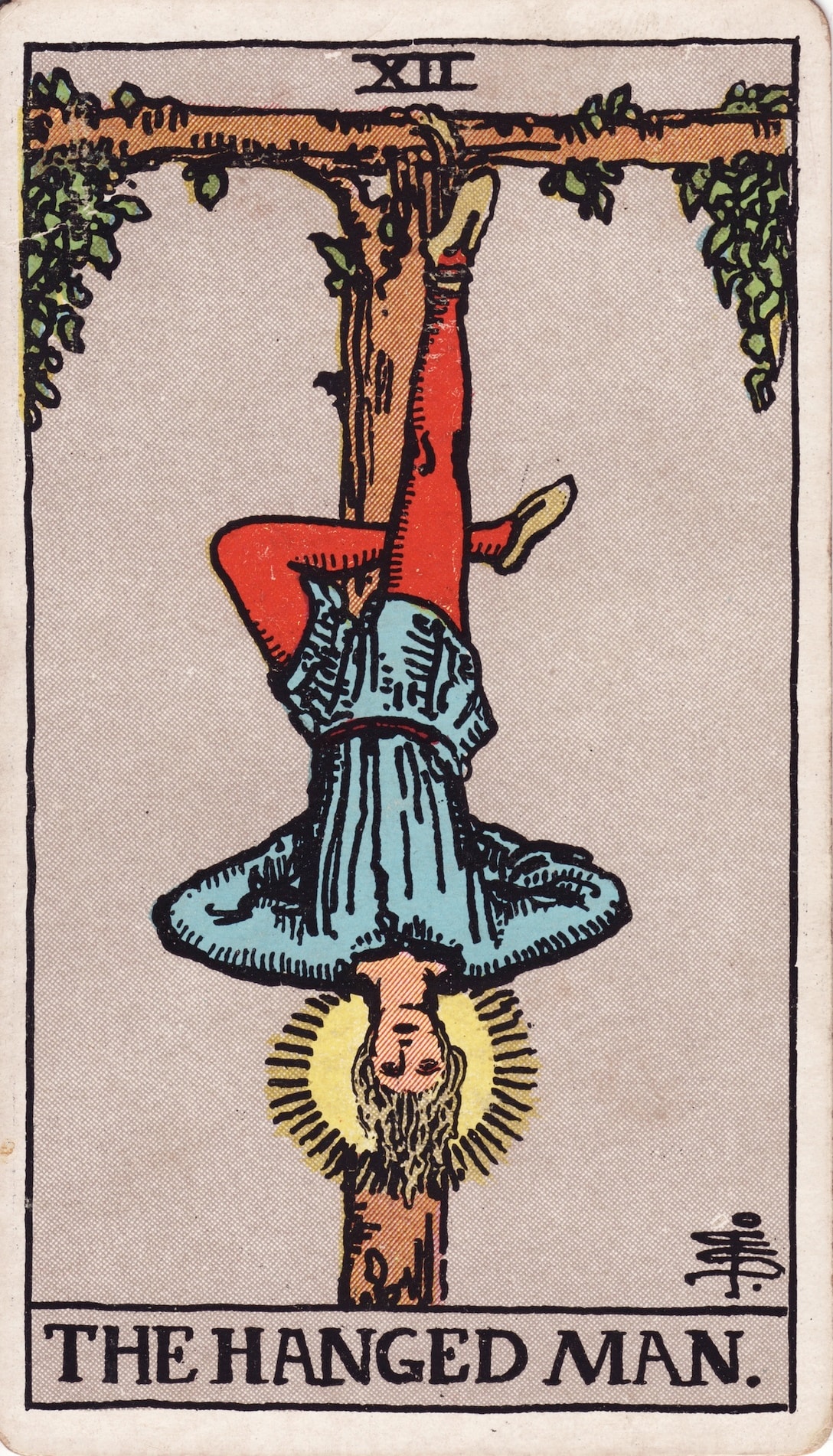
Turn one card upside down beside the other. What hung, now dances.
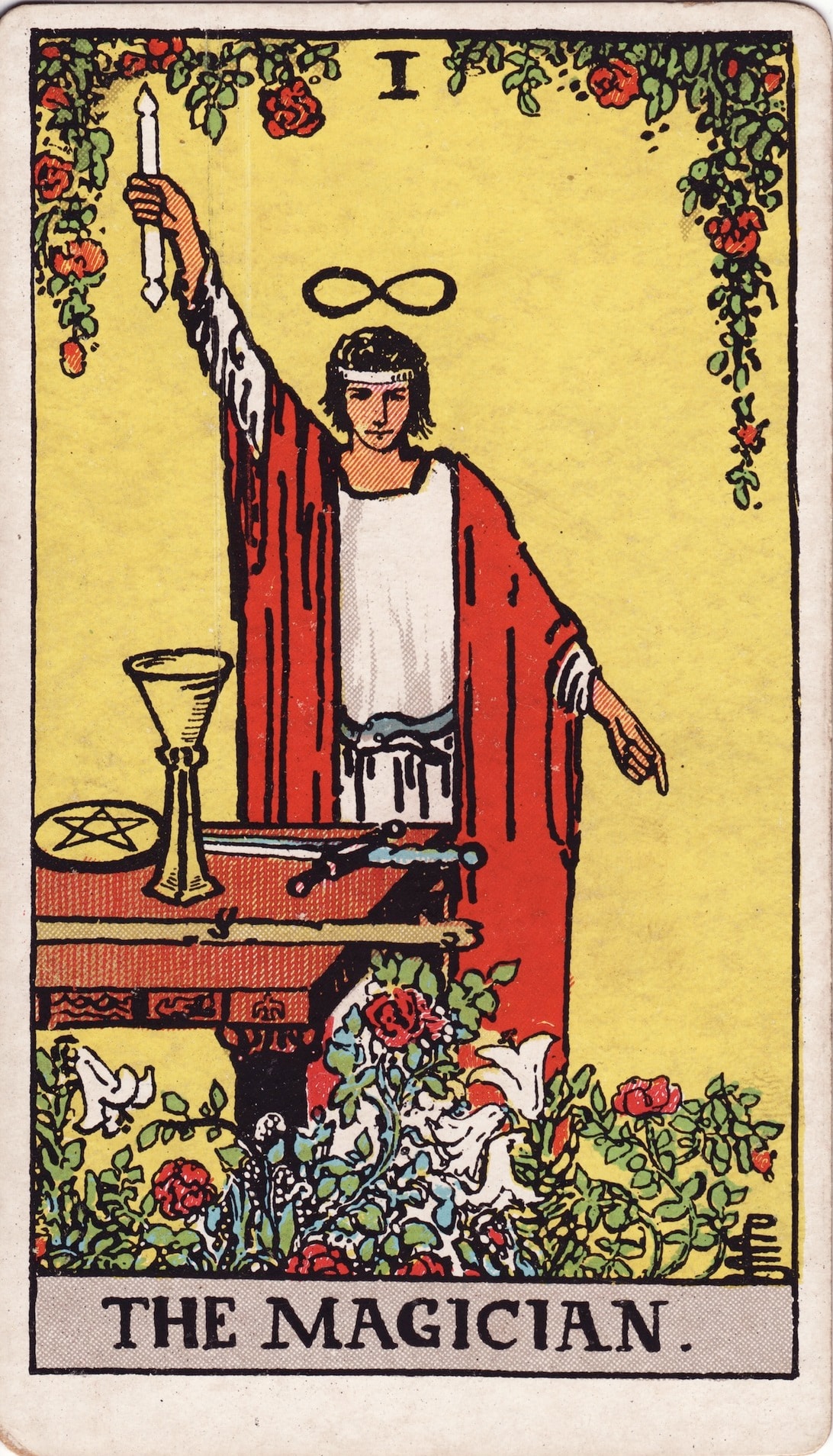
She holds two wands, one in each hand. The Magician, card I, raised a single wand toward the sky. Here there are two, held lightly, pointing both ways.
The wreath is a tall oval, like the zero at the top of the Fool's card. Waite called it "an elliptic garland", a chain of flowers, and he saw in the card "joy attained in the body".
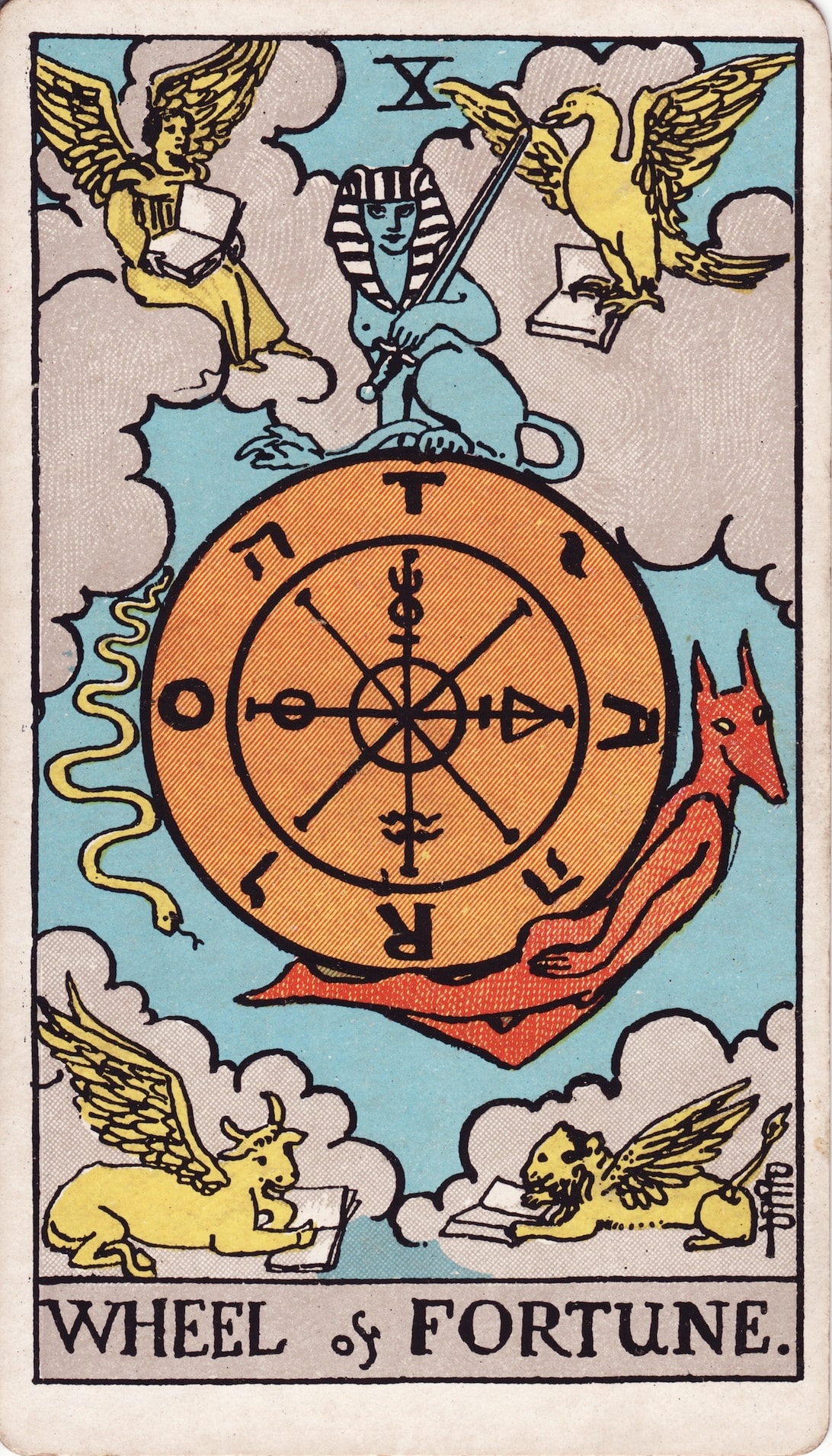
Now the four heads. They also appear on the Wheel of Fortune, card X, in the same four corners. There they have wings and read books. Here the books are gone, and only their faces remain, watching the dance.
The inner journey
Here the Fool arrives. He has met every figure. He has weighed his life, hung upside down, lost what had to end, walked through the dark and heard the call. Now all of it is gathered into one ring, and he moves inside it with ease.
Carl Jung spent years looking at round pictures. He called them mandalas, from an old Sanskrit word for circle. His patients drew them without being told to, often at confusing times in their lives. For Jung, such pictures were images of the Self, the whole person, larger than the everyday "I". The World card is close to a mandala. It has a centre, a ring and four quarters. Seen through his idea of individuation, it is a picture of being whole.
Even so, she keeps moving. She is dancing. And the ring is shaped like the Fool's zero. Waite wrote that the sun behind the Fool knows "how he will return by another path after many days". In his book, Waite even set the Fool after card 20. The ending leads back to a beginning.
So you could read the World as an arrival. You could also read it as a place to stay a while, and dance there, before the next first step.
Across traditions
The four heads are old. In the Bible, the prophet Ezekiel sees four living creatures. Each has "the face of a man, and the face of a lion", "the face of an ox" and "the face of an eagle". Christian artists later gave one creature to each of the four Gospel writers. The monks who made the Book of Kells, around the year 800, painted all four together on one page, each with wings. The book is now in Trinity College Dublin.
Waite borrowed a line from the Book of Job for this card. It speaks of the day the world was made, "when the morning stars sang together and all the Sons of God shouted for joy".
The Golden Dawn's Book T calls this card "The Great One of the Night of Time". It gives the card Tav, the last letter of the Hebrew alphabet, and Saturn, the slowest of the classical planets. Its short note on the card includes one word: "Synthesis", the putting together.
XXI and the Hanged Man's XII hold the same two digits, and both add up to 3. That is the number of the Empress, the card of growing things.
Try this
Take two pens or two sticks, one in each hand. Stand up, and hold them loosely, like her wands. Cross one foot behind the other and let yourself sway a little. Turn slowly once, all the way round. Notice what it feels like to finish a circle. Then look at the four corners of the room, one by one, as if something were watching from each. Which corner feels most like a beginning?
Questions to sit with
- What does the Hanged Man know that the dancer has forgotten, or remembered?
- What has she gathered inside the wreath?
- Who are the four watchers, for you?
- What in your life has come full circle?
- Where will the Fool step next?
The film
No film for this card yet.
Sources
- Waite on the elliptic garland, the four living creatures given to the evangelists, the dancer with a wand in either hand, and joy attained in the body.Arthur Edward Waite, The Pictorial Key to the Tarot (London, 1911), Part I, Trumps Major, no. 22, pp. 30–31
- Waite on the day when the morning stars sang together.Arthur Edward Waite, The Pictorial Key to the Tarot (London, 1911), Part II, The World, pp. 156 and 159
- The morning stars sang together, and all the sons of God shouted for joy.Job 38:7, King James Version (1611)
- Waite on the Fool returning by another path after many days.Arthur Edward Waite, The Pictorial Key to the Tarot (London, 1911), Part II, The Fool, p. 155
- Waite set the Zero after No. 20 but kept the World as 21.Arthur Edward Waite, The Pictorial Key to the Tarot (London, 1911), Part II, Conclusion as to the Greater Keys, p. 161
- Jung on mandalas drawn by his patients as images of the self, of wholeness.C. G. Jung, Concerning Mandala Symbolism (1950) and Mandalas (1955), Collected Works 9i
- Mandala, a Sanskrit word for a circle or disc.Monier Monier-Williams, A Sanskrit-English Dictionary (Oxford, 1899), p. 775, maṇḍala
- Ezekiel's four living creatures: the faces of a man, a lion, an ox and an eagle.Ezekiel 1:10, King James Version (1611)
- The four creatures, winged, on one page of the Book of Kells.Book of Kells (c. 800), folio 27v, Trinity College Dublin, MS 58; Wikimedia Commons
- Book T's title for the World, The Great One of the Night of Time; Tav, Saturn and earth; "Synthesis" in its brief meanings.Book T, The Equinox I.8 (1912), table of the Keys and brief meanings
- Saturn takes nearly twenty-nine and a half years to go round the sun.Webster's Revised Unabridged Dictionary (1913), Saturn
Around this card
Before and after it in the deck
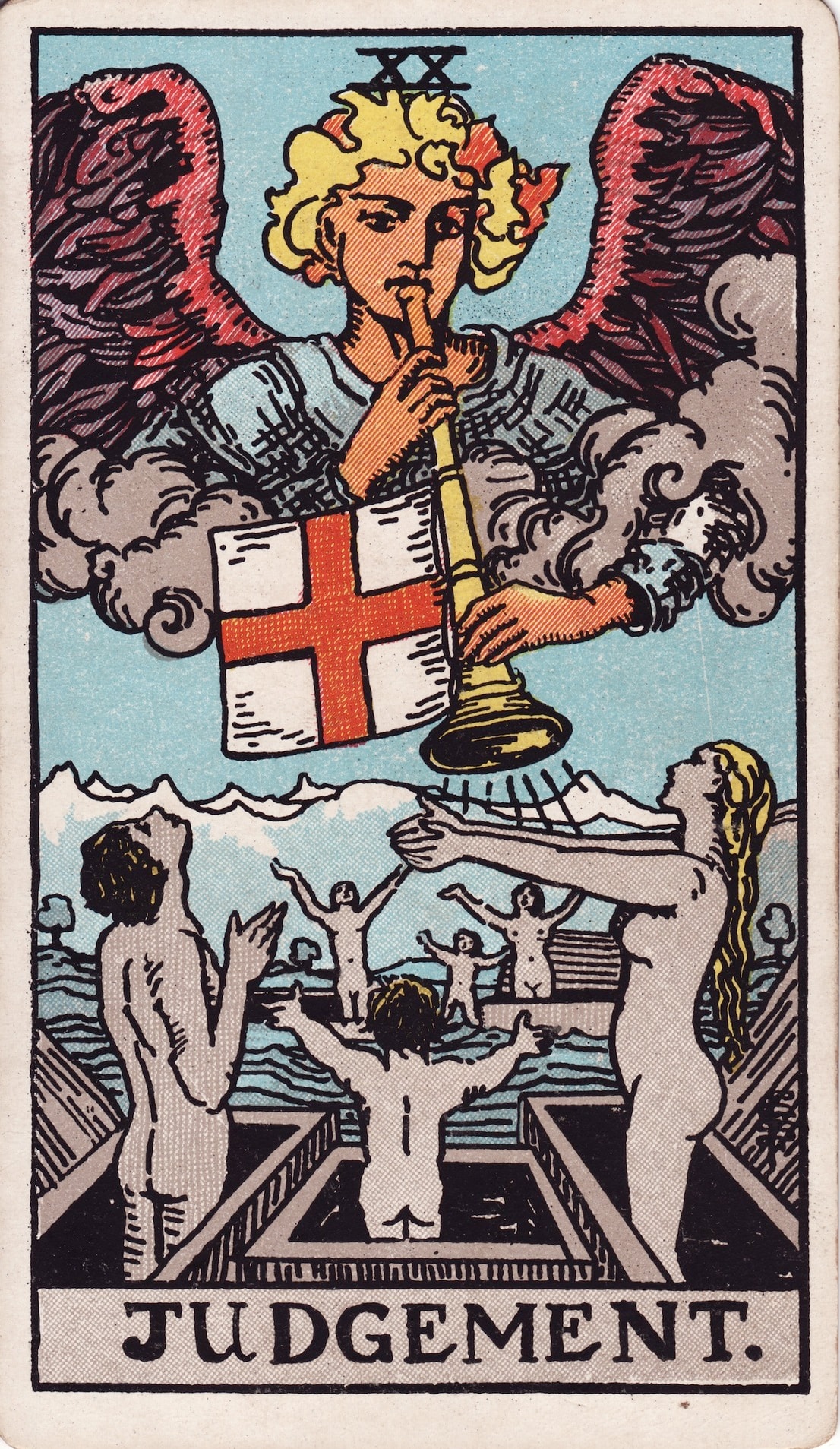
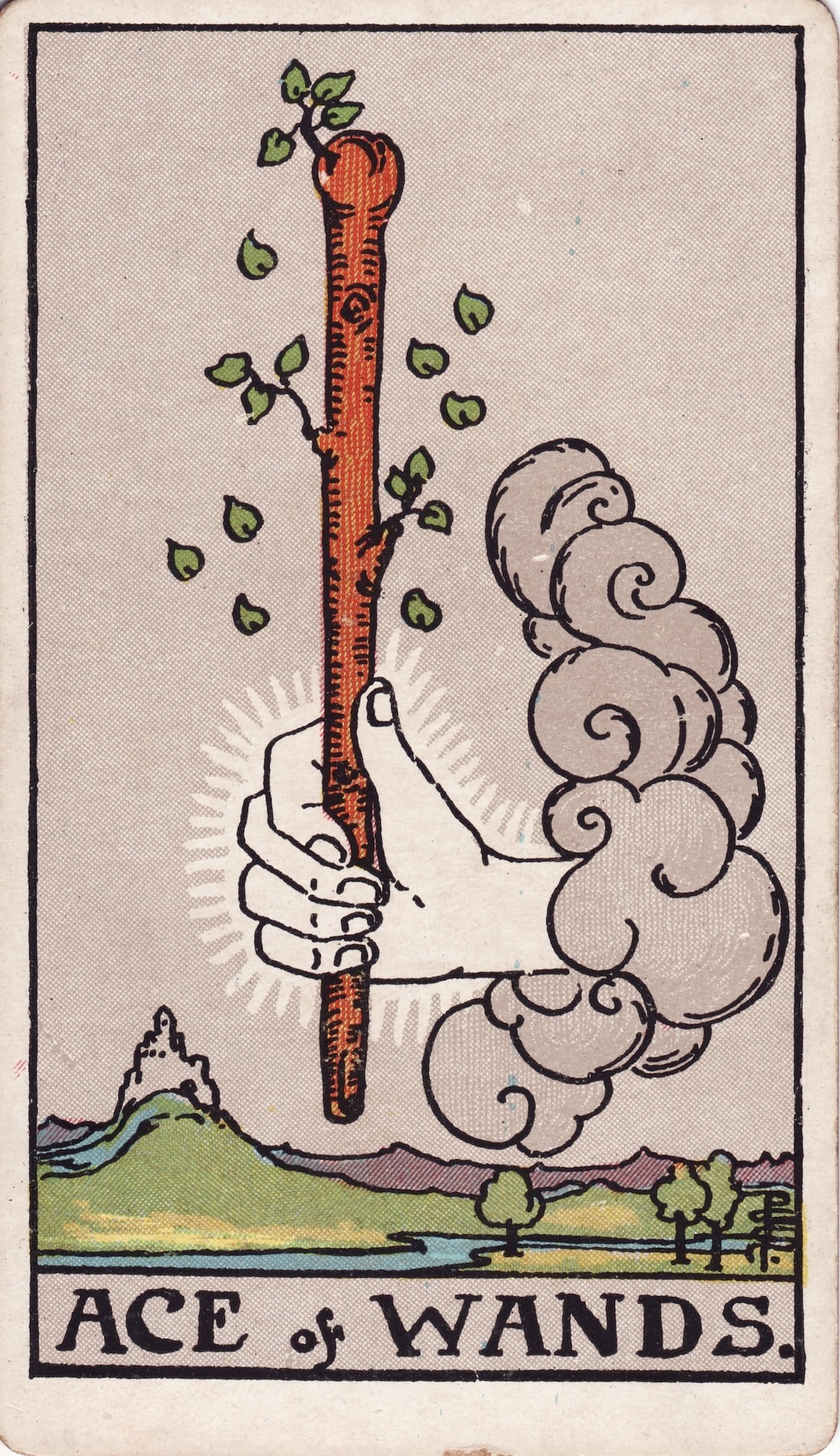
The third row of the Fool's journey
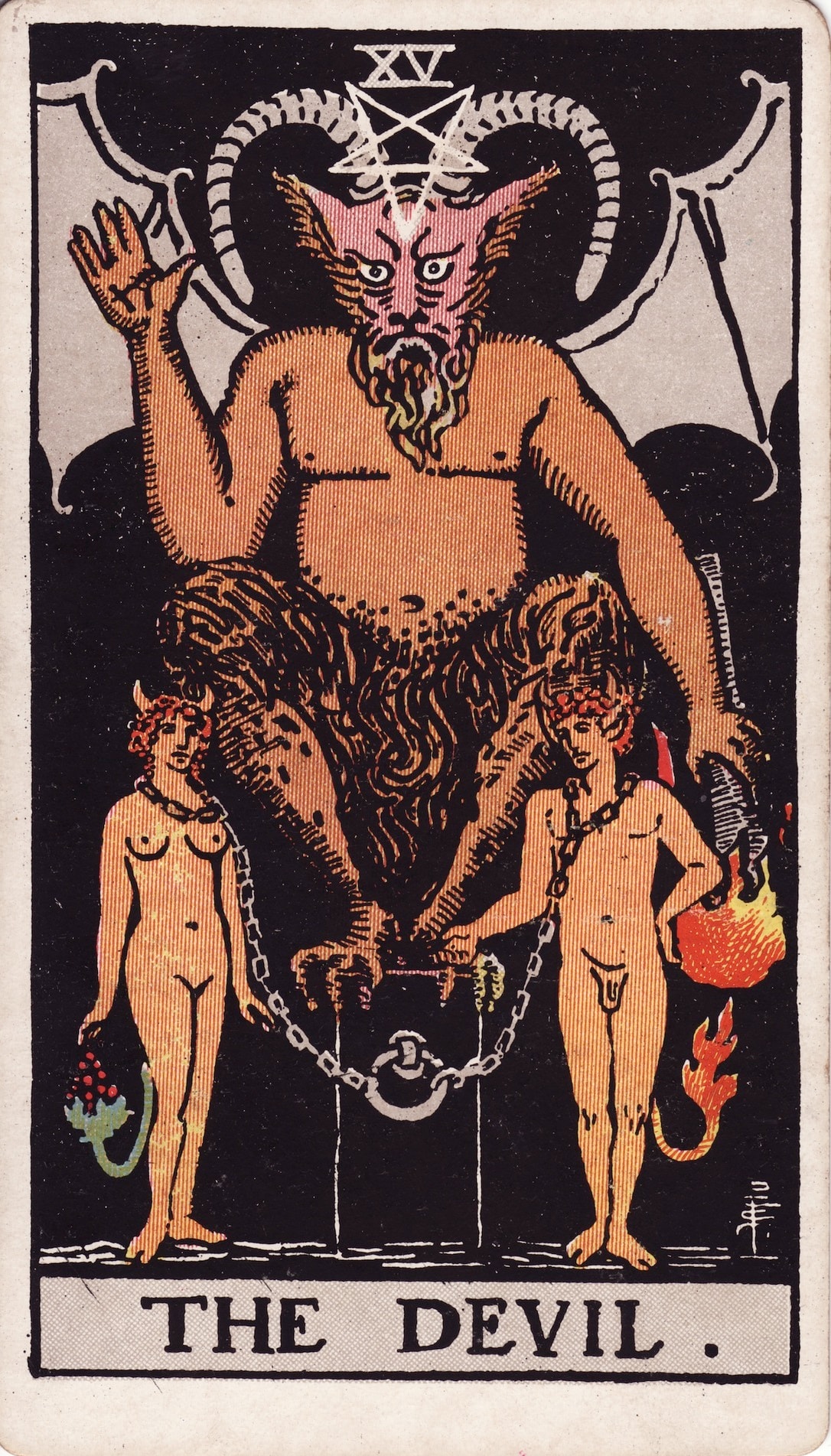
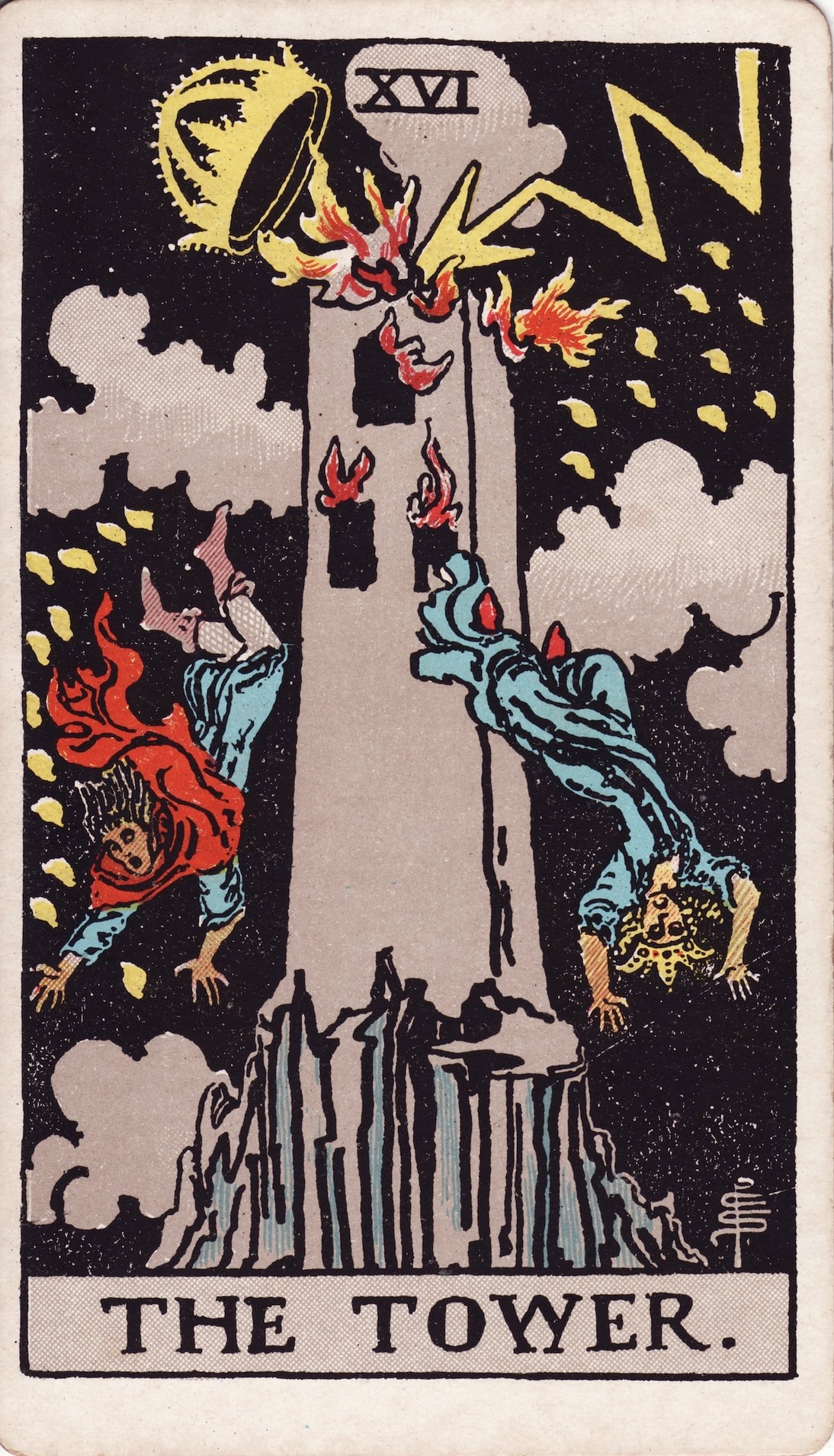


All the cards of the Major Arcana, or the whole deck.